

Top 7 Industrial Timer Brands Compared
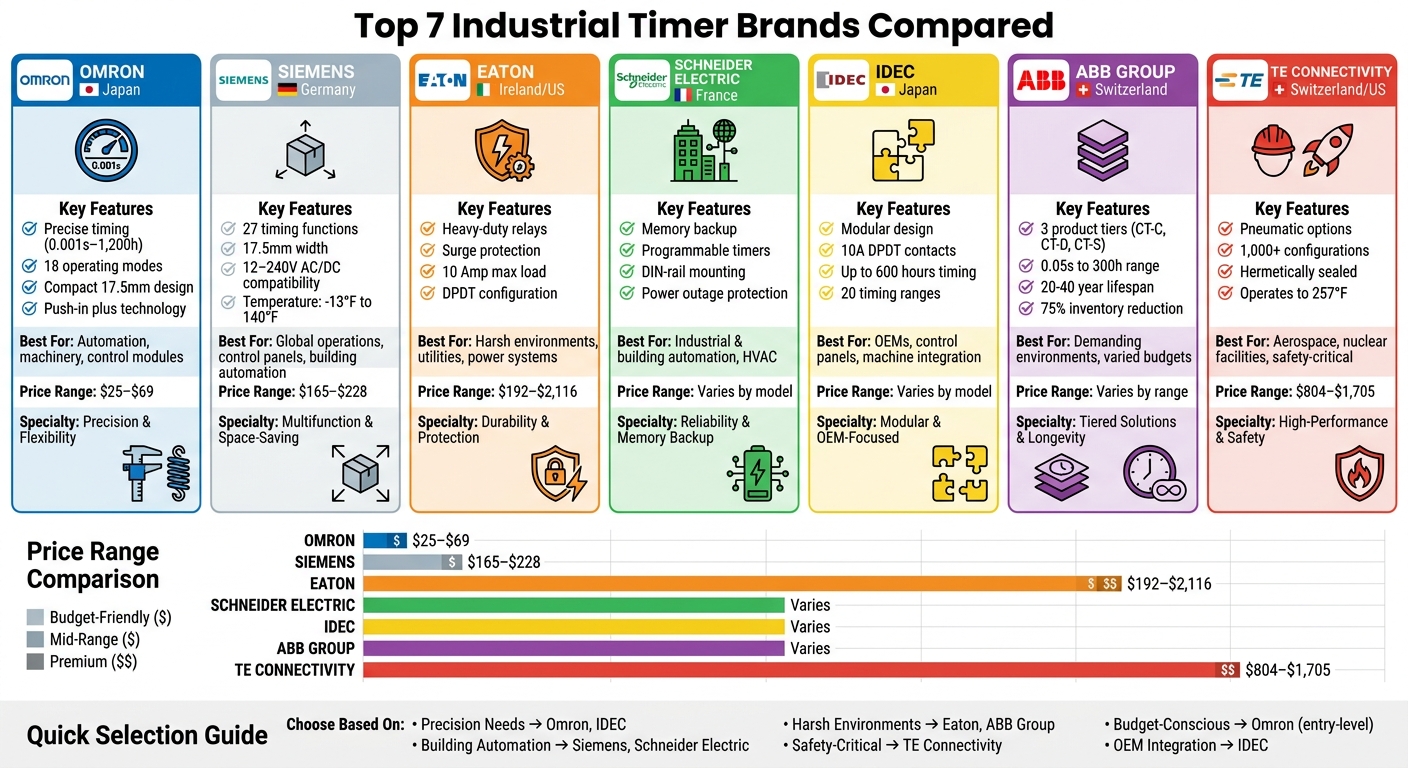
Industrial timers automate processes in manufacturing, building automation, and power systems. This article compares Omron, Siemens, Eaton, Schneider Electric, IDEC, ABB Group, and TE Connectivity, focusing on performance, reliability, and cost. Here's what you need to know:
- Omron: Offers precise digital and analog timers with flexible timing ranges (0.001s–1,200h) and compact designs for automation needs.
- Siemens: Known for space-saving designs and multifunction timers (up to 27 modes), ideal for global operations.
- Eaton: Heavy-duty relays built for harsh conditions, offering durability and surge protection.
- Schneider Electric: Reliable timers for industrial and building automation, with memory backup for power outages.
- IDEC: Modular timers for OEMs, combining flexibility and high power ratings.
- ABB Group: Durable timers for demanding environments with a tiered product lineup for various budgets.
- TE Connectivity: High-performance solutions, including pneumatic timers for safety-critical tasks.
Each brand has unique strengths tailored to specific applications. Omron and IDEC excel in precision and compact designs for machinery. Siemens and Schneider Electric are great for building automation. Eaton and ABB Group focus on durability, while TE Connectivity stands out in safety-critical industries.
Quick Comparison
| Brand | Key Features | Best For | Price Range |
|---|---|---|---|
| Omron | Precise timing, compact design | Automation, machinery | $25–$69 |
| Siemens | Space-saving, 27 timing modes | Global operations, control panels | $165–$228 |
| Eaton | Heavy-duty, surge protection | Harsh environments, utilities | $192–$2,116 |
| Schneider Electric | Memory backup, programmable timers | Industrial, building automation | Varies by model |
| IDEC | Modular, high power ratings | OEMs, control panels | Varies by model |
| ABB Group | Durable, tiered product lineup | Demanding environments | Varies by range |
| TE Connectivity | Pneumatic options, safety-critical | Aerospace, nuclear facilities | $804–$1,705 |
Choose based on your needs: precision, durability, or specific applications. Always check certifications and technical specs to ensure compatibility.
Industrial Timer Brands Comparison: Features, Applications, and Price Ranges
How to Select a Timer | Galco
sbb-itb-501186b
Omron: Precision and Flexibility in Automation
Omron offers a blend of analog and digital timer solutions, designed to meet a wide range of automation needs. For straightforward applications, their analog timers, like the H3CR/H3DT series, rely on physical dials and selectors for easy time adjustments - perfect for machinery where settings don’t change often. On the other hand, the digital H5CC series stands out with its LCD display, which provides a visual countdown and supports sub-second precision, making it ideal for tasks requiring detailed timing or frequent monitoring.
Key Features and Applications
Omron’s timers come with up to 18 operating modes, including ON-delay, Flicker (OFF/ON start), Signal ON-/OFF-delay, Interval, Star-delta for motor starting, and One-shot outputs. This range of modes allows engineers to handle diverse automation tasks with a single device. Timing ranges are equally versatile - digital models like the H5CC can measure intervals down to 0.001 seconds, while analog timers, such as the H3DT and H3DK, can manage cycles as long as 1,200 hours.
For compact control panels, the H3DT and H3DS series, at just 17.5 mm wide, are an excellent fit. Additionally, Omron integrates "Push-in plus" technology in models like the H3DT and H3YN-B, replacing screw terminals with a simpler, tool-free connection system. This feature is particularly beneficial in environments with high vibration, where secure connections are essential without the need for constant maintenance. Most of Omron’s timers also feature multi-voltage operation (24 to 240 VAC/DC), making them suitable for facilities with varying power requirements or international installations.
These features highlight the versatility and performance of Omron’s timer solutions while setting the stage to weigh their strengths and trade-offs.
Strengths and Limitations
Omron excels in offering precision and versatility. Digital timers provide highly configurable timing options, ranging from 0.001 seconds to 9,999 hours, while analog timers allow for quick manual adjustments using knobs. The slim 17.5 mm design and Push-in plus wiring system save valuable panel space and reduce installation time compared to traditional screw terminals.
However, some advanced features - like stopwatch functions, twin timer modes, and cumulative time tracking - are exclusive to digital models, which can be more challenging to program than their analog counterparts. Another consideration is that the choice between Push-in plus and screw terminals must be made when purchasing, as these features are model-specific and cannot be interchanged later. While the wide product range offers plenty of choices, it may require extra effort upfront to select the best model for a given application.
Siemens: Industrial Timer Solutions
Siemens has developed a rail-mounted design for its SIRIUS product family, tailored for control cabinets, motor starters, and building automation. These timers emphasize space-saving designs and global compatibility, making them an excellent choice for standardization across international operations. Below are some standout product lines that highlight Siemens' expertise in efficient and reliable timer solutions.
Key Product Lines
The SIRIUS 3RP25 series is a multifunctional timer relay that combines 27 timing functions into a compact unit, available in widths of just 17.5 mm or 22.5 mm. With a time-setting range from 0.05 seconds to 100 hours, it supports modes like ON-delay, OFF-delay, Flicker, Interval, and motor-starting sequences. Its 12–240V AC/DC compatibility simplifies inventory management, especially for companies operating across regions with different power standards.
For installations where space is at a premium, the SIRIUS 3RP20 series offers a reduced mounting depth and height, making it ideal for low-profile setups. The 7PV15 series, also 17.5 mm wide, is specifically designed for HVAC and compressor applications, meeting electromagnetic compatibility (EMC) standards for those environments. It features an adjustable changeover delay from 50 ms to 1 second, perfect for star-delta motor transitions.
The 3RA28 function modules take a modular approach, snapping directly onto 3RT2 contactors to manage motor-starting sequences without requiring additional wiring. These modules also include built-in varistors to protect control circuits from voltage spikes.
Engineers can also take advantage of Siemens’ timing relay simulator for the 3RP25 series. This tool allows users to visualize output sequences and troubleshoot potential issues in a virtual setup before physical installation. High-end models like the 3RP25 operate in temperatures ranging from -13°F to 140°F (-25°C to 60°C) and come with LED indicators to display switch position and voltage status, simplifying diagnostics in demanding industrial environments.
Pros and Cons
Siemens stands out for its durability and adherence to industry standards, including IEC 61812-1 for industrial time relays and IEC 60947-5-1 for electromechanical control devices. The compact 17.5 mm width and reduced mounting depths make these timers perfect for tight control panels, while the wide voltage range minimizes the need for multiple variants in stock. The 3RP25 series, with its 27 integrated functions, provides exceptional flexibility for complex automation tasks.
On the downside, the 3RP25 series is priced between $165 and $228, making it more expensive than basic timer options. Its multifunctional design also requires more setup time compared to single-function alternatives, which may be unnecessary for simpler applications. Additionally, while Siemens offers both screw-type and vibration-resistant spring-loaded (cage clamp) terminals, these options are model-specific and must be selected at the time of purchase.
Eaton: Heavy-Duty Time Delay Relays
Eaton stands out by prioritizing toughness and reliability in industrial environments where equipment endures constant challenges like vibration, shock, extreme temperatures, and high humidity. These relays are built to handle such conditions, with features like integrated surge protection and noise suppression to counteract electrical disturbances often found on busy factory floors or outdoor setups. This makes them a solid choice for industries like heavy manufacturing and utilities, where minimizing downtime is critical.
Main Product Series
Eaton's TMR series is a dependable option, designed with octal-style terminals (8 or 11 pins), a 10 Amp maximum load capacity, and a DPDT (Double Pole Double Throw) contact configuration. These relays support a variety of timing functions - on-delay, off-delay, flasher, and single-shot - offering adjustable ranges that span from fractions of a second to several hours. The TMR6 series is particularly notable for its true off-delay function, which doesn’t require continuous input voltage, mimicking the performance of traditional pneumatic relays while benefiting from modern electronic accuracy.
For installations where space is limited, the ETR4 series provides a compact solution with its 45 mm frame and a 6 A thermal rating, making it perfect for star-delta motor transitions. The ZRER/W models bring user-friendly functionality with their three-dial control system: one dial for selecting the time range (seconds, minutes, or hours), another for fine adjustments, and a third for choosing the timing function. This design allows engineers to tweak settings without replacing the unit. Meanwhile, the 82410H series is built for extreme industrial conditions, offering durability where standard relays might fall short.
Advantages and Disadvantages
Eaton's relays are designed to endure harsh environments and meet UL, CSA, and CE certifications, ensuring reliable performance. The TMR series, priced between $192.15 and $274.50, and the TMR6 series, with its efficient off-delay function, are cost-effective solutions for many standard applications. These relays also offer flexible mounting options, including octal, blade, and DIN rail, making them suitable for both retrofits and new setups.
However, the 82410H heavy-duty series comes with a steep price tag of around $2,116.28, which might be excessive for less demanding needs. Similarly, the ETR4 series, priced at approximately $530.51, is considerably more expensive than basic timing alternatives. A common limitation across these models is their reset behavior - if the input signal is interrupted before the countdown finishes, the relay resets and fails to switch states, potentially disrupting precise workflows.
Schneider Electric: Industrial and Building Automation Timers

Schneider Electric offers timer solutions designed for both industrial and commercial applications, enabling programmable schedules that ensure consistent operation. These timers are invaluable in settings where precise timing is crucial - whether it's protecting motors in factories or managing energy use in office buildings.
While precision and reliability are standard across the industry, Schneider Electric stands out with its advanced digital programmability.
Product Features
Schneider's range of timers is equipped to handle various timing modes, catering to diverse operational needs. The configuration options differ by model. Basic models rely on manual dials for simple adjustments, whereas advanced units feature digital keys or programmable software for more precise control. One major advantage of Schneider's digital timers is their backup memory, which retains schedules during power outages. This feature sets them apart from mechanical timers that reset entirely when power is lost. Additionally, the timers include internal contacts functioning as automatic switches. In industrial motor applications, these contacts typically work with contactors, ensuring safe management of heavy loads rather than directly connecting to the equipment.
Practical installation and durability are central to the design of these timers, ensuring they perform reliably over time.
Key Considerations
Schneider's digital timers are particularly effective in environments prone to power interruptions, as they maintain programmed schedules where mechanical timers would falter. To ensure their longevity, always install them in dry panels. For damp or dusty settings, it’s essential to use a protective enclosure. When managing multiple devices or heavy industrial equipment, route the timer through a relay or contactor instead of connecting loads directly. This approach prevents overload damage and extends the timer's lifespan.
Proper wiring and voltage setup are critical for avoiding operational issues. If a timer malfunctions, check the wiring and voltage first, as setup errors or excessive loads are common causes of failure. A clicking sound during operation is normal, as it indicates internal relay switching. However, irregular or loud clicking might signal problems with mounting or load connections.
Schneider's timers also shine in commercial applications like HVAC systems and signage controls. By operating only when needed, they help reduce energy costs, making them an excellent choice for buildings with predictable occupancy patterns. This energy efficiency directly translates into lower utility bills.
As with any timer system, careful installation and proper load management are essential for achieving optimal performance.
IDEC: Modular Timer Components for OEMs
With over 80 years of expertise in industrial control, IDEC offers modular timers that seamlessly integrate into production lines. These timers are designed to meet the needs of OEMs by simplifying standardization and ensuring easy replacement when necessary.
Product Highlights
The RTE series stands out for its ability to handle heavy loads, thanks to its high-power 10A DPDT contacts and IDEC's reliable RH2 relay. It offers timing ranges of up to 600 hours across 20 settings. As IDEC puts it, "The RTE series timers offer the most popular timing functions in 2 models (Power and Signal Triggered) together with high power 10A contacts. In fact, they use our famous RH2 relay, so you can be sure of the reliability".
For straightforward timing applications, the GE1A series provides an ON-delay function with a maximum range of 10 hours. IDEC describes it as "a perfect fit for the large OEM who wants a simple 'plug and play' timing solution". Meanwhile, the GT3 series caters to more specialized needs. For example, the GT3D digital model offers 16 timing functions, an LCD display for precise adjustments up to 99.9 hours, and niche variants like the GT3S, which is ideal for Star-Delta motor starting. For installations where space is tight, the GT8A series features a slim 17.5 mm profile, making it a practical choice for crowded control cabinets.
These timers also provide flexible mounting options, including plug-in sockets, DIN rail, surface mounting, and 45 mm square panel cutouts (with optional adapters). Terminal options include tubular pin, 0.187″ quick-connect, and 0.110″ solder/blade connections, ensuring compatibility with a variety of setups.
These features highlight IDEC's modular approach and its potential to streamline OEM processes.
Benefits and Drawbacks
IDEC's modular design simplifies inventory management by enabling a single RTE model to cover 20 timing ranges. High contact ratings and socket-based mounting make maintenance quicker and easier, allowing for fast replacements without extensive rewiring.
However, this specialization does have its limitations. Models like the GT3S or GT3F, which are tailored for specific applications such as Star-Delta starting or True Power OFF Delay, may not be as versatile for general-purpose timing needs. Additionally, some series, such as the GT5P, require a fixed time range to be selected at the time of purchase, which can limit adaptability if process requirements change down the line. Furthermore, certain mounting configurations may need separate adapters, which are not always included with the base unit.
ABB Group: Durable Timer Relays

ABB has structured its timer relay offerings into three distinct categories, each tailored to meet specific needs in terms of durability and functionality. The CT-C range is an economical choice aimed at general industrial use, the CT-D range is suited for building automation with its modular housing, and the CT-S range is built for the most demanding industrial environments. This approach allows users to align their choice with both technical requirements and budget constraints. Below, we’ll dive into ABB’s durability features and weigh the pros and cons of each tier.
Durability Focus
The CT range from ABB is built to withstand challenging conditions, making it a reliable choice for harsh environments. These relays can handle time settings ranging from just 0.05 seconds to an impressive 300 hours, covering both quick operations and long-duration tasks - a level of versatility ABB highlights as a key feature. Additionally, the electromechanical relays in this series often last between 20 and 40 years, depending on factors like environmental conditions and how well they’re maintained.
The CT-C range, for instance, is housed in a slim 17.5 mm (approximately 0.69 inches) wide casing, offering a 22% reduction in control cabinet space compared to standard industrial timer designs. Despite its compact size, this range includes 11 devices, addressing both single-function and multifunctional applications. Features like tool-free DIN rail mounting minimize mechanical stress during setup and maintenance. Additionally, secure push-in and screw terminal connections provide resistance to vibration, making these relays suitable for demanding environments.
Strengths and Challenges
ABB’s tiered design strategy delivers a variety of benefits. For example, the multifunctional design and wide voltage compatibility of the CT-C range can cut inventory needs by up to 75%. This is especially useful for facilities managing diverse machines or production lines. The relays also come with global certifications and support a broad supply voltage range, making them an excellent choice for international OEMs and standardized machinery.
That said, the CT-C range does have its limitations. Its maximum time setting caps at 100 hours, falling short of the 300-hour capability available in the broader CT lineup. Applications requiring advanced timing functions or extended durations might find the CT-C range insufficient. In such cases, the high-performance CT-S range - though more expensive - offers a better fit. While the CT-C range is perfect for cost-conscious projects, facilities with more intricate needs should consider whether the additional features of the CT-S range warrant the higher investment.
TE Connectivity: Timing and Connectivity Solutions

TE Connectivity stands out for its focus on reliability and adaptability in industrial timing applications, much like other top brands in the industry.
Integrated Solutions
TE Connectivity combines timing circuitry with electromechanical relays, creating a compact unit that handles both timing and switching tasks. This approach minimizes the system's overall footprint and reduces potential failure points. With over 1,000 time delay relay configurations available, engineers have plenty of options to meet specific needs. The product range includes both solid-state and pneumatic circuits, the latter offering time delays without requiring electrical power - an essential feature for safety-critical applications like those in the nuclear industry.
To accommodate different industrial connectivity systems, TE Connectivity provides various termination options, including screw terminals, gold-plated socket pins, tin-dipped hook terminals, and DIN rail or chassis mounts. Many of their units are hermetically sealed, making them suitable for demanding environments such as nuclear facilities, aerospace operations, and military applications (MIL-PRF-83726). Some models are even capable of withstanding extreme temperatures, operating effectively in conditions as high as 257°F (125°C).
This streamlined design not only reduces the number of components needed but also highlights the balance between cost considerations and regulatory compliance.
Opportunities and Limitations
The integrated design offers several advantages, including enhanced reliability by cutting down on space requirements and reducing connectivity vulnerabilities. For applications that demand timing functions during power outages - like emergency shutdowns or safety interlocks - the pneumatic technology provides a dependable alternative to standard electronic timers.
However, these specialized solutions come with a high price tag. Basic chassis-mount models, like the 7022PK, start at $804.58, while DIN rail-mounted units, such as the SSFR90X, can cost up to $1,705.12. Additionally, some high-performance and military-grade models are marked as "Not EU RoHS Compliant", which could pose challenges for projects that must adhere to European environmental regulations. It's crucial for facilities to confirm compliance before using these components in projects subject to such standards.
Brand Comparison Table
Here's a quick side-by-side look at some of the top brands in industrial timing. Each brand brings its own strengths, specializing in areas tailored to different engineering demands. This table breaks down their headquarters, focus areas, key product lines, and common applications.
| Brand | Headquarters | Specialization | Main Product Lines | Typical Applications |
|---|---|---|---|---|
| Omron | Japan | Precision Industrial Control | Industrial digital time relays, electronic timers, compact relay-style timers | Automation, machinery, control-grade modules |
| Eaton | Ireland/US | Power Systems & Safety | Time delay relays, industrial time switches | Power systems, industrial automation, control panels |
| Schneider Electric | France | Industrial & Building Automation | DIN-rail time switches, programmable timers, weekly timers | Commercial distribution, electrical panels, building automation |
| IDEC | Japan | OEM Control Components | Compact time relays, programmable timer modules | Control panels, OEM machines, commercial appliances |
For OEM integration, brands like Omron and IDEC stand out with their compact modules designed for machine control panels. On the other hand, building and commercial automation projects benefit from Schneider Electric and Eaton, whose products integrate smoothly with electrical distribution systems. When precision is key, especially in high-accuracy machinery, Omron's digital timers are a reliable choice for automated production lines.
How to Choose the Right Industrial Timer
When selecting an industrial timer, it's essential to match the device to your specific operational needs and technical requirements. Start by identifying the timer's intended use. For example, DIN-rail units from brands like Schneider Electric or Eaton are ideal for electrical distribution systems, while compact relay-style timers from manufacturers such as Omron or IDEC work better for machinery applications. Additionally, consider the mounting style - DIN-rail, panel-mount, or socket-mount - as this will impact how the timer integrates with your existing equipment.
Rather than focusing solely on brand names, prioritize the technical specifications of the timer. Key factors to evaluate include voltage requirements, the timing range (which can vary from milliseconds to weekly cycles), and the type of timing mode needed - on-delay, off-delay, or retentive. For instance, on-delay timers are useful for pre-start warnings, while off-delay timers are better suited for post-shutdown operations. Retentive timers are critical for maintaining continuity after power interruptions.
Certifications are another crucial consideration to ensure compliance and safety. In the U.S., look for UL or ETL certifications, while CE and RoHS are essential for European markets. Always request conformity certificates, especially for large orders, to verify compliance. Additionally, take into account potential failure rates and associated return costs. Basic models typically start around $25, while advanced multi-channel timers can cost up to $69.
For industrial environments, durability is key. Opt for timers with water-resistant designs and flush screens to minimize debris buildup and simplify cleaning. In noisy settings, consider timers with features like adjustable volume up to 100 dB and flashing visual indicators to ensure alerts are noticeable. For ease of use, timers with full numerical keypads allow for faster and more precise time entry compared to single-button interfaces that require multiple presses.
Before finalizing your purchase, request datasheets and sample units to confirm the timer's fit and accuracy for your application. Carefully review the datasheets for details on after-sales support, warranty terms, and the availability of spare parts. For a broad selection of options and detailed specifications, check out platforms like Electrical Trader.
Conclusion
To wrap up, let's break down the key strengths of each brand. Omron stands out with its high-precision industrial timing relays, perfect for machinery and automation that demand dependable performance. Schneider Electric offers durable DIN-rail and panel-mounted time switches, ideal for commercial electrical distribution and building automation where meeting regulatory standards is a priority. Eaton focuses on heavy-duty time delay relays, emphasizing safety and seamless integration into power systems. Meanwhile, IDEC delivers compact and modular timer components, making them a cost-effective choice for OEM applications.
Choosing the right timer comes down to matching the technical specs - like voltage, timing range, mounting style, and interface features - to your specific needs. Don’t forget to ensure the timers comply with regional standards, such as CE or RoHS for Europe and UL or FCC for North America. For larger orders, securing conformity certificates is a smart move.
Looking for a one-stop shop? Electrical Trader offers a convenient platform to explore and compare these trusted industrial timer brands. Check out Electrical Trader to find reliable solutions tailored to your performance and compliance requirements.
FAQs
Which timer type should I choose: analog, digital, solid-state, or pneumatic?
When selecting an industrial timer, consider your specific needs in terms of accuracy, operating environment, and control requirements:
- Analog timers: Straightforward and dependable, these are a budget-friendly choice for simpler tasks.
- Digital timers: Offer high precision and programmability, making them perfect for automated systems.
- Solid-state timers: Built for durability and quick responses, they perform well in tough environments.
- Pneumatic timers: Designed specifically for pneumatic control systems.
Your choice should align with the demands and complexity of your application.
What specs should I check to ensure a timer is compatible with my control panel?
When evaluating a timer, start by checking its timing modules, relay type, and standards compliance. Make sure it aligns with your panel’s relay type - whether it's electronic or mechanical - and adheres to key standards like UL or IEC.
For PLCs, dig deeper into specifics like the timer type (on-delay, off-delay, or retentive), its timing range, and whether it integrates smoothly with your system’s programming and hardware. Also, confirm details such as electrical ratings, communication protocols, and mounting options to ensure everything fits and functions seamlessly.
How do I choose between on-delay, off-delay, interval, and retentive modes?
To pick the best timer mode, it's important to know how each one works:
- On-delay timers: These delay the start of an action after receiving a signal, making them perfect for control processes that need a delayed response.
- Off-delay timers: These keep outputs active for a short time after the signal stops, useful for tasks requiring a brief continuation.
- Interval timers: Designed to produce consistent pulses, they are great for repetitive operations.
- Retentive timers: These save the accumulated time even if there's a power loss, ensuring accurate timing when power is restored.
Choose the mode that aligns with your specific control requirements to achieve the best results.