

FAQs About Control Panels: Features, Configurations, and More
Control panels are the backbone of industrial systems, controlling and monitoring processes in manufacturing, HVAC, and power distribution. They house components like PLCs, circuit breakers, and relays, ensuring efficiency and safety. Configurations range from wall-mounted panels for small setups to floor-standing units for large systems. Key considerations include proper voltage segregation, thermal management, and compliance with safety standards like UL 508A.
Key Takeaways:
- Main Components: PLCs, HMIs, circuit breakers, relays, VFDs, and enclosures.
- Custom Options: Modular designs, tailored enclosures, and advanced features like SCADA integration.
- Configurations: Wall-mounted for compact spaces, floor-standing for large systems, and hazardous location panels for high-risk environments.
- Safety Standards: UL 508A, NFPA 79, and NEC Article 409 govern design and compliance.
- Sourcing Components: Focus on compatibility, SCCR ratings, and supplier reliability.
Control panels are critical for smooth industrial operations, and thoughtful design ensures safety, reliability, and long-term performance.
Control Panel Features
Main Components
Control panels bring together essential components to manage industrial processes effectively. At the core of these systems is the Programmable Logic Controller (PLC), which acts as the "brain" of the operation. It processes inputs from sensors - like proximity, speed, and level sensors - and controls outputs such as motors, valves, and alarms. As Process Solutions puts it:
"The Programmable Logic Controller is the brain of your control system."
The Human-Machine Interface (HMI) provides a graphical interface, allowing operators to monitor system performance and interact with controls. To protect the system from electrical issues, circuit breakers and fuses are used - breakers can be reset, while fuses need replacement. Relays are employed for low-current tasks (like controlling lights), while contactors handle high-current operations, such as running motors.
Power supplies and transformers ensure the system operates at the correct voltage. For example, transformers can reduce AC voltage from 480V to 120V, and power supplies convert AC to DC. A 24V DC standard is often used for internal control logic due to its safety advantages. Variable Frequency Drives (VFDs) are another key component, adjusting motor speed and torque by varying frequency and voltage, which boosts efficiency.
Terminal blocks provide modular, insulated connection points, keeping wiring neat and making maintenance simpler. Ethernet switches act as communication hubs, connecting the PLC, HMI, VFDs, and external systems like SCADA. The enclosure protects the internal components from dust and moisture, while the backplate offers a surface for mounting DIN rails and wiring ducts. It's worth noting that every 10°C increase above a component's rated temperature can halve its service life.
Customization Options
While standard components form the backbone of a control panel, customization tailors it to specific operational needs. Modular designs, with DIN rails and standardized wiring ducts, allow for scalable setups. This makes it easy to add I/O modules or upgrade components without a complete system overhaul. Leaving extra space during installation also simplifies future expansions.
Adaptations for environmental conditions are another key area of customization. For example, stainless steel enclosures are ideal for corrosive or pharmaceutical environments, while carbon steel enclosures work well in standard indoor settings. In extreme environments, panels might include integrated air conditioning to manage heat and humidity or heating elements to protect electronics in cold conditions.
Voltage segregation is crucial for minimizing electrical noise and interference. High-voltage components (like 480V devices) are typically kept separate from low-voltage electronics (such as 24V DC systems). Additionally, communication cables are routed away from high-voltage lines. A common layout practice involves routing power from the upper right, near the main disconnect, while placing sensitive PLCs on the left.
Advanced features can further optimize control panel performance. SCADA integration, remote network access, and data logging for predictive maintenance are valuable additions. Modern panels with PID temperature control systems can manage up to 1,024 individual zones, showcasing their scalability. For specialized uses, panels can also meet strict standards, such as UL 698A for hazardous locations or specific NEMA/IP ratings for ingress protection, ensuring both safety and compliance. Up next, we’ll look at how these custom configurations influence various panel setup strategies within power systems.
sbb-itb-501186b
Control Panel Configurations
Common Configuration Types
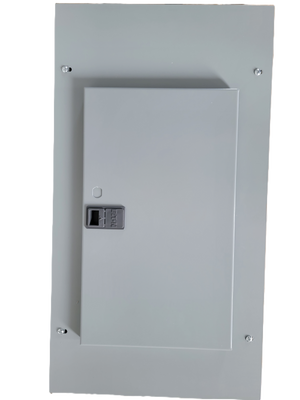
Control panels come in various physical formats, designed to meet specific space and operational needs. Wall-mounted enclosures are a practical choice for tight spaces, often used for junction boxes or small motor starters. On the other hand, floor-standing (free-standing) configurations are better suited for large systems requiring significant internal space, such as Motor Control Centers (MCCs) or main power distribution setups. In areas where rear access isn't feasible, front-access panels are a smart solution. These panels allow all maintenance to be done from the front, making them ideal for data centers or crowded electrical rooms.
Functionally, control panels are further categorized by their roles. Motor Control Centers (MCCs) consolidate the control of multiple motors, making them indispensable in facilities with extensive conveyor systems or pumping stations. PLC control panels serve as the central hub for automated systems, housing industrial computers that process sensor data and execute programmed actions. Variable Frequency Drive (VFD) panels are designed to regulate motor speed and torque, enhancing energy efficiency in HVAC systems and pumping applications. For high-risk environments, such as oil and gas facilities, hazardous location panels use explosion-proof or purged enclosures to prevent sparks from igniting flammable gases or dust.
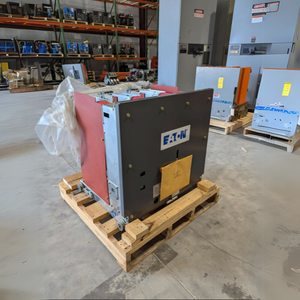
When dealing with high-powered electrical loads - typically above 500KVA - Vacuum Circuit Breaker (VCB) panels are the go-to option. These examples highlight how the choice of configuration is closely tied to the specific demands of the system and its environment.
Power System Integration
Control panels play a critical role in ensuring seamless integration with transformers, power supplies, and distribution systems. Transformers adjust high incoming voltages to levels suitable for control devices, while power supplies convert AC voltage to DC power, usually 24V DC, which is essential for PLCs, sensors, and interfaces. To distribute power efficiently within the panel, busbars and distribution blocks break down large power feeds into smaller branch circuits.
Understanding the electrical hierarchy is crucial when incorporating control panels into broader power systems. High-capacity feeds (ranging from 630A to over 5,000A) are managed through primary distribution using switchgear, while secondary distribution relies on panelboards for branch circuits. The Short Circuit Current Rating (SCCR) of a panel is determined by the component with the lowest rating, meaning any addition or upgrade requires careful consideration. As defined by the National Electrical Code (NEC) Section 409.2:
An industrial control panel is an assembly of two or more power circuit components, control circuit components, or any combination of power and control circuit components.
PLC Control Panel Explained | Components, Wiring & Working (Beginner Friendly)
Safety and Compliance
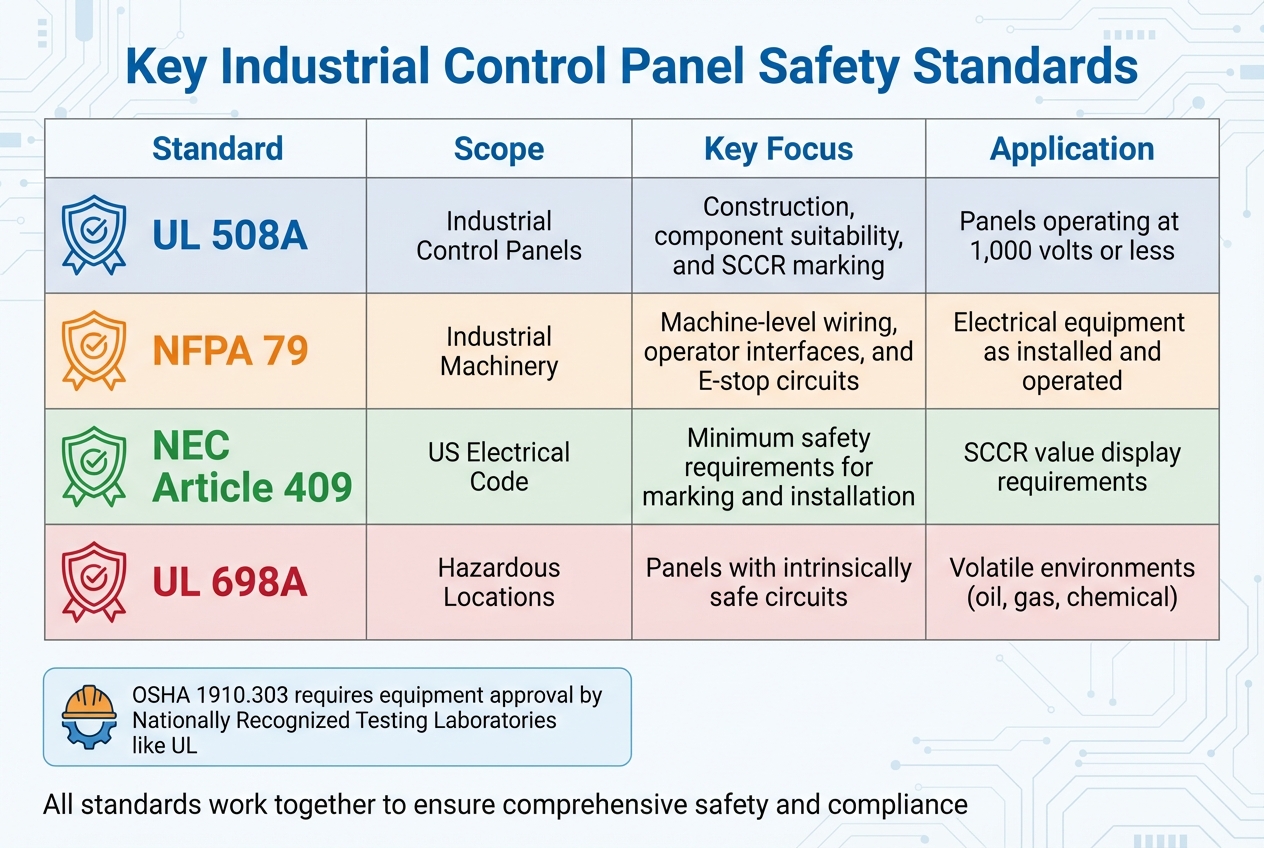
Industrial Control Panel Safety Standards Comparison: UL 508A, NFPA 79, NEC Article 409, and UL 698A
Safety Features
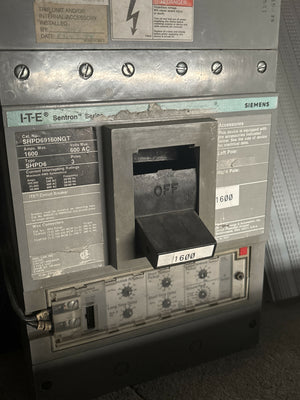
Control panels are designed with several protective measures to minimize electrical hazards. For example, overcurrent protection is achieved using UL 489 molded-case circuit breakers and UL 98 main disconnects. These devices allow technicians to safely disconnect power before performing maintenance tasks. The panel's Short-Circuit Current Rating (SCCR) represents the maximum fault current it can handle. However, the SCCR is only as strong as the panel's weakest component - one subpar part can compromise the entire system's safety.
Proper grounding and bonding, as outlined in NEC Article 250, ensures electrical faults are cleared effectively. This reduces electrical noise and eliminates voltage differences between metallic parts that could potentially shock personnel. Maintaining adequate spacing between live parts and grounded surfaces prevents arcing, while thermal management systems - like fans or heat exchangers - keep internal temperatures below 104°F (40°C). Exceeding this temperature not only shortens component lifespan but also increases fire risks. Additionally, the 2025 UL 508A updates now require emergency stop (E-stop) mechanisms in certain control schemes, emphasizing their importance in preventing injuries during equipment malfunctions.
"A correctly established SCCR and appropriate protective devices add resiliency to an operation and reduce the likelihood of catastrophic faults and extended downtime." - Erich Zende, aeSolutions
These safety measures are built on established industry standards, ensuring both reliability and protection.
Industry Standards
In the United States, industrial control panels must meet several critical safety and compliance standards. UL 508A is the primary standard for panels operating at 1,000 volts or less, covering everything from construction requirements to component suitability and documentation. NEC Article 409 mandates that all panels display their SCCR values, while OSHA 1910.303 requires electrical equipment to be "approved" by a Nationally Recognized Testing Laboratory, such as UL. For machinery, NFPA 79 governs electrical equipment as installed and operated, complementing UL 508A to ensure system-wide safety.
| Standard | Scope | Key Focus |
|---|---|---|
| UL 508A | Industrial Control Panels | Construction, component suitability, and SCCR marking |
| NFPA 79 | Industrial Machinery | Machine-level wiring, operator interfaces, and E-stop circuits |
| NEC Art. 409 | US Electrical Code | Minimum safety requirements for marking and installation |
| UL 698A | Hazardous Locations | Panels with intrinsically safe circuits for volatile environments |
To ensure compliance, the Manufacturer's Technical Representative (MTR) program requires UL 508A-listed manufacturers to have at least one certified staff member. This certification involves a rigorous exam and must be renewed every three years. Proper training is essential, as a recent survey revealed that over 50% of OEMs struggle to locate SCCR information for components. This highlights the growing need for skilled professionals to design panels that meet evolving safety standards.
Sourcing Control Panel Components
Where to Buy Components
Ensuring the reliability of your control panel starts with sourcing high-quality components. The right parts not only keep your system running smoothly but also help maintain compliance with safety standards. Platforms like Electrical Trader provide a nationwide marketplace for new, used, and surplus electrical equipment. They connect buyers with trusted brands such as Siemens, ABB, and GE, offering a wide range of products, from circuit breakers to transformers and even complete distribution panels. This makes it a one-stop shop for both common and hard-to-find components.
For those who prefer regional suppliers, options like Thompson Power Systems cater to businesses in Alabama and northwest Florida, offering new, used, and rental power equipment. Similarly, Switcher Electric supplies a variety of control panels, circuit breakers, and transformers. If you're looking for enclosures and integrated systems that meet UL, IEC, and NEMA standards, E-Abel is a specialized provider.
The used and reconditioned market can be a cost-effective alternative. Depending on their age and condition, used distribution panels can cost between 40% and 70% of the price for new ones. Reconditioned panels are typically priced at 60%–75% of new equipment, while "as-is" components might range from 30% to 50% of the original cost. This secondary market is especially useful during supply chain challenges or when working within a tight budget.
Once you've identified potential suppliers, the next step is to ensure that every component aligns with your system's safety and operational requirements.
Purchasing Considerations
When buying control panel components, compatibility should be your top priority. Components must match your system's voltage ratings (e.g., 120/240V, 208/120V, or 480/277V) and ampacity. Additionally, verify that all parts comply with SCCR (Short-Circuit Current Rating) standards, as the lowest-rated component determines the panel's overall rating. Misaligned ratings can lead to safety hazards and failed inspections.
If you're considering used components, a thorough inspection is critical. Look for issues like discoloration, pitting, or corrosion on bus bars, and check for signs of overheating or water damage. Testing and inspection costs for used panels can range from $200 to $1,000, depending on the unit's size. Also, ensure the enclosure meets environmental demands by verifying its NEMA or IP rating - for example, NEMA 3R or 4 for outdoor applications.
Planning for future needs is another key consideration. Opt for modular control panels that can accommodate additional modules, sensors, or automation features down the line. This approach allows for scalability without requiring a complete system overhaul.
Conclusion
Control panels act as the central nervous system for industrial automation and power distribution systems, ensuring smooth operation and safety across various applications. A well-designed control panel combines essential components like PLCs, HMIs, circuit breakers, and enclosures to monitor, control, and protect equipment effectively. But it’s not just about the parts - it’s about how they’re configured. For instance, keeping high-voltage power (such as 480V) separate from low-voltage control signals (24V DC) minimizes electromagnetic interference. Similarly, proper thermal management safeguards components from overheating, extending their lifespan. Together, these design considerations are critical for operational efficiency and safety.
Safety and compliance standards cannot be overlooked. A panel’s SCCR (short-circuit current rating) is only as strong as its weakest component. That’s why every part needs to meet standards like UL 508A and NFPA 70. Cutting corners here can lead to costly consequences. As Jerry Smith, Owner of Integrity Integration Resources, wisely states:
The momentary satisfaction of paying the lowest price for the panel quickly fades during the first sign of trouble.
Investing in high-quality components ensures long-term reliability, making the total cost of ownership a far more meaningful metric than just the upfront price.
When sourcing components, focus on compatibility, certifications, and supplier support instead of simply chasing the lowest price. Platforms like Electrical Trader can be helpful, but always confirm that voltage ratings, ampacity, and environmental protections meet your system’s needs. These considerations are key to answering questions about control panel features, configurations, and long-term performance.
Ultimately, the choices you make in component selection and supplier support have a direct impact on the reliability, safety, and efficiency of your system. Thoughtful design and sourcing decisions pave the way for safer and more effective industrial operations.
FAQs
How do I determine the right SCCR for my control panel?
To figure out the proper SCCR (Short Circuit Current Rating) for your control panel, start by identifying the SCCR of each power component, such as circuit breakers and fuses, in line with UL 508A guidelines. Pay attention to current-limiting devices, as they can influence the overall SCCR of the panel. The final SCCR must be higher than the fault current at the installation site and meet the requirements of NEC Article 409 and UL 508A standards. This ensures the panel is safe, reliable, and protected against potential failures.
What enclosure rating do I need for my environment (NEMA/IP)?
The type of enclosure rating you should select depends on the conditions your equipment will face, including exposure to dust, water, or corrosive substances. For instance, NEMA 1 is ideal for indoor, general-purpose applications. If you're dealing with outdoor environments where rain is a factor, NEMA 3R or NEMA 4 are better options. For areas with highly corrosive conditions, go with NEMA 4X. Always align the enclosure rating with your specific environmental needs to ensure adequate protection.
When should I choose a wall-mounted vs. floor-standing panel?
When deciding between panel types, wall-mounted panels are ideal for tight spaces or situations where easy maintenance access is crucial. On the other hand, floor-standing panels work best for larger, heavy-duty systems. These panels offer sturdy, elevated enclosures and enhanced durability to handle more demanding applications.