

Hybrid Energy Storage Control Methods for Microgrids
Microgrids powered by renewable energy face one big challenge: energy output is unpredictable. Sudden drops in solar or wind energy can destabilize the grid, making it hard to maintain balance. A single energy storage solution like batteries or supercapacitors often can't solve this problem alone. That's where Hybrid Energy Storage Systems (HESS) come in.
HESS combines batteries (for long-term energy needs) with supercapacitors or other high-power-density technologies (for quick fluctuations). This pairing improves grid stability, reduces wear on batteries, and handles rapid energy changes more effectively. Advanced control strategies like consensus-based and adaptive filter-based methods further improve performance by optimizing how power is distributed between storage systems.
Key takeaways:
- Batteries handle long-term energy demands; supercapacitors manage fast fluctuations.
- Hybrid systems extend battery life, improve efficiency by up to 21.55%, and stabilize grid voltage.
- Advanced control strategies ensure smooth operation, even with variable renewable energy sources.
- Alternatives like SMES (Superconducting Magnetic Energy Storage) and Flywheel Energy Storage offer unique benefits for specific use cases.
HESS is transforming how microgrids manage renewable energy, making them more reliable and efficient.
Battery and Supercapacitor Integration
Benefits of Combining Batteries with Supercapacitors
Pairing batteries with supercapacitors takes advantage of their individual strengths. Batteries are ideal for storing large amounts of energy, while supercapacitors shine in delivering quick bursts of power, thanks to their high power density and rapid response capabilities. By dividing these responsibilities, the overall performance of the system improves significantly.
"The most typical HESS is based on batteries/supercapacitors, which combines the advantages of high energy density of the battery, also high-power density and long cycle life of the supercapacitor." - Scientific Reports
One major advantage of this combination is extending battery life. Supercapacitors handle high-frequency power fluctuations and peak current demands, sparing batteries from the stress of frequent charge-discharge cycles that can lead to faster degradation. Since supercapacitors rely on electrostatic processes rather than chemical reactions, they charge and discharge much faster and require little to no maintenance. Studies have shown that hybrid energy storage systems can enhance efficiency by as much as 21.55% compared to systems that rely solely on lithium-ion batteries.
These efficiency and durability improvements make a big difference in real-world applications, particularly in microgrids.
Microgrid Applications
In microgrids, the combination of batteries and supercapacitors leads to better stability and efficiency. For example, when solar energy dips due to passing clouds or wind generation slows, supercapacitors react instantly to stabilize the DC bus voltage. Meanwhile, batteries handle the steady, consistent supply needed to cover the base load, ensuring reliable power delivery even when renewable energy sources falter. This setup reduces voltage fluctuations and protects sensitive equipment.
Hybrid systems also improve the speed and accuracy of power management. For instance, data-driven control systems using this approach have shown average computation times of 25.78 seconds, compared to 30.28 seconds for traditional PI control methods, all while achieving lower power error rates. Advanced control strategies, such as those using low-pass filters, further optimize performance by directing high-frequency demands to supercapacitors and low-frequency loads to batteries, ensuring each component operates where it performs best.
sbb-itb-501186b
Control Strategies for Hybrid Energy Storage
Consensus-Based Control Methods
Hybrid energy storage systems are adopting advanced strategies like consensus-based and adaptive filter-based control methods to enhance microgrid stability.
Consensus-based control uses a distributed approach where each device communicates with its neighbors to coordinate power delivery and balance the state of charge (SOC). This method makes the system highly resilient.
"Each SC or battery has equal priority in participating in voltage or state of charge (SOC) regulation using only neighboring information exchange instead of global communication." - IEEE Transactions on Industrial Electronics
In March 2020, researchers tested a distributed consensus protocol on a four-HESS system within an islanded DC microgrid. The results showed that the control scheme successfully achieved consensus for both battery SOC and supercapacitor terminal voltage. It also demonstrated robustness against communication issues and device failures. Since no single device acts as a leader, this approach allows for seamless integration or removal of storage units, enhancing system flexibility.
An alternative approach, the semi-consensus strategy, reduces the need for extensive communication infrastructure. Here, batteries rely on voltage-power droops with local compensators, while supercapacitors use integral droops without exchanging data. This method still enables autonomous power sharing while cutting costs.
In October 2020, researchers from the University of Chile and the University of Waterloo validated a secondary distributed consensus-based control strategy using a 24-kW hybrid AC/DC microgrid prototype. Their findings highlighted improved power-sharing accuracy and the elimination of circulating currents during load changes and plug-and-play tests. This protocol also supports plug-and-play functionality.
Adaptive filter-based control builds on these distributed methods by further fine-tuning power allocation in real time.
Adaptive Filter-Based Control
Adaptive filter-based control dynamically divides power demands between batteries and supercapacitors, adjusting to real-time conditions. It monitors each storage device's SOC and modifies filtering parameters to prevent battery overcharging or deep discharging - key for maintaining chemical stability and extending battery life.
This strategy uses a two-stage process. First, it optimizes load and DC bus power differences using IPSO (Improved Particle Swarm Optimization). Then, it applies fuzzy control to regulate the SOC. Together, these measures reduce battery stress and stabilize DC bus voltage.
"A combination of low-pass filtering and fuzzy control strategy... reduces the dynamic stress and peak current demand of the battery to prolong battery life and slow bus power fluctuation." - IEEE Access
SIH 2025 | AI-Powered Smart Microgrid with Hybrid Energy Storage & ToD Switching
Alternative Hybrid Energy Storage Configurations
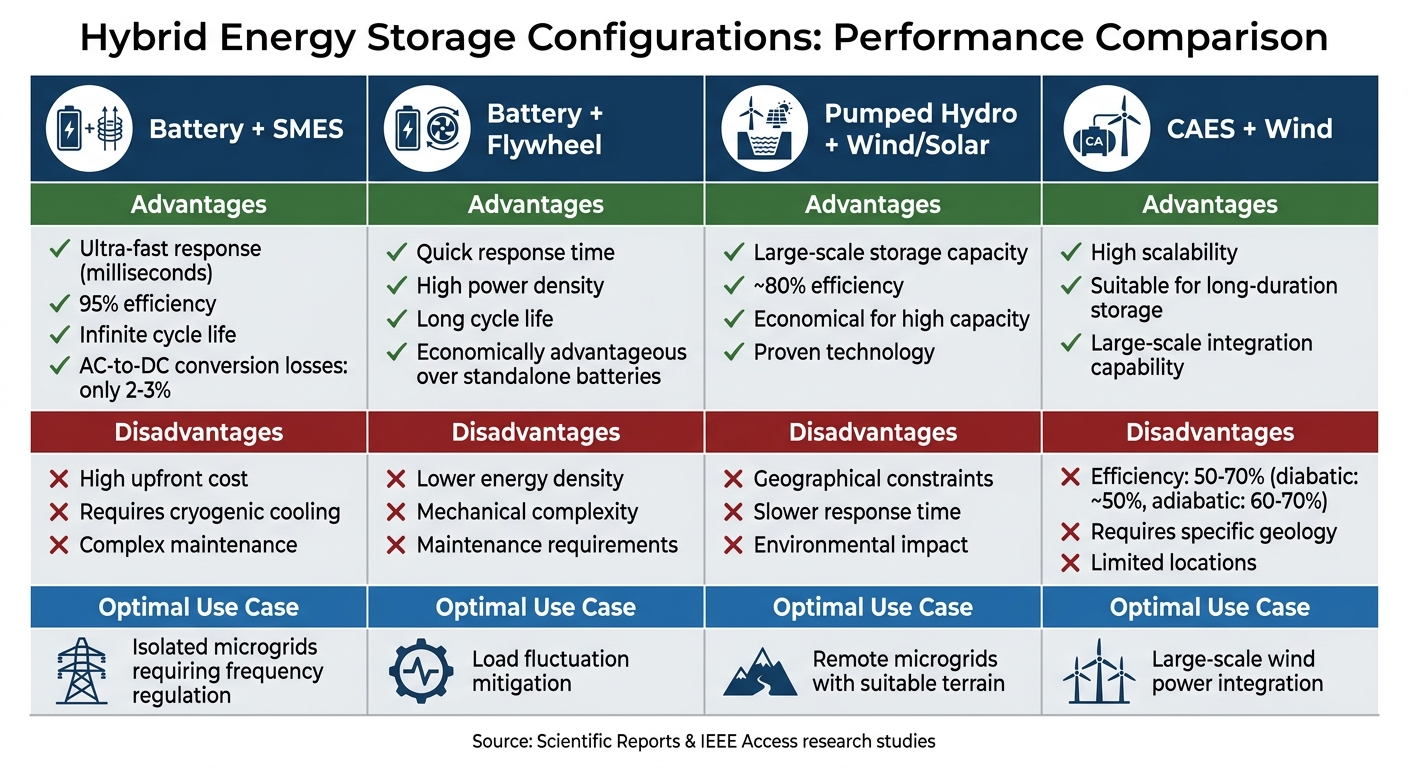
Hybrid Energy Storage System Configurations Comparison for Microgrids
Superconducting Magnetic Energy Storage (SMES) Systems
Looking beyond the common battery–supercapacitor combinations, systems like Superconducting Magnetic Energy Storage (SMES) bring unique advantages to the table. While battery–supercapacitor setups dominate microgrids, SMES stands out for managing ultra-fast power fluctuations. These systems store energy in a magnetic field generated by direct current flowing through a superconducting coil, which requires cryogenic cooling to function.
SMES systems are impressively fast, with response times measured in milliseconds - much quicker than traditional batteries, making them ideal for frequency regulation . When integrated with batteries in a hybrid setup, SMES takes on the rapid power bursts, leaving batteries to handle longer, sustained energy needs. This not only reduces the strain on batteries but also extends their operational lifespan .
"Compared to other ESSs, SMES devices exhibit higher efficiency, longer working lifetimes, and faster reaction times. Fast power grid disruptions can be handled by the SMES, improving frequency response regulation." - Scientific Reports
SMES systems boast a remarkable efficiency rate of about 95%, with minimal AC-to-DC conversion losses of just 2–3%. Unlike chemical batteries, they offer an infinite cycle life . For instance, a study in the Maldives demonstrated how dynamic droop control effectively stabilized a microgrid using a battery–SMES hybrid system. However, the technology's reliance on complex cryogenic cooling and its high upfront costs remain significant challenges .
These distinctive features make SMES an intriguing option for hybrid energy storage, particularly in applications requiring rapid response and high efficiency.
Comparing Hybrid Storage Configurations
Different hybrid energy storage systems come with their own strengths, weaknesses, and ideal applications. For instance, Flywheel Energy Storage Systems (FESS) are known for their high power density and quick response times, making them well-suited for smoothing out load fluctuations. A study on the Greek island of Naxos, conducted using Homer Pro software, highlighted the economic advantages of a flywheel–battery hybrid over standalone battery systems.
On the other hand, Compressed Air Energy Storage (CAES) is a scalable option for large wind energy systems. However, its efficiency varies: diabatic CAES operates at around 50%, while adiabatic systems can reach 60–70%.
Here's a quick comparison of various hybrid storage configurations:
| Configuration | Advantages | Disadvantages | Optimal Use Case |
|---|---|---|---|
| Battery + SMES | Ultra-fast response; 95% efficiency; infinite cycle life | High cost; requires cryogenic cooling | Isolated microgrids |
| Battery + Flywheel | Quick response; high power density; long cycle life | Lower energy density; mechanical complexity | Load fluctuation mitigation |
| Pumped Hydro + Wind/Solar | Large-scale storage; ~80% efficiency; economical for high capacity | Geographical constraints; slower response | Remote microgrids |
| CAES + Wind | High scalability; suitable for long-duration storage | Efficiency around 50–70%; requires specific geology | Large-scale wind power integration |
Each configuration has its niche, whether it's the ultra-fast response of SMES or the large-scale capabilities of pumped hydro and CAES. Understanding these trade-offs helps in selecting the right system for specific energy needs.
Hierarchical and Modular Control Frameworks
Multi-Level Control Architecture
Managing a microgrid effectively calls for a layered control system, where each level operates on distinct time scales and handles specific tasks. Here's how it breaks down:
- The primary layer focuses on local control, ensuring quick reactions (within milliseconds to seconds) to maintain power quality and stability.
- The secondary layer oversees voltage and frequency restoration and synchronizes the system as a whole, operating within a seconds-to-minutes timeframe.
- The tertiary layer handles broader tasks like economic optimization and grid interaction, working on a minutes-to-hours scale.
This structure connects the dots between long-term planning and immediate response. For instance, hour-ahead scheduling, which operates in 15-minute intervals, helps reduce operational costs. Meanwhile, real-time scheduling, with 1-minute intervals, addresses power imbalances caused by renewable energy variability. A case study from December 2017 on a seven-bus microgrid system highlighted how this framework extended battery life by using supercapacitors to handle high-frequency power fluctuations.
The coordination within this hierarchical system assigns supercapacitors to manage rapid transients (under 500 milliseconds) and reserves batteries for longer, sustained demands. This strategy has been shown to reduce stress on critical components by 20%. Such a structured approach creates a pathway for scalable and decentralized control systems.
Modular Control for System Expansion
While hierarchical control provides structure, modular frameworks take scalability and resilience to the next level. Unlike centralized systems that depend on a single controller (making them vulnerable to single-point failures), modular control relies on decentralized coordination. Here, local measurements - like DC link voltage and frequency deviations - guide power-sharing decisions.
"The centralized technique is not robust due to its single-point failure in the communication link." – Nature Scientific Reports
This decentralized setup also keeps costs in check when expanding the system. For example, adding hydrogen gas tanks to a Hydrogen Energy Storage System is more affordable than expanding battery banks, all while maintaining seamless coordination through the supervisory layer. Additionally, modern systems are integrating AI and machine learning into these hierarchical levels. These technologies improve control accuracy and solve complex optimization problems more effectively than traditional methods.
Conclusion
Hybrid energy storage systems are changing the way microgrids handle the unpredictability of renewable energy sources. By pairing supercapacitors with high-energy density batteries or fuel cells, these systems offer both quick response times and sustained energy management. Advanced control strategies play a key role, helping to minimize voltage fluctuations during sudden changes.
These strategies bring clear benefits: longer battery life, tighter DC bus voltage regulation within ±1.7%, and improved efficiency - all of which lower operational costs while ensuring consistent power delivery. These improvements not only boost performance but also make it easier to scale systems for larger applications.
Scalability is another major advantage. Modular control setups allow microgrids to grow without requiring a complete overhaul, while hierarchical designs manage both short-term disruptions and long-term economic goals. The addition of AI and machine learning further refines system performance, tackling complex optimization problems that traditional methods often can't solve.
As microgrids become more common across the United States, professionals in power distribution need to grasp these advanced control strategies. The combination of smarter controls, hybrid storage setups, and layered coordination creates systems that are not just efficient but also more resilient to the challenges posed by renewable energy variability. Additionally, the evolving cost structure of hybrid systems makes them an even more attractive option.
With hydrogen fuel cell systems now costing roughly 0.005× that of comparable battery storage, hybrid energy storage solutions are becoming increasingly viable and accessible. These systems, backed by advanced control methods, are setting a new standard for modern microgrid design.
FAQs
How do I size the battery vs. the supercapacitor in a HESS?
Sizing the components in a hybrid energy storage system (HESS) revolves around their specific functions. The battery is designed to handle long-term energy storage, acting as the primary energy reserve. On the other hand, the supercapacitor is tailored for managing high-power demands and handling rapid charge and discharge cycles.
To size the supercapacitor effectively, you can use the smoothing time constant. This approach ensures the supercapacitor absorbs short-term power fluctuations, reducing stress on the battery. By doing so, the battery's workload is optimized, which can help extend its lifespan while maintaining overall system efficiency.
What control method works best if microgrid communications are unreliable?
A hybrid control approach works well for unreliable microgrid communications. By blending centralized and decentralized methods, it provides the adaptability needed to manage power efficiently while maintaining resilience in unpredictable situations.
How do HESS controllers prevent battery overcharge and deep discharge?
HESS controllers play a critical role in protecting batteries from overcharging and deep discharging. They achieve this by carefully managing the state of charge (SOC) using advanced control techniques. By regulating the power flow, these controllers ensure the SOC stays within safe boundaries. Additionally, they incorporate hybrid energy storage systems - like batteries combined with supercapacitors or flywheels - to improve both stability and overall efficiency.