How OLTC Works in Voltage Control
On-Load Tap Changers (OLTCs) are devices built into power transformers that regulate voltage without interrupting power flow. They adjust the transformer's turns ratio in small steps, ensuring stable voltage even during demand fluctuations. Here's what you need to know:
- Purpose: OLTCs maintain consistent voltage levels to protect equipment and ensure grid stability.
- Operation: They use a make-before-break mechanism to switch between transformer taps seamlessly, completing each change in 30–70 milliseconds.
- Voltage Range: Typically regulate voltage within ±10% to ±16%, divided into 16–32 steps for precise adjustments.
- Types: Two main designs - resistive (faster switching) and reactor (smoother transitions) - are chosen based on application needs.
- Applications: Widely used in hospitals, data centers, manufacturing plants, and renewable energy systems to avoid power interruptions.
- Durability: Modern vacuum-type OLTCs can handle up to 600,000 operations without replacement.
On Load Tap Changer :- How it works?
sbb-itb-501186b
What is an On-Load Tap Changer (OLTC)?
An On-Load Tap Changer (OLTC) is a device that allows a transformer to adjust its turn ratio in specific steps while staying energized and under load . Essentially, it acts as a built-in voltage regulator by altering the number of turns in one winding - typically on the high-voltage side - to maintain a consistent output voltage.
Here’s what sets OLTCs apart: unlike Off-Circuit Tap Changers (OCTCs), which require the transformer to be shut down for adjustments, OLTCs allow changes to be made without interrupting power flow. This eliminates the need for downtime, a critical advantage for systems where uninterrupted power is essential. OLTCs achieve this seamless operation by adjusting voltage step-by-step while the transformer remains in service.
The OLTC mechanism uses a make-before-break approach, briefly connecting two taps through transition resistors or reactors to limit circulating currents. This entire process, completed in 30 to 70 milliseconds, minimizes arcing and ensures smooth operation.
Modern OLTCs are often automated via Automatic Voltage Regulators (AVRs), which monitor voltage levels and adjust taps as needed. This feature is particularly useful in systems that incorporate renewable energy sources like solar or wind, where voltage levels can spike during peak production periods.
Main Purpose of OLTC
When you look at how an OLTC operates, its primary goal becomes clear: to maintain a stable secondary voltage, even when the primary supply or connected load fluctuates. Whether demand surges during a hot afternoon or drops during the night, the OLTC works in real time to ensure downstream equipment gets the correct voltage.
This real-time regulation is crucial for grid stability. By making precise voltage adjustments, OLTCs ensure that sensitive equipment like motors and computers receive consistent power, regardless of upstream conditions.
"This capability is essential for maintaining a stable and reliable power supply, especially during periods of fluctuating demand or system disturbances."
– Harold Williams, Associate Editor, Electricity Forum
Beyond protecting equipment, OLTCs also improve system efficiency by optimizing voltage and reducing reactive power losses. For facilities with variable loads - like manufacturing plants, data centers, or hospitals - this continuous adjustment removes the need for costly service interruptions that would come with using OCTCs.
How OLTC Works: Step-by-Step Process
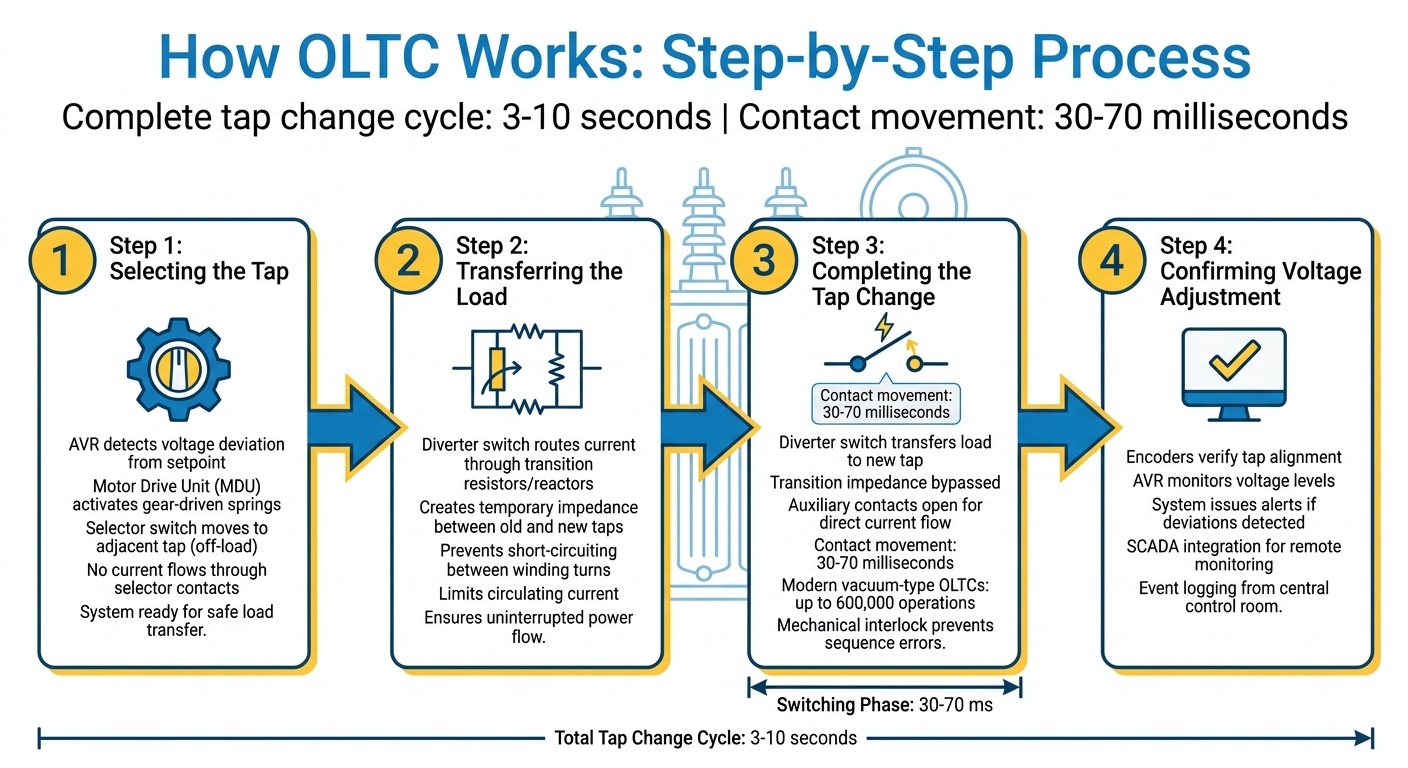
How OLTC Works: 4-Step Voltage Control Process in Power Transformers
Understanding how an OLTC (On-Load Tap Changer) operates provides insight into its role in maintaining voltage stability. The entire process, from detecting a voltage fluctuation to confirming the adjustment, usually takes between 3 and 10 seconds. This methodical approach ensures voltage stability without disrupting service.
Step 1: Selecting the Tap
When the Automatic Voltage Regulator (AVR) detects that the output voltage has strayed from its setpoint, it sends a signal to the Motor Drive Unit (MDU). The MDU activates the mechanism using gear-driven springs to prepare for the adjustment. At the same time, the selector switch moves to the adjacent tap while off-load, ensuring no current flows through its contacts. This prevents damage to the selector contacts, as the diverter switch continues to carry the load current. With the new tap selected, the system is ready to transfer the load safely.
Step 2: Transferring the Load
Once the selector switch is positioned, the diverter switch steps in to route the load current through transition resistors or reactors. These components create temporary impedance, which bridges the old and new taps. This design prevents short-circuiting between winding turns and limits circulating current.
"Reactors (inductors) are used in the circuit to increase the impedance of the selector circuit and limit the amount of current circulating due to this voltage difference"
– Edvard Csanyi, Electrical Engineer
This setup ensures uninterrupted power flow while the transition is safely managed.
Step 3: Completing the Tap Change
The diverter switch then finishes its movement, transferring the load current to the new tap. At this point, the transition impedance is bypassed, and auxiliary contacts open, allowing direct current flow through the new contact. The actual movement of the contacts happens in just 30 to 70 milliseconds. A mechanical interlock system ensures the sequence is executed correctly - any misstep could cause significant transformer damage. Modern vacuum-type OLTCs, known for their durability, can handle up to 600,000 operations without requiring replacement. Once the tap change is complete, the system verifies the adjustment.
Step 4: Confirming Voltage Adjustment
After the physical tap change, the system checks to confirm the adjustment was successful. Encoders verify the tap alignment, and the AVR monitors the voltage, issuing alerts if any deviations are detected. Many modern systems integrate with SCADA, enabling remote monitoring of tap positions and event logging from a central control room. This added layer of verification ensures the system operates as intended.
Main Components of an OLTC System
An OLTC (On-Load Tap Changer) system is designed to regulate voltage under load without interrupting power. This involves a coordinated effort between several components, each playing a specific role in the tap-changing process - from selecting the next tap to transferring the load current safely.
Selector Switch and Diverter Switch
The selector switch is responsible for pre-selecting the next tap while off-load, ensuring its contacts remain protected. Once the tap is selected, the diverter switch quickly transfers the load current to the new tap. To handle the arcing that occurs during this transfer, the diverter switch is typically housed in a separate oil-filled compartment. This design keeps arcing byproducts from contaminating the main transformer oil. After the switching process, transition resistors or reactors manage the current transfer, ensuring it is smooth and controlled.
Transition Resistors or Reactors
Transition resistors or reactors are critical for limiting circulating currents between short-circuited turns during the tap-changing process. These components provide temporary impedance to prevent arcing and reduce electrical stress.
- In resistor-type OLTCs, energy is dissipated as heat, requiring very fast switching to avoid overheating. This makes them ideal for compact designs and transmission substations.
- Reactor-type OLTCs, on the other hand, use inductive impedance for a smoother transition and are better suited for high-capacity transformers. They can handle off-tap loading for longer durations, making them a preferred choice in such applications.
To automate the physical tap-changing process, the system relies on the Motor Drive Unit.
Drive Motor
The Motor Drive Unit (MDU) automates the tap-changing process by using an electric motor to drive a shaft and gear mechanism. This mechanism tensions springs, which, when released, activate the diverter switch contacts. The entire operation is completed in just 30 to 70 milliseconds.
As described by Scotech:
"The MDU serves as the 'power brain' of the OLTC, with the two working as an electromechanical system to enable dynamic voltage regulation in transformers."
– Scotech
Routine maintenance of the MDU is essential to keep the selector and diverter switches synchronized, ensuring the system operates reliably and efficiently. This is especially important given that OLTC-related issues contribute to over 30% of power transformer failures.
Resistive vs. Reactor OLTC: A Comparison
When it comes to OLTC (On-Load Tap Changer) designs, the way they handle circulating current sets them apart. Whether you choose a resistive or reactor OLTC depends on factors like the application, location, and power requirements.
Resistive OLTCs are the go-to choice in most parts of the world, with the exception of North America. These systems rely on transition resistors to manage energy during tap changes. To avoid overheating the resistors, resistive OLTCs operate at a fast pace. This quick switching reduces arcing and minimizes wear on contacts, making them a solid choice for transmission and distribution transformers globally.
On the other hand, Reactor OLTCs provide a different approach and are more common in the United States, particularly for distribution-side applications. These systems use center-tapped reactors (inductors) to control circulating current, ensuring smoother transitions for high-power loads. Harold Williams, Associate Editor at Electricity Forum, highlights their functionality:
"Reactor-type OLTC – employs reactors for smoother switching, suitable for high-power applications"
A notable feature of reactor OLTCs is how, under balanced load conditions, the currents in the two halves of the reactor cancel each other out. This reduces the inductive voltage drop.
These differences not only affect performance but also influence regional preferences for OLTC technology. Resistive OLTCs are valued for their speed and proven reliability worldwide, while reactor OLTCs are preferred for their smoother transitions, especially in high-power scenarios. Choosing the right OLTC design is essential for ensuring accurate voltage regulation and dependable power distribution.
Comparison Table
| Feature | Resistive OLTC | Reactor OLTC |
|---|---|---|
| Transition Impedance | Uses resistors to limit circulating current | Uses reactors (inductors) to limit circulating current |
| Switching Speed | Very fast (30–70 milliseconds) to prevent resistor overheating | Slower, smoother transitions |
| Energy Dissipation | Higher energy dissipation during switching | Lower energy dissipation; smoother transition |
| Typical Applications | Global transmission and distribution transformers | North American distribution networks and high-power systems |
| Design Style | Usually "Diverter" style (round, dropped into transformer top) | Usually "Selector" style (welded compartment on side/front) |
| Geographic Preference | Global standard for over 90 years | Predominantly used in the United States |
Voltage Regulation Capabilities of OLTC
OLTC (On-Load Tap Changer) transformers typically manage voltage regulation within a range of ±10%, though larger systems can extend this to ±16%. This is achieved through a series of tap positions - usually between 17 and 33. A common setup includes 33 positions: 16 above neutral, 16 below, and one neutral position.
The step size varies depending on the configuration. For instance, a 33-position system adjusts voltage in increments of 0.625% per tap, while a 17-position system uses larger steps, ranging from 1.25% to 1.5%. Smaller step sizes provide the precision needed to maintain stable transmission voltages. Harold Williams, Associate Editor at Electricity Forum, explains:
"Each tap step adjusts the transformer's output voltage by about 0.625%, allowing precise fine-tuning to meet grid and load demands."
In practice, this means that in a 33-position system, moving 8 steps above the neutral position increases the output voltage by 5%. Similarly, in a 17-position system with 1.25% steps, moving 4 steps below neutral results in a 5% voltage decrease. To achieve the full ±10% regulation, a 16-step movement from neutral is required.
Voltage Adjustment Examples
The precision of tap adjustments directly correlates to predictable voltage changes.
Take a 33-kV transformer with a ±10% regulation range using 16 steps. The tap positions span from –8 to +8, enabling voltage adjustments between approximately 29.7 kV and 36.3 kV to account for variations on the primary side. For example, at tap position +4, the voltage rises to around 34.65 kV (a 5% increase), while at tap position –4, it drops to about 31.35 kV (a 5% decrease).
For larger transmission systems operating at higher voltages, like 220 kV to 500 kV, a 32-step configuration with 0.625% increments allows for a broader ±16% regulation range. This level of control is essential for meeting ANSI C84.1 standards, which require service voltage to stay within ±5% of nominal and utilization voltage within ±10%.
The time required for single tap changes typically ranges from 3 to 5 seconds. However, when delays are introduced, full adjustments may take between 30 and 60 seconds. David Kim, P.E., an electrical engineer, shares his insight:
"Most engineers set OLTC deadband too narrow (±0.5%), causing excessive tap changes and contact wear... I always set deadband to ±1.5-2% and add 30-60 second time delay to ride through transient voltage sags."
These examples highlight the OLTC's essential role in maintaining grid voltage stability and ensuring reliable power distribution.
OLTC's Role in Power Distribution Stability
On-load tap changers (OLTCs) play a crucial role in modern power distribution by offering real-time voltage control without disrupting service. This ability to operate continuously helps avoid downtime and ensures uninterrupted power for essential facilities like hospitals, data centers, and manufacturing plants. By stabilizing voltage, OLTCs not only improve reliability but also protect equipment and boost energy efficiency.
One of their key functions is to keep voltage levels within the ANSI C84.1 standard, working seamlessly with precise tap adjustments. Harold Williams, Associate Editor at Electricity Forum, highlights their importance:
"Voltage fluctuations, even minor ones, can cause cascading failures across power systems. OLTC transformers mitigate this risk by dynamically adjusting tap positions to maintain stability".
Beyond voltage stability, OLTCs also cut power losses by reducing reactive power waste across the distribution network. This efficiency can lead to significant cost savings. For example, a 2 MVA transformer with just 5 mΩ of contact resistance at a 1,000 A load could waste between $3,500 and $5,000 annually in energy costs.
OLTCs are particularly essential for integrating renewable energy into the grid. Take a 20 MVA transformer at a solar farm substation, for instance. Equipped with an OLTC, it automatically adjusted its taps to maintain a steady 33 kV output, even during peak solar production when voltage tends to rise. These rapid, dynamic adjustments are critical for managing voltage fluctuations in renewable installations, though they require careful monitoring to maintain grid stability.
However, OLTC-related failures account for over 30% of all transformer issues. This makes regular maintenance essential for ensuring grid reliability. Modern OLTC systems often integrate with SCADA and Automatic Voltage Regulators (AVR), enabling remote monitoring. These advancements support smart grid technologies and allow for continuous voltage optimization across the distribution network.
Where to Source OLTC-Compatible Transformers and Equipment
Once you understand how OLTCs work and their advantages, the next step is finding high-quality equipment to ensure reliable voltage control. Since OLTC performance depends on precision, choosing the right supplier is critical. Finding dependable OLTC-compatible transformers and distribution equipment can be tricky, but Electrical Trader (https://electricaltrader.com) simplifies the process. This platform serves as a one-stop marketplace, offering everything from distribution transformers to specialized voltage control gear - no need to juggle multiple suppliers.
Electrical Trader's Product Range
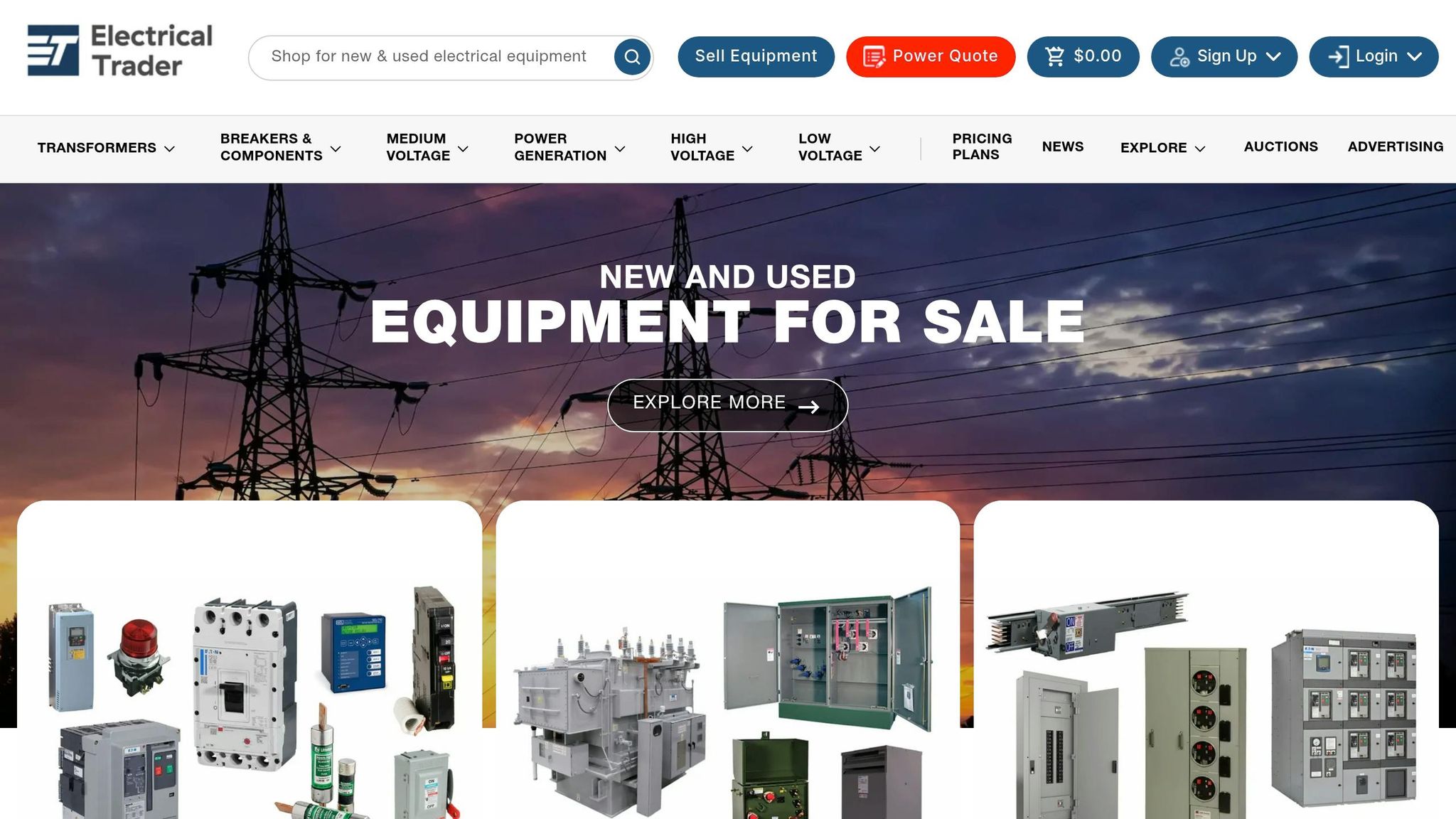
Electrical Trader provides an extensive selection of transformers and components. Their inventory includes:
- Distribution transformers
- Large transmission transformers
- Autotransformers
- Phase-shifting transformers
Beyond full transformer systems, they also stock essential OLTC components like selector switches, diverter switches, transition resistors or reactors, and drive motor mechanisms.
The platform caters to a wide range of industries and project needs. For instance, utility substations can find high-capacity transformers (10 MVA to 100 MVA) equipped with automatic OLTCs to maintain grid stability. Industrial facilities managing voltage drops in long feeders (11 kV to 33 kV) will find suitable options, while renewable energy projects can source fast-response OLTCs designed to handle fluctuations from solar and wind power generation.
As the industry increasingly adopts vacuum-type OLTCs for their sealed designs and reduced maintenance, Electrical Trader keeps pace by offering these advanced systems alongside traditional resistor-type and reactor-type options. This extensive variety ensures that buyers can find equipment tailored to their project needs, balancing cost, performance, and specifications.
Benefits of Using Electrical Trader
Electrical Trader stands out by providing detailed technical specifications for each listing, making it easier for professionals to match equipment to their exact requirements. Key details include:
- kVA ratings (250 kVA to 2,000 kVA)
- Voltage classes (11 kV to 33 kV)
- Cooling methods (oil-cooled or dry-type)
This transparency helps buyers ensure compatibility with their grid systems.
Another major advantage is cost flexibility. The marketplace features both new and used equipment, offering options for various budgets. For projects where OLTC systems can add $15,000–$30,000 to the cost compared to standard tap changers, access to verified used equipment can significantly cut expenses without sacrificing quality.
Electrical Trader creates a comprehensive ecosystem for electricians, end-users, and buyers, as well as sellers. Whether you’re looking for a complete transformer system or individual OLTC components, the platform has the inventory and tools to support any voltage control project.
Conclusion
On-Load Tap Changers (OLTCs) play a key role in ensuring voltage stability in today’s power distribution systems. By allowing transformers to adjust voltage levels automatically while energized, they help maintain service voltage within the strict ±5% range specified by ANSI C84.1. This functionality not only prevents costly downtime but also protects equipment downstream and ensures smooth operation under varying load conditions.
The switching process for OLTCs is quick, completing in just a few seconds. With regulation ranges of up to ±16% and adjustment steps as small as 0.625%, they provide the precise control needed for applications ranging from utility substations to renewable energy systems.
Understanding how OLTCs work is critical for engineers aiming to optimize system reliability. As David Kim, P.E., a Licensed Electrical Engineer, explains:
"The most common mistake I see is selecting OCTC when OLTC is needed... The cost difference ($15,000-30,000) is justified by avoiding production downtime for voltage adjustments".
Properly configuring deadband settings and time delays further minimizes contact wear and avoids unnecessary switching, known as hunting.
These advantages highlight why choosing dependable OLTC equipment is so important. Whether maintaining grid stability, addressing voltage drops over long distances, or integrating renewable energy sources, OLTCs provide the continuous voltage regulation that modern electrical systems require. For those looking to source OLTC-compatible transformers and components, Electrical Trader (https://electricaltrader.com) offers a centralized marketplace with a wide range of inventory and detailed technical specifications to meet project needs.
FAQs
When should I choose an OLTC instead of an off-circuit tap changer?
When you need continuous voltage regulation while the transformer remains energized and under load, an On-Load Tap Changer (OLTC) is the way to go. OLTCs let you adjust taps without shutting down the transformer, making them perfect for scenarios like transmission systems where frequent or real-time voltage adjustments are essential.
On the other hand, off-circuit tap changers are more suitable for transformers that only require occasional voltage adjustments. These adjustments can be made while the transformer is de-energized, making them a better fit for less demanding applications.
What deadband and time delay settings help prevent OLTC hunting?
To minimize OLTC hunting, it’s important to set a deadband - a small range of a few percent - around the target voltage. This creates a buffer zone where minor voltage fluctuations won’t trigger the system to adjust unnecessarily. Additionally, implementing a time delay of several seconds allows the voltage to stabilize before any further adjustments are made. Together, these measures help maintain smoother operation and cut down on excessive switching.
How do I decide between a resistive OLTC and a reactor OLTC?
Choosing the right OLTC (On-Load Tap Changer) depends on your system's requirements and regional norms. Resistive OLTCs are well-suited for scenarios requiring precise voltage adjustments, as they minimize transients during operation. On the other hand, Reactor OLTCs, which utilize inductors, are known for their durability and are commonly preferred by utilities in the U.S. When deciding, take into account factors such as the system's need for voltage stability, maintenance practices, and how well the OLTC integrates with your existing setup.