Global vs Local Sourcing: Cost Comparison
When deciding between global and local sourcing for electrical components, the total landed cost - not just unit prices - should guide your decision. Factors like tariffs, shipping, lead times, and inventory requirements can significantly impact overall costs. Here's a quick breakdown:
- Global Sourcing: Lower unit costs but higher tariffs (up to 245%), longer lead times (weeks), and extra inventory needs (30–40% more). Total landed costs often narrow the savings.
- Local Sourcing: Higher unit costs but avoids tariffs, reduces shipping costs, and offers faster lead times (days). Reliability and flexibility often offset the price premium.
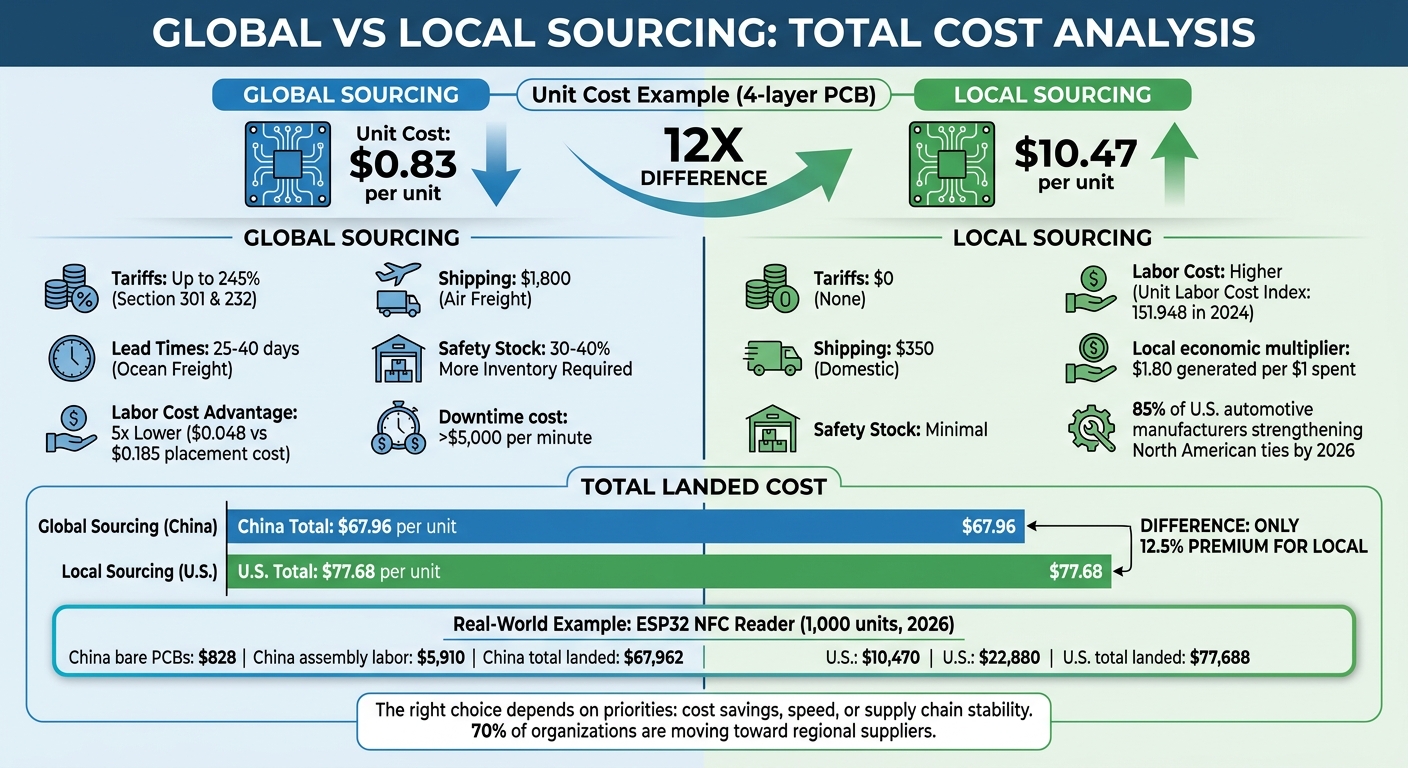
For example, in 2026, sourcing a 4-layer PCB assembly from China had a total landed cost of $67.96 per unit, while U.S. production cost $77.68 - a difference of just 12.5%. Balancing these trade-offs often requires a hybrid strategy: combining global sourcing for non-critical, high-volume components with local sourcing for essential items.
| Factor | Global Sourcing | Local Sourcing |
|---|---|---|
| Unit Costs | Lower (e.g., $0.83 for a 4-layer PCB) | Higher (e.g., $10.47 for the same PCB) |
| Tariffs | Up to 245% (e.g., Section 301 and 232 duties) | None |
| Shipping Costs | Higher (e.g., $1,800 for air freight) | Lower (e.g., $350 for domestic shipping) |
| Lead Times | Weeks (25–40 days for ocean freight) | Days (1–3 business days) |
| Inventory Needs | 30–40% more safety stock | Minimal safety stock |
| Total Landed Cost | $67.96 (China, after duties and freight) | $77.68 (U.S. production) |
Takeaway: The right choice depends on your priorities - cost savings, speed, or supply chain stability. Many companies now adopt hybrid strategies to balance cost efficiency and reliability.
Global vs Local Sourcing Cost Comparison for Electrical Components
1. Global Sourcing Costs
Unit Costs
At first glance, the lower prices of globally sourced electrical components seem like a no-brainer. But dig deeper, and the picture gets more complex. For example, China holds a 5x labor cost advantage in PCB assembly, with placement costs at just $0.048 compared to $0.185 in the U.S. The gap becomes even more striking when looking at bare PCB fabrication: a 4-layer board costs approximately $0.83 per unit in China, while the same board costs $10.47 in the U.S. - a staggering 12x difference.
To put this into perspective, a 4-layer ESP32 NFC reader with 124 placements was analyzed in April 2026. The cost for bare PCBs in China was $828 per 1,000 units, compared to $10,470 in the U.S. Similarly, assembly labor costs came to $5,910 overseas versus $22,880 domestically. These numbers highlight why global sourcing remains attractive for high-volume production, even as tariffs start to erode the advantages. And this doesn’t even account for additional costs like shipping and tariffs, which can further complicate the equation.
Shipping and Tariffs
Shipping and tariffs are major factors that can dramatically alter cost calculations. Section 301 tariffs, for instance, add 25% or more to the landed cost of many electrical assemblies, depending on their component makeup. Section 232 duties tack on about 50% to the cost of steel, aluminum, and copper content in imported goods. For companies using consigned assembly in China, there’s an added challenge: double taxation. Duties are often applied to U.S.-origin parts entering China (10–25%) and again on the finished assemblies when they’re imported back into the U.S..
Then there’s the issue of logistics. Ocean freight from East Asia to the U.S. typically takes 25–40 days under normal conditions, while air express - though faster - comes with a hefty price tag. By late 2025, tariffs on Chinese electrical components reached 35%, further driving up the cost of goods sold.
Total Landed Costs
When all expenses are accounted for, the cost gap narrows significantly. For that same ESP32 NFC reader in 2026, the total landed cost from China was $67.96 per unit, compared to $77.68 for full U.S. production - a difference of just 12.5%.
"The magnitude of the cost advantage for China depends on the service level (consigned versus turnkey) and on whether the full BOM must be imported into China before assembly." - Laura V. Garcia, Octopart
It’s also worth noting that companies often carry 30–40% more safety stock when sourcing globally. This is a buffer against port delays and other supply chain disruptions, but it adds hidden costs for warehousing and capital that don’t show up in initial quotes.
Supply Chain Factors
Shipping fees and tariffs might adjust the numbers, but other supply chain challenges also play a big role in total costs. Long lead times can extend production schedules and limit flexibility. Ocean freight alone can take weeks, and customs clearance or port congestion adds even more unpredictability. Language barriers and time zone differences make quality control harder, often requiring costly on-site inspections. On top of that, exchange rate fluctuations can turn a profitable deal into a financial headache, while geopolitical tensions create risks that are tough to quantify.
Understanding these layered costs is crucial when comparing global sourcing to domestic options, as the next sections will explore in more depth.
sbb-itb-501186b
Global Sourcing & Supply Chain: Understanding Costs of Procurement from Overseas & in the USA
2. Local Sourcing Costs
While sourcing locally often comes with higher unit costs, the savings in logistics, tariffs, and lead times can help balance out the price difference.
Unit Costs
Manufacturing domestically tends to be more expensive due to higher labor costs, overhead, and non-recurring engineering (NRE) charges. For example, in 2026, producing 1,000 units of an ESP32 NFC reader in the U.S. cost $77,688, showcasing the steep expense of domestic production. This increase aligns with the Unit Labor Cost index for U.S. electrical equipment manufacturing, which rose to 151.948 in 2024 from a baseline of 100 in 2017. Factors like direct labor, overhead, and setup costs - such as TDR testing - contribute significantly to these expenses.
However, advancements in automation and government incentives are starting to mitigate these costs. As the U.S. semiconductor industry works to fill 67,000 additional positions by 2030, these efforts may continue to narrow the pricing gap.
Even with higher unit costs, domestic production offers advantages in shipping and tariff savings.
Shipping and Tariffs
Local sourcing simplifies logistics in a way that can lead to significant savings. For instance, shipping a 1,000-unit PCBA order domestically costs about $350, compared to $1,800 for air express from China. Additionally, components sourced within the U.S. avoid hefty tariffs - such as the Section 301 tariffs, which can exceed 25%, and Section 232 duties, which add around 50% to the cost of steel, aluminum, and copper content.
By sourcing locally, companies also sidestep customs paperwork, port delays, and double taxation on U.S.-origin parts sent overseas for assembly and then re-imported.
"One of the largest financial benefits of local sourcing is the reduction in transportation expenses. Working with nearby suppliers eliminates international freight charges, customs duties, tariffs, and port fees." - Lisa Schwarz, Senior Director of Global Product Marketing, NetSuite
These savings on logistics and tariffs help offset the higher unit costs, especially when considering the total landed cost.
Total Landed Costs
When all costs are factored in, the price difference between local and global sourcing becomes narrower. For example, the $77,688 price tag for U.S. turnkey manufacturing is only a 12.5% premium over the $67,962 landed cost from China after accounting for duties and freight. This calculation doesn’t even include hidden costs like currency fluctuations, administrative overhead, and the need to maintain 30–40% more safety stock when sourcing globally to mitigate supply chain disruptions.
"A 12.5% cost delta can be offset by eliminating IP risk, achieving faster time-to-market, and eliminating customs risk for the US build." - Laura V. Garcia, Supply Chain Writer
When you weigh these factors, the total cost premium of local sourcing becomes more manageable, especially when paired with operational benefits.
Supply Chain Factors
Local sourcing offers a level of speed and reliability that’s hard to quantify but critical for smooth operations. Lead times, for instance, shrink drastically from 6–16 weeks to just 1–3 business days for in-stock items. Additionally, working with domestic suppliers eliminates challenges like language barriers, time zone differences, and miscommunication.
For high-volume manufacturers, this reliability can prevent costly production delays, where downtime can cost more than $5,000 per minute. Domestic sourcing also provides the benefit of local warranties and real-time technical support, reducing the hassle of managing overseas suppliers.
These supply chain efficiencies make local sourcing an attractive option for companies prioritizing predictability and responsiveness.
Advantages and Disadvantages
After breaking down the costs, it’s time to look at the bigger picture: the pros and cons of each sourcing strategy. Global sourcing often stands out for its lower unit costs, thanks to reduced labor expenses in certain regions and access to specialized components like RF modules or custom ICs that may not be readily available domestically. But here’s the catch - tariffs and longer lead times can quickly eat into those savings.
On the flip side, local production comes with higher unit costs due to domestic labor and overhead. However, it eliminates expenses like international freight, duties, and port fees. Plus, shorter lead times - measured in days instead of weeks - make just-in-time delivery feasible and free up capital that would otherwise be tied up in inventory. The downside? Advanced electrical components are sometimes harder to source locally, which may push companies toward a hybrid model.
Let’s put it in numbers. A February 2026 comparison of wire harness pricing revealed some eye-opening insights. A unit from China priced at $8.50 jumped to $12.18 after factoring in tariffs and shipping. Meanwhile, a Mexican unit priced at $11.20 ended up at $11.85 under the USMCA agreement, avoiding tariffs altogether. The U.S. option? It came in higher at $17.05 per unit. These figures highlight how hidden costs and regional factors can drastically shift the perceived value. And here’s a compelling stat: for every $1 spent with a local supplier, an extra $1.80 is generated in regional economic activity.
"The cheapest quote isn't always the best value. When you factor in tariffs, shipping, lead times, and supply chain risk, the 'obvious' choice often isn't." - Hommer Zhao, Global Sourcing Expert
The landscape is already shifting. Seventy percent of consumer product and retail organizations are moving toward regional supplier bases, and 85% of American automotive manufacturers plan to strengthen ties with North American suppliers by 2026. For industries like electrical components - where downtime can cost over $5,000 per minute - local sourcing’s speed and reliability often outweigh its higher price tag. Balancing these trade-offs is essential for making smart sourcing decisions.
Conclusion
Deciding between global and local sourcing isn't a simple yes-or-no choice - it’s about weighing the total landed cost and aligning your strategy with what your business needs most.
While global sourcing often offers lower unit prices, these savings can be offset by hefty tariffs - sometimes as high as 245% - and the need to carry 30–40% more inventory to guard against supply chain disruptions.
On the flip side, local sourcing shifts the cost dynamics. Higher unit prices may be a factor, but you avoid import duties, drastically reduce lead times to just days, and free up working capital. In industries where downtime costs can exceed $5,000 per minute, speed and reliability become critical. For instance, a February 2026 analysis revealed that even with a $2.70 per unit discount overseas, Mexico’s total landed cost of $11.85 still beat China’s $12.18. These comparisons highlight the potential advantages of a balanced approach.
This is where a hybrid strategy comes into play. By combining global sourcing for high-volume, non-critical components with local sourcing for essential items - like PLCs, drives, and transformers - you can achieve both cost efficiency and supply chain resilience. Using tools like a “time-to-line” metric and supply chain mapping helps pinpoint and monitor vulnerabilities. Platforms such as Electrical Trader offer real-time inventory insights, enabling quick adjustments when tariffs rise or lead times shift. This approach is gaining momentum, with 85% of U.S. automotive manufacturers strengthening ties with North American suppliers through 2026.
FAQs
What costs should I include in total landed cost?
The total landed cost represents all the expenses involved in getting a product to its final destination. This includes the purchase price along with costs for transportation (both inland and ocean), customs, duties, taxes, tariffs, insurance, currency conversion, crating, handling, and payment fees. Factoring in these elements provides a clear picture of the actual cost of acquiring and delivering the product.
When does local sourcing become cheaper overall?
Local sourcing often ends up being more cost-effective when factors like shipping costs, tariffs, and supply chain risks outweigh the savings from lower global unit prices. For instance, shorter shipping distances can significantly cut transportation costs. High import tariffs, especially on components from specific countries, can also make global sourcing pricier. On top of that, local sourcing helps sidestep risks like delays or quality problems, which can lead to additional expenses such as paying for expedited shipping or fixing defective goods.
How do I decide a hybrid global-local sourcing mix?
To create an effective hybrid mix of global and local sourcing, you need to balance cost efficiency, supply chain stability, and risk management. Local suppliers are ideal for critical or time-sensitive components since they can provide quicker delivery and enhanced reliability. On the other hand, global suppliers work well for bulk procurement of less critical parts, often offering lower costs.
This strategy helps reduce risks like supply chain interruptions or unexpected tariffs while still keeping costs under control. The key is tailoring the mix to match your company's specific needs and the level of risk you're comfortable taking.