

Generator Synchronization in Startup Automation
Generator synchronization ensures a generator safely connects to the grid or other generators by matching key parameters: frequency, phase angle, and voltage. Without this alignment, severe damage can occur, such as electrical circuit failures or mechanical stress on generator components.
Key points include:
- Parameters to match: Voltage (within ±5%), frequency (within 0.2 Hz), and phase angle (within ±10°).
- Methods: Manual synchronization uses tools like synchroscopes, while automated systems rely on digital controllers for precision.
- Automation benefits: Reduces human error, speeds up startup processes, and protects equipment from damage.
Switching to automated synchronization is now standard in power systems, offering safer, faster, and more reliable generator operation.
Generator Synchronization (Full Lecture)
sbb-itb-501186b
Required Parameters for Generator Synchronization
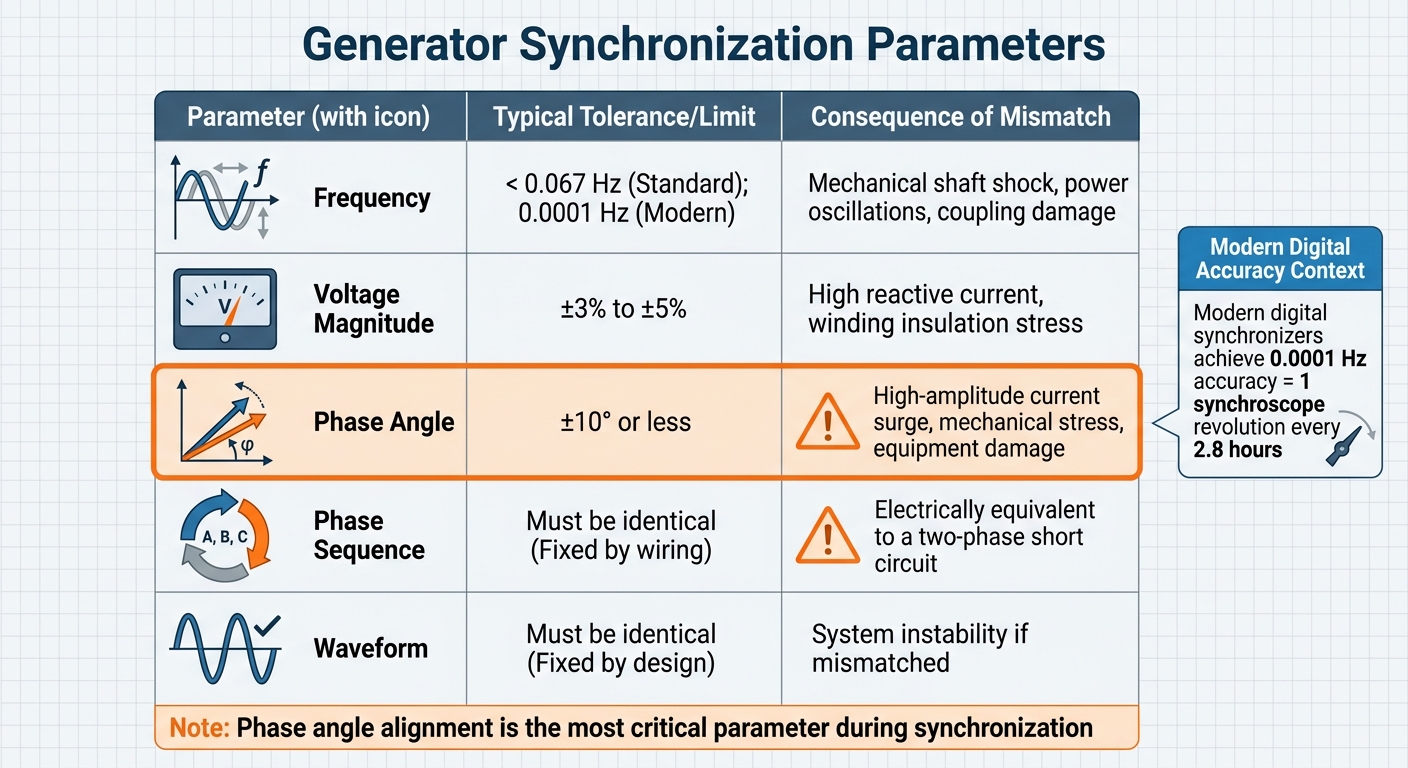
Generator Synchronization Parameters: Tolerances and Consequences of Mismatch
Generator synchronization hinges on five key conditions: voltage, frequency, phase angle, phase sequence, and waveform. While phase sequence and waveform are set during installation and remain constant, the other three - voltage, frequency, and phase angle - must be actively adjusted each time the generator starts. Grasping these parameters is essential before diving into specific synchronization techniques.
Frequency Matching and Tolerance
Frequency matching involves fine-tuning the generator's speed using its governor to align with the grid frequency. In the U.S., this means achieving a precise 60 Hz. The difference between the generator's and grid's frequencies, known as "slip", must be kept minimal before connection. Most manufacturers specify a slip frequency limit of 0.067 Hz. However, modern digital synchronizers can achieve incredible accuracy, reducing slip to as little as 0.0001 Hz - this equates to a single synchroscope revolution every 2.8 hours.
Voltage Magnitude Equality
The generator's voltage output must closely match the grid's voltage to avoid reactive power surges, which can damage equipment without providing any useful energy. The Automatic Voltage Regulator (AVR) is used to control this. Voltage differences are typically tolerated within ±3% to ±5%. If this threshold is exceeded, reactive currents begin circulating, stressing winding insulation and potentially leading to premature failure. To ensure safe synchronization, modern systems start measuring and aligning frequencies only after the generator reaches 70% to 80% of its rated voltage.
Phase Angle Alignment
Aligning the phase angle ensures that the generator's voltage waveform peaks at the same moment as the grid's. This is arguably the most critical parameter, as even small misalignments can lead to severe consequences. The standard requirement is a phase angle alignment within ±10° of the in-phase position (zero degrees). Misalignments greater than this threshold can result in high-amplitude synchronization transients - massive current surges that place substantial mechanical and electrical stress on the generator. Electrical engineer Edvard Csanyi emphasizes this risk:
"Electrical and mechanical systems have become less tolerant of the rough synchronization of impatient or inattentive operators as generator sizes have grown and designs have become more efficient".
The fallout from poor phase alignment can include heavy cross-currents, voltage instability, and in extreme cases, catastrophic damage to generator components like shafts, couplings, and windings.
| Parameter | Typical Tolerance/Limit | Consequence of Mismatch |
|---|---|---|
| Frequency | < 0.067 Hz (Standard); 0.0001 Hz (Modern) | Mechanical shaft shock, power oscillations, coupling damage |
| Voltage Magnitude | ±3% to ±5% | High reactive current, winding insulation stress |
| Phase Angle | ±10° or less | High-amplitude current surge, mechanical stress, equipment damage |
| Phase Sequence | Must be identical (Fixed by wiring) | Electrically equivalent to a two-phase short circuit |
| Waveform | Must be identical (Fixed by design) | System instability if mismatched |
Understanding these synchronization parameters is a crucial foundation for learning manual synchronization techniques.
Manual Synchronization Methods
Manual synchronization allows operators to directly manage a generator's connection to the power system. While automation is becoming the norm, knowing how to manually synchronize is crucial for backup situations or when automated systems fail.
Adjusting Speed and Voltage
To begin, the operator adjusts the generator's speed and voltage. The governor is used to bring the generator's frequency close to 60 Hz, while the Automatic Voltage Regulator (AVR) matches the generator's output voltage to the bus voltage. To prevent a condition called "motoring" - where the grid forces the generator to accelerate, potentially causing damage - the generator's frequency is set slightly higher than the grid's, but by no more than 0.2 Hz.
Electrical engineer Edvard Csanyi explains this concept clearly:
"In order for the oncoming generator to supply electricity as a generator rather than consume it like a motor would, it is set to a slightly higher frequency when it is connected".
Once the speed and voltage are aligned, phase indicators are used to complete the synchronization process.
Using Synchroscopes and Indicators
After the initial adjustments, synchroscopes are used for precise phase alignment. These devices show the phase angle difference between the generator and the bus using a rotating needle. A clockwise rotation means the generator is running faster than the system, while counterclockwise indicates it is running slower. For safe synchronization, the needle should rotate slowly - no faster than once every 15 seconds, which corresponds to a slip frequency of 0.067 Hz.
When the needle moves slowly in the "fast" direction and nears the twelve o'clock position, the generator and system are nearly synchronized. The operator then closes the breaker when the needle is about 10° before twelve o'clock to account for the mechanical lag of the breaker.
Modern manual systems also incorporate a synchronism-check relay, known as Device 25, which is connected in series with the control switch. This relay monitors voltage, frequency, and phase angle, preventing the breaker from closing if synchronization is outside safe limits. This safeguard is especially important for larger, modern generators, which are less tolerant of synchronization errors and could suffer damage if improperly connected.
These manual synchronization methods form the foundation of the principles used in today's automatic systems.
Automatic Synchronization Systems
Automatic synchronization systems take the guesswork out of generator alignment by continuously monitoring key parameters like frequency, voltage, and phase angle. These systems compare real-time measurements against preset tolerances. Once all the conditions are within acceptable limits, the system sends a closing command to connect the generator to the bus. By automating these adjustments, the process builds on traditional manual synchronization methods, delivering greater precision and reliability.
Digital Synchronizers and Their Functions
Digital paralleling controllers simplify synchronization by combining governor control and Automatic Voltage Regulator (AVR) adjustments into a single automated system. These controllers adjust the generator’s speed - often targeting 1,800 RPM for 60 Hz systems - to match the bus frequency. At the same time, they fine-tune the AVR to align the generator’s terminal voltage with the bus voltage.
Modern systems incorporate a ramp function, which gradually adjusts the generator’s speed, ensuring its frequency aligns closely with the bus. This gradual adjustment minimizes phase angle differences and reduces the electrical and mechanical stress that can occur during the connection process.
Manufacturers like Caterpillar, Cummins, Kohler, and Baldor have integrated these synchronization capabilities into their digital control panels. For instance, systems such as Cummins PowerCommand and DEIF modules not only handle synchronization but also include load-sharing algorithms and protective relay functions. These systems are designed with safety in mind, ensuring that breakers will not engage if any parameter falls outside the defined tolerances, regardless of the control logic.
Benefits of Automatic Systems
Automatic synchronization systems bring precision and efficiency to generator operations. They maintain tight tolerances during synchronization, such as keeping voltage differences below 5%, frequency variations within 0.2 Hz, and phase angle alignment within 5 electrical degrees at the moment of breaker closure.
These systems also speed up the synchronization process, especially during startup sequences. They manage tasks like "load add" and "load shed" automatically, starting additional generators as demand increases and shutting them down as demand decreases. This ensures that generators consistently operate within their optimal efficiency range - between 75% and 100% of their rated load.
Research Findings: Manual vs. Automatic Synchronization
Accuracy Comparison Between Methods
Studies reveal a noticeable gap in performance between manual and automatic synchronization methods. Manual synchronization relies entirely on an operator observing a synchroscope and timing the breaker closure as the needle approaches the twelve o'clock position. This approach is prone to human error.
Automatic synchronizers, on the other hand, use anticipatory logic to remove the guesswork. They determine the exact moment for breaker closure by analyzing real-time slip data, ensuring a perfect zero-degree phase match. The precision of these systems is striking: modern digital synchronizers can handle slip rates as low as 0.0001 Hz, equivalent to one synchroscope revolution every 2.8 hours. In contrast, manual methods, such as the dark-lamp technique, have inherent flaws. Lamps require a minimum voltage to illuminate, which means they may turn off before the voltages are fully in phase.
The IEEE Power System Relaying and Control Committee highlights the importance of automation, stating that "a synchronizing system that is designed and verified to operate within a generator's synchronizing limits is critical in helping maintain the life of generating plant assets and improving stability of the power system". This reflects the industry's move away from manual synchronization, driven by numerous incidents where out-of-phase synchronizing caused significant damage to generators and step-up transformers. The stark difference in performance has made automated synchronization the preferred choice in modern systems.
How Synchronization Fits Into Startup Sequences
Research also illustrates how these advancements in synchronization seamlessly integrate into generator startup sequences. During the initial phase of startup, an operator typically controls the generator's acceleration. Once the generator reaches its critical voltage, the automatic synchronizer takes over, managing the governor and voltage regulator to complete synchronization and execute the breaker closure. This transition eliminates human involvement during the most critical stage of paralleling.
In situations where manual synchronization is required - usually during emergencies or maintenance - protective relays are essential. These relays prevent breaker closure if parameters fall outside preset limits, as mandated by NFPA 110 for emergency power systems. As Csanyi notes, "as a result of these shifts and the catastrophic harm caused by some operator misjudgments, hands-off, completely automated synchronizing techniques have become the norm for synchronizing equipment". Research supports that automation not only increases system reliability but also extends the lifespan of generator assets.
Conclusion
Switching from manual to automated synchronization marks a major step forward in how generators connect to power systems. Studies highlight that automated systems can cut startup times to under 5 minutes while eliminating expensive human errors. These advancements translate into better operational efficiency, as seen in several key benefits.
When selecting equipment, prioritize devices that support standardized protocols like IEC 61850, DNP3, or Modbus TCP/IP to ensure compatibility with smart grids. It's also crucial to confirm that the equipment adheres to regional standards like IEEE 1547, particularly for grid code compliance concerning voltage and frequency operating ranges. Always include a synchronism-check relay (Device 25) as a hardware safeguard to prevent breaker closure if system parameters fall outside acceptable limits.
In addition to improving performance, automated systems tackle security challenges effectively. By enabling intelligent load sharing and unit cycling, these systems help generators operate at peak efficiency, cutting down on fuel costs, reducing mechanical wear, and extending equipment life. They also make advanced power generation technologies more accessible, especially for facilities with limited technical expertise, by reducing reliance on highly skilled operators.
Modern automation solutions address cybersecurity risks by incorporating strong authentication, encryption, and audit logging in line with NERC CIP and IEC 62351 standards. As power grids increasingly incorporate variable renewable energy sources, the ability of automated synchronizers to quickly adapt to frequency changes becomes essential for maintaining grid stability. Research underscores that automated synchronization is no longer just a convenience - it's a critical component for ensuring reliable and efficient power generation in today’s energy landscape.
FAQs
What happens if a breaker closes out of sync?
If a breaker closes while out of sync, it can result in mechanical stress, electrical faults, and potential damage to critical equipment like generators or transformers. Beyond equipment damage, this misstep can disrupt system stability or even lead to failure. Ensuring proper synchronization is essential for maintaining the safety and efficiency of power systems.
How does an automatic synchronizer decide the exact close time?
An automatic synchronizer works by constantly tracking critical system parameters like voltage, frequency, and rotor angle. It ensures the breaker closes at the precise moment when these parameters are aligned and fall within predefined limits. This process helps maintain smooth operation while reducing mechanical stress and disturbances.
When should manual synchronization be used instead of automation?
Manual synchronization becomes crucial when precise control is needed. This is especially true during situations like system startup, maintenance activities, or when automatic systems are either unavailable or not dependable. It plays a key role in ensuring the system operates safely and correctly in critical circumstances.