

Generator Noise Control: Key Specifications
Generators can be extremely noisy, with sound levels often exceeding safe or acceptable limits. Unchecked, this noise can harm health, violate regulations, and lead to costly fixes. Here’s the key takeaway: controlling generator noise requires understanding its sources, measuring sound accurately, and choosing the right noise reduction methods.
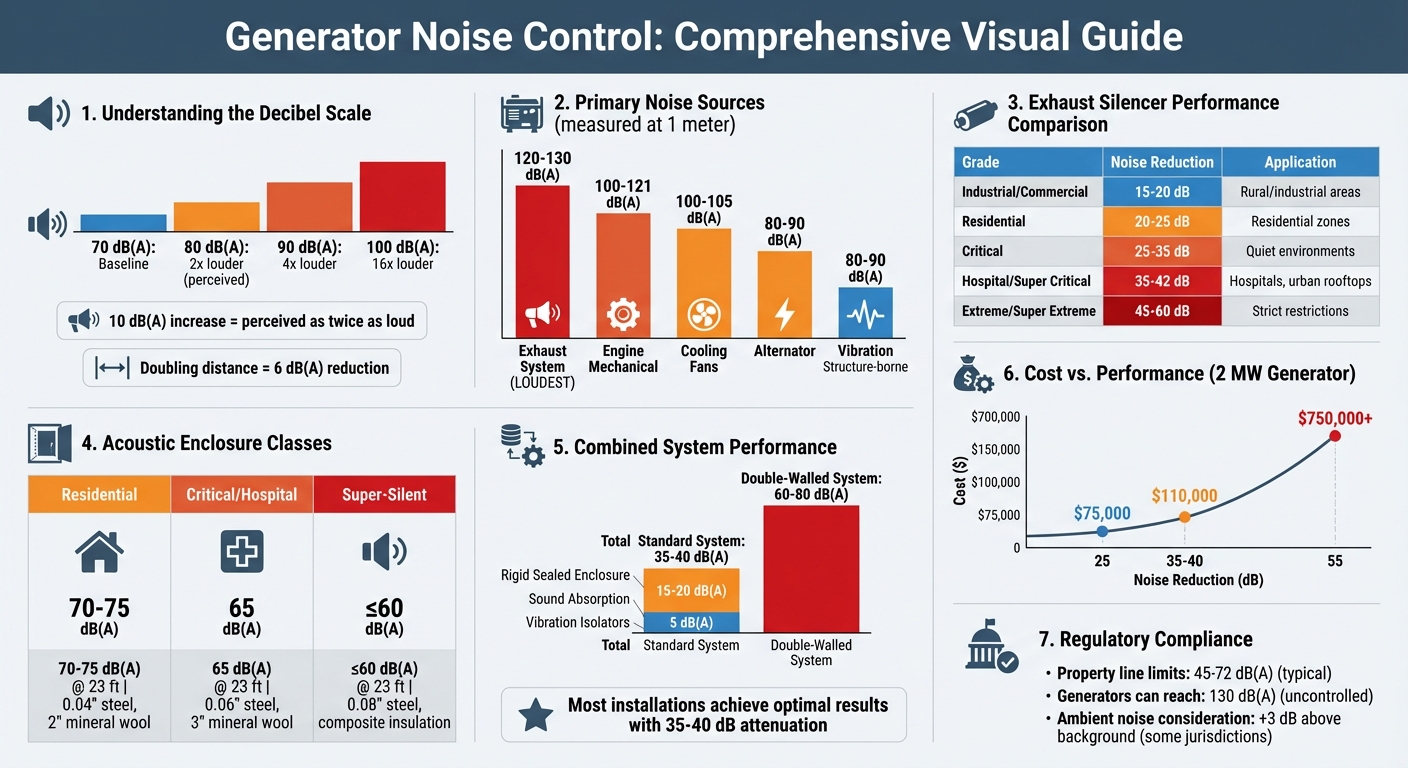
- Noise Levels Matter: Property line limits are typically 45–72 dB(A). Generators can reach up to 130 dB(A), louder than a circular saw. Even small reductions in decibels make a big difference since a 10 dB(A) increase is perceived as twice as loud.
- Primary Noise Sources: Exhaust systems (120–130 dB(A)) are the loudest, followed by engine noise, cooling fans, alternators, and vibrations.
- Noise Control Solutions: Common strategies include exhaust silencers, acoustic enclosures, vibration isolators, and sound-absorbing materials. These can reduce noise by 35–40 dB(A) in most cases.
- Cost Implications: Noise reduction costs rise sharply with stricter requirements. Reducing a 2 MW generator’s noise by 25 dB might cost $75,000, but achieving 55 dB can exceed $750,000.
Quick Tip: Combining methods - like silencers, enclosures, and isolators - yields the best results. For example, doubling the distance from a generator reduces noise by 6 dB(A). Proper planning ensures compliance with regulations and avoids unnecessary expenses.
Let’s dive deeper into how to measure, reduce, and manage generator noise effectively.
Generator Noise Control Components: Performance Levels and Cost Comparison
18dB Generator Noise Reduction - Echo Barrier
sbb-itb-501186b
How Generator Noise is Measured
To understand how generator noise is measured, it’s important to start with the basics: the decibel (dB) scale. This logarithmic scale measures sound pressure levels, but the industry typically uses the dB(A) weighted scale. Why? Because it aligns with how the human ear perceives sound at various frequencies. That’s why two generators with similar power outputs can sound noticeably different.
Standard testing procedures involve placing microphones 23 feet (7 meters) away from the generator at 45° angles around its perimeter. These measurements are taken at multiple points, and manufacturers calculate a logarithmic mean - not an arithmetic mean - to ensure accuracy. As Roger Rosborough, a Market Development Consultant at Caterpillar Northern Ireland, explains:
"It is critical for manufacturers to calculate the logarithmic mean of the peripheral measurements, not the arithmetical mean, which would be mathematically incorrect and may cause the generator set to appear quieter on paper than it is in practice".
Testing also includes measuring ambient noise (with the generator off) and operational noise at full load across eight octave bands. This data is essential for developing effective noise reduction strategies.
Distance significantly affects perceived noise levels. For instance, doubling the distance from a generator in an open area reduces noise by about 6 dB(A). If a generator produces 80 dB(A) at 23 feet, moving to 46 feet drops the noise level to roughly 74 dB(A). This demonstrates how distance impacts the sound you hear.
The logarithmic nature of the decibel scale also reveals some surprising facts. A 10 dB(A) increase doesn’t just make something a little louder - it’s perceived as twice as loud. For example, an 80 dB(A) sound is twice as loud as 70 dB(A), while 100 dB(A) is a staggering 16 times louder than 70 dB(A). This is why even small reductions in decibel ratings can make a big difference in how loud a generator seems.
Now that the basics of measurement are clear, let’s look at where this noise actually comes from.
Where Generator Noise Comes From
Generator noise isn’t a single source - it comes from five main components, each contributing different sound levels when measured at one meter. The loudest culprit? The exhaust system, which produces 120–130 dB(A) due to its direct exhaust emissions.
Other contributors include:
- Engine mechanical noise: Moving parts and combustion processes generate 100–121 dB(A).
- Cooling fans: These produce 100–105 dB(A) as they push air through radiators and enclosures.
- Alternator noise: The alternator and its internal cooling air contribute 80–90 dB(A).
- Vibration: Structure-borne noise travels through the base, affecting foundations or building structures.
Each source plays a role in the overall noise profile, and understanding these origins helps in designing better noise control solutions.
Typical Noise Levels by Generator Type
Noise levels vary widely depending on the generator’s size, enclosure type, and manufacturer. At the standard 23-foot measurement distance, here’s how different enclosure types compare:
- Portable and residential units: These typically range from 84–98 dB(A) with basic weather-proof industrial enclosures.
- Level I enclosures: Units from brands like Cummins and Caterpillar reduce noise to 70–95 dB(A).
- Level II enclosures: These advanced designs achieve 63–78 dB(A).
- Level III or sound-attenuated enclosures: Premium setups can reach as low as 68–70 dB(A).
Noise levels can also vary between manufacturers and even between different model years of the same kilowatt-rated generator. These ranges highlight how design and engineering choices influence the overall sound profile.
Noise Reduction Components and Specifications
This section breaks down the components that help reduce generator noise. Each part has its own performance characteristics and is suited for specific needs. Choosing the right setup depends on your noise reduction goals and budget.
Exhaust Silencers and Noise Reduction Ratings
Exhaust systems are often the loudest part of a generator, with open-type models producing about 100–105 dB(A) at a distance of one meter. To manage this, exhaust silencers are the first solution in noise control. These silencers come in three main types:
- Reactive silencers: Use chambers to reflect and cancel low-frequency noise.
- Absorptive silencers: Rely on insulation to dampen high-frequency sounds.
- Combination silencers: Blend reactive and absorptive designs to target a range of frequencies.
For specialized needs, there are also spark-arrested silencers for flammable environments, heat recovery units to capture energy, and catalytic silencers to reduce emissions.
Silencers come in various shapes - cylindrical, disc, or rectangular - and offer different inlet and outlet configurations, such as end-in/end-out or side-in/side-out, to fit enclosure layouts. Size matters too: a super-critical-plus silencer for a large generator can measure over 6.5 feet in diameter, 23 feet in length, and weigh up to 8,000 pounds.
Noise reduction performance varies by silencer grade:
| Silencer Grade | Noise Reduction Rating | Typical Application |
|---|---|---|
| Industrial / Commercial | 15–20 dB | Rural or industrial areas with louder ambient noise |
| Residential | 20–25 dB | Residential zones with lower ambient noise |
| Critical | 25–35 dB | Quiet environments needing significant reduction |
| Hospital / Super Critical | 35–42 dB | Hospitals and urban rooftops |
| Extreme / Super Extreme | 45–60 dB | Locations with strict noise restrictions |
Higher noise reduction levels come with higher costs. For instance, reducing noise by 25 dB for a 2 MW generator might cost $75,000, while achieving 55 dB reduction could exceed $750,000.
When selecting a silencer, consider factors like exhaust gas flow rate, noise spectrum, operating temperature (usually 450–550°F), and allowable back-pressure. Most engines can handle a maximum exhaust restriction of 7–10 kPa, but exceeding this can cause overheating or damage. To avoid problems, keep the total pressure drop, including pipe friction and silencer loss, below 90% of the engine’s limit to allow for future fouling.
Installation is just as important. Exhaust piping should slope downward by at least 3° away from the engine, with drain taps at low points to prevent condensation damage. Use flexible bellows or braided stainless connectors between the turbo outlet and rigid piping to manage thermal expansion. Exhaust pipes expand roughly 0.04 inches per 3.3 feet for every 180°F increase in temperature. Finally, ensure the stack exit velocity is at least 115 feet per second to avoid soot fallout and backflow into air intakes.
Next, we'll look at how acoustic enclosures complement silencers to reduce overall generator noise.
Acoustic Enclosures and Performance Metrics
While silencers focus on exhaust noise, acoustic enclosures tackle the generator as a whole. These enclosures reduce noise through:
- Sound absorption: Converts sound energy into heat using porous materials.
- Isolation: Prevents vibration transmission with mounts.
- Mass barriers: Uses heavy materials to block sound.
According to the mass law, doubling a wall's mass per unit area can increase transmission loss by about 6 dB(A). Effective sound absorption materials, like mineral wool or foam, need to be porous and open-cell to let sound waves penetrate. Closed-cell materials lose much of this effect. The absorption coefficient measures effectiveness (0 to 1 scale) - a rating of 0.8 means 80% of sound energy is absorbed. If using perforated facings over absorbent materials, ensure at least 20% open cavity area to maintain high-frequency absorption.
Labyrinth air paths, such as Z-shaped ducts, can further reduce noise. These paths force sound waves to reflect off absorbent surfaces, adding 8–10 dB(A) of attenuation when lined with 2-inch mineral wool.
Different enclosure classes offer varying levels of noise control:
| Enclosure Class | Typical Sound Level @ 23 ft | Construction Details |
|---|---|---|
| Residential | 70–75 dB(A) | 0.04-inch steel, 2-inch mineral wool, standard muffler |
| Critical / Hospital | 65 dB(A) | 0.06-inch steel, 3-inch mineral wool, high-performance silencer |
| Super-Silent | ≤ 60 dB(A) | 0.08-inch steel, composite insulation, labyrinth vents |
Combining components significantly boosts noise reduction. For example, vibration isolators alone reduce noise by about 2 dB(A), sound absorption adds 5 dB(A), and a rigid, sealed enclosure contributes 15–20 dB(A). Together, these can achieve 35–40 dB(A) of reduction, while double-walled enclosures with full treatments can hit 60–80 dB(A).
Proper sealing is crucial. Even small leaks can undermine an enclosure's performance. Compression latches and bulb gaskets ensure doors are gas-tight and sound-proof.
Other Noise Control Methods
For a complete noise control system, several additional methods can complement silencers and enclosures.
- Vibration isolation: Structure-borne noise can travel through foundations and into buildings. Elastomeric pads, spring isolators, or rubber-in-shear mounts can decouple the generator from its base. For critical setups, generators are often mounted on an inertia base - a concrete-filled steel frame that dampens vibrations. These bases should weigh at least 150% of the generator's total weight. Spring isolators are typically tuned to a 3–5 Hz natural frequency, offering 90% isolation at 1,500 rpm.
- Flexible connectors: Prevent vibrations from transferring through rigid piping.
- Site placement and orientation: Passive noise reduction can be achieved by increasing the distance between the generator and the receiver. Sound pressure levels drop by 6 dB each time the distance is doubled. Directional exhaust deflectors or curved pipes can also reduce noise by 6–10 dB without requiring structural changes.
Each of these methods plays a role in creating a quieter and more efficient generator setup.
Building a Complete Noise Control System
When it comes to reducing noise effectively, combining individual methods into a cohesive system is a must. The approach you take will depend on the specific needs of your site. For example, a residential installation near homes demands a different strategy than an industrial setup where background noise is already higher.
Start by assessing the ambient noise levels at your site and reviewing local noise regulations. Let’s say your property line limit is 50 dB(A), but the current background noise already hits 55 dB(A). In this case, you’ll need a more aggressive solution than standard equipment can offer. Keep in mind that doubling the distance from the noise source reduces sound levels by about 6 dB(A). Another simple trick? Position the exhaust away from reflective surfaces like concrete walls - this adjustment alone can reduce noise by 6–10 dB(A) without any extra equipment.
Layering components is where the magic happens. Combine a rigid sealed enclosure (which reduces noise by 15–20 dB(A)) with sound-absorbing materials (another 5 dB(A)) and vibration isolators. Together, these elements can provide a total reduction of 35–40 dB(A). If you’re dealing with extreme noise requirements, double-walled enclosures with full isolation can cut noise by 60–80 dB(A). This layered approach helps you strike the right balance between performance, cost, and compliance.
Cost vs. Performance Trade-offs
Once you’ve built your noise control system, it’s time to consider the costs. Here’s the reality: the price tag rises steeply as noise reduction levels increase. For example, reducing noise by 25 dB for a 2 MW generator costs about $75,000. Jumping to 35–40 dB pushes the cost to $110,000, while achieving 55 dB can soar past $750,000.
"The principles of generator set noise control are well understood, leaving economics as the primary limiting factor in implementing noise reduction strategies for specific applications." – William Bloxsom, Ph.D., P.E., Mechanical Engineer, MTU Solutions
Avoid the temptation to over-engineer your system. For most installations, 35–40 dB of attenuation is sufficient without piling on unnecessary expenses. Keep in mind that higher attenuation levels also mean larger enclosures. For instance, moving from 25 dB to 55 dB can increase the enclosure’s size by 2.5 times. These larger setups often require more complicated ventilation systems with winding air passages, which can restrict airflow. To compensate, you may need bigger, pricier cooling fans to prevent overheating.
Design with practicality in mind. Use enclosures with removable panels to simplify maintenance. Plan for acoustic needs during the early design stages to avoid costly retrofits caused by clearance issues with fuel lines or electrical conduits.
For fuel lines and electrical conduits, flexible braided metallic connections are a smart choice. Hard-piping these components can create vibration pathways that bypass your isolation system altogether. If your generator is installed on a rooftop or upper floor, use an inertia base weighing at least 150% of the generator’s total weight to prevent vibrations from traveling through the building structure.
Meeting Local Noise Requirements
After fine-tuning your system’s design and costs, the next step is ensuring compliance with local noise ordinances. These regulations vary widely. Some areas set absolute limits at the property line - typically between 45 and 72 dB(A) - while others restrict noise to no more than 3 dB above the existing ambient level. Resources like nonoise.org can help you identify the specific requirements for your location.
Field conditions can throw a wrench into even the best-laid plans. Nearby walls, signs, and buildings often reflect sound in unpredictable ways, so it’s wise to add a safety margin to your calculated attenuation values.
To meet noise regulations, you’ll need to address both airborne and structure-borne noise. For low-frequency vibrations, spring isolators with at least 2 inches of compression work well. Neoprene pads are better suited for managing high-frequency noise. In critical settings like executive offices or healthcare facilities, use a combination of acoustic barriers, insulation, isolation mounts, and high-grade exhaust silencers to ensure compliance. This layered strategy reduces the risk of relying on a single method that might not perform as expected in real-world conditions.
Ventilation is another key factor. Sound-attenuating baffles and louvers must allow enough airflow to keep the engine cool while still blocking noise. For residential setups, commercial-grade enclosures typically provide 20–35 dB of noise reduction and include engineered airflow systems. DIY covers, on the other hand, only achieve 4–6 dB of reduction and can even damage your equipment.
Conclusion
Controlling noise effectively starts with identifying its sources, selecting the right mitigation components, and ensuring they work together smoothly. Exhaust systems, which can reach noise levels of 120–130 dB(A), are typically the loudest culprits, followed by engines producing 100–121 dB(A). A well-planned approach using exhaust silencers, acoustic enclosures, vibration isolators, and sound-absorbing materials can reduce noise by 35–40 dB(A) in most setups. For even greater reductions - up to 60–80 dB(A) - double-walled enclosures with complete isolation are the way to go. Heavier materials, like concrete block walls or high-density panels, consistently outperform lighter options in noise reduction.
When designing a system, it's essential to weigh performance, costs, and compliance with local noise regulations. These regulations often range from 45–72 dB(A) at the property line or are based on ambient noise levels. Start by measuring your site's background noise to establish a baseline, then choose components tailored to your environment. For example, industrial-grade silencers work well in high-ambient noise areas, while critical-grade silencers are better suited for residential settings. Enclosures should also strike a balance between noise attenuation and proper ventilation to avoid overheating and ensure the engine runs efficiently.
Cost is another key factor. For instance, achieving 25 dB of noise attenuation for a 2 MW generator might cost around $75,000, but reducing noise to 55 dB could push costs beyond $750,000. For most installations, a reduction of 35–40 dB is both practical and effective. Additionally, using flexible connections for fuel lines and electrical conduits can help prevent vibration from being transmitted, ensuring all components work harmoniously.
FAQs
How do I figure out my noise limit at the property line?
To find out how loud your generator can be at the property line, start by checking local ordinances or zoning rules. If no specific regulations are in place, noise control guidelines suggest a maximum sound level of about 50 dBA at the boundary. This level is commonly in line with community noise standards and helps ensure your generator operates within acceptable noise limits.
What’s the best way to measure generator dB(A) on-site?
Measuring the noise level of a generator on-site is best done with a microphone to capture sound pressure levels. To ensure accurate results, take the measurement at a specific distance from the generator, factoring in the surroundings and distance. This approach helps provide reliable comparisons and ensures compliance with noise regulations.
How do I choose between a silencer, enclosure, or vibration isolation?
When deciding how to address noise issues, the choice between a silencer, enclosure, or vibration isolation hinges on the source of the noise and the level of reduction you need.
- Silencers are designed to tackle exhaust noise right at its origin, making them an effective solution for reducing this specific type of sound.
- Enclosures work by containing and reducing overall noise levels. Depending on your requirements, you can opt for options like critical enclosures or those that offer super-silent noise reduction.
- Vibration isolation targets noise caused by structural vibrations, helping to minimize the transmission of sound through physical structures.
In many cases, the best results come from combining these methods. Tailoring the approach to the generator's specific noise characteristics and any compliance requirements ensures the most effective noise control.