




GE SmartSignal: Case Study in Power Analytics
GE SmartSignal is a predictive analytics platform designed to help power plants avoid costly equipment failures and unplanned downtime. By analyzing sensor data in real-time using digital twin technology, it detects anomalies early - often weeks before potential failures. This allows plants to schedule maintenance during planned outages, reducing emergency repairs and saving millions of dollars.
Key insights:
- Cost Savings: Prevents failures, saving an average of $60 million per detected issue.
- Efficiency: Reduces unplanned downtime by up to 5% and cuts false alarms by 75%.
- Scalability: Processes 20 billion sensor data tags daily via cloud infrastructure powered by AWS.
- Real Results: Customers report ROI within 3.41 months and have avoided over $1.6 billion in losses globally.
SmartSignal represents a shift from reactive to predictive maintenance, ensuring power plants operate more reliably while minimizing costs and disruptions.
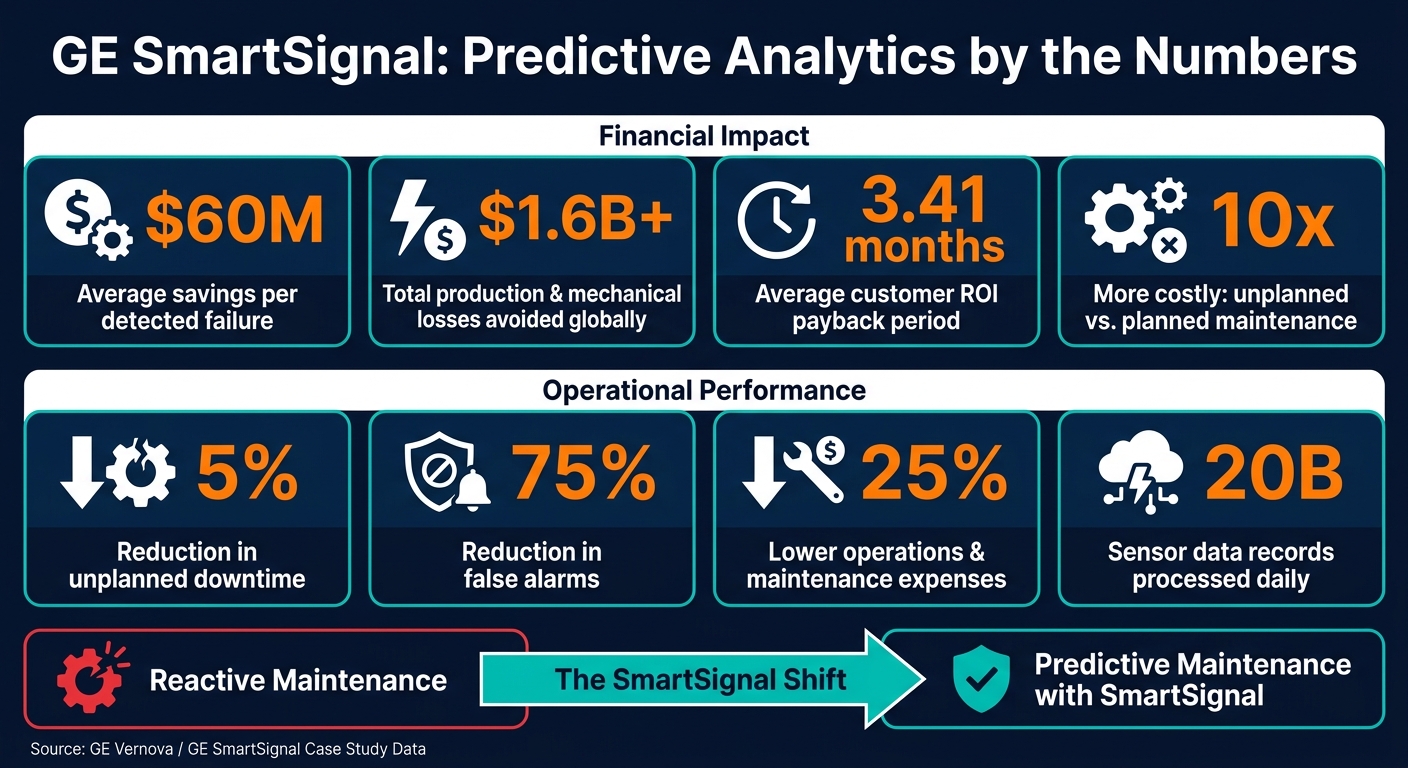
GE SmartSignal: Key Stats & ROI at a Glance
Case Study: Sasol Uses SmartSignal Predictive Analytics for Enhanced Decision-Making | GE Vernova
sbb-itb-501186b
Power Plant Challenges Before GE SmartSignal
Before predictive analytics entered the picture, power plant teams faced an uphill battle. Managing hundreds of assets spread across massive facilities was a logistical nightmare, especially when relying on fragmented data and outdated, paper-based processes. Without a clear way to prioritize time, budgets, or manpower, teams often had no choice but to wait until equipment broke down - a reactive approach that brought hefty financial and operational consequences.
The Cost of Unplanned Downtime
Unplanned downtime is a budgetary black hole. GE Vernova reports that unplanned downtime costs businesses 10 times more than planned maintenance due to the ripple effects of lost production and operational chaos. Emergency repairs demand overtime pay, rush shipping for parts, and mobilization of resources on short notice - all of which add up quickly.
Take the case of "Plant D", a fossil-fueled power plant in the Midwest. In July 1998, this facility experienced a catastrophic failure when an air heater support bearing ran out of oil. The fallout? A nine-day repair that resulted in the loss of 138,800 MWh of electricity generation. With production costs ranging from $10 to $30 per MWh, the financial hit was estimated between $1.4 million and $4 million. This preventable disaster highlighted the urgent need for better monitoring systems capable of catching problems before they escalated.
Limits of Older Maintenance Methods
Traditional maintenance approaches were riddled with inefficiencies. Reactive maintenance often led to severe equipment damage, while scheduled preventive maintenance wasted time and resources on unnecessary tasks - all while missing early signs of failure.
Older condition monitoring systems only made things worse. These systems relied on fixed upper and lower thresholds for alarms - broad parameters meant to cover all operating conditions. The result? They lacked the precision to detect small but critical sensor deviations that could signal a developing issue.
"Because the limits must encompass the broad range of equipment operation and states, CM [Condition Monitoring] algorithms may lack the sensitivity to pick up subtle sensor deviations from normal that could signal an incipient equipment failure." - Donald S. Doan, Senior Power Plant Specialist, SmartSignal Corp.
On top of that, legacy on-premises systems created frustrating delays, with data collection and analysis often lagging by weeks or even months. These outdated tools and methods left power plants vulnerable, paving the way for GE SmartSignal to introduce a much-needed shift in maintenance strategy.
How GE SmartSignal Works: A Technical Overview
GE SmartSignal offers three deployment options: as a cloud-based SaaS solution on GE's Predix platform or AWS, as on-premises software, or as a fully managed turnkey service. These days, the cloud-based version is the go-to choice for most deployments because it can handle massive data loads that would overwhelm traditional on-site systems. Plus, it scales effortlessly as sensor networks expand. The cloud infrastructure relies on Amazon Kinesis Data Streams for real-time data ingestion and Amazon Elastic MapReduce (EMR) for processing, while archival data is stored in Amazon S3. This setup replaces what used to be a modest 8 GB on-premises storage footprint, which ballooned to 200 TB as sensor data grew.
"Using Amazon Kinesis Data Streams and Amazon EMR, we can ingest close to 20 billion machine‐data records per day from sensors at power plants, a number that continues to grow." - Eric Pool, Director of Data and Analytics Infrastructure, GE Power
Data Collection and Monitoring
SmartSignal connects directly to existing equipment sensors and IoT tags installed on plant assets. It monitors a wide range of parameters, such as vibration, flow, temperature, valve position, and discharge pressure. This applies not only to centerline equipment like gas turbines but also to balance-of-plant assets, including condensers, transformers, and cooling water systems. The implementation process begins with GE's analytic blueprints - pre-built digital twin templates for over 300 industrial asset types. These blueprints are then tailored using historical and real-time data specific to each asset, creating machine learning models that define the normal operating conditions for each piece of equipment. This level of customization enables highly accurate fault detection.
Diagnostic and Predictive Capabilities
Once data is collected, SmartSignal uses advanced analytics to predict issues before they escalate. Instead of relying on fixed thresholds to trigger alarms, the platform identifies anomalies by comparing real-time sensor readings to the predicted normal values generated by its digital twins. This approach catches subtle deviations that traditional systems might miss, often providing days or even weeks of lead time before a failure occurs. When an anomaly is detected, SmartSignal cross-references it with a database of precursor signatures from over 19,500 assets to determine the likely cause and recommend a course of action. The platform also includes "time-to-action" forecasting, which helps maintenance teams estimate how long they have before an issue becomes critical, allowing for efficient planning.
"Adding a time factor to the problem diagnosis provides an important benefit toward optimizing maintenance activities while avoiding downtime." - Joe Perino, LNS Research Analyst
Take this example: In June 2025, SmartSignal identified a gradual drop in fan discharge pressure on a 9HA.02 gas turbine at a major European industrial site. The local pressure transmitter didn’t raise any alarms, but SmartSignal’s digital twin detected the deviation and traced it to a clogged inlet filter. Replacing the filter in time prevented an estimated $543,120 in potential damage and downtime. In many setups, SmartSignal is integrated with GE's Industrial Managed Services (IMS), which offers 24/7 remote monitoring and expert alert triage for added support.
Measured Results: Power Plant Performance After GE SmartSignal
The measurable outcomes highlight how GE SmartSignal has reshaped power plant performance. By significantly reducing downtime, this system ensures plants can operate at full capacity. Across its customer network, GE SmartSignal has helped avoid over $1.6 billion in production and mechanical losses. On average, customers see a return on investment in just 3.41 months, along with savings of around $60 million per detected failure.
Efficiency Gains and Cost Reductions
The real-world application of SmartSignal's predictive analytics has proven its ability to enhance efficiency and cut costs. For example, in February 2026, a European utility using a combined-cycle plant noticed an increase in generator bearing 1 vibration - from 60 µm to 71 µm - just above the 68 µm threshold. SmartSignal flagged this anomaly, prompting an IMS engineer to investigate. During a planned outage, the site team inspected the unit and found that loosened distance pieces in the rotor end winding were the issue. Early detection allowed for a focused repair instead of a full rotor replacement, saving an estimated $3.8 million.
Another success story comes from ACWA Power, which oversees more than 70 GW of global power generation. Over a 12-month span ending in 2025, its Monitoring and Prognostics Center identified potential failures across its fleet before they escalated into forced outages. This proactive approach ensured the delivery of approximately 445 gigawatt hours of electricity to the grid.
On a broader scale, the integration of GE's Predix APM suite, which includes SmartSignal, has shown the ability to reduce unplanned downtime by up to 5%, cut false alarms by as much as 75%, and lower operations and maintenance expenses by up to 25%.
SmartSignal's benefits go beyond cost savings - it also streamlines decision-making processes.
Better Decisions Through Real-Time Data
The operational improvements provided by SmartSignal directly enhance strategic decision-making. What once took weeks or months to address can now be resolved in days.
"As recently as one year ago, it would routinely take us weeks or even months to collect data, run analysis, generate results, and implement a change request for a customer. Now, as soon as the application notifies us of an equipment problem, we can have the issue fixed within days." - Eric Pool, Director of Data and Analytics Infrastructure, GE Power
With proactive alerts, maintenance can be scheduled with precision, reducing the need for rushed repairs. This creates a ripple effect: fewer emergency fixes, better labor allocation, and equipment that operates closer to its intended performance levels. SmartSignal not only keeps plants running efficiently but also empowers teams to make quicker, more informed decisions.
Key Takeaways from the GE SmartSignal Case Study
Predictive analytics has become a must-have for power plants, not just an optional tool. The evidence is clear: catching issues early - even something as minor as a slight pressure drop - can prevent catastrophic failures. Switching from reactive maintenance to a proactive approach leads to major financial and operational benefits, all made possible by advanced cloud technologies.
Why Cloud-Based Predictive Analytics Works
The move to the cloud has unlocked new levels of scale and real-time monitoring for SmartSignal. This kind of capability simply isn’t achievable with traditional on-premises systems.
"We use this data to monitor the overall health of our customers' equipment, so they can proactively take maintenance actions during scheduled downtime, instead of in response to failures, which is magnitudes more costly." - Eric Pool, Director of Data and Analytics Infrastructure, GE Power
Cloud technology also ensures global accessibility. Engineers can check asset health alerts from their phones or tablets, no matter where the plant is located. Plus, SmartSignal supports over 330 types of industrial assets, giving operators the ability to monitor a wide range of equipment.
This scalable, real-time capability is a key step toward broader digital transformation in power generation.
Getting Ready for Digital Transformation in Power Generation
Adopting predictive analytics isn’t just about technology - it’s a shift in operational culture. Take the Olympia Angel power station (InterGen) in the UK as an example. Between 2016 and 2022, Ningwei Lu, Performance & Reliability Engineer, spearheaded the integration of SmartSignal with GE Vernova's Industrial Managed Services across their gas-fired portfolio. By building on the platform’s proven cost savings and efficiency improvements, the plant started scheduling outages during periods of low market demand and preordering parts in advance.
For power plants exploring this route, integrating managed services is a critical step. GE Vernova's Industrial Managed Services (IMS) team oversees more than 7,000 customer assets worldwide, offering round-the-clock expert support that smaller internal teams often can’t match. Sultan Al Hazmi, Reliability Superintendent at TASNEE, highlighted the importance of this approach:
"GE Vernova's predictive analytics software will play a pivotal role in our holistic APM strategy, providing us with actionable insights to enhance asset performance, reduce operational risks, and drive sustainable growth."
While data is the foundation of digital transformation in power generation, success ultimately depends on the collaboration of people, processes, and the right infrastructure.
Conclusion: Predictive Analytics and the Future of Power Generation
The numbers don't lie: GE SmartSignal delivers an average ROI payback period of just 3.41 months, saves approximately $60 million per detected failure, and has helped avoid over $1.6 billion in production and mechanical losses globally.
But there's more to this success than just the technology. It's about a shift in mindset. As May Millies, Manager of Power Generation Services at Salt River Project, put it:
"SmartSignal has us listening to the right data and using that data to impact our work operations... we are improving asset utilization across the enterprise."
This shift - from reacting to problems after they occur to proactively addressing them before they escalate - is a game-changer. It’s the difference between plants struggling with downtime and those running efficiently and safely. This cultural transformation is paving the way for advancements in power generation.
Predictive analytics is set to play an even bigger role in the future of this industry. With AI and machine learning evolving at breakneck speed and SaaS-based delivery models making these tools more accessible, even smaller power plants can now leverage advanced monitoring systems. Jeremiah Stone, General Manager of Industrial Data Intelligence Solutions at GE Digital, highlighted this progress, noting that capabilities like predictive anomaly detection were once limited to large enterprises with deep pockets - but that's no longer the case. The barriers are falling, and the shift toward proactive maintenance is becoming a necessity, not an option.
Plants relying on outdated methods like fixed-threshold alarms and manual inspections will be left behind. The technology is ready, the return on investment is clear, and the risks of sticking with reactive approaches are well-documented. The gap between traditional practices and SmartSignal-driven operations will only grow wider. Predictive analytics isn’t just a tool for the future - it’s a competitive advantage for today. GE SmartSignal proves that adopting predictive analytics now is the key to staying ahead in tomorrow’s power generation landscape.
FAQs
What data is needed to start using SmartSignal?
To get started with SmartSignal, you'll need access to equipment data. This includes sensor readings and operational parameters. The software combines this data with predictive analytics, AI/ML models, and insights into failure modes to help identify, diagnose, and even predict potential equipment failures.
How does the digital twin spot issues that fixed alarms miss?
Digital twins go beyond fixed alarms by employing predictive analytics to spot issues early, often before traditional alarms even activate. For instance, they can detect subtle signs of generator bearing vibrations or inlet filter blockages. This means maintenance teams can act proactively, addressing potential issues before they grow into bigger problems. The result? Better system reliability and improved performance overall.
What does it take to integrate SmartSignal with our existing plant systems?
Integrating GE SmartSignal into your plant systems means ensuring it works smoothly with your existing workflows and infrastructure - like CMMS, SCADA, or ERP platforms. This process involves setting up connections that enable seamless data exchange and real-time monitoring. Since GE SmartSignal is designed to work across various equipment types, it can be customized to meet the unique needs of your plant. When properly integrated, it boosts asset reliability and helps minimize downtime, fitting neatly into your current operations.





