

Fossil Fuels in Power: Efficiency by Type
Fossil fuel power plants vary significantly in efficiency, which impacts costs and emissions. Here's a quick breakdown:
- Natural Gas: The most efficient fossil fuel for power generation. Combined-cycle plants achieve 50–60% efficiency, with some advanced systems exceeding 64%. They emit less CO₂ and pollutants compared to coal and oil.
- Coal: Typically operates at ~40% efficiency. Advanced technologies like ultra-supercritical systems can push efficiency beyond 54%, but most U.S. coal plants lag behind due to older designs.
- Oil: The least efficient, with 30–37% efficiency in older plants. High costs and emissions make oil-fired power generation a declining option, used mainly for peak demand.
Key Takeaways:
- Efficiency matters: Higher efficiency reduces fuel use and emissions.
- Natural gas leads: It offers the best balance of efficiency, cost, and emissions.
- Coal improves slowly: Newer technologies help, but older plants still dominate.
- Oil fades: High costs and low efficiency limit its role in modern power generation.
For a deeper understanding of how these factors shape fossil fuel power, continue reading.
Electricity vs Fossil Fuels - Why Efficiency Changes Everything
sbb-itb-501186b
What Is Thermal Efficiency in Power Plants?
Thermal efficiency is a crucial metric for comparing how effectively fossil fuels are used in power generation. It represents the percentage of a power plant's fuel energy that is converted into electricity, with the rest being lost as waste heat. For example, a plant with a 40% thermal efficiency converts 40% of its fuel energy into electricity, while the remaining 60% dissipates as waste heat. To better understand this, let’s explore the thermodynamic principles and measurement methods that influence these efficiency figures.
Thermal power plants are fundamentally limited by the Carnot efficiency principle, which defines the maximum theoretical efficiency for converting heat into work. This principle makes it impossible to achieve 100% efficiency, as some waste heat must always be released. Typically, this excess heat is expelled through cooling towers or water systems. Additionally, how fuel energy is measured impacts efficiency calculations. The Lower Calorific Value (LCV) excludes the heat recovered from water vapor condensation, while the Higher Calorific Value (HCV) includes it. Depending on which method is used, the apparent efficiency of a gas-fired plant can differ by as much as 10%.
Another widely used metric is the heat rate, which measures the amount of fuel needed to produce one unit of electricity. In an ideal plant with 100% efficiency, the heat rate would be 3,412 Btu/kWh. Real-world efficiency can be calculated using this formula:
Efficiency = (3,412 / Heat Rate) × 100.
Efficiency levels vary depending on the type of fuel and the technology used. Coal and oil-fired power plants generally achieve about 37% thermal efficiency, while combined-cycle natural gas plants perform significantly better, with efficiencies ranging between 56% and 60%. These differences are due to variations in thermodynamic cycles and the ability to recover waste heat. Additionally, power plants operate most efficiently at their design capacity. Running at lower loads or under different temperature conditions usually reduces efficiency.
For context, in 2010, coal-fired power generation in the United States had a carbon intensity of 2,249 lbs/MWh, while natural gas combustion was nearly half that at 1,135 lbs/MWh. This disparity is partly due to the higher efficiency of natural gas plants. Such links between efficiency and emissions are essential when analyzing the performance of coal, natural gas, and oil-based power plants.
Coal Power Generation: Efficiency Rates and Limitations
Coal plants in the U.S. generally operate at thermal efficiency levels of 32–33%, which is below the global average of 37%. This gap largely stems from the age of many U.S. coal plants and their reliance on subcritical technology. Subcritical systems operate at lower steam pressures and temperatures compared to more advanced designs, limiting their performance.
Lower efficiency not only increases emissions but also drives up operating costs. Emissions control measures, like scrubbers and the use of low-sulfur Powder River Basin (PRB) coal, further reduce net efficiency. These systems consume additional energy, particularly to manage excess moisture. Other factors, such as turbine inefficiencies - caused by leakage (40%), nozzle erosion (35%), and condenser backpressure - along with fan power consumption (2–3% of gross output), also cut into the electricity delivered to the grid.
Technology Improvements in Coal Plants
Modern technology has helped mitigate some of these limitations in certain areas. For instance, newer U.S. subcritical cycles can reach about 46% efficiency, while supercritical cycles achieve around 50%, and ultra-supercritical cycles exceed 54%. These improvements are made possible by operating at higher steam pressures and temperatures. Ultra-supercritical plants, for example, typically operate at pressures of about 4,640 psi and temperatures as high as 1,130°F, compared to subcritical units that stay below 3,200 psi and 1,025°F.
A notable example is the John W. Turk Jr. Power Plant in Arkansas, operated by American Electric Power (AEP). In August 2013, this ultra-supercritical plant achieved a steam cycle efficiency of 39–40%, significantly outperforming the 35% efficiency typical of subcritical boilers at the time. Globally, ultra-supercritical technology has gained traction, with over 600 units deployed by July 2025, particularly in countries like China, Japan, South Korea, and Germany.
How Efficiency Affects Emissions and Costs
Boosting coal plant efficiency has a direct impact on reducing CO₂ emissions and lowering operating costs. Higher efficiency means burning less coal to generate the same amount of electricity, which reduces greenhouse gas emissions and other pollutants. For context, in 2000, the CO₂ intensity of U.S. coal combustion was 2,249 lbs/MWh (1,029 kg/MWh). Efficiency improvements can help bring this number down.
Even small upgrades can lead to noticeable benefits. For example, a $1.3 million sootblower upgrade allowed a switch to higher-heat-content, lower-moisture coal, improving the heat rate by over 2% and achieving a payback period of 18–24 months. Other cost-efficient measures include:
- Boiler tuning: Offers a 0.5–1.5% heat rate improvement with payback in under a year.
- Condenser cleaning and repair: Provides a 0.5–1.0% improvement, also with payback in less than a year.
- Variable-frequency drives on plant fans: Delivers a 0.2–0.5% improvement, with payback in 2–4 years.
Despite these advancements, coal's role in the U.S. energy mix continues to shrink as natural gas and renewable energy sources gain economic appeal. This trend underscores the growing challenges coal faces in maintaining relevance within the power sector.
Natural Gas: Highest Efficiency Among Fossil Fuels
While coal struggles with efficiency limitations, natural gas emerges as a more effective option, thanks to combined-cycle technology. Natural gas stands out as the most efficient fossil fuel, with combined-cycle gas turbine (CCGT) plants regularly achieving 50–60% efficiency - some even surpassing 64% in advanced setups. This is a significant leap from coal plants, which typically cap out at around 40%. The key lies in capturing and reusing energy that would otherwise be lost as waste heat.
Simple-cycle gas turbines operate by compressing air, mixing it with fuel, and combusting the mixture to power a turbine. While these systems are quick to ramp up and ideal for meeting peak electricity demand, they lose a substantial amount of energy through hot exhaust gases. Combined-cycle plants, however, take it a step further by adding a secondary stage that converts this waste heat into additional electricity.
| Plant Type | Efficiency Range | Usage |
|---|---|---|
| Simple-Cycle Gas Turbine | 20–35% | Peak demand and intermediate loads |
| Combined-Cycle Gas Turbine (CCGT) | 50–64% | Baseload and intermediate power |
The efficiency of combined-cycle plants translates into lower fuel costs and fewer emissions per megawatt-hour. These plants also boast availability factors nearing 100%, meaning they can operate virtually whenever needed. With capital costs of approximately $1,032 per kilowatt for conventional combined-cycle systems, they strike a balance between performance and affordability. The waste heat recovery process, facilitated by a Heat Recovery Steam Generator (HRSG), is central to this efficiency boost.
How Combined-Cycle Plants Use Waste Heat
The impressive efficiency of combined-cycle plants comes from running two thermodynamic cycles back to back. The first cycle uses a gas turbine that generates electricity at temperatures ranging from 1,620°F to 2,550°F (900–1,400°C). Instead of releasing the exhaust - still hot at 840–1,200°F (450–650°C) - into the atmosphere, it is routed into an HRSG.
The HRSG functions like a high-tech boiler, converting this waste heat into high-pressure steam. This steam then powers a secondary turbine, generating extra electricity without burning additional fuel. By doing so, the system doubles the energy output for the same fuel input. The HRSG, equipped with an economizer, evaporator, and superheater, ensures maximum extraction of energy from the exhaust gases.
This process explains how a simple-cycle gas turbine, which might achieve around 43% efficiency, can reach up to 64% efficiency when combined with a steam bottoming cycle. Real-world examples showcase this potential. In April 2016, Électricité de France (EDF) launched a plant in Bouchain, France, achieving a Guinness World Record-certified efficiency of 62.22% with a General Electric 9HA turbine, producing between 592 and 701 MW. Similarly, Siemens achieved 60.75% efficiency in May 2011 at Germany’s Irsching Power Station with a 578 MW turbine.
Natural Gas Adoption in the U.S.
In the U.S., natural gas has become the top choice for new power generation, largely due to its efficiency and lower emissions compared to coal or oil. The technology is well-established, operating close to its theoretical limits. This maturity ensures dependable performance, even as further cost reductions become harder to achieve.
The efficiency edge of natural gas plants isn’t just about saving fuel - it also means fewer emissions. Combined-cycle plants emit significantly less CO₂ and other pollutants per megawatt-hour than coal-fired plants. For facilities incorporating carbon capture and storage (CCS), the emissions reductions are even greater, though the added cost is around $2,154 per kilowatt.
Research and development continue to push the boundaries of performance. Innovations in turbine blade materials, steam cooling systems, and real-time optimization software aim to exceed 60% efficiency. Some plants are also experimenting with blending up to 30% hydrogen with natural gas, as Xcel Energy is doing in the Midwest, further cutting carbon emissions while maintaining high efficiency. These advancements not only enhance efficiency but also align with efforts to make fossil fuel power generation cleaner. Natural gas remains a leading option, paving the way for further breakthroughs in energy production.
Oil Power Generation: Lowest Efficiency Rates
Oil-fired power plants operate with thermal efficiency rates of just 30–37%, making them the least efficient option compared to other fossil fuels. For context, natural gas combined-cycle plants achieve efficiency levels of 50–60%, while coal-fired units typically operate around 40%. This inefficiency places oil-fired plants at a clear disadvantage.
Adding to the problem, 70% of oil-fired capacity in the U.S. was built before 1980. These older facilities rely on outdated technology, such as gas turbines or internal combustion engines (ICEs), instead of modern combined-cycle systems. ICEs are particularly inefficient, converting less than 25% of fuel energy into electricity. Unlike newer natural gas plants that use heat recovery systems to capture waste energy, older oil plants allow most of it to escape as heat. This reliance on simple cycle designs creates both technical and economic challenges.
Another major drawback is the high cost of petroleum compared to coal and natural gas. As a result, oil-fired plants are primarily used as "peaker" units, running only during brief periods of high electricity demand or when natural gas prices spike. By late 2018, petroleum-based power generation made up just 3% of U.S. electric generating capacity and contributed less than 1% of total electricity production. While Heavy Fuel Oil (HFO) may be cheaper than distillate fuels by about 30%, it still costs more than coal or natural gas, further limiting oil's appeal.
Technical and Economic Drawbacks of Oil Plants
Oil-fired plants face a host of challenges beyond their aging infrastructure. Operating as peaking units often means running at lower capacities or "off-design" temperatures, which reduces thermal efficiency even further compared to baseload operation. Additionally, oil plants produce high carbon emissions - 1,672 lb/MWh (758 kg/MWh) - which exceed those of natural gas plants. Incomplete combustion in these systems also generates sludge residues that require specialized disposal, adding to operational costs.
Long-term storage of distillate oil presents another issue. Over time, the fuel degrades chemically and absorbs water, which negatively impacts combustion efficiency. Combined with capital costs of $700 to $1,500 per kW and high variable operating expenses, these factors make oil-fired plants increasingly uneconomical.
Why Oil Use Is Declining in Power Generation
The decline of oil-fired power generation has been driven by a combination of high costs, environmental concerns, and shifts in energy markets. The 1970s oil crises - triggered by the Arab Oil Embargo and the Iranian Revolution - discouraged further investment in oil-fired plants. More recently, the shale gas boom has made natural gas a cheaper and more attractive alternative. Between 2016 and February 2026, petroleum steam turbine capacity decreased from 15,114 MW to 13,476.6 MW, while natural gas combined-cycle capacity grew by around 24.2%.
Utilization rates further illustrate oil's decline. In 2025, petroleum steam turbines operated at an annual capacity factor of just 2.1%, compared to 58.4% for natural gas combined-cycle plants and 48.7% for coal-fired units. Petroleum gas turbines fared even worse, with a capacity factor of only 1.9%. Even during peak winter demand in January 2026, petroleum steam turbines reached just 7.4% capacity factor, underscoring their role as backup sources rather than primary power providers.
Stricter environmental regulations targeting pollutants like nitrous oxides, sulfur oxides, and mercury have further reduced the viability of oil-fired plants. Many facilities are being converted to natural gas to cut costs and lower emissions. Globally, oil use for energy is expected to drop from 100 million barrels per day to 77 million barrels per day by 2030. New oil-fired plant construction is now rare, except in regions like Saudi Arabia and Iran, where domestic oil availability makes it a practical choice for electricity generation. In the U.S., oil is now primarily a last-resort fuel, used during extreme weather or grid emergencies. These limitations highlight why oil-fired power generation continues to decline in relevance.
Efficiency Comparison: Coal vs. Natural Gas vs. Oil
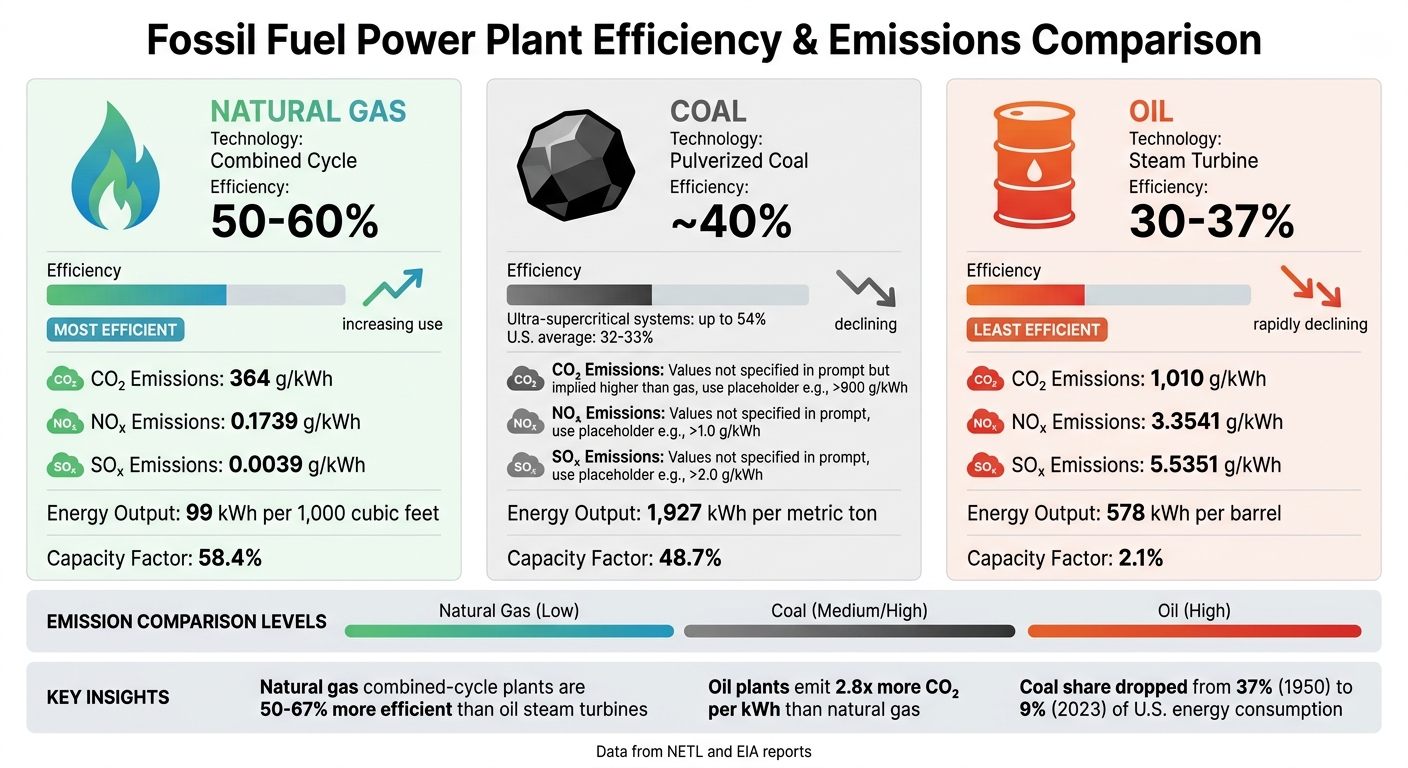
Fossil Fuel Power Plant Efficiency and Emissions Comparison: Coal vs Natural Gas vs Oil
Side-by-Side Efficiency Metrics
This section provides a direct comparison of efficiency and emissions across coal, natural gas, and oil power plants. Natural gas combined-cycle plants lead the pack, converting about 50–60% of fuel energy into electricity. Coal plants generally achieve around 40% efficiency, while oil-fired plants lag behind, with steam turbine systems reaching 30–37% efficiency. However, modern combined-cycle oil systems can improve slightly, achieving 40–45% efficiency. To put this into perspective, every 1,000 cubic feet of natural gas generates about 99 kWh, one metric ton of coal produces roughly 1,927 kWh, and one barrel of residual fuel oil yields approximately 578 kWh.
When it comes to emissions, the differences are stark. Natural gas combined-cycle plants emit about 364 grams of CO2 per kWh, while oil-fired steam turbines release a much higher 1,010 grams per kWh. Other pollutants, such as nitrogen oxides (NOx) and sulfur oxides (SOx), also vary significantly. For instance, natural gas combined-cycle plants emit just 0.1739 g/kWh of NOx and 0.0039 g/kWh of SOx, compared to oil-fired steam turbines, which emit 3.3541 g/kWh of NOx and 5.5351 g/kWh of SOx.
| Fuel Type | Technology | Efficiency | CO2 (g/kWh) | NOx (g/kWh) | SOx (g/kWh) |
|---|---|---|---|---|---|
| Natural Gas | Combined Cycle | 50–60% | 364 | 0.1739 | 0.0039 |
| Natural Gas | Steam Turbine | ~35–40% | 679 | 0.4669 | 0.0073 |
| Coal | Pulverized Coal | ~40% | Variable | Variable | Variable |
| Oil | Combined Cycle | ~40–45% | 480 | 1.7343 | 0.5719 |
| Oil | Steam Turbine | 30–37% | 1,010 | 3.3541 | 5.5351 |
Natural gas plants also benefit from lower operating costs. The Levelized Cost of Electricity (LCOE), which accounts for fuel costs, efficiency, and environmental compliance, tends to favor natural gas due to its higher efficiency and reduced emissions. These factors make natural gas a more competitive option compared to coal and oil.
How Efficiency Has Changed Over Time
The efficiency levels in the table above reflect years of technological advancements, particularly for natural gas and coal plants. Oil-fired systems, however, have seen little improvement, keeping them less efficient and less competitive.
Natural gas combined-cycle plants have made significant strides, with efficiency increasing from the low 40% range in the 1990s to 50–60% today. Coal plants have also improved, albeit more slowly. Modern pulverized coal plants with supercritical steam cycles now achieve around 40% efficiency, up from about 33% in older subcritical designs. The National Energy Technology Laboratory (NETL) has closely monitored these developments through assessments conducted in 2007, 2013, 2019, 2022, and 2025. These reports focus on metrics like Levelized Cost of Electricity (LCOE), Cost of CO2 Capture (CCC), and Cost of CO2 Avoided (CCA).
In contrast, oil-fired plants remain largely stagnant in efficiency. Many still rely on outdated simple-cycle designs, reinforcing oil's position as the least efficient fossil fuel for electricity generation. This lack of progress underscores oil's diminishing role in the modern energy landscape.
What's Next for Fossil Fuel Efficiency?
Right now, fossil fuel systems operate with efficiency rates ranging from 30% to 64%. But the future holds the potential to close that gap even further.
Possible Gains from Better Efficiency
Improving efficiency in fossil fuel systems could lead to lower fuel usage and fewer emissions, especially in coal plants, which currently trail behind natural gas in performance. One promising upgrade for coal-fired power is the Advanced Ultra-Supercritical (AUSC) steam cycle. These systems are built with materials that can handle extreme steam conditions - temperatures as high as 1,400°F and pressures of 4,250 psig, compared to the 1,100°F limit seen in most current supercritical plants. These higher operating temperatures directly translate to better fuel efficiency and reduced emissions per kilowatt-hour.
Natural gas plants are also poised for advancements. The next wave of "X-Class" combustion turbines is expected to push firing temperatures to an impressive 3,100°F, surpassing the limits of existing H-class and J-frame turbines. When paired with advanced bottoming cycles, these turbines could squeeze even more energy from the same fuel. However, for these technologies to become a reality, significant investment in research, development, and demonstration (RD&D) is essential. Without such funding, experts predict efficiency gains will stall through 2050.
These improvements lay the groundwork for even more transformative technologies aimed at making fossil fuel power cleaner.
New Technologies for Cleaner Fossil Fuel Power
Efficiency upgrades are just the beginning. Emerging technologies are paving the way for a cleaner future in fossil fuel energy.
Carbon capture and storage (CCS) systems are advancing quickly, with new designs targeting capture rates between 95% and 99%, far surpassing the traditional 90% benchmark. Next-generation post-combustion systems, particularly those using solvent-based technology, are addressing the energy challenges that have historically held CCS back. These newer systems have reduced the energy required for solvent regeneration by 30% and auxiliary power needs by 65% compared to current setups. Such advancements could help offset the efficiency losses caused by diverting steam for carbon capture.
Another leap forward comes from direct-fired supercritical CO2 (sCO2) cycles, like the Allam cycle. These systems replace steam with supercritical CO2 as the working fluid, allowing for smaller equipment and integrated carbon capture. Optimized sCO2 natural gas plants can achieve over 50% efficiency (on a higher heating value basis) while capturing more than 98% of CO2 emissions. However, these systems come with higher costs - 13% to 17% more than traditional natural gas combined-cycle plants with CCS - due to the expensive air separation units and sCO2 power blocks. For coal, semi-closed sCO2 cycles using CO2-based gasification can hit a net efficiency of 51.35% on a lower heating value basis.
Lastly, Natural Gas Fuel Cells (NGFC) present another exciting possibility. By using solid oxide fuel cell (SOFC) technology combined with steam Rankine cycles, these systems promise high efficiency through electrochemical energy conversion and nearly complete carbon capture. Commercial feasibility for NGFCs is expected by 2035. Similarly, technologies like AUSC coal plants and X-class turbines are projected to reach maturity around the same time, but only if there’s strong RD&D investment and successful demonstration projects.
Conclusion
Natural gas leads the way in power generation efficiency, followed by coal, with oil trailing behind. This efficiency hierarchy is reflected in the U.S. power sector's evolution. Coal's share of total energy consumption has plummeted from about 37% in 1950 to just 9% in 2023, while natural gas has surged to approximately 36% of total primary energy consumption as of 2024. Meanwhile, petroleum has largely faded from the electric power landscape due to its economic and technical shortcomings.
"The cost and performance of fossil fuel‐based generation technologies represented in this report are important inputs to assessments and determinations of technology combinations to be utilized to meet the projected demands of future power markets."
- National Energy Technology Laboratory (NETL)
These trends highlight the value of investing in advanced, efficient technologies. Upgrading plant efficiency not only reduces fuel expenses and emissions but also strengthens the practicality of carbon capture systems. Relying on thorough technical evaluations ensures better long-term outcomes for power generation.
For high-quality new and used power generation and distribution products that help optimize efficiency and manage costs, check out Electrical Trader.
FAQs
Why can’t power plants reach 100% efficiency?
Power plants will never reach 100% efficiency because of unavoidable thermodynamic constraints. During energy conversion - like transforming heat into mechanical energy - some energy is inevitably lost. Factors such as friction and heat dissipation further contribute to these losses, making them an inherent part of all power generation systems.
What’s the difference between LHV and HHV efficiency ratings?
When discussing energy efficiency in combustion systems, two terms often come up: Lower Heating Value (LHV) and Higher Heating Value (HHV).
- LHV focuses on the usable energy by excluding the energy lost as water vapor during combustion. This often leads to a higher efficiency rating because it disregards the latent heat of vaporization.
- HHV, on the other hand, accounts for the energy contained in the water vapor present in exhaust gases, assuming that the vapor condenses back into liquid form. While this approach results in a lower efficiency rating, it provides a more thorough measurement for specific calculations.
Understanding the distinction between these two can help in accurately evaluating energy performance.
How much does carbon capture reduce a plant’s efficiency?
Carbon capture systems can lower a power plant’s efficiency by approximately 8–10%. The extent of this reduction largely depends on the specific technology employed and the percentage of carbon being captured. Generally, aiming for higher capture rates tends to result in greater efficiency losses.