




Europe Energy Shift Lifts T&D Equipment Sales
If I buy transformers, switchgear, breakers, or cables, Europe matters to my lead times now. Demand from grid build-out, renewable tie-ins, and substation replacement is pushing the same global suppliers many U.S. buyers rely on.
Here’s the short version:
- Europe is adding grid capacity, and that pulls demand into power transformers, HV/MV switchgear, breakers, and cables
- Wind, solar, and HVDC projects can tighten supply months before equipment orders become public
- Power transformers are the biggest risk, with lead times often running 12–24+ months
- Switchgear is also under pressure, while cable pricing can move with copper and aluminum
- If I need gear on a short schedule, I may need to look at surplus or reconditioned equipment earlier
The market backdrop is hard to ignore. The global power T&D equipment market is projected to reach $327.28 billion by 2034, and Europe is expected to be the fastest-growing region at a 6.55% CAGR. That tells me this is not just a Europe story. It can hit U.S. pricing, stock, and project timing too.
What I’d watch first is simple:
- Grid expansion plans → more demand for HV cables, transformers, HVDC gear
- Renewable connection activity → more demand for MV switchgear, relays, distribution transformers, subsea cable
- Substation upgrades → more demand for replacement gear and digital control systems
Bottom line: I’d treat Europe’s utility spending plans and auction results as an early buying signal. If those signals point up, I’d lock in long-lead equipment before quotes climb and delivery windows slip.
Problem: Europe's energy transition is creating grid bottlenecks
Renewable growth is outpacing grid capacity
Europe’s shift toward renewable power is running into a hard limit: the grid isn’t keeping up.
The strain is already showing up in renewable curtailment, grid congestion, and delays in grid connection approvals. Many grids are old and need upgrades to reduce losses and move more renewable electricity.
That pressure is pushing up orders for high-voltage cables, medium-voltage switchgear, transformers, and circuit breakers. In plain terms, grid access now decides which projects can move ahead. In many cases, delays come from permitting and grid availability, not financing. And where do these bottlenecks appear first? In grid expansion, interconnection, and substation work.
How investment plans turn policy into equipment orders
EU targets don’t become purchase orders on their own. They turn into demand only when transmission operators and utilities approve spending. That’s why multi-year investment programs are the clearest near-term signal to watch.
A good example came in July 2026, when Montenegro’s transmission operator, CGES, announced a three-year infrastructure investment program to reinforce its subsea interconnector with Italy. The goal was to help position the country as a regional renewable exporter.
Programs like this often lead to orders for:
- High-voltage cables
- Transformers
- Interconnection equipment
For buyers, the clearest signals are spending plans tied to grid expansion, renewable interconnection, and substation budgets. Those plans are where policy starts to look like equipment demand.
sbb-itb-501186b
Solution: Read grid expansion and renewable interconnection as sourcing signals
Grid expansion points to high-voltage and medium-voltage demand
Published investment plans can work like a sourcing map. When you see interconnectors, HVDC projects, and domestic grid reinforcement, demand usually shows up first in transformers, HV/MV switchgear, HVDC systems, and protection relays. There’s also a compliance angle here. Equipment must match country-specific utility interconnection rules and grounding systems, and CE marking alone does not guarantee utility grid compatibility.
Examples like Siemens Energy's January 2026 transformer production expansion and Hitachi Energy's May 2026 investments in high-voltage infrastructure, transformer technologies, and HVDC systems point the same way.
Then the pattern shifts again at the connection point.
How wind and solar interconnection shifts equipment demand
Backbone grid buildout is only part of the story. The type of generation changes the equipment mix, too. If you track auction awards and operator plans, you can spot where wind and solar projects are likely to pull the next wave of grid-connection orders.
Large-scale wind tends to push demand toward high-voltage equipment. Utility-scale solar leans more toward medium-voltage switchgear, distribution transformers, and protection relays. Offshore wind also supports demand for cables and accessories, including subsea cables.
Türkiye's July 2026 announcement of a 2.4 GW renewable-energy auction, which includes new wind capacity, is a direct signal for upcoming grid-connection equipment demand in that region. Buyers who follow auction results like this can spot lead-time pressure on specific categories months before orders are placed.
In many cases, that connection demand appears first in substations.
Substation upgrades reveal replacement and modernization demand
For buyers, substation work is where replacement demand and modernization demand split into two different tracks. One is about old assets that need to be swapped out. The other is about adding digital control and new system functions.
Replacement demand comes from aging infrastructure - old switchgear, end-of-life transformers, and outdated protection systems that utilities need to replace to cut losses. Modernization demand comes from digitalization, IEC 61850 adoption, and the integration of battery energy storage systems (BESS) into existing nodes.
ABB's March 2026 investment in medium-voltage technologies and digital substation controls reflects this shift. When a TSO joins a balancing platform, it usually needs digital protection and control upgrades. That kind of regulatory milestone gives buyers an early read on modernization orders by voltage class and project scope.
| Equipment Category | Primary Demand Signal | Key Equipment Types |
|---|---|---|
| High-Voltage (HV) | Interconnectors, HVDC projects, large-scale wind | Power transformers, HV switchgear, HVDC systems |
| Medium-Voltage (MV) | Utility-scale solar, digital substation controls, smart grids | MV switchgear, distribution transformers, protection relays |
| Digital/Automation | IEC 61850 adoption, balancing platform entry | Monitoring equipment, smart meters, control devices |
| Cables & Accessories | Offshore wind, urban grid reinforcement | Cable accessories, insulated conductors, subsea cables |
POWER TALK #1 - Powering Europe’s future: delivering the EU grids package
How buyers can act on these signals when sourcing equipment
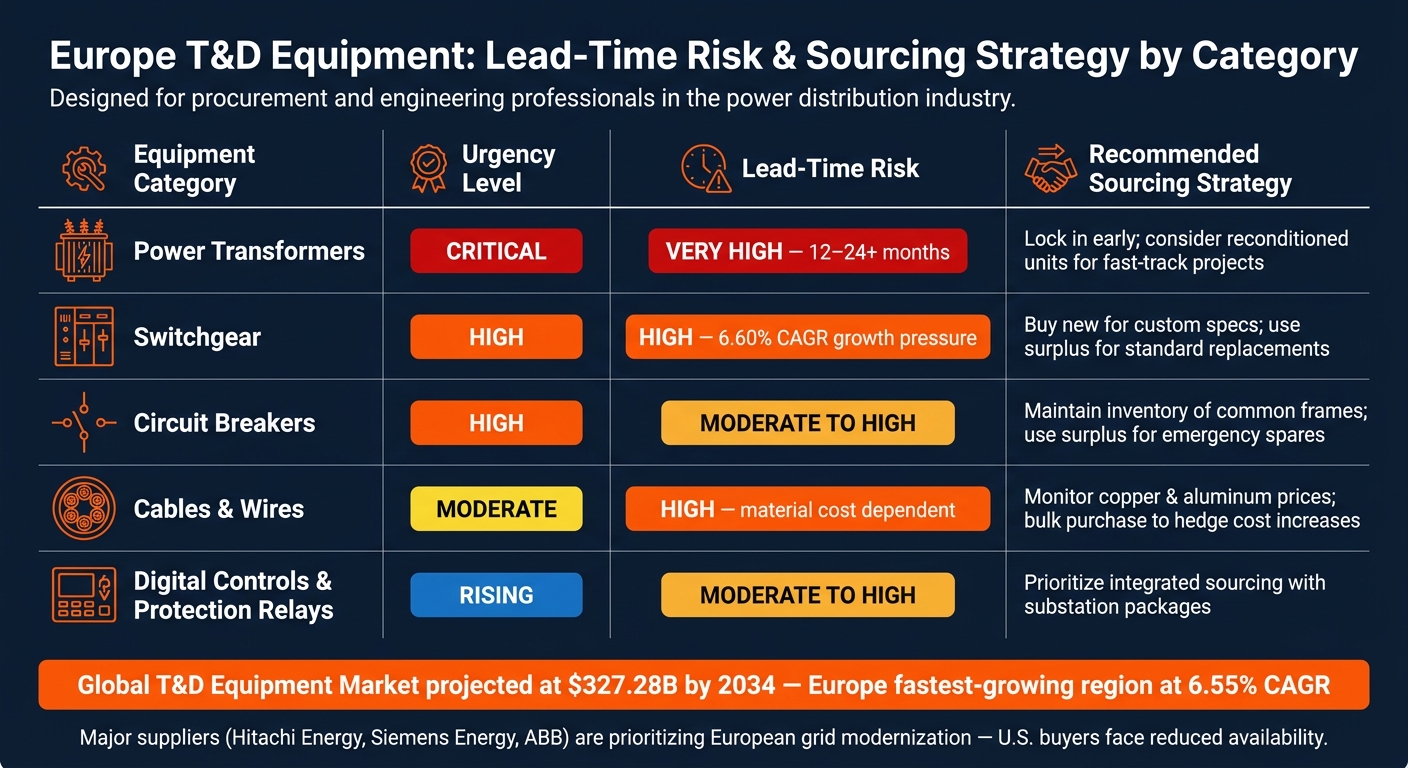
Europe T&D Equipment: Lead-Time Risk & Sourcing Strategy by Category
Match market signals to equipment categories and lead-time risk
European grid signals only matter if they change what you buy and when you buy it. That’s the point. If cross-border capacity pressure starts building, it can be a warning sign that supply may tighten for transformers and breakers.
Power transformers are at the top of the risk list. Lead times now stretch well past 12–24 months, which means early sourcing isn’t optional for many projects. At the same time, major manufacturers like Hitachi Energy, Siemens Energy, and ABB are putting heavy focus on European grid modernization, high-voltage infrastructure, and digital substations. That can leave less supply available for U.S. buyers.
Switchgear is under pressure too. It remains the main contributor to the T&D market by equipment type and is projected to grow at a 6.60% CAGR through 2034. When demand rises in that part of the market, buyers can feel the squeeze pretty fast.
It also makes sense to watch copper and aluminum prices alongside project announcements. Those materials shape the cost of cables, transformer windings, and conductors. If a wave of grid projects hits and metals move at the same time, equipment pricing can shift fast.
Use Electrical Trader to align purchasing with demand shifts
If factory delivery starts slipping, shift to surplus or reconditioned stock before your project dates are set in stone. Waiting too long can box you in.
When new-build lead times run longer than your schedule, go to the secondary market early. Electrical Trader offers categorized listings for new and used transformers, breakers, and low- to high-voltage equipment, including 3-phase transformers and substation transformers. For buyers who need verified surplus or reconditioned units faster than a factory build can deliver, that can help keep a project on schedule.
Sourcing priority table by equipment type
Use the table below to rank equipment by urgency, lead-time risk, and sourcing path.
| Equipment Category | European Demand Driver | Urgency | Lead-Time Risk | Sourcing Strategy |
|---|---|---|---|---|
| Power Transformers | Grid modernization & HVDC projects | Critical | Very High (12–24+ months) | Lock in early; consider reconditioned units for fast-track projects |
| Switchgear | Substation upgrades & renewable integration | High | High (major market contributor) | Buy new for custom specs; use surplus for standard replacements |
| Circuit Breakers | Grid reliability & aging infrastructure | High | Moderate to High | Maintain inventory of common frames; use surplus for emergency spares |
| Cables & Wires | Cross-border interconnections | Moderate | High (material dependent) | Monitor copper and aluminum prices; bulk purchase to hedge cost increases |
| Digital Controls & Protection Relays | Substation modernization and balancing services | Rising | Moderate to High | Prioritize integrated sourcing with substation packages |
Conclusion: The Europe signals that matter most for T&D equipment buyers
Europe’s project pipeline still points to tighter supply for high-voltage, medium-voltage, and protection equipment. The key is simple: spot the grid driver, tie it to the right equipment class, and buy before lead times get worse.
Cross-border interconnection projects point to near-term demand for high-voltage transformers and HVDC-related equipment. Substation modernization programs point to near-term demand for switchgear and circuit breakers. Aging infrastructure is another major signal because replacement cycles often center on transformers and switchgear. Renewable integration adds more pressure on grid capacity demand.
For buyers, these aren’t just market trends sitting in the background. They’re sourcing triggers.
Read Europe’s planning and funding signals early, map them to the equipment class with the longest lead time, and source before demand tightens. Electrical Trader lists new and used transformers, breakers, and other power distribution equipment.
FAQs
How can I spot Europe demand signals early?
Track Europe T&D demand through a few big drivers tied to the energy shift and grid buildout:
- EU decarbonization goals, including the SF6 phaseout
- Cross-border capacity projects such as HVDC converter stations
- Digital substation rollout using IEC 61850
There’s also a less flashy, but very real, driver in the background: aging-grid replacement.
Nearly 40% of distribution grids are over 40 years old. That matters because old infrastructure doesn’t wait politely. As equipment ages, utilities often have little choice but to replace parts, upgrade systems, and deal with reliability risks before they turn into outages. That can speed orders for replacement components.
Which equipment categories face the longest lead times?
The most exposed categories are large power transformers and GSU transformers. In some cases, lead times stretch to 210 weeks. That’s not a minor delay. It can push major grid and generation projects far off schedule.
High-voltage circuit breakers are also under heavy pressure, with lead times that can go beyond 150 weeks.
In Europe, the biggest choke points are specialized HVDC cables and subsea cables. These parts often take 5 to more than 10 years, which gives you a sense of just how tight supply is.
At the distribution level, the strain hasn’t gone away either. Distribution transformers and medium-voltage switchgear still come with waits of 44 to 100+ weeks, depending on the setup and local demand.
When should I consider surplus or reconditioned equipment?
Consider surplus or reconditioned equipment when OEM lead times are long, demand is high, or new equipment prices keep climbing. It can be a practical, budget-friendly choice when you need gear fast or you're working on a retrofit project.
To cut delays and keep capital spending in check, verify the equipment before installation. That should include dielectric testing, primary injection, and a documentation review to confirm current ratings and code compliance.





