Middle East & Africa Power Equipment Market Leaders
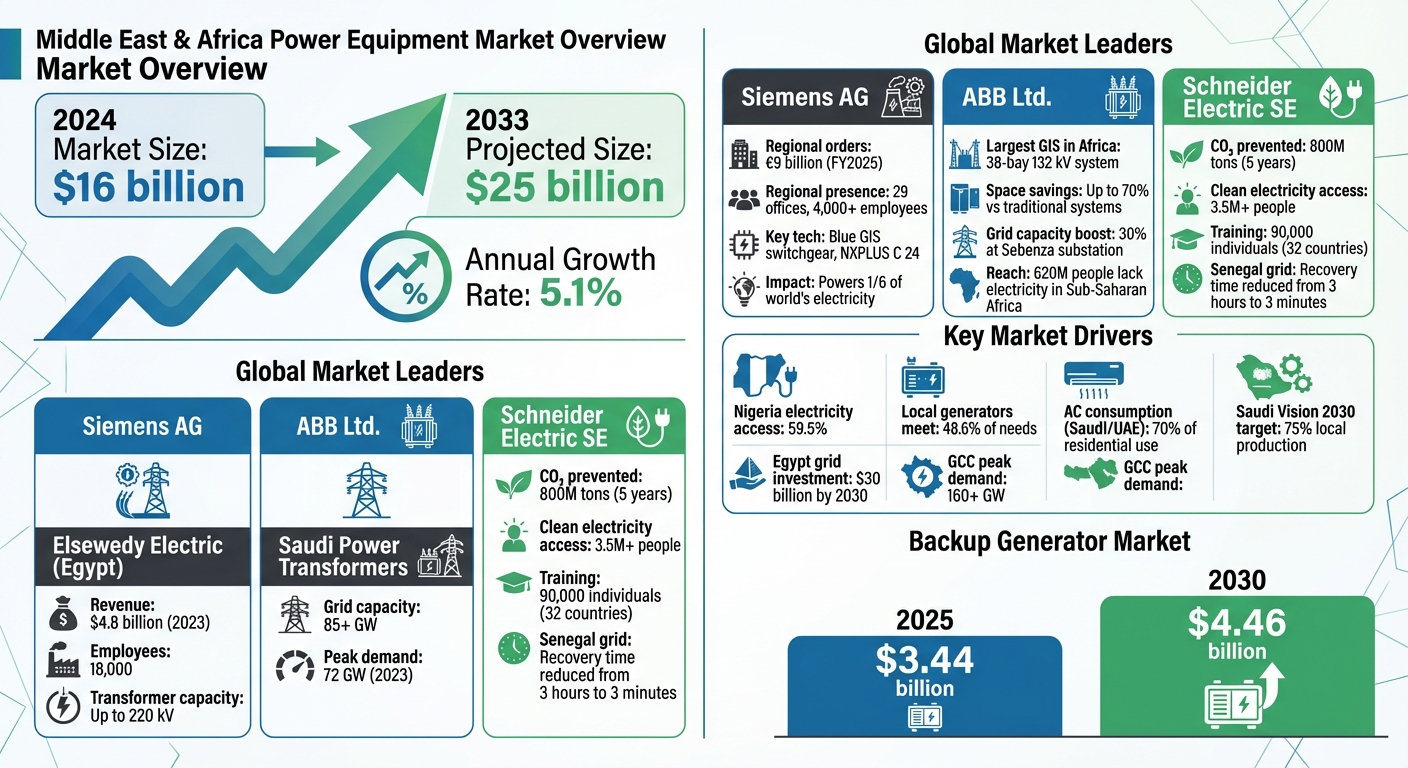
The Middle East and Africa's power equipment market is rapidly growing, driven by infrastructure projects, urbanization, and renewable energy targets. By 2024, the market reached $16 billion and is projected to hit $25 billion by 2033, with a 5.1% annual growth rate. Key factors include Saudi Arabia's NEOM project, Dubai's underground grid upgrades, and the region's push for renewable energy. Challenges like supply chain delays and oil price fluctuations persist, but demand for advanced transformers, switchgear, and circuit breakers continues to rise.
Major global players like Siemens AG, ABB Ltd., and Schneider Electric SE lead the market with cutting-edge technologies and regional investments. Siemens focuses on decarbonized solutions and smart grids, ABB excels in space-saving GIS systems and microgrids, while Schneider drives digital efficiency in national grids. Local companies such as Elsewedy Electric and Saudi Power Transformers address specific regional needs like extreme heat and localized manufacturing.
Success in this market hinges on addressing regional challenges, leveraging advanced digital tools, and participating in large-scale projects like Saudi Arabia's Vision 2030 and Egypt's $30 billion grid investment plan. The market's growth showcases the balance between global expertise and local solutions.
Middle East & Africa Power Equipment Market: Key Statistics and Leaders 2024-2033
Global Companies Leading the Market
Global companies have firmly established themselves in the Middle East and Africa by building regional operations, utilizing advanced technology, and leading ambitious projects. These firms supply critical transformers, switchgear, and circuit breakers that support the region's growing power infrastructure.
Siemens AG
Siemens has become a standout player in the region, thanks to its extensive regional presence. With 29 offices and over 4,000 employees across the Middle East and Africa, Siemens has cultivated a strong foothold. In fiscal 2025, the company reported €9 billion in regional orders, contributing to its €39.1 billion global revenue. Impressively, about one-sixth of the world's electricity is generated using Siemens Energy technologies.
Siemens covers the entire energy spectrum, from traditional power generation and transmission to renewable energy solutions like hydrogen and wind. In December 2025, the company appointed Hussein Shoukry as Managing Director for the region, aiming to accelerate energy diversification and strengthen localized supply chains. As energy demand surges, the Middle East focuses on diversified energy strategies, while Africa prioritizes reliable electricity access for millions.
Siemens also leads in cutting-edge technology with its "Blue GIS" medium-voltage switchgear, which uses F-gas-free "Clean Air" insulation with a near-zero Global Warming Potential. Its NXPLUS C 24 switchgear integrates digital controls and sensors, enabling smart grid operations and predictive maintenance. Over half of Siemens Energy's portfolio is decarbonized, aligning with regional goals like Saudi Arabia's Vision 2030.
ABB Ltd.
ABB has secured a strong position in Africa, particularly through its Gas-Insulated Switchgear (GIS) technology, which addresses space challenges in densely populated urban areas. For example, at Johannesburg's Sebenza substation, ABB installed a 38-bay 132 kV GIS system - the largest of its kind in Africa - boosting grid capacity by 30%. This GIS solution reduces installation space requirements by up to 70% compared to traditional air-insulated systems.
Mauro Damonte, ABB's Manager for High Voltage Products in the Middle East and Africa, highlighted the company's role:
"Our technology is powering one of the largest GIS installations in all of Africa and we are proud to support South Africa's development and the region's growing need for power."
Beyond urban centers, ABB addresses the energy gap in remote areas, where approximately 620 million people in Sub-Saharan Africa lack electricity. The company has deployed modular microgrid solutions, including one at its Johannesburg facility. This microgrid achieves up to 100% solar energy penetration during peak periods, stabilized by battery-based systems and managed through ABB's "Microgrid Plus" control system.
Schneider Electric SE

Schneider Electric has built a strong presence in Northern and Southern Africa, operating out of Dubai and serving key sectors. The company utilizes its EcoStruxure™ platform - an IoT-enabled system architecture - to deliver digital solutions across buildings, data centers, and industries.
In December 2025, Schneider completed a digital overhaul of Senegal's national grid, cutting power recovery times from three hours to just three minutes. This transformation saved 10 GWh annually, valued at around €21 million. Additionally, the company enhanced operations at Egypt's Al Galala Desalination Plant, improving efficiency and lowering emissions.
Over the past five years, Schneider's projects have prevented over 800 million tons of CO₂ emissions and brought clean electricity to more than 3.5 million people in the Middle East and Africa. The company has also trained 90,000 individuals in energy-related skills across 32 countries, including over 7,200 women in Africa, supporting the green energy transition. Walid Sheta, President of Schneider Electric's Middle East & Africa Zone, remarked:
"Sustainability is not a finish line; it's a shared journey."
In Egypt's Marsa Matrouh project, Schneider collaborated with Abu Dhabi Commercial Bank to provide clean water and solar energy to over 5,000 people, reducing CO₂ emissions by 40 tons annually. The company achieved a global sustainability score of 8.06/10 in Q2 2025 and was recognized by TIME and Statista as the world's most sustainable company in 2025.
These industry leaders highlight the key strategies and innovations shaping the power sector in the Middle East and Africa.
sbb-itb-501186b
Regional Companies in the Market
Regional manufacturers play a crucial role in addressing local market demands, offering solutions tailored to specific challenges like harsh climates and infrastructure limitations. In the Middle East and Africa, several companies have carved out strong positions by combining local expertise with strategic operations.
Elsewedy Electric
Elsewedy Electric, based in Egypt, stands out as a leading power equipment manufacturer in the region. Established in 1938, the company reported revenues of $4.8 billion in 2023 and employed around 18,000 people as of 2020. A key strength lies in its vertical integration, producing raw materials such as PVC compounds and copper rods, which helps maintain quality and control costs.
The company has strategically placed manufacturing facilities in Algeria, Ethiopia, Saudi Arabia, Zambia, and Qatar, ensuring efficient service to local markets. Facilities near major ports further reduce logistics expenses and improve delivery times. Early on, their transformer plant was designed to produce 6,000 units annually.
Elsewedy has also diversified its offerings to include wind energy, energy management, and Engineering, Procurement, and Contracting (EPC) services, aligning with the region's push for infrastructure and renewable energy projects. Acquisitions like Iskraemeco for smart metering (adding capacity for 3 million energy meters) and MTorres for wind energy technology have enhanced its capabilities. Partnerships with firms such as Southwire and Elastimold have expanded its technical expertise. The company now produces high-voltage transformers capable of operating at up to 220 kV, which are essential for national power grids. Similarly, companies like Saudi Power Transformers leverage local knowledge to meet the unique demands of regional grids.
Saudi Power Transformers Company
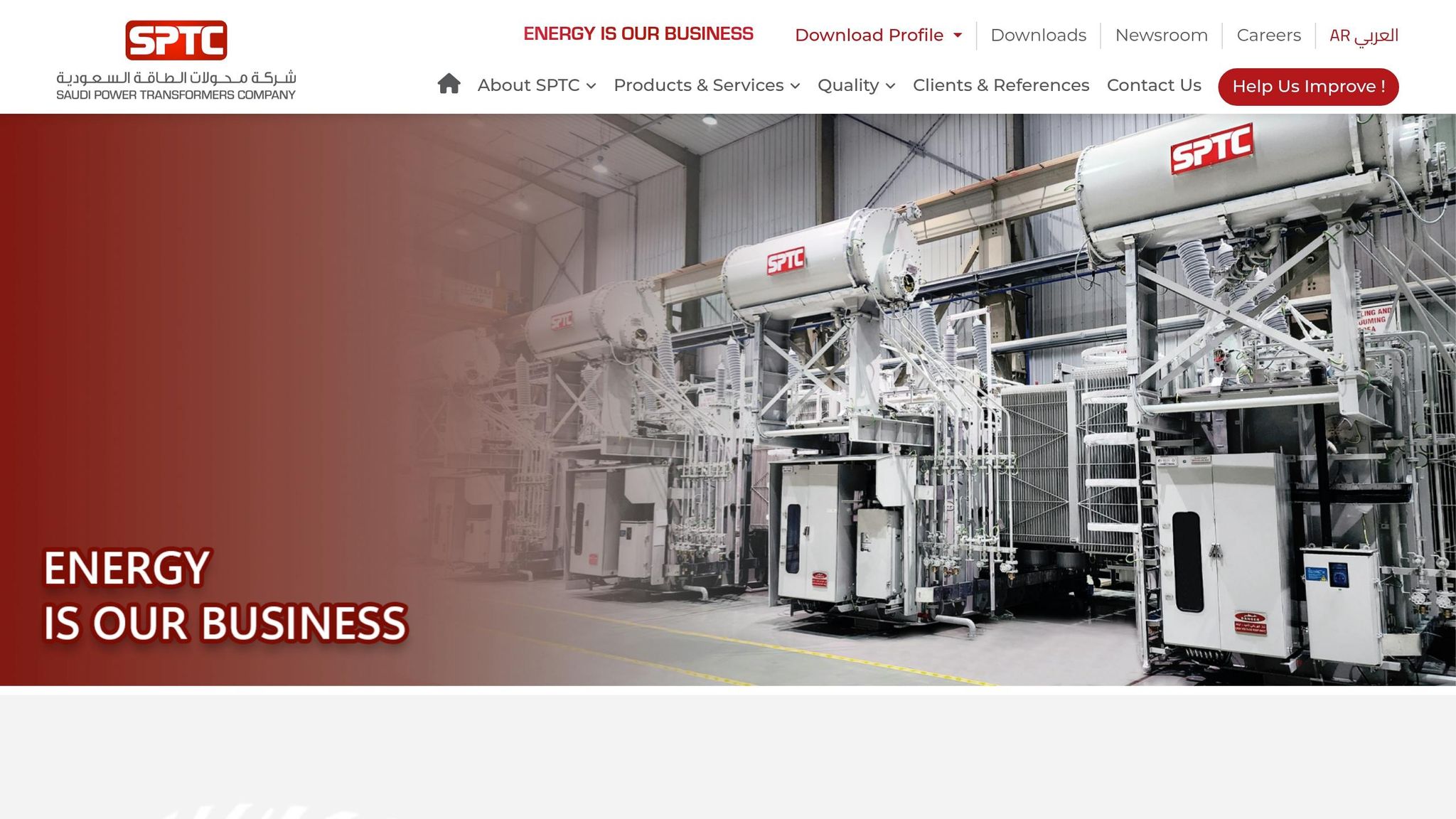
Saudi Power Transformers Company focuses on Saudi Arabia’s power infrastructure, supporting utilities like the Saudi Electricity Company, which manages over 85 GW of power generation with a peak demand of 72 GW in 2023. Their transformers are tailored to meet the country’s grid requirements and the modernization goals outlined in Vision 2030.
The company benefits from its deep understanding of local regulations and environmental conditions. For instance, in Saudi Arabia and the UAE, air conditioning accounts for nearly 70% of residential electricity consumption, highlighting the need for equipment that can handle extreme heat. Additionally, local production helps meet national content rules for large infrastructure projects.
Factors Determining Market Leadership
Success in the Middle East and Africa power equipment market depends on delivering solutions tailored to local needs, adopting advanced digital tools, and actively participating in transformative projects.
Meeting Regional Requirements
Market leaders in this region excel by addressing specific challenges. For example, in Nigeria, 48.6% of electricity needs are met by localized generators running on petrol, diesel, and gas due to unreliable utility services. With electricity access in Nigeria at just 59.5% as of 2021, manufacturers are focusing on backup power solutions, including hybrid generators that reduce dependence on traditional fuels.
Another challenge is the harsh operating environment. Equipment must endure extreme temperatures and conditions, which has led to the adoption of specialized materials like cross-linked polyethylene insulated (XLPE) aluminum cables and aerial spacer cables to enhance transmission efficiency. Additionally, navigating local content regulations is critical. For example, Saudi Arabia's Vision 2030 initiative aims to boost local energy sector production to 75% by 2030. Companies that establish regional manufacturing facilities position themselves to win large contracts in this market.
These localized strategies provide a foundation for integrating advanced digital technologies into grid management.
Technology Development
In addition to durable hardware, digital intelligence plays a growing role in grid optimization. Tools like advanced grid analytics and Dynamic Line Rating (DLR) enable operators to use real-time data - such as weather conditions and equipment performance - to safely increase power flow through existing infrastructure. AI-powered Digital Twin technology is another game-changer, allowing utilities to enhance reliability and efficiency without the cost and delays of building new infrastructure.
"The next decade of grid development will not be driven only by new hardware, but also by advanced software, data, and artificial intelligence." – ABB/Enline
Recent projects highlight this shift. In December 2022, Siemens AG and Saudi Electricity Co. signed contracts for smart grid projects, introducing advanced control centers and metering systems in Egypt and Saudi Arabia. The Saudi project alone was valued at $720 million. Similarly, ABB Electrification Ventures invested in Enline in March 2026 to scale AI-powered Digital Twin technology, following Enline's recognition in the 2024 ABB Startup Distribution Solutions Challenge.
This digital evolution strengthens companies' ability to secure contracts for large-scale infrastructure projects.
Participation in Large Projects
Active involvement in major infrastructure projects sets market leaders apart. For example, peak electricity demand in GCC countries exceeds 160 gigawatts, with air conditioning accounting for nearly 70% of residential energy use in Saudi Arabia and the UAE. Companies engaged in these large-scale projects not only achieve the production volumes needed for localizing technology but also build credibility for future tenders.
Key projects illustrate this trend. In 2023, Siemens Energy enhanced efficiency at Saudi Arabia's Qurayyah IPP, increasing its power output by over 1.2 GW. That same year, GE Vernova commissioned the world’s first HA-class gas turbine capable of running on 100% hydrogen at DEWA's M'Shereib power plant in Dubai. In October 2022, ACWA Power launched operations at the 1.5 GW Al Kharsaah Solar Power Plant in Qatar. These projects not only demonstrate technical expertise but also foster long-term relationships with national utilities. For instance, Egypt plans to invest $30 billion in its electricity grid by 2030, creating significant opportunities for companies with proven track records in large-scale projects.
Summary
The market's growth highlights a mix of global advancements and localized strategies.
Key players like ABB Ltd., Schneider Electric SE, Siemens AG, General Electric, and Eaton Corporation plc lead the regional switchgear market. They face competition from regional manufacturers such as Alfanar Group and Elsewedy Electric, who benefit from local expertise and closer customer connections. In the backup generator market - expected to grow from $3.44 billion in 2025 to $4.46 billion by 2030 - companies like Caterpillar Inc., Cummins Inc., and Atlas Copco AB deliver critical power solutions.
Staying ahead in the market requires addressing regional needs, adopting advanced technologies, and engaging in large-scale projects. Local manufacturing plays a key role by meeting content regulations and reducing supply chain delays. Innovations like SF6-free switchgear and digital tools enhance market stability, as utilities increasingly demand equipment for real-time monitoring and environmental standards compliance.
Market leaders excel by blending global expertise with regional customization. From modular switchgear designs and AI-driven grid analytics to cables built for harsh climates, companies that adapt to regional challenges - such as extreme weather, unreliable grids, and rapid urban growth - are better positioned to retain their leadership in this expanding market. These insights shed light on how businesses in the Middle East and Africa sustain their competitive edge.
FAQs
What power equipment types are driving growth in the region?
Transformers and medium voltage switchgear are playing a central role in the expansion and modernization of power distribution networks across the Middle East and Africa. These components are crucial for meeting the region's growing energy demands and ensuring a more reliable power supply.
How are renewables changing demand for transformers and switchgear?
Renewable energy is fueling a surge in demand for transformers and switchgear across the Middle East and Africa. With solar power making up more than 85% of the planned capacity growth, countries are focusing on modernizing infrastructure to support renewable energy integration. This includes investments in medium and high-voltage switchgear, as well as oil-type transformers known for their durability in challenging environments. These advancements are crucial for meeting the region’s renewable energy goals and adapting to its shifting energy landscape.
What should buyers watch for with extreme heat and supply delays?
Extreme heat in the Middle East and North Africa can challenge the reliability of power systems and slow down equipment availability. These conditions often lead to higher energy demand and put added pressure on supply chains. To minimize risks, buyers should take proactive steps such as planning in advance, keeping a close eye on supply conditions, and preparing backup strategies to handle delays or shortages caused by extreme weather.