

Edge Computing for Predictive Maintenance: Case Studies
Unexpected equipment failures cost manufacturers an average of $260,000 per hour. Combining edge computing and predictive maintenance tackles this issue by enabling real-time data processing and failure prediction directly on-site. This approach has led to:
- 75% fewer breakdowns and 45%-50% less unplanned downtime in industrial settings.
- Cost savings of 12%-30% on maintenance and reduced data storage expenses by over 90%.
- Faster responses, with anomaly detection in under 5 milliseconds, compared to seconds or minutes with cloud systems.
Key case studies include Siemens Electronics Factory, which reduced model retraining time by 80%, and a global automotive OEM, which cut downtime by 12% across 10,000 assets in just 12 weeks. These results highlight how edge computing enhances speed, lowers costs, and ensures reliable equipment monitoring.
Why it works: Edge computing processes data locally, avoiding cloud latency, reducing bandwidth costs, and maintaining functionality during internet outages. Predictive maintenance uses this data to detect early warning signs like vibration or temperature changes, preventing costly failures.
The article dives into real-world applications, tools like AI Inference Servers, and outcomes like Siemens' 4% productivity boost and 50% false call reduction. Whether for automotive factories, wind turbines, or logistics, edge computing proves to be a powerful solution for predictive maintenance.
Edge AI Predictive Maintenance for Motor Control
sbb-itb-501186b
Case Study: Siemens Industrial Edge in Automotive Manufacturing
In August 2025, the Siemens Electronics Factory in Erlangen, Germany, faced production delays due to manual 30-minute ML model retraining and GPU bottlenecks that hindered efficiency. Process Engineer Marvin Herchenbach spearheaded a project to integrate Siemens Industrial Edge with AWS cloud services to tackle these challenges.
Technology Used
To address the bottlenecks, the factory implemented a hybrid edge-cloud solution. SIMATIC S7-1500 PLCs handled high-speed control and real-time data processing, while SIMATIC IoT2040s served as edge computing devices. The system also utilized Armv9-based AI sensors to monitor key parameters like vibration, temperature, and energy usage in motors, conveyors, and actuators.
Three standout tools played a pivotal role in the transformation:
- The AI Inference Server performed image and sensor data analysis directly on the shop floor.
- The AI Model Manager enabled streamlined deployment and updates of models across thousands of devices without requiring extensive IT support.
- The AI Model Monitor tracked model performance and retrained models automatically when anomalies were detected.
For more resource-intensive machine learning tasks, shop floor images were uploaded to Amazon S3 for cloud-based training. Once trained, the models were deployed back to edge devices for real-time inference.
"We were running into GPU bottlenecks before deploying to cloud-based ML training on AWS." - Marvin Herchenbach, Process Engineer and Application Owner for Computer Vision, Siemens Electronics Factory Erlangen
Results and Benefits
The integration delivered immediate and measurable improvements. Retraining models now takes just 5 minutes, an 80% reduction from the previous 30-minute process, enabling faster responses to quality issues. The AI-driven error detection system cut the false call rate by over 50%, reducing the number of good products mistakenly flagged as defective. Productivity climbed by 4%, while routine inspections became automated, decreasing employee workload by 60%.
The financial benefits were equally striking. Data storage costs dropped by over 90% compared to the older on-premises system. Additionally, the system supported sustainability goals by minimizing scrap through early detection of process deviations and reducing power consumption per unit produced.
This case highlights the power of edge computing in predictive maintenance. For example, in April 2025, a global automotive OEM deployed Senseye Predictive Maintenance across 10,000 assets, including robotic welders and stamping machines, across four continents. Within just 12 weeks, they achieved a 12% reduction in unplanned downtime and received early warnings for several critical failures.
Case Study: SaM Solutions IoT Prototype with Toradex and Amazon Greengrass
In August 2018, SaM Solutions introduced a predictive maintenance prototype designed for DC brushless motors. Although the demonstration used a fan as a motor simulator, the technology was capable of identifying motor malfunctions even when cloud connectivity was slow or unreliable.
System Components
The prototype integrated Toradex hardware with AWS cloud technologies to create a dependable edge computing solution. At its heart was the Toradex Colibri iMX6ULL System on Module (SoM), powered by the NXP i.MX 6ULL processor, which handled local data analysis. The system also included the Toradex Aster Carrier Board, which connected vibration sensors and other hardware peripherals.
AWS IoT Greengrass brought AWS cloud functionality directly to the edge device, enabling the system to run AWS Lambda functions locally and perform machine learning predictions. To make the most of the hardware, AWS SageMaker Neo was employed, cutting the memory requirements of the ML model by up to 90% while doubling its execution speed. Vibration sensors collected high-frequency data from the motor, monitoring for signs of issues like bearing wear or imbalance.
Maintenance Improvements
This prototype showcased how edge computing systems can remain effective, even in environments with unreliable network connections.
The edge-based design revolutionized maintenance workflows. Instead of relying on scheduled maintenance routines, which often fail to catch critical failures between inspections, the system continuously monitored vibration data to identify anomalies in real time. If the ML model detected problems such as overheating or excessive vibration, it sent immediate alerts or adjusted machine settings to prevent production disruptions.
Case Study: Siemens Wind Turbine Optimization
In March 2019, Siemens Gamesa Renewable Energy introduced "Hermes", a digital solution designed to revolutionize wind turbine inspections and maintenance. By using autonomous drones and AI-powered edge computing, the company set an ambitious goal: to inspect 1,700 turbines within a year. This approach replaced the hazardous practice of sending technicians to rappel down turbines, especially in remote or offshore locations.
AI and Edge Computing Integration
Siemens combined Azure AI with autonomous drones capable of capturing 400 high-resolution images of turbine blades in just 20 minutes. The AI system then analyzed these images, accurately identifying real faults, such as cracks, while ignoring irrelevant issues like bird droppings or water marks. This eliminated the need for technicians to manually review hundreds of thousands of photos.
The edge computing setup was equally impressive. It utilized SIMATIC S7-1500 PLCs for fast control and SIMATIC IoT2040s for flexible, local data processing. This ensured reliable data handling, even in areas with poor connectivity. Armv9-based AI-powered sensors provided continuous monitoring of key metrics like vibration patterns, temperature changes, and energy consumption. These sensors enabled real-time adjustments to parameters such as load balancing and cooling cycles, ensuring optimal performance.
"The fact that we now can have the data going directly into Hermes with the cloud, without us having to carry hard drives, and having the data automatically sorted and stitched, saves us many people hours."
– Anne Katrine Karner-Gotfredsen, Manager of Product Integrity and Warranty Management, Siemens Gamesa
Performance Improvements
The integration of AI-powered image recognition drastically reduced the time needed to stitch drone photos into an accurate rotor model - from 4–6 hours to just 34 seconds. This shift from reactive to predictive maintenance led to a 35–50% reduction in unplanned downtime and a 70–75% decrease in equipment breakdowns. Additionally, by predicting equipment failures days or even weeks in advance, the system delivered a return on investment in less than three months.
Performance Metrics Across Case Studies
Edge Computing Predictive Maintenance Performance Metrics Across Industries
Results Comparison
A variety of organizations, ranging from mid-sized manufacturers to large multinational corporations, have reported measurable gains in reducing downtime, cutting costs, extending equipment life, and improving response times. These results align with earlier case studies, confirming that edge computing can consistently deliver fast responses and significant cost reductions. Here are some specific examples that highlight these achievements.
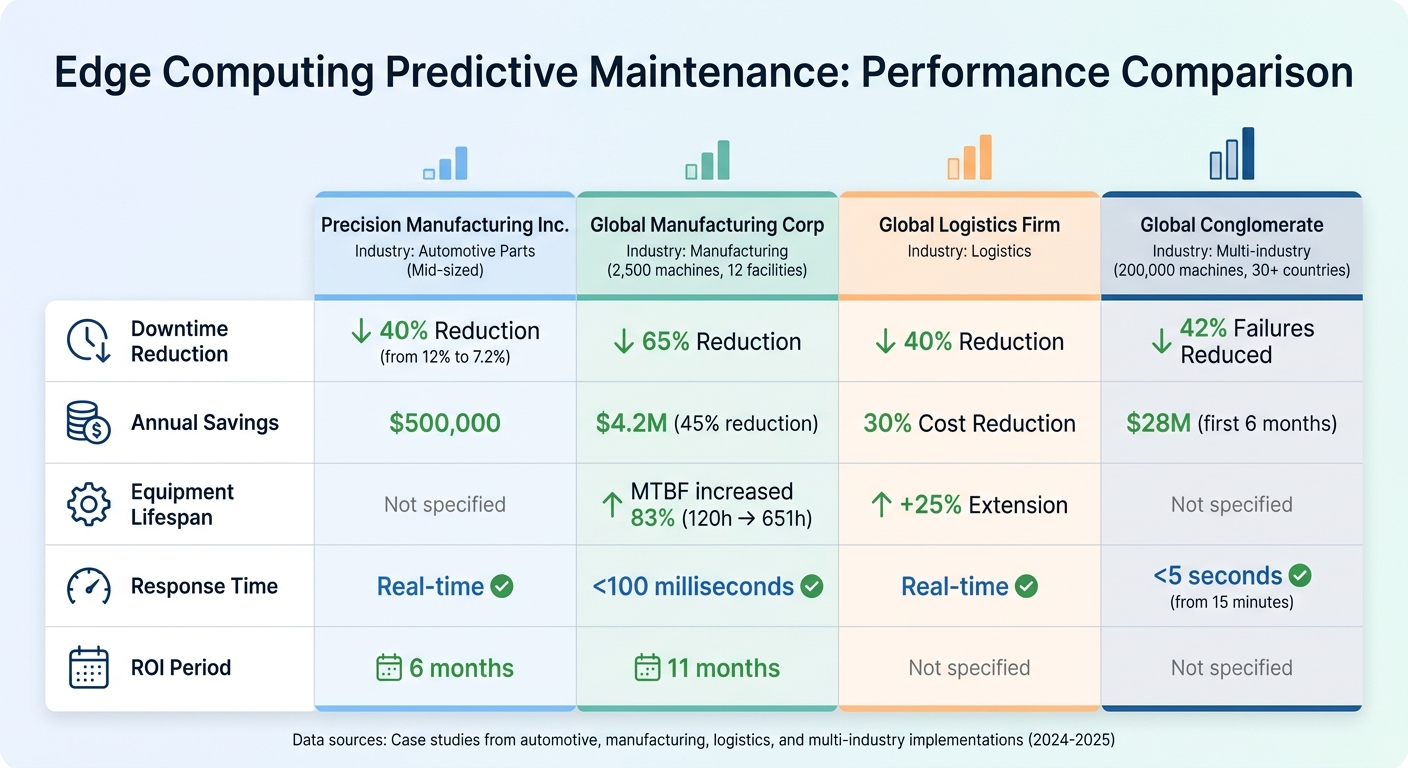
One of the most consistent benefits observed was downtime reduction. Take Precision Manufacturing Inc., a mid-sized automotive parts producer. Over a 12-month period starting in October 2024, they managed to cut unplanned downtime by 40%, dropping from 12% to 7.2%. Similarly, Global Manufacturing Corp achieved an impressive 65% reduction in downtime across 2,500 machines spread across 12 facilities by Q3 2024. Under the guidance of VP of Operations Michael Chen, their Mean Time Between Failures (MTBF) saw a remarkable jump of 83%, increasing from 120 hours to 651 hours.
The financial benefits scaled with the size of the implementation. Precision Manufacturing Inc. saved $500,000 annually, achieving a full return on investment within just six months. A global logistics company using Azure IoT Edge reduced maintenance expenses by 30% while extending equipment lifespan by 25%. On an even larger scale, a global conglomerate monitoring 200,000 machines across more than 30 countries saved an estimated $28 million annually within the first six months. This was made possible by slashing alert response times from 15 minutes to under 5 seconds.
Response speed emerged as a key factor for real-time operations. Michael Torres from Tesan AI highlighted that edge computing is critical because cloud latency alone cannot support real-time monitoring. Global Manufacturing Corp achieved local processing latencies of less than 100 milliseconds, while the global conglomerate’s edge system delivered alerts in under 5 seconds. These rapid response times allowed organizations to address up to 70% of potential equipment failures while optimizing spare parts inventory.
The data below summarizes these performance metrics, showcasing the impact of edge computing across different industries:
| Organization | Downtime | Annual Savings | Lifespan | Response Time | ROI Period |
|---|---|---|---|---|---|
| Precision Manufacturing Inc. | 40% | $500,000 | Not specified | Real-time | 6 months |
| Global Manufacturing Corp | 65% | $4.2M (45% reduction) | Not specified | <100 ms | 11 months |
| Global Logistics Firm | 40% | 30% cost reduction | +25% | Real-time | Not specified |
| Global Conglomerate | 42% (failures) | $28M | Not specified | <5 seconds | Not specified |
These numbers clearly illustrate how integrating edge computing with predictive maintenance strategies can lead to significant operational and financial benefits.
Conclusion
Main Findings
The case studies discussed in this article highlight how edge computing is transforming predictive maintenance across various industries. Companies have consistently reported major reductions in downtime and costs. Beyond financial benefits, organizations extended equipment lifespan by 20% to 40% and cut maintenance expenses by 12% to 18%.
On-site data processing played a critical role, reducing alert times from 15 minutes to under 5 seconds, which allowed for faster interventions. This capability, combined with the ability to function even during connectivity outages, proved vital for remote operations. For instance, during a pilot program in Kazakhstan, Delphisonic's DS-Track edge sensors prevented a locomotive bearing failure, saving an estimated US$75,000 in repair costs - all while operating in extreme temperatures ranging from -31°F to 113°F.
Rapid scaling was further validated by quick returns on investment. Precision Manufacturing Inc. achieved ROI in just six months, while Global Manufacturing Corp saw full returns within 11 months. CFO David Thompson summed it up well:
"The ROI exceeded our expectations. This isn't just about cost savings - it's about operational excellence".
Future Applications
The results achieved so far open the door to exciting possibilities. One of the most promising developments is the shift from predictive to prescriptive maintenance. Future systems will not only forecast potential failures but also recommend and even execute the best interventions based on real-time operational data and supply chain insights. Bhanu Handa, Lead Product Manager for Rugged Computing at Dell Technologies, elaborated:
"As edge AI becomes more sophisticated, predictive maintenance will evolve into prescriptive maintenance - systems will not only predict failures but also recommend and automate optimal interventions".
The integration of edge computing with emerging technologies is set to amplify its potential even further. For example, combining edge AI with private 5G networks will enable ultra-low latency, critical for autonomous factory systems. Federated learning, on the other hand, offers a secure way to update AI models across thousands of devices. Additionally, the use of robotics is gaining traction, where edge AI predictions can directly trigger automated maintenance tasks. These advancements promise to revolutionize operational efficiency and equipment reliability. For those looking to explore these innovations, Electrical Trader offers a wide selection of quality components to support such initiatives.
FAQs
What data should we process at the edge vs. send to the cloud?
In predictive maintenance, real-time sensor data - such as vibration, temperature, and pressure - is analyzed directly at the edge. This allows for instant fault detection and quick responses, like shutting down equipment, to prevent further damage or failures.
Meanwhile, aggregated or less urgent data, including maintenance logs or diagnostic reports, is sent to the cloud. The cloud handles resource-intensive tasks like model training and long-term trend analysis, striking a balance between speed and efficiency.
How do we deploy and update AI models across thousands of edge devices?
Deploying and managing AI models on thousands of edge devices requires systems that can scale and workflows that are well-organized. To make this process efficient, flexible architectures play a crucial role. They ensure that models perform well even in environments with limited resources.
One key advantage of edge computing is local data processing. By handling data directly on the device, latency is reduced, and bandwidth demands are minimized. At the same time, cloud-based systems complement this by enabling remote updates and retraining of models, keeping them current without the need for physical intervention.
For added efficiency and security, embedded solutions come into play. These systems integrate security measures directly into the devices, allowing for smooth model updates and ongoing improvements. This approach is particularly valuable for applications like predictive maintenance, where consistent optimization is essential to ensure reliability and performance.
What connectivity, security, and power requirements do edge setups need on the shop floor?
Edge setups on the shop floor demand fast, low-latency connectivity using technologies like industrial Ethernet or wireless protocols. They also require strong security measures, such as compliance with IEC 62443-4-2 standards, and reliable power sources like 24V DC or Power over Ethernet (PoE). Additionally, these setups must be built to withstand common shop floor challenges, including electromagnetic interference, fluctuating temperatures, and limited space, ensuring they operate consistently and securely in predictive maintenance scenarios.