




Construction Calibration: Key Compliance Standards
Accurate calibration is critical in construction for safety, compliance, and cost management. Without it, measurement errors can compromise project quality, safety, and lead to costly rework or audit penalties. Key takeaways include:
- Why Calibration Matters: Tools like multimeters and insulation testers naturally lose accuracy over time. Annual drift rates range from 0.1%-0.5% for premium tools to 2%-5% for budget ones. Uncalibrated tools risk safety and project reliability.
- Compliance Goals: Calibration ensures traceability to national standards (e.g., NIST) and defensibility in audits or legal reviews. Intermediate checks between annual calibrations can catch issues early.
- Standards to Follow: Key frameworks include ASTM, IEEE, AASHTO, ISO/IEC 17025, and UL standards. These ensure precise measurements and adherence to regulatory requirements.
- Critical Equipment: Instruments like multimeters, load cells, and inspection tools must follow strict calibration schedules to maintain accuracy and compliance.
- Documentation: Proper calibration records must include lab details, traceability, measurement uncertainty, and "as-found" and "as-left" conditions. Missing records can invalidate compliance.
Avoid common risks like expired calibration stickers, unqualified labs, and firmware updates post-calibration. Regular checks, accredited providers, and a well-documented process ensure compliance and prevent costly errors.
Construction Quality Failing ? Check Your Instrument Calibration First
sbb-itb-501186b
Core Standards for Construction Calibration
In the U.S. construction industry, calibration standards play a critical role in ensuring precise measurements and maintaining project safety. These standards vary depending on the project type and regulatory requirements, collectively creating a reliable calibration framework.
ASTM and IEEE Standards

ASTM International provides technical standards for materials testing in construction. Meanwhile, IEEE C57.13.10-2025 focuses on calibration procedures for energized current transformers used in power systems up to 34.5 kV AC. This standard specifies the requirements, testing methods, and result documentation needed to guarantee accuracy and regulatory compliance.
AASHTO Requirements
The American Association of State Highway and Transportation Officials (AASHTO) defines calibration protocols for highway and transportation construction projects. AASHTO mandates that laboratories use calibrated equipment and maintain detailed documentation. These requirements are strictly enforced on federally funded road and bridge projects, ensuring that every test directly contributes to safety and quality at the construction site.
ISO/IEC 17025 and Laboratory Competence
ISO/IEC 17025:2017 sets the global standard for testing and calibration laboratories. It outlines the requirements for technical expertise, impartiality, and consistent operations. Last reviewed in 2023, this standard remains aligned with modern laboratory practices. One of its standout features is its risk-based approach, which requires laboratories to identify and mitigate risks that could jeopardize the reliability of their results.
"ISO/IEC 17025 enables laboratories to demonstrate that they operate competently and generate valid results, thereby promoting confidence in their work both nationally and around the world." - ISO
Construction firms should ensure their calibration service providers are accredited to ISO/IEC 17025. This guarantees that lab results will hold up under audits or legal scrutiny. Additionally, the requirement for NIST traceability further strengthens the reliability of calibration data.
NIST Traceability
NIST traceability ensures that calibration results are linked to national or international standards through an unbroken chain of calibrations. This process must include a clearly defined measurement uncertainty to confirm the results are appropriate for their intended use. According to NIST:
"Metrological traceability requires the establishment of an unbroken chain of calibrations to specified reference standards: typically national or international standards, in particular realizations of the measurement units of the International System of Units (SI)."
When working with a calibration provider, always request both the traceability certificate and the stated measurement uncertainty.
UL Calibration Standards

UL standards focus on the safety and performance of electrical equipment used in construction. For on-site testing or verification of items like circuit breakers, transformers, and distribution panels, it’s essential that the instruments used are properly calibrated. UL standards not only ensure the functionality of electrical components but also align with broader industry calibration practices. When sourcing electrical components - whether new or used - contractors should verify that they meet the necessary UL standards. For further guidance on compliant electrical components, contractors can explore resources like Electrical Trader.
Equipment That Requires Calibration in Construction
Calibration plays a key role in ensuring safety, quality, and compliance on construction sites. Certain equipment, especially those involved in measurements critical to these areas, must undergo regular calibration. This equipment generally falls into two main categories: measurement and testing instruments and inspection and verification tools.
Measurement and Testing Instruments
These tools are designed to measure electrical or physical values such as voltage, current, load, and resistance. Common examples include multimeters, clamp meters, load cells, and high-voltage test sets. Precision is especially important in high-power or high-voltage environments.
OSHA emphasizes the importance of inspecting test instruments before every use. As OSHA notes:
"If there is a defect or evidence of damage that might expose an employee to injury, the defective or damaged item shall be removed from service."
For field testing, particularly when trailers or vehicles are involved, chassis grounding is required to protect workers from hazardous touch potentials. Operators must ensure barriers are intact and ground connections are secure before performing high-voltage tests.
When a device falls out of tolerance, it casts doubt on all subsequent measurements. This highlights the importance of adhering to calibration schedules. While annual calibration is common, some processes might demand more frequent checks to maintain accuracy.
Inspection and Verification Tools
Unlike high-voltage instruments, inspection and verification tools are primarily used for routine quality assessments. These include items like pull boxes, signal heads, LED luminaires, controller cabinets, and service equipment enclosures, which are often found in roadway, traffic, and infrastructure projects.
Compliance for these tools is typically managed through manufacturer-provided test data and Certificates of Compliance, rather than frequent recalibration. For example, pull boxes require load-rating test reports, while LED modules and signal heads need quality control data to verify performance standards.
Before installing equipment on federally funded projects, ensure items like LED luminaires and controller cabinets are listed on the Authorized Materials List (AML). Many of these components undergo source inspections at the manufacturer’s facility, but proper documentation - such as wiring diagrams, maintenance manuals, and installation instructions - should still be collected and securely stored for audits. Keeping accurate calibration and quality control records is essential for maintaining compliance across the board.
Maintaining Compliance Through Documentation
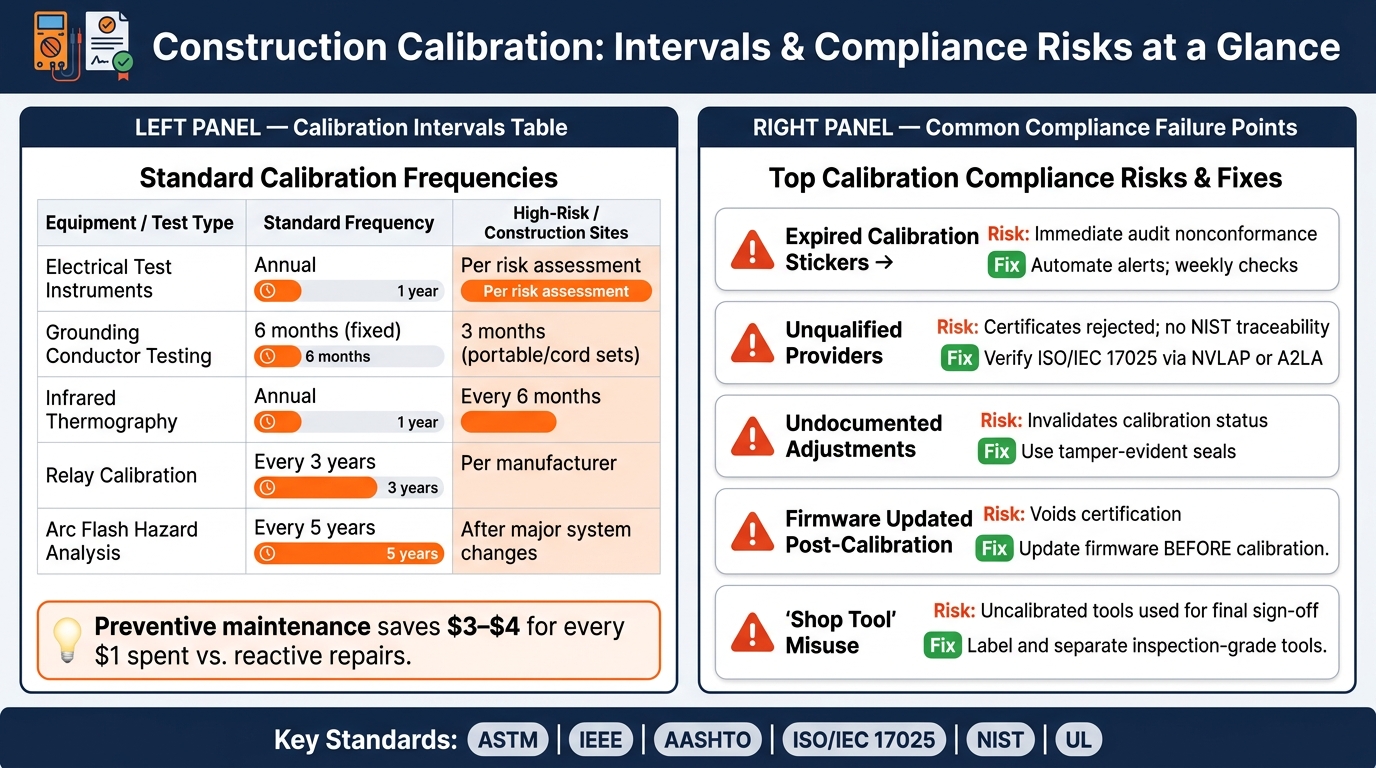
Construction Calibration Intervals & Compliance Risks Quick Reference
Calibration isn’t just about the process - it’s about the proof. Without proper documentation, calibration efforts lack the credibility needed to stand up during audits, regulatory reviews, or even legal disputes. Documentation transforms calibration into a compliance record, directly supporting the standards and practices outlined earlier.
Key Documentation Requirements
Every calibration record must include certain critical details:
- The laboratory's identification
- A unique certificate number
- Measurement results with units
- Stated measurement uncertainty
- A traceability statement linking the calibration to national standards like NIST
Additionally, records should document both as-found and as-left conditions. This means noting the tool's state before any adjustments (as-found) and after adjustments are made (as-left). This is especially important when a tool is found out of tolerance, as the as-found data determines whether earlier measurements taken with that tool need to be reviewed or recalled.
As Chuck Meredith, President of F. D. Hurka Metrology, explains:
"Proper calibration documentation protects your organization during audits, product recalls, and legal disputes."
Another essential detail is the use of tamper-evident labels on tools, which must match the entries in your master equipment register. Any mismatch between the label and the register is a red flag for auditors. Accurate and thorough records also help establish reliable calibration intervals.
Calibration Intervals
The frequency of calibration depends on several factors, including the type of equipment, how often it is used, and the conditions in which it operates. For example:
- Electrical test instruments like multimeters typically require annual calibration.
- Portable cord sets and receptacles under an assured equipment grounding conductor program need testing every 3 months.
- Fixed equipment not exposed to wear or damage can extend to 6 months.
Here’s a quick reference table for standard calibration intervals:
| Equipment/Test Type | Standard Frequency | High-Risk/Construction Sites |
|---|---|---|
| Electrical Test Instruments | Annual | Per risk assessment |
| Grounding Conductor Testing | 6 months (fixed) | 3 months (portable/cord sets) |
| Infrared Thermography | Annual | Every 6 months |
| Relay Calibration | Every 3 years | Per manufacturer |
| Arc Flash Hazard Analysis | Every 5 years | After major system changes |
It’s worth noting that preventive maintenance is a smart investment. Studies show it saves $3–$4 for every $1 spent compared to reactive repairs. So, a well-planned calibration schedule not only meets compliance requirements but also makes financial sense.
Audit Readiness
Auditors often begin their inspections on the shop floor, looking for expired calibration stickers. From there, they trace tools through the equipment register and calibration certificates, searching for any gaps in records. If a tool doesn’t have a valid certificate, it’s automatically considered non-compliant - even if it’s functioning properly.
"A gauge that works perfectly but has no certificate is indistinguishable from a gauge that's been reading wrong for months. That's why the record matters as much as the calibration itself." - The Standards Navigator
To ensure audit readiness, maintain a centralized equipment register with unique IDs, calibration due dates, and current tool locations. This system helps track tools and prevents expired calibrations from slipping through the cracks. Combine this with a proactive schedule that flags upcoming expirations in advance.
It’s also crucial to have a documented out-of-calibration (OOT) response process. This ensures your team knows exactly how to handle tools found out of tolerance, including assessing the impact on any work completed with those tools. These practices tie directly into your overall calibration strategy, keeping compliance and safety at the forefront.
Common Compliance Risks and How to Address Them
Even well-run operations can encounter calibration compliance issues, often stemming from avoidable gaps within the organization.
Typical Failure Points
One of the most obvious red flags is expired calibration stickers, which signal nonconformance during audits. Another critical issue arises when companies use calibration providers that lack accreditation. If a lab isn't certified under ISO/IEC 17025, its certificates may be outright rejected because they fail to establish traceability back to NIST.
Field equipment presents additional challenges. For instance, firmware updates after calibration can alter constants, rendering the certification invalid. Similarly, placing test instruments near electromagnetic sources like Variable Frequency Drives (VFDs) can lead to corrupted readings. As Techmaster Electronics puts it:
"Inaccurate readings from an uncalibrated device are often more dangerous than no readings at all, as they provide a false sense of security while your infrastructure suffers from harmonic distortion or transient voltages."
Another overlooked risk is misusing "shop tools" - tools meant for layout or setup being used for final inspections without ensuring they're part of the calibration register. This compromises the reliability of final sign-offs.
| Failure Point | Risk | Fix |
|---|---|---|
| Expired calibration stickers | Immediate audit nonconformance | Automate alerts; conduct weekly checks |
| Unqualified providers | Certificates rejected; no traceability | Check ISO/IEC 17025 accreditation via NVLAP or A2LA |
| Undocumented adjustments | Invalidates current calibration status | Use tamper-evident seals on adjustment points |
| Firmware updated post-calibration | Shifts calibration constants; voids certification | Update firmware before calibration |
| "Shop tool" misuse | Uncalibrated tools used for final sign-off | Label and separate inspection-grade tools |
Addressing these issues requires a mix of strict provider standards and disciplined practices on-site.
Preventive Measures
To maintain compliance and ensure accurate measurements, proactive prevention is key. Start by carefully selecting your calibration provider. Always verify that the lab holds ISO/IEC 17025 accreditation - this is essential for traceability under ISO 9001 and most federal construction standards. For electrical test instruments used frequently on active job sites, consider a 6-month calibration cycle instead of the standard 12 months.
Small, consistent field practices also help. For example, performing a "Zero" or "Null" calibration on current clamps before measuring three-phase systems helps mitigate magnetic interference. Avoid tightly coiling or kinking voltage leads and current clamps, as this can compromise probe integrity and measurement accuracy. Additionally, storing diagnostic tools at 40–60% battery charge can prevent internal voltage-related issues.
Lastly, have a written Out-of-Tolerance (OOT) response protocol in place. If a tool is found out of calibration, this protocol should ensure the equipment is quarantined immediately and trigger an impact assessment for all measurements taken since its last valid certification. Without such a process, a single failed calibration could create widespread compliance issues across an entire project.
Conclusion and Key Takeaways
The Role of Compliance Standards in Construction Calibration
In construction, calibration compliance ensures that measurement data remains reliable throughout a project. Organizations like ASTM, AASHTO, ISO/IEC 17025, NIST, and UL collectively create a system of accountability that supports this reliability.
ISO describes ISO/IEC 17025 as "the international standard for testing and calibration laboratories. It sets out requirements for the competence, impartiality, and consistent operation of laboratories, ensuring the accuracy and reliability of their testing and calibration results." This accuracy is crucial for meeting compliance requirements in DOT projects, FHWA contracts, and third-party audits.
However, ISO/IEC 17025 accreditation does not replace AASHTO re:source accreditation, which is specifically required for transportation and highway projects. This distinction is especially critical for federal projects involving DOT and FHWA standards. Joe Moser, CEO of Accredited Labs, clarifies this point:
"ISO 17025 accreditation does not automatically confer AASHTO accreditation. The two are related but not interchangeable."
This interconnected framework requires constant attention and updates to maintain compliance and ensure accurate practices.
Keeping Calibration Practices Current
Calibration practices must evolve alongside changing standards. While ISO/IEC 17025:2017 remains the current benchmark as of 2023, ISO periodically reviews and updates its standards. Staying informed about these changes is essential.
Regularly verify your calibration provider's accreditation scope - not just at the start of a contract. Use the AASHTO re:source directory to confirm that the provider's scope matches your specific equipment needs. Additionally, review certificates for NIST traceability, measurement uncertainty data, and the proper accreditation body logo. Relying solely on expiration dates can leave gaps in compliance. As Joe Moser points out:
"A gap in the compliance chain can call prior test results into question, since calibration records are used to demonstrate equipment performance over time."
Proactively identifying and addressing these gaps can save you from costly issues down the line.
FAQs
How do I verify a calibration lab is ISO/IEC 17025 accredited for my exact tool?
To verify that a calibration lab is accredited to ISO/IEC 17025 standards for your tool, start by examining their calibration certificate. Look for the official accreditation body logo on the certificate. It should also clearly mention compliance with ISO/IEC 17025, name the accrediting organization, include the lab’s accreditation number, and confirm that the service is within their accredited scope. For extra assurance, you can contact the accrediting body directly to confirm the lab’s scope and ensure your specific tool is covered.
What should we do if a tool is found out of tolerance after a job is completed?
If a tool is discovered to be out of tolerance after completing a task, it’s crucial to evaluate whether earlier measurements were compromised. Pinpointing when the tool began to deviate from its calibrated state is essential, as any measurements taken since its last calibration might be inaccurate. Depending on the seriousness of the issue, corrective actions could involve re-checking or even redoing the work. This is particularly critical in high-stakes areas like nuclear safety or manufacturing, where such errors might lead to recalls or other significant consequences.
Does NIST traceability alone satisfy DOT/FHWA calibration requirements?
While being traceable to NIST standards guarantees precise measurements, it does not satisfy DOT or FHWA calibration requirements on its own. FHWA requires that testing laboratories working on highway projects be accredited by AASHTO or an FHWA-approved program. Beyond that, state quality assurance programs must incorporate regular equipment assessments, such as calibration checks or proficiency testing, to ensure adherence to project specifications.





