




How to Conduct Ex Equipment Inspections Safely
Ex equipment inspections are critical for ensuring safety in explosive environments. Faulty installations or maintenance can lead to catastrophic incidents. Here's what you need to know:
- Ex Equipment: Designed to prevent ignition in hazardous zones with explosive gases, vapors, or dust.
- Failure Rates: 40% of newly installed Ex equipment fails inspections due to errors like incorrect cable glands or missing blanking plugs.
- Inspection Types: Visual (basic checks), Close (detailed external checks), and Detailed (internal component checks).
- Preparation: Gather documentation like the Explosion Protection Document (EPD) and equipment certifications.
- Tools & PPE: Use intrinsically safe tools, torque wrenches, and flame-resistant clothing to ensure safety.
- Compliance: Follow standards like IEC 60079-17 and ATEX 1999/92/EC, and maintain accurate records for audits.
Regular inspections prevent risks caused by corrosion, vibration, or improper installation. Prioritize safety by following structured inspection steps and adhering to compliance standards.
What is Ex Equipment and How Are Hazardous Zones Classified?
Ex Equipment Defined
The term "Ex" refers to equipment specifically designed to prevent ignition in explosive environments. As HAZATEX explains:
The Ex rating isn't merely a label; it's a commitment to high safety and reliability in hazardous settings.
Ex-rated equipment incorporates safety mechanisms like intrinsic safety (Ex i), which limits energy levels, and flameproof enclosures (Ex d), which contain potential explosions. These devices meet stringent standards, such as IEC 60079 and ATEX 2014/34/EU. The goal is to ensure they don't produce sparks or excessive heat - two key factors that could ignite a catastrophic explosion in high-risk environments like chemical plants, refineries, grain elevators, or mines.
Grasping this design philosophy is crucial before diving into how hazardous zones are classified.
How Hazardous Zones Are Classified
Hazardous zones are categorized based on how often explosive atmospheres occur and how long they persist. These classifications play a key role in determining the type of Ex equipment required.
For gases and vapors, zones are divided into Zone 0, Zone 1, and Zone 2, while for dusts, they are classified as Zone 20, Zone 21, and Zone 22.
- Zone 0/20: Represents the highest level of risk, where explosive atmospheres are present continuously or for more than 1,000 hours per year (over 10% of the time).
- Zone 1/21: Covers situations where explosive conditions are likely during normal operations, occurring between 10 and 1,000 hours annually (0.1% to 10% of the time).
- Zone 2/22: The lowest-risk category, where explosive atmospheres are rare and, if they occur, last less than 10 hours per year (under 0.1% of the time).
The classification of these zones determines the level of protection required from Ex equipment. Equipment is assigned an Equipment Protection Level (EPL):
- Ga/Da: Suitable for Zone 0/20.
- Gb/Db: Designed for Zone 1/21.
- Gc/Dc: Rated for Zone 2/22.
Importantly, equipment rated for higher-risk zones can be used in lower-risk areas, but the reverse is not allowed. Additionally, all Ex equipment is rigorously tested to ensure its surface temperature stays below 80% of the autoignition temperature of the hazardous materials in the environment. This ensures maximum safety in any classified zone.
sbb-itb-501186b
How to Prepare for Safe Inspections
Gather Documentation and Certifications
Before stepping into a hazardous area, it's crucial to have all the necessary documentation ready. Start with the Explosion Protection Document (EPD), which is required under ATEX 1999/92/EC. This document includes essential details like zone classification drawings, criteria for equipment selection, and maintenance schedules. Another key resource is the Ex Register, which lists all installed Ex equipment along with their certification details. Additionally, ensure you have the manufacturer's Operations & Maintenance (O&M) manuals for each piece of equipment, as they outline specific installation and maintenance requirements.
Pay close attention to ATEX/IECEx equipment certificates. If you notice an "X" suffix on the certificate number, it’s a red flag - this signifies specific conditions for safe use that must be carefully verified before proceeding. Fraser Heggie, Chief Technical Officer at EUTEX International, emphasizes:
Unless you know the intended use and limits of equipment you do not know if the installed equipment is suitable for safe/compliant use!
For intrinsically safe (IS) systems, make sure to have Descriptive System Documents on hand. These are critical for confirming that system parameters stay within safe operational limits.
Assess the Hazardous Environment
Once your documentation is in order, the next step is to evaluate the hazardous environment itself. Begin by confirming the zone classification - whether it’s Gas Zone 0, 1, or 2, or Dust Zone 20, 21, or 22. Determine the gas or dust group as well. For example, Group IIC gases have the lowest ignition energy, which means they require equipment with stricter ratings.
Check that the equipment’s T-rating matches the autoignition temperatures in the area. If the ambient temperature regularly exceeds 104°F (40°C), be cautious - equipment surface temperatures might surpass their certified T-class, increasing the risk of ignition.
Lastly, evaluate the Ingress Protection (IP) rating based on the levels of moisture and dust present. Don’t just consider normal operating conditions - factor in cleaning processes to decide if an IP54 or IP66 rating is adequate. Before opening any enclosures, always secure a gas-free certificate and a hot work permit.
Ex Inspections – Understanding what Ex inspectors are looking at (20-03-2025)
Required Tools and Safety Equipment
When working in hazardous environments, using the right tools and protective gear is essential to ensure safe and effective inspections.
Inspection Tools You'll Need
The tools you'll need depend on the level of inspection being performed. For basic visual inspections, a reliable intrinsically safe (IS) flashlight is often enough to identify visible damage or missing parts in poorly lit areas. For closer inspections, hand tools are useful for checking cable glands or tightening enclosure bolts without the need to open them.
For more detailed inspections, specialized tools come into play. Torque drivers or wrenches are necessary to confirm that terminal connections and enclosure bolts are tightened to the manufacturer's torque specifications. Feeler gauges (gap gauges) are critical for checking flame path gaps in Ex d (flameproof) enclosures, ensuring these gaps remain within certified tolerances to prevent potential ignition. Digital calipers provide precise measurements of flame path lengths and other critical dimensions.
When electrical testing is required, you'll need several key devices:
- An insulation resistance tester (minimum 1.0 MΩ for intrinsically safe apparatus and cabling)
- An earth resistance/continuity tester (below 1 Ω for IS Zener barriers)
- A multimeter for checking connections and voltage levels
It's important to disconnect IS cables before testing to avoid damaging sensitive electronics.
Thermal imaging cameras are another valuable tool, helping to detect overheating electrical connections before they lead to failures. For documentation, use IP-rated or intrinsically safe cameras and tablets to capture findings and maintain digital logs in real time.
These tools, combined with the safety measures outlined earlier, are vital for thorough and secure inspections.
Personal Protective Equipment (PPE)
Equipping yourself with proper PPE is just as important as having the right tools. In hazardous zones, wearing flame-resistant (FR) clothing is a must to guard against flash fires and arc flashes. Combine this with anti-static safety footwear to minimize the risk of static discharge igniting a flammable atmosphere. Other essential items include a safety helmet, gloves, and eye protection.
The exact PPE required will depend on the site's risk assessment, but these items are standard for most hazardous environments. Always ensure your gear is suited to the zone classification and environmental conditions. For example, in areas prone to moisture or dust, verify that your equipment has the appropriate Ingress Protection (IP) rating.
How to Conduct Ex Equipment Inspections: Step-by-Step
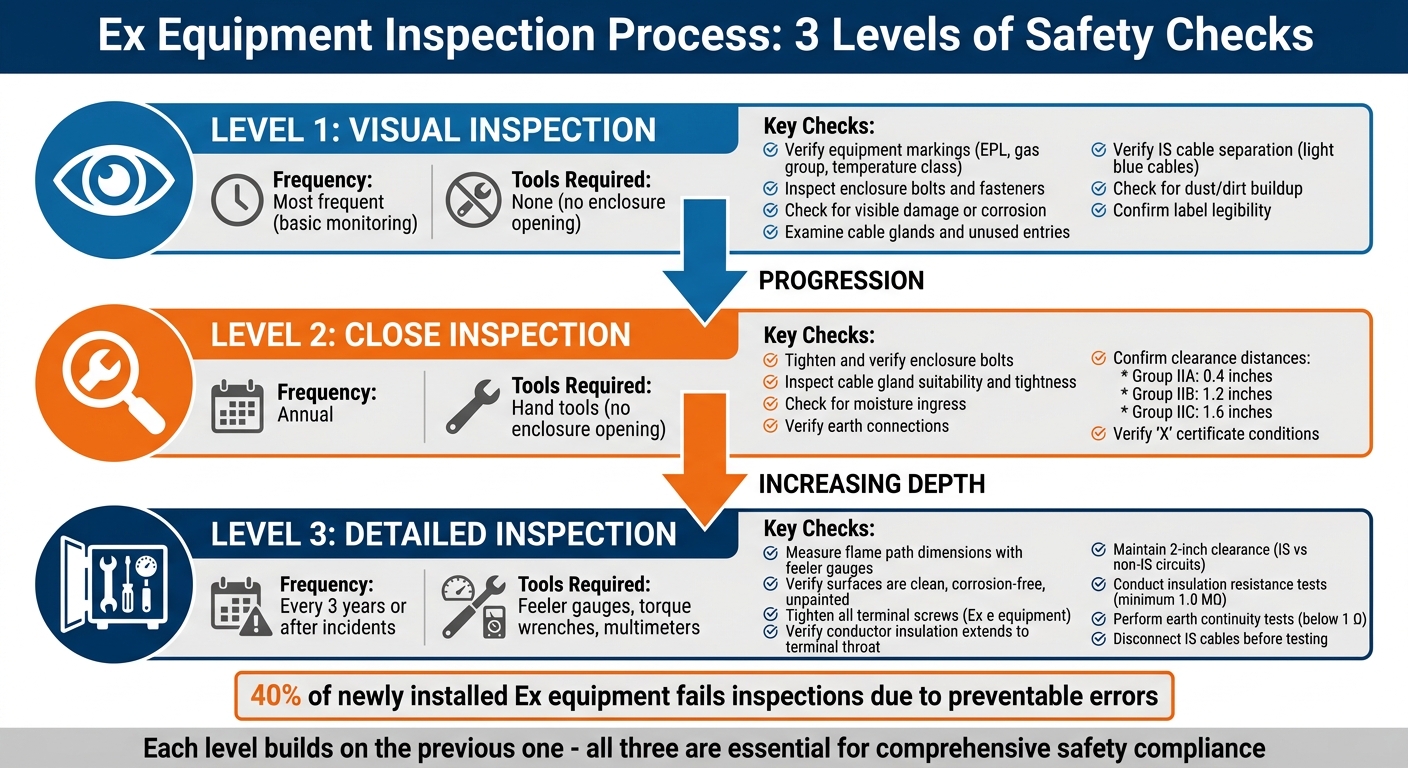
3-Level Ex Equipment Inspection Process: Visual, Close, and Detailed Steps
With the right tools and personal protective equipment (PPE) at hand, it's time to follow a structured approach to Ex equipment inspections. These inspections are divided into three levels - visual, close, and detailed - each with its own purpose and frequency. Together, they ensure safety in hazardous environments.
Step 1: Perform a Visual Inspection
Start with a visual inspection, which doesn’t require tools or opening enclosures. This step focuses on identifying obvious issues. Check that the equipment's markings - such as EPL, gas group, and temperature class - align with the zone classification and operating environment. Inspect all enclosure bolts and fasteners to confirm they’re present and appear secure. Look for visible damage or corrosion that might compromise the equipment’s integrity.
Pay close attention to cable glands, ensuring they’re correctly installed and that unused entries are sealed using certified blanking elements - not regular plastic plugs. For intrinsically safe (IS) circuits, verify that IS cables (commonly light blue) are properly separated from non-IS cables. Check for dust or dirt buildup, which can insulate enclosures and increase surface temperatures. Finally, confirm that all labels and markings remain legible. Once this step is complete, move on to a close inspection for more detailed checks.
Step 2: Conduct a Close Inspection
A close inspection involves using tools to examine the equipment without opening enclosures. This should be done annually to catch issues that aren’t visible during a basic visual inspection. Use tools to confirm that all enclosure bolts are tight and of the correct type. Inspect cable glands to ensure they’re suitable for the specific cable used and are properly tightened to maintain a secure seal.
Look for signs of moisture ingress and check that sealing compounds are intact. Ensure all earth connections are secure and verify the integrity of conduit or trunking systems. For flameproof (Ex d) enclosures, confirm clearance distances: 0.4 in for Group IIA, 1.2 in for IIB, and 1.6 in for IIC. If the equipment is marked with an "X" on its certificate, double-check that all specific safe-use conditions are met. Once these checks are complete, proceed to the final step - a detailed inspection.
Step 3: Complete a Detailed Inspection
The detailed inspection is the most thorough and involves opening enclosures to examine internal components. These inspections should be conducted every three years or after significant incidents. Use feeler gauges to confirm that flame path dimensions in Ex d enclosures meet certified tolerances. Ensure surfaces are clean, free of corrosion, and never painted.
For increased safety (Ex e) equipment, tighten all terminal screws, including unused ones, and verify that conductor insulation extends up to the metal throat of the terminal. In intrinsically safe (Ex i) systems, ensure IS and non-IS circuits maintain at least 2 inches of clearance, and check that cable screens are earthed at only one point as specified. Before conducting insulation resistance tests (minimum 1.0 MΩ) and earth continuity tests (below 1 Ω), disconnect IS cables to prevent damage.
"Without the underlying skills, knowledge, and ability to interpret standards and then document compliance - an inspection just literally becomes a box-ticking exercise!" - Fraser Heggie, Chief Technical Officer, EUTEX International
Documentation and Compliance Requirements
Documentation isn’t just about ticking boxes - it’s your proof that safety and compliance measures are in place. Accurate records confirm adherence to standards and provide essential evidence during audits. In the U.S., OSHA 1910.307(b) mandates that all hazardous locations be properly documented, with these records accessible to authorized personnel involved in designing, installing, inspecting, maintaining, or operating electrical equipment in such areas. Once inspections are finished, detailed documentation not only confirms compliance but also strengthens overall safety management.
How to Record Inspection Findings
When documenting inspection results, focus on four key details: the items inspected, the findings, the inspection date, and the inspector’s signature. Digital tools like modern Ex registers make this process more efficient by enabling features like photo documentation, NFC or QR tagging for quick equipment identification, and auto-generated, audit-ready reports. For intrinsically safe systems, it’s crucial to maintain a "Descriptive System Document" that confirms voltage, current, and capacitance remain within safe operating limits. These records don’t just prove compliance - they also guide future maintenance and inspection plans.
Under ATEX 1999/92/EC, employers are required to keep an Explosion Protection Document (EPD). This document must include zone classification diagrams, criteria for equipment selection, and maintenance and inspection schedules. It must also be updated whenever there are changes to processes, equipment, or operating procedures. To avoid conflicts of interest, ensure that the inspector is not the same person who installed the equipment. Industry data reveals a 40% failure rate for newly installed Ex equipment - many of these issues could be caught by independent, qualified inspectors.
Inspection Frequency Guidelines
Once inspections are completed, retaining records and setting appropriate inspection intervals are critical for maintaining safety. OSHA specifies retention periods: monthly inspection records must be kept for at least three months, while annual or comprehensive inspection records need to be stored for a minimum of 12 months.
For high-risk areas like Zone 0 or Zone 20 - where explosive atmospheres are present continuously or for extended periods - inspection frequencies should be increased based on your site’s risk assessment. Equipment in challenging environments, such as offshore platforms or chemical processing plants, often requires more frequent checks. Document your reasoning for these intervals in your EPD and ensure your schedule aligns with NFPA 70 (National Electrical Code) standards. Keep in mind, non-compliance with OSHA safety rules can lead to fines of up to $16,550 per violation per day, with willful or repeated violations reaching as high as $165,351 per violation.
Conclusion
Ex equipment inspections go far beyond ticking boxes - they are crucial for protecting lives and preventing disasters in hazardous environments. Fraser Heggie, Chief Technical Officer at EUTEX International, emphasizes this point:
Without the underlying skills, knowledge, and ability to interpret standards and then document compliance - an inspection just literally becomes a box-ticking exercise!
The numbers speak for themselves: a staggering 40% of new Ex equipment installations fail inspections, often due to preventable issues that proper preparation and skilled inspections could address.
Preparation is the cornerstone of a safe and effective inspection. This means reviewing the Ex Product Declaration (EPD), equipment manuals, and any special certification conditions ahead of time. Inspectors must also ensure that equipment aligns with the correct zone classifications, gas groups, and temperature ratings, as discussed earlier.
Using the proper tools and adhering to compliance standards is non-negotiable. Each type of inspection - Visual, Close, and Detailed - has a specific role to play, depending on the situation and timing. Technical checks, such as ensuring flame path clearances and proper cable separation, are vital for preventing ignition risks. And don’t cut corners - always use manufacturer-approved parts. Substituting components not only voids certifications but also introduces immediate safety hazards.
Documentation ties everything together. Keeping thorough records of inspection dates, findings, and inspector signatures is a regulatory requirement and reinforces the safety process. By following these practices, Ex equipment inspections achieve their ultimate goal: ensuring that equipment can safely operate in explosive atmospheres while maintaining its safety integrity throughout its lifecycle.
For additional expert advice and certified Ex components, visit Electrical Trader.
FAQs
Who is qualified to inspect Ex equipment?
Inspections of Ex equipment must be carried out exclusively by qualified personnel. These individuals should possess recognized certifications such as CompEx, IECEx CoPC, or similar credentials. Such certifications verify their expertise in understanding standards and accurately documenting compliance, ensuring inspections are performed both safely and correctly.
When do I need a gas-free certificate or hot work permit?
A hot work permit is necessary for tasks such as welding, cutting, or grinding when performed outside designated hot-work areas, particularly if combustible materials are nearby. Similarly, a gas-free certificate is required in hazardous areas with potential explosive atmospheres. This certificate confirms the absence of flammable gases or vapors, ensuring the area is safe for maintenance or inspection work.
What are the most common Ex inspection failures to look for?
Ex inspection failures often stem from a range of avoidable mistakes, such as:
- Improper cable gland installation: Incorrectly installed cable glands can compromise the integrity of the system, leading to potential safety hazards.
- Incorrect certification of accessories: Using accessories that lack the proper certification can result in non-compliance with safety standards.
- Mismatched environmental conditions: Equipment not suited for specific environmental factors, such as humidity or temperature, can fail or become unsafe.
- Failure to verify zone classification or temperature ratings: Overlooking these critical factors can result in the use of unsuitable equipment in hazardous areas.
These issues, highlighted in industry guidelines, are crucial to address to ensure the safety and reliability of Ex-rated equipment.