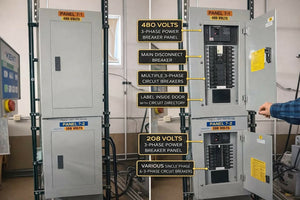
How to Compare Power Distribution Equipment Brands
Comparing power distribution equipment brands is essential because your choice impacts long-term costs, compatibility, and safety. Here's what you need to know:
- Product Quality: Copper bus bars offer better conductivity and durability than aluminum. Premium brands often include features like faster breaker trip times and overheating prevention.
- Reliability: Square D excels in flexibility with its I-Line system, while Allen-Bradley is favored for automation. Siemens has faced reliability concerns in industrial settings.
- Cost: Upfront price is only part of the story. Consider warranties (Eaton offers 10 years, others 5 years) and lifetime costs, including maintenance and repairs.
- Compliance: Ensure UL listing and adherence to NEC, ANSI, and NFPA 70E standards to avoid inspection failures or insurance issues.
- Support: Local distributor stock and 24-hour emergency support can reduce downtime and save money.
Quick Comparison
| Feature | Square D | Allen-Bradley | Eaton | Siemens |
|---|---|---|---|---|
| Bus Material | Copper/Aluminum | Copper | Copper/Aluminum | Copper |
| Warranty | 5 years | – | 10 years | 5 years |
| Strength | I-Line bus system | EtherNet/IP support | Reliability | Monitoring |
Choosing the right brand involves balancing quality, performance, cost, and support. Always evaluate your project’s specific needs before making a decision.
Power Distribution Boards_ ABB vs. Chint vs. Schneider!
sbb-itb-501186b
Key Factors to Consider When Comparing Brands
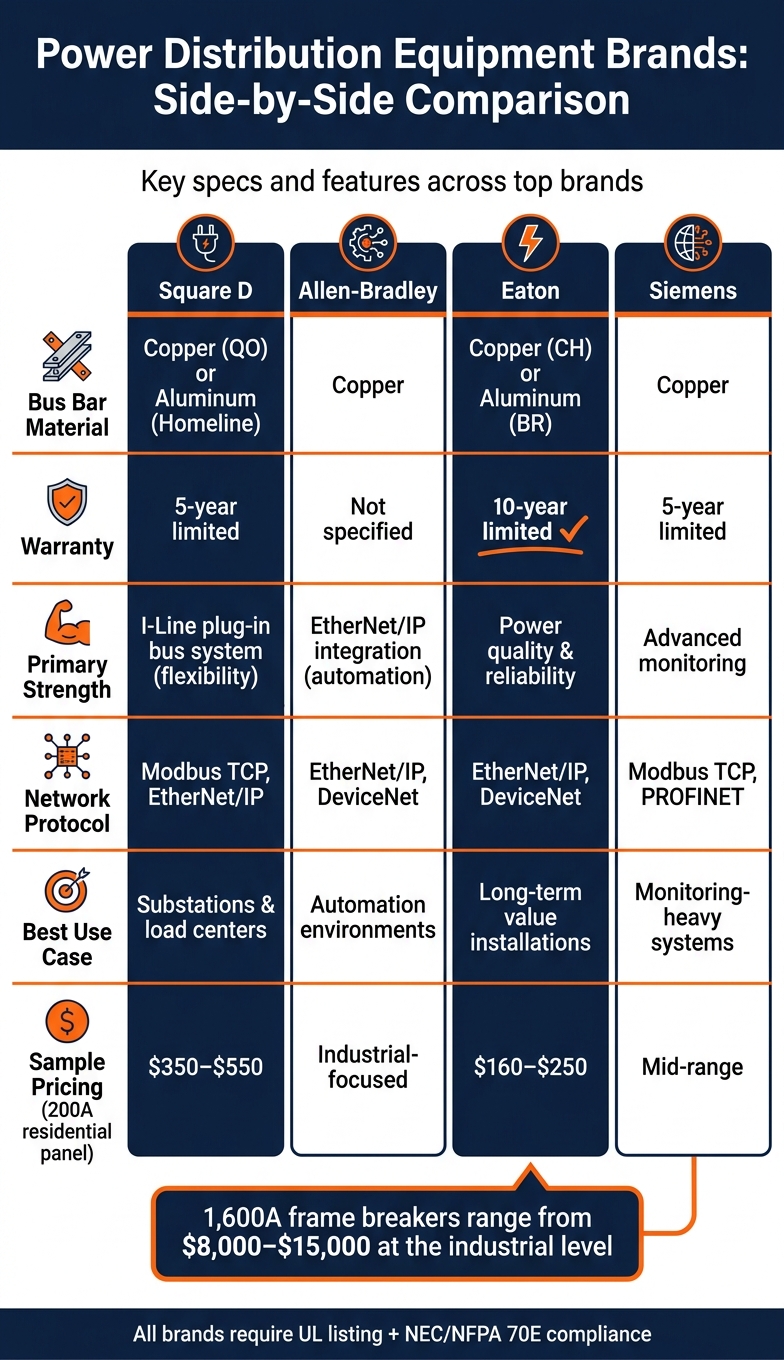
Power Distribution Equipment Brands Compared: Square D vs Allen-Bradley vs Eaton vs Siemens
When it comes to power distribution equipment, there’s more to think about than just price. Before making any decisions, it’s essential to weigh these five key factors.
1. Product Quality and Durability
The bus bar material is one of the clearest indicators of quality. Copper bus bars are the go-to for top-tier conductivity and corrosion resistance, making them ideal for premium installations. Aluminum with copper plating offers a decent compromise, but plain aluminum tends to develop connection issues over time. Another critical aspect is breaker performance - premium brands provide faster trip times and include features to prevent overheating.
Pay attention to the bus system design as well. For example, plug-in bus systems like Square D's I-Line allow you to reconfigure or expand without shutting down the entire system, which is a huge plus for facilities that need flexibility.
Once you’ve assessed the quality, the next step is to look at how the equipment performs in demanding conditions.
2. Reliability and Performance
Consider how well the equipment holds up in environments similar to yours. Arc flash risk, for instance, is a significant concern in industrial setups. Look for equipment with arc-resistant ratings (Type 2B per IEEE C37.20.7) and features like zone selective interlocking, which help reduce arc flash energy exposure.
In terms of reliability, industry professionals often favor Square D for substations and load centers. Allen-Bradley, on the other hand, excels in automation environments, thanks to its native EtherNet/IP support. Siemens has faced some criticism in industrial contexts, with reports of startup issues and hardware failures causing production delays.
With performance in mind, it’s time to balance those findings against cost.
3. Cost and Value for Money
The upfront price tag isn’t the full story. A cheaper panel that requires frequent repairs or has a shorter warranty can end up costing more over its lifetime. Warranty coverage varies significantly between brands, with Eaton offering a 10-year limited warranty, while Square D, Siemens, and Leviton provide 5-year limited warranties.
| Brand | Warranty Period |
|---|---|
| Eaton | 10-year limited |
| Square D | 5-year limited |
| Siemens | 5-year limited |
| Leviton | 5-year limited |
For smaller projects, like residential or light commercial work, price differences between brands are relatively minor. For example, a 200A Square D QO panel costs around $350–$550, compared to an Eaton BR panel at $160–$250. However, at the industrial level, the cost gap becomes much larger - a single 1600A frame breaker can range from $8,000 to $15,000.
Beyond cost, compliance with industry standards also plays a big role in value.
4. Compliance with Standards and Certifications
Always ensure that the equipment meets required standards. For the U.S. market, a UL listing is essential. Additionally, look for compliance with ANSI/IEEE standards for medium-voltage systems and NFPA 70E for arc flash safety. These certifications aren’t just bureaucratic - they directly impact whether your installation passes inspections and how your insurance policy applies.
When it comes to arc flash mitigation, the method you choose determines the required PPE category under NFPA 70E. For example, arc-resistant switchgear (Type 2B) provides Category 3/4 protection, while remote racking devices and zone selective interlocking can reduce requirements to Category 2. Make sure the brand you’re considering supports the mitigation strategy that fits your needs.
5. Brand Reputation and Support Services
Lastly, consider a brand’s reputation and its local support network. Local service availability is just as important as the brand’s overall standing. Many manufacturers rely on lean inventory models, meaning your local distributor’s stock levels and emergency response capabilities can significantly affect your project timeline.
Before choosing a brand, check whether your local distributor keeps common frame breakers (like 400A and 800A) in stock and offers 24-hour emergency support. Paying a bit more - around 10% - for locally stocked equipment can save you time and money by reducing downtime. If your facility already uses a specific brand for over 60% of its load, sticking with that brand can also save on spare parts inventory costs.
Steps to Conduct a Brand Comparison
Now that you’ve got a handle on what to look for, here’s how to approach a brand comparison in a structured way.
1. Identify Project Requirements
Start by defining the technical details of your project. Figure out your nominal voltage (e.g., 480V for low-voltage systems or 4.16kV/13.8kV for medium-voltage setups) and the ampacity you’ll need - this could range from 100A for residential systems to 2,500A for industrial ones. Don’t forget to assess the short-circuit withstand capacity and environmental factors. For example, in coastal or high-humidity areas, copper bus bars are often a better choice than aluminum. Also, establish your networking needs early. Depending on your system, you might need EtherNet/IP (Allen-Bradley), Modbus TCP (Square D or ABB), or PROFINET (Siemens).
2. Research Available Brands and Products
With your requirements in hand, dive into the available options. Manufacturer websites and technical catalogs are good starting points, but don’t stop there. Talking to engineers, contractors, and distributors can give you practical insights that aren’t always in the brochures.
A resource like Electrical Trader can simplify this process. It’s an online marketplace packed with listings for new and used electrical components. By browsing there, you can get a sense of product availability, pricing trends, and brand options - all in one spot.
3. Compare Product Specifications and Features
Once you’ve narrowed down your options, create a side-by-side comparison of the key features. A table can make this process clear and efficient, helping you spot differences in areas like bus bar material, network protocols, arc flash ratings, and warranties.
| Feature | Square D | Allen-Bradley | Eaton | ABB |
|---|---|---|---|---|
| Primary Strength | Trouble-free I-Line bus system | Superior EtherNet/IP integration | Power quality & reliability | Advanced monitoring & arc-resistant |
| Bus Material | Copper (QO) or Aluminum (Homeline) | Typically copper | Copper (CH) or Aluminum (BR) | Typically copper |
| Network Protocol | Modbus TCP, EtherNet/IP | EtherNet/IP, DeviceNet | EtherNet/IP, DeviceNet | Modbus TCP, PROFINET |
| Warranty | 5-year limited | – | 10-year limited | – |
After comparing technical specifications, dig into user feedback to validate how these features perform in real-world conditions.
4. Review Customer Feedback and Case Studies
Numbers and specs are helpful, but they don’t tell the whole story. Look for contractor forums, field reports, and case studies from facilities with setups similar to yours. These can highlight practical aspects like lead times, spare parts availability, and how responsive technical support is. Pay attention to recurring themes - whether positive or negative - and weigh them against cost and performance to make an informed choice.
5. Calculate Total Cost of Ownership (TCO)
Now it’s time to crunch the numbers. The initial purchase price is just part of the equation. A proper TCO analysis should include installation labor, maintenance, energy efficiency, spare parts, and potential downtime costs.
For instance, buying individual breakers separately can cost 30–50% more than going for bundled pricing. A single 1,600A frame breaker might run anywhere from $8,000 to $15,000. Specialty breakers can take 8–12 weeks to arrive, which could delay your project. Ordering them along with the panel can help avoid these setbacks.
"A common procurement blind spot is focusing solely on initial purchase price. While premium switchgear may come with a higher upfront cost, its durability, low maintenance needs, and prolonged service life significantly reduce ongoing operational and replacement expenses." - JEELIX
Don’t forget to consider staff training costs, especially if you’re switching to a brand that’s unfamiliar to your team. A steeper learning curve could mean extra labor hours and delays during the startup phase.
How Electrical Trader Simplifies Brand Comparison
Electrical Trader makes selecting the right electrical equipment easier by offering tools and resources that simplify the comparison process. With a centralized platform, it helps users efficiently source and evaluate options, saving both time and effort.
Access to a Wide Range of Products
Electrical Trader hosts products from over 130 trusted manufacturers, providing an extensive selection of electrical equipment. Whether you're comparing new or used items, the platform lets you see the differences side by side. For instance, certified reconditioned equipment is often priced between 40% and 70% of the cost of new units. A panel that costs $15,000 when new might be available for as little as $6,000. This variety ensures you can find equipment that fits both your technical needs and budget.
Detailed Product Listings and Specifications
Each product listing on Electrical Trader includes essential technical details like voltage ratings, ampacity, AIC, bus configuration, and NEMA ratings. For used equipment, listings also feature testing and inspection reports, which are critical for assessing reliability. As Electrical Trader emphasizes:
"While used panels can offer substantial savings, the critical role they play in electrical safety makes proper evaluation particularly important." - Electrical Trader
This level of detail ensures buyers can make informed decisions without overlooking key safety and performance factors.
Buying Guides and Expert Resources
To further simplify the process, Electrical Trader offers buying guides tailored to low, medium, and high voltage equipment. These guides cover critical areas like maintenance history, bus bar condition, and system compatibility. The platform also advises on budgeting for professional testing, which typically costs between $200 and $1,000, helping users plan for any hidden expenses.
"Finding the right electrical equipment for your needs can be challenging and time-consuming. At Electrical Trader, we're committed to being your reliable partner throughout the procurement process." - Electrical Trader
Conclusion: Making Informed Decisions
Choosing the right power distribution equipment brand is a decision that resonates far beyond the initial purchase. As JEELIX wisely states:
"Selecting a switchgear manufacturer is far more than a routine procurement exercise - it is a strategic choice that shapes the entire lifecycle of your project." - JEELIX
This decision ties you to a specific ecosystem of spare parts, maintenance routines, and system compatibility. While a lower upfront price might seem appealing, it can often lead to hidden costs down the road - think higher maintenance fees, unexpected downtime, or frequent replacements. On the other hand, investing in premium equipment may cost more initially, but its durability and reduced operational expenses over time often prove to be the smarter choice.
FAQs
How do I choose the right ampacity and short-circuit rating?
To choose the right ampacity and short-circuit rating for your system, make sure both exceed your system's maximum load demands and fault conditions. Select equipment with an ampacity capable of handling your load safely, factoring in temperature adjustments if necessary. For the short-circuit rating, ensure it exceeds the highest possible fault current in your system. Properly verifying these ratings is essential to avoid equipment failures and maintain safety.
When is copper bus worth the extra cost over aluminum?
Copper busbars are a smart investment when you need to handle high current density, achieve a compact design, or ensure low-maintenance operation. They’re particularly well-suited for premium switchboards and tightly packed distribution panels, especially in settings that demand high short-circuit strength. While aluminum busbars may save on costs, copper stands out in challenging applications where reliability and efficiency can’t be compromised.
What should I include in total cost of ownership (TCO)?
The total cost of ownership (TCO) goes beyond just the upfront purchase price. It also includes ongoing expenses such as operational costs (like energy losses) and maintenance fees. Other potential costs to keep in mind are those for cooling systems, employee training, and addressing startup issues. Additionally, future expenses, such as those related to energy consumption or carbon emissions, can play a significant role. Taking all these factors into account provides a clearer picture of the long-term financial and environmental impact of power distribution equipment.