




Durability of Electrical Brands: Industrial Applications Compared
In industrial settings, choosing the right electrical equipment is crucial for minimizing downtime and managing long-term costs. This article compares the durability, reliability, and maintenance strategies of five major electrical brands - Siemens, ABB, Schneider Electric, Rockwell/Allen-Bradley, and Eaton. Here's a quick summary of what you need to know:
- Siemens: Offers robust medium-voltage vacuum circuit breakers but has issues with mechanical wear and AFCI nuisance tripping. Ideal for automation and modular systems.
- ABB: Excels in harsh conditions with predictive maintenance tools and corrosion-resistant technologies. Best for heavy manufacturing and high-voltage systems.
- Schneider Electric: Known for reliable low-voltage distribution and advanced digital monitoring. Recommended for data centers and food processing.
- Rockwell/Allen-Bradley: Strong in factory automation but with mixed durability in compact drive models. Suited for PLC-integrated systems.
- Eaton: Focuses on safety and reduced maintenance with vacuum interruption and remote racking systems. Fits safety-critical and budget-conscious operations.
Quick Comparison:
| Brand | Strengths | Weaknesses | Best Fit |
|---|---|---|---|
| Siemens | High heat resistance, modular systems | Mechanical wear, AFCI tripping issues | Automation and modular systems |
| ABB | Predictive maintenance, corrosion resistance | Integration challenges, long lead times | Heavy manufacturing, high-voltage |
| Schneider Electric | Reliable low-voltage systems, digital monitoring | Higher upfront costs | Data centers, food processing |
| Rockwell/Allen-Bradley | Factory automation, PLC integration | Mixed drive durability, high costs | PLC-integrated systems |
| Eaton | Safety features, reduced maintenance | Long replacement lead times | Safety-critical, cost-sensitive sites |
Selecting the right brand depends on your specific needs, environment, and budget. For facilities with high downtime costs, investing in durable, reliable equipment is worth the upfront expense.
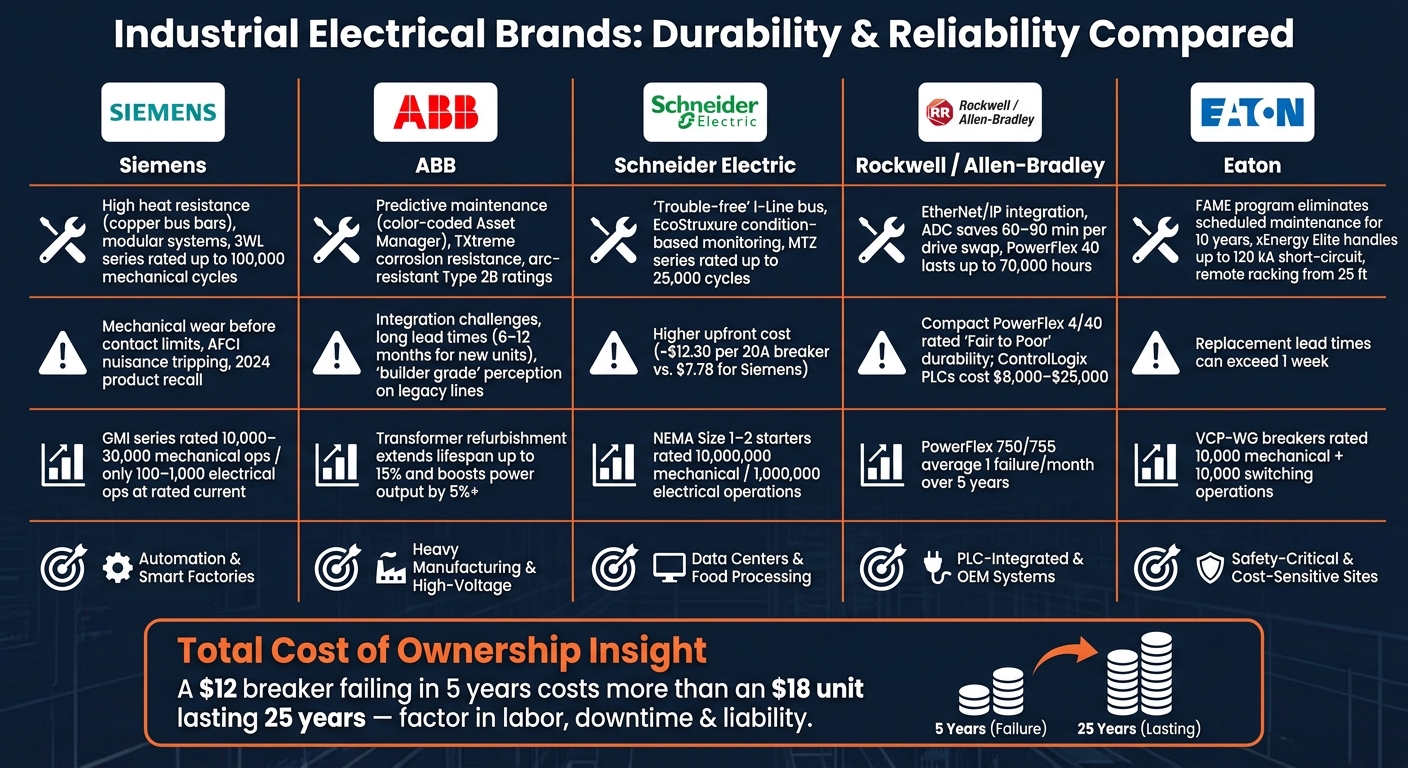
Industrial Electrical Brands Compared: Durability, Strengths & Best Fit
1. Siemens
Siemens stands out for its modular, automation-friendly medium-voltage (MV) vacuum circuit breakers. A prime example is the GMI series, commonly used in heavy-duty environments like refineries and power plants. These breakers leverage vacuum interrupter technology, which ensures rapid dielectric recovery and reduces contact wear significantly.
However, the mechanical components - such as springs, linkages, and racking mechanisms - tend to fail before the vacuum interrupter contacts reach their wear limits. David Krause, an Industrial Controls Specialist at Industrial Monitor Direct, explains:
"Mechanism wear typically causes failure before contacts reach wear limits, especially in frequent switching applications. Most breaker shop repairs involve springs, linkages, and racking mechanisms."
The data supports this observation. Siemens GMI series 5kV vacuum circuit breakers are rated for 10,000 to 30,000 mechanical operations, but their electrical operations at rated current significantly drop to just 100 to 1,000 cycles. In motor starting duties, where locked rotor current can be 6–8 times higher, contact wear accelerates much faster than in standard feeder operations. This makes the difference especially critical for equipment requiring frequent start/stop cycles.
| Parameter | Siemens Vacuum Circuit Breaker | Vacuum Contactor |
|---|---|---|
| Mechanical Operations | 10,000–30,000 | 250,000–1,000,000 |
| Electrical Operations | 100–1,000 (at rated current) | 100,000+ (at rated current) |
| Replacement Cost | $15,000–$40,000 | $3,000–$12,000 |
For applications involving frequent motor starts, vacuum contactors are a better choice than circuit breakers. These devices are specifically designed for repetitive switching and offer a much longer operational lifespan. To maximize the service life of Siemens MV breakers, a proactive maintenance schedule is essential. Recommended practices include quarterly visual inspections of racking mechanisms, semi-annual checks for contact wear, and annual mechanical timing tests. Keeping a detailed log of operations can also help predict service life based on manufacturer ratings.
One issue to watch for is unintended tripping in Siemens AFCI breakers, which has led some contractors to avoid them in new installations. On the other hand, Siemens load centers with copper bus bars are highly reliable in high-temperature environments. They resist thermal cycling and oxidation better than aluminum-only options, making them a solid choice for demanding conditions.
sbb-itb-501186b
2. ABB
ABB takes an organized approach to ensuring durability in industrial environments. A key tool in their arsenal is the ABB Asset Manager, which uses a color-coded risk scale - green, yellow, orange, and red - to monitor the health of switchgear and circuit breakers. Instead of following rigid, calendar-based maintenance schedules, this system employs algorithms that consider factors like age, environmental conditions, and usage patterns. This allows ABB to identify potential issues before they escalate into failures. The result? Predictive maintenance that significantly cuts down on unplanned downtime - where the biggest savings come into play. Alongside these predictive measures, ABB also integrates advanced protective technologies to ensure equipment reliability.
For particularly tough environments, ABB's TXtreme™ technology offers robust protection for distribution transformers against corrosion caused by saltwater, wind, and chemical exposure - common challenges in offshore oil and gas operations. Traditional transformers in such settings often fail prematurely due to moisture and salt damage. TXtreme, however, is designed to withstand these harsh conditions, eliminating the need for frequent repainting or expensive stainless steel housings. As ABB explains:
"ABB's new innovation significantly protects the transformer from corrosive substances, extending its service life and eliminating the cost of frequent repainting."
While distribution transformers typically last 20–30 years, exposure to corrosive environments often shortens their lifespan. TXtreme directly tackles this issue, ensuring equipment stays operational longer.
ABB also highlights that electronic components deteriorate faster than mechanical ones, making planned upgrades essential during a machine's lifecycle. For high-voltage motors and generators, refurbishment often proves to be the more economical choice. ABB points out that a complete refurbishment using existing capital spares can be completed in just weeks, compared to the 6–12 month lead time required for a brand-new unit. For instance, upgrading a rotor can extend the equipment's lifespan by up to 15% while increasing power output by over 5%.
"Managing a planned maintenance activity is less expensive than reacting when a problem occurs." - ABB
To minimize downtime, ABB advises industrial operators to maintain custom-made capital spares, such as rotors and stators, which often have long delivery times. Additionally, retrofitting slip-ring motors with brush-lifting systems can reduce wear and lower service costs over time. These combined strategies focus on maximizing uptime and extending the life of critical industrial assets while keeping costs under control.
3. Schneider Electric

Schneider Electric's Square D brand has earned a solid reputation for reliability in industrial low-voltage distribution. According to Industrial Monitor Direct, the Square D I-Line is described as "most trouble‐free from substations to load centers". This reputation is supported by strong performance metrics and forward-thinking maintenance strategies.
The durability of Schneider's components is evident in their performance ratings. For example, NEMA Size 1 and 2 starters are built to handle 10,000,000 mechanical operations and 1,000,000 electrical operations. Larger NEMA Size 7 starters are rated for 500,000 mechanical and 50,000 electrical operations. Similarly, UL endurance standards for circuit breakers vary by size: smaller frames (0–100A) are tested for 6,000 full-load operations, while larger frames (801–2,500A) are rated for 500 full-load operations.
The MasterPacT MTZ series is designed to perform reliably under a wide range of conditions. It operates between –13°F and +158°F (–25°C to +70°C), withstands constant vibration at 0.7 g from 13.2 Hz to 100 Hz, and passes damp heat testing at 131°F (55°C) with 95% relative humidity. Additionally, it meets salt mist resistance standards (IEC 60068-2-52, Level 2), making it ideal for corrosive environments like coastal or offshore locations. For environments exceeding Category 3C3 corrosive atmospheres, Schneider recommends enclosures rated IP54 or higher.
Schneider employs a tiered maintenance strategy tailored to the criticality of the application. For systems in severe environments with high criticality, the company advises manufacturer-led maintenance every two years. The MTZ1 model is rated for 12,500 cycles, while the MTZ2 and MTZ3 models can achieve up to 25,000 cycles with proper preventive care. Key wear parts, such as interlocking cables, need replacement every 3,000 cycles, with specific thresholds set for arc chutes and main contacts. This proactive maintenance approach ensures reliability even under demanding conditions.
To further enhance reliability, Schneider integrates its EcoStruxure platform, shifting maintenance from time-based schedules to condition-based monitoring. With built-in sensors and QR-coded hardware, the platform offers real-time diagnostics and triggers maintenance when degradation is detected. This system is comparable to ABB's Asset Manager but goes a step further by incorporating energy management features. Schneider transforms circuit breakers into active monitoring devices, not just passive protection tools. These advanced digital strategies play a crucial role when comparing the strengths and weaknesses of top electrical brands.
4. Rockwell Automation/Allen-Bradley
Rockwell Automation's Allen-Bradley product line is a dominant force in factory automation and OEM machinery across North America. The Centerline low-voltage switchgear is frequently rated as "Excellent" by seasoned electricians, thanks to its seamless integration with ControlLogix and CompactLogix PLCs, which proves especially useful in discrete manufacturing setups.
When it comes to durability, performance varies across product lines. For instance, field data shows that PowerFlex 750 and 755 series drives average one failure per month over a five-year span. On the other hand, legacy 160 series drives have an impressive lifespan of over 15 years, while PowerFlex 40 models can last up to 70,000 hours before replacement is needed. However, compact models like the PowerFlex 4 and 40 have received mixed reviews, with some users rating their longevity as "Fair" to "Poor" compared to older models. These insights are crucial for understanding Allen-Bradley's performance under challenging conditions.
"I pulled out one of our PowerFlex® 40 AC Drives and it had 70,000 hours on it. Whether it's age, heat... or other factors, electronics in a plant environment don't last forever." - Senior Automation Controls Engineer, North American Beverage Facility
On the environmental resistance front, Allen-Bradley drives such as the PowerFlex 525 come equipped with conformal-coated PCBs and can operate in temperatures up to 122°F (50°C). They also offer IP54/NEMA 12 enclosure options for added protection. For more demanding environments - those with high dust, moisture, or corrosive elements - the "XT" portfolio is built to handle extreme conditions, including washdowns. Additionally, the ArcShield™ technology provides arc-resistant enclosures rated up to 50 kA. For installations in high-altitude or high-temperature settings, liquid-cooled medium voltage VFDs remove up to 90% of generated heat using a heat exchanger, a critical feature in such scenarios. However, for outdoor or heavy dust applications, ABB's IP66-rated products still hold a slight edge.
Where Allen-Bradley truly excels is in maintenance efficiency. The Studio 5000 platform simplifies fault diagnosis, while Automatic Device Configuration (ADC) eliminates the need for manual reprogramming during drive replacements, saving technicians 60–90 minutes per swap. As one engineer explained:
"For our technicians, it's just a matter of identifying a failure and then replacing the drive. Then their job is done, and automation takes care of the rest of it." - Senior Automation Controls Engineer, North American Beverage Facility
Cost is another important consideration. Allen-Bradley's hardware comes with a notable price premium - a 1600A frame breaker, for example, can range from $8,000 to $15,000. However, the system's reliability and time-saving maintenance features often justify the higher upfront cost. For facilities where Allen-Bradley equipment accounts for more than 60% of the plant load, sticking with the brand is often more economical. Switching brands can lead to additional costs, such as maintaining a dual spare parts inventory. When expanding switchgear, ordering breakers alongside panels instead of separately can help avoid a 30–50% price markup on the replacement market.
5. Eaton
Eaton focuses on reducing maintenance needs and ensuring reliable operation, especially in demanding industrial environments. The company has carved out a niche in markets where equipment failure is simply not an option. This commitment is evident in their design choices and performance metrics.
A standout feature of Eaton's offerings is mechanical life. For instance, the VCP-WG medium-voltage generator circuit breakers are tested to withstand 10,000 mechanical operations and 10,000 normal switching operations under high continuous AC current conditions. These breakers use eco-conscious vacuum interruption technology, which avoids the contamination risks associated with older oil-filled or SF6 systems. Meanwhile, the R-VAC series is engineered for repetitive switching duties, offering extended operational life with minimal upkeep.
Eaton's Factory Authorized Mechanism Enhancements (FAME) program is a game-changer for maintenance. A standard VCP-W breaker might require up to four reconditioning sessions over a decade. However, with FAME upgrades - featuring advanced synthetic lubricants, cast iron bearing blocks, and a rugged anti-reverse mechanism - scheduled maintenance can be entirely eliminated during that same period. Beyond high-voltage innovations, Eaton also excels in low-voltage switchgear durability.
"The FAME process returns a superior product that requires no scheduled maintenance over a 10-year period - versus a typical VCP-W circuit breaker that may require reconditioning up to four times in that time period." - Eaton
Eaton’s low-voltage solutions are equally robust. The xEnergy Elite switchgear can handle short-circuit currents up to 120 kA and peak withstand currents up to 264 kA. Its patented silver-plated contact system actually improves the electrical connection as current increases, a practical feature for high-load conditions. Additionally, the system meets AG2–AG5 seismic standards, making it suitable for earthquake-prone areas without requiring structural modifications. For enhanced safety, Eaton's RPR-2.1 remote power racking system allows technicians to operate switchgear from at least 25 feet away, keeping them outside the arc flash protection zone during maintenance.
| Feature | VCP-WG Generator Breakers | xEnergy Elite (Low Voltage) |
|---|---|---|
| Mechanical Life | 10,000 operations | Optimized for high-frequency operations |
| Short-Circuit Rating | Up to 75 kA | Up to 120 kA |
| Environmental Rating | Marine / Mining / Industrial | Seismic AG2–AG5 / IP54 |
| Maintenance Feature | Vacuum interruption; FAME program | Virtually maintenance-free busbars |
| Max Continuous Current | Up to 6,000A | Drawout configurations available |
Pros and Cons by Brand
Here’s a quick look at the durability strengths and weaknesses of each brand, along with their ideal applications. The best choice will vary depending on your operating environment, maintenance resources, and integration requirements.
| Brand | Key Durability Strengths | Notable Weaknesses | Best Fit |
|---|---|---|---|
| Siemens | Known for precision engineering and copper bus options that enhance heat resistance. The 3WL series is rated for up to 100,000 mechanical cycles. | Issues with AFCI nuisance tripping in sensitive setups and quality control concerns, including a 2024 recall of nearly 4,000 "SolarReady" meter combos due to fire hazards. | Ideal for industrial automation, smart factories, and modular systems. |
| ABB | Built tough for harsh environments like mining and oil & gas. Offers arc-resistant (Type 2B) ratings and warranties extendable up to 5 years. | Challenging network integration and "builder grade" perception of GE-legacy PowerMark lines. | Suited for heavy manufacturing, high-voltage systems, and continuous-duty operations. |
| Schneider Electric | Praised for its "trouble-free" I-Line bus system, digital monitoring with Masterpact MTZ, and an 18-month commercial/industrial warranty. | Higher costs - standard 20-A breakers are ~$12.30, compared to ~$7.78 for Siemens. | Best for low-voltage distribution, data centers, and food processing facilities. |
| Rockwell/Allen-Bradley | Excels in EtherNet/IP integration. PowerFlex 750/755 series shows an average of one failure per month over five years. | Compact PowerFlex 4/40 drives have higher failure rates in demanding industrial settings, and ControlLogix PLCs are priced steeply ($8,000–$25,000). | Perfect for PLC-integrated systems, OEM applications, and North American manufacturing. |
| Eaton | Offers cross-brand "Classified" breaker compatibility (UL-listed for Square D, Siemens, and GE panels) and is noted for safety innovations. | Replacement breaker lead times can exceed one week, posing risks for critical operations. | Fits power management, safety-critical sites, and budget-conscious industrial setups. |
When selecting a brand, it’s important to weigh upfront costs against long-term reliability. For example, if more than 60% of your plant's load relies on a single brand, switching could mean maintaining a separate inventory of spare parts - an expense that could easily outweigh any savings on individual units. Additionally, bundling breakers with panels is often more cost-effective since buying them separately can increase costs by 30–50%.
For facilities where downtime is not an option - like oil refineries or continuous-process manufacturing - ABB’s predictive maintenance tools and arc-resistant ratings provide a clear edge. On the other hand, operations focused on seamless automation will find Allen-Bradley’s systems to be a top choice, as long as the higher upfront costs align with the budget.
Conclusion
No single brand excels in every category; the right choice depends entirely on your facility's specific needs. Our detailed comparisons of Siemens, ABB, Schneider Electric, Allen-Bradley, and Eaton highlight this. For extreme environments, ABB's motors and VFDs stand out as top performers. When it comes to low-voltage distribution and switchgear, Square D's I-Line system has earned its reputation as a reliable solution, from substations to load centers. Meanwhile, Allen-Bradley dominates in PLC-integrated automation, particularly in North American manufacturing, thanks to its EtherNet/IP support and Logix ecosystem.
Beyond reliability, it's crucial to factor in total cost of ownership. As Joe from VIOX Electric explains:
"A $12 MCB that fails after 5 years costs significantly more than an $18 unit that operates reliably for 25 years when you factor in replacement labor, downtime, and potential liability."
High-quality breakers often last 25–30 years, while cheaper options may fail 40–60% sooner. For facilities where downtime costs can exceed $5,000 per hour, investing in premium equipment becomes a smart financial decision.
Operational efficiency and inventory consistency are equally important. Sticking to a single brand for inventory reduces spare parts costs, and ordering spare breakers with your initial panel purchase can save you from the 30–50% markup that often comes with buying them later.
To address extended specialty lead times, Electrical Trader provides a wide selection of breakers, transformers, and power distribution gear to keep your operations running smoothly.
FAQs
How do I choose a brand based on my plant’s environment?
When choosing a brand, consider factors like temperature, humidity, and air quality, as these directly affect the lifespan of the equipment. For example, standard enclosures might not hold up in conditions exceeding 104°F or 80% humidity. In such cases, you’ll need sealed or arc-resistant designs to ensure durability.
It’s also crucial to check if the brand provides equipment rated for your specific fault current and altitude. Additionally, if your current brand already supports over 60% of your load, staying with it can help cut down on spare-part inventory costs.
When should I use a vacuum contactor instead of a vacuum breaker?
When you need high-frequency switching, like starting motors, controlling pumps, or managing capacitor banks, a vacuum contactor is the go-to choice. These devices are designed to handle millions of cycles, offering a long mechanical lifespan. Plus, their sealed contacts make them reliable in harsh or corrosive conditions.
On the other hand, vacuum breakers are more appropriate for infrequent switching and providing short-circuit protection. Each device has its strengths, so choosing the right one depends on your specific application.
What’s the best way to reduce downtime from long replacement lead times?
To cut down on downtime caused by lengthy lead times, think about sourcing used or reconditioned equipment, which is often available within 1–4 weeks - much faster than waiting for new units. Companies like Electrical Trader provide quick access to electrical components and power distribution equipment. For a balanced approach, plan ahead for new equipment to ensure long-term reliability while using surplus inventory to meet immediate demands.





