Ultimate Guide to North American Power Distribution Market Leaders
- Market Size & Growth: Valued at $98.1 billion in 2024, projected to hit $125.5 billion by 2030.
- Key Drivers: Aging infrastructure, federal investments (e.g., $65 billion from the Bipartisan Infrastructure Law), and rising energy demands from AI, EVs, and renewables.
- Challenges: Equipment shortages, long lead times, and regulatory changes like SF₆ gas bans.
- Top Players: General Electric, Eaton, Schneider Electric, ABB, Siemens Energy, and Hitachi Energy dominate with solutions in transformers, switchgear, and digital grid technologies.
- Emerging Trends: SF₆-free switchgear, IoT-enabled systems, and localized manufacturing to tackle supply chain issues.
For sourcing equipment amidst delays, platforms like Electrical Trader offer alternatives with verified new, used, and reconditioned inventory, cutting waiting times significantly. This guide dives deeper into these companies, their strategies, and market innovations.
Who Owns the Largest Power Companies in the U.S.? - Your Utilities Hub
sbb-itb-501186b
Leading Companies in North American Power Distribution
Six companies hold a commanding presence in North America's power distribution sector, each bringing distinct expertise and strategies to the table. Understanding their histories, product offerings, and market approaches is crucial for those navigating the dynamic landscape of grid modernization and equipment sourcing.
General Electric Company

General Electric's involvement in power distribution dates back to the Thomson-Houston era. Today, its GE Vernova division, operating through Prolec GE, is a major player in North American transformer manufacturing.
Recently, GE took full ownership of the Prolec GE joint venture, a move that extended transformer lead times from 50 to 120 weeks. By securing its supply chain, the company aims to deliver utility-grade transformers and grid stability equipment more reliably.
Eaton Corporation
Eaton, founded in 1911, has grown into a leader in intelligent power management, bolstered by strategic acquisitions. The company celebrated its 100th anniversary on the New York Stock Exchange in 2023.
Eaton's product range includes three-phase transformers, voltage regulators, switchgear, circuit breakers, and EV charging systems. In 2025, the company reported $27.4 billion in total sales, with data center sales increasing by 45% year-over-year in 2024. This reflects Eaton's focus on AI-driven data centers, which are expected to account for over 9% of U.S. electricity consumption by 2030, up from 4% in 2024.
Eaton's "Data Centers as a Grid" approach allows bi-directional power flow between data centers and the grid. In February 2025, the company announced a $340 million investment in a new manufacturing facility for three-phase transformers in Jonesville, North Carolina, set to begin operations in 2027. Additionally, Eaton doubled its manufacturing output in Texas in 2025 after completing a major expansion to help utilities streamline project timelines.
Schneider Electric

Schneider Electric excels in medium-voltage equipment, offering digitalized, integrated solutions that combine transformers, switchgear, and monitoring systems.
These solutions address the growing demands of AI-driven load increases and facility upgrades. Schneider's smart energy management systems integrate hardware with advanced analytics, enabling utilities to optimize grid performance in real time. The company's multi-state capital plans through 2027 highlight its commitment to expanding capacity for these advanced solutions.
ABB Ltd

ABB focuses on digitalization and condition-based maintenance, providing grid components like sensors and protection devices to support predictive maintenance.
In 2025, ABB announced a $110 million investment in U.S. manufacturing facilities to boost production of electrification solutions for data centers and the power grid. This investment emphasizes component traceability and the integration of digital sensors, combining physical hardware with digital intelligence. ABB’s localized manufacturing strategy positions it to meet utilities' needs for reliable delivery and advanced monitoring technologies.
Siemens Energy

Siemens Energy is prioritizing onshoring key grid components, such as large power transformers produced at its Charlotte facility.
This approach addresses equipment bottlenecks, offering greater delivery predictability and faster response times for grid modernization projects. Siemens Energy's focus on power generation and grid stability supports the ongoing efforts to modernize North America's aging infrastructure.
Hitachi Energy

Hitachi Energy is expanding its operations in Virginia and Mexico to meet Department of Energy (DOE) efficiency standards for distribution transformers by April 23, 2029.
The company's product portfolio includes distribution transformers, grid automation technologies, and renewable energy integration solutions. Hitachi Energy is aligning its designs with DOE efficiency timelines, with utilities already seeking compliant designs and test evidence by 2026. This positions Hitachi Energy as a key partner for utilities planning long-term investments under evolving regulatory requirements.
Market Competition and Business Strategies
North American Power Distribution Market Leaders Product Portfolio Comparison 2025
Product Portfolio Comparison
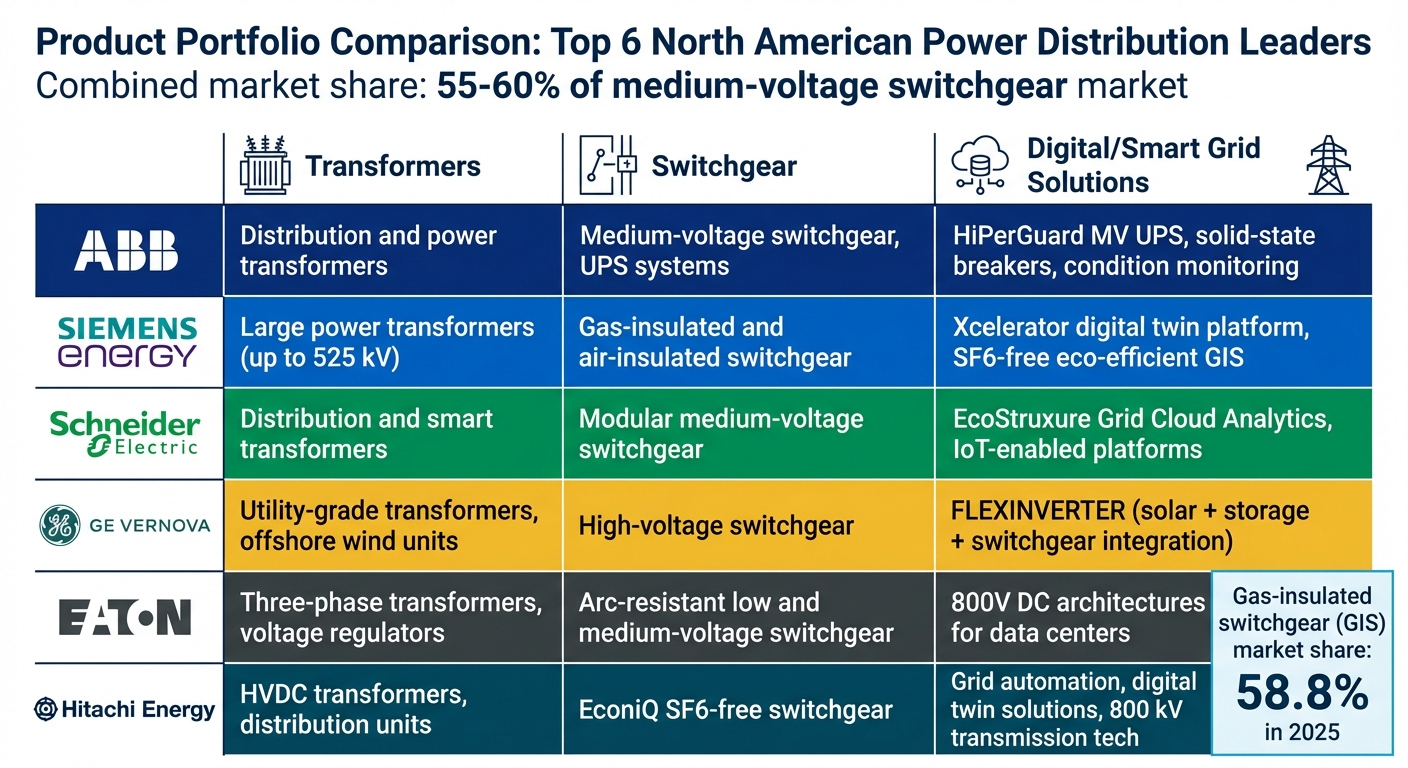
The six leading players in the North American medium-voltage switchgear market - ABB, Siemens Energy, Schneider Electric, GE Vernova, Eaton, and Hitachi Energy - together account for about 55%–60% of market share. These companies focus on three key product categories: transformers, switchgear, and digital solutions.
| Company | Transformers | Switchgear | Digital/Smart Grid Solutions |
|---|---|---|---|
| ABB | Distribution and power transformers | Medium-voltage switchgear, UPS systems | HiPerGuard MV UPS, solid-state breakers, condition monitoring |
| Siemens Energy | Large power transformers (up to 525 kV) | Gas-insulated and air-insulated switchgear | Xcelerator digital twin platform, SF6-free eco-efficient GIS |
| Schneider Electric | Distribution and smart transformers | Modular medium-voltage switchgear | EcoStruxure Grid Cloud Analytics, IoT-enabled platforms |
| GE Vernova | Utility-grade transformers, offshore wind units | High-voltage switchgear | FLEXINVERTER (solar + storage + switchgear integration) |
| Eaton | Three-phase transformers, voltage regulators | Arc-resistant low and medium-voltage switchgear | 800V DC architectures for data centers |
| Hitachi Energy | HVDC transformers, distribution units | EconiQ SF6-free switchgear | Grid automation, digital twin solutions, 800 kV transmission tech |
Gas-insulated switchgear (GIS) dominated the North American medium-voltage switchgear market in 2025, holding 58.8% of the market share. Its compact design makes it ideal for urban substations. Regulatory changes, such as California's 2025 ban on SF6 gas and similar restrictions in other states, have accelerated the adoption of fluoroketone-based insulation and vacuum interrupters. For instance, Hitachi Energy received 65 orders for its EconiQ SF6-free switchgear in North America, primarily from investor-owned utilities aiming to cut Scope 1 emissions.
These product strategies are shaping the path toward more integrated digital solutions and regional market dominance.
Smart Grid Technologies and Digital Solutions
The top players are combining hardware with advanced software platforms to deliver integrated grid management systems. These systems rely on IoT sensors, cloud-based analytics, and artificial intelligence for real-time monitoring and predictive maintenance. Siemens Energy, for example, introduced eco-efficient GIS featuring fluoroketone insulation, which works alongside its Xcelerator digital twin platform. This platform allows utilities to simulate equipment performance and predict potential failures.
GE Vernova has taken a modular approach with its FLEXINVERTER system. This solution integrates solar energy, battery storage, and switchgear into plug-and-play units, cutting commissioning time by 40%. In May 2024, GE partnered with a major U.S. utility to implement digital substation technologies, enhancing fault detection and grid reliability.
Eaton, meanwhile, is focusing on hyperscale data centers, developing specialized 800V DC switchgear to reduce energy losses and cooling needs. With U.S. data center capacity expected to triple to 90 GW by 2030, this market is a key growth area. In November 2024, Eaton launched an updated version of its arc-resistant low-voltage switchgear, designed to improve safety and minimize downtime for healthcare and critical infrastructure facilities in North America.
These advancements are strengthening the competitive edge of these companies in the North American market.
Market Share in North America
The combination of digital innovation and localized production is driving strong performance, as reflected in a 71.4% U.S. market share in 2025. Companies like ABB, Siemens Energy, and Powell Industries are prioritizing supply chain localization to enhance component traceability, reduce lead times, and accelerate project delivery.
For example, Powell Industries used its Texas manufacturing facility in 2025 to deliver customized switchgear to data center clients in just 10 weeks. This is a significant improvement over the typical 12–18 month lead time for gas-insulated switchgear.
The global power transmission and distribution market was valued at $342,640.5 million in 2024. Growth is expected to remain strong, driven by grid modernization efforts, renewable energy projects, and the expanding data center sector. By 2027, nearly 40% of utility control rooms are projected to incorporate AI for optimizing grid operations.
How Electrical Trader Serves the Power Distribution Industry
About Electrical Trader
Electrical Trader is an online marketplace specializing in new, used, surplus, and reconditioned electrical components, particularly for power distribution equipment like transformers, switchgear, circuit breakers, and motors. With the industry facing a 30% shortage in transformers and a 10% shortfall in distribution units - and lead times for high-voltage equipment stretching beyond two years - Electrical Trader steps in to address this pressing need.
The platform connects buyers with verified listings across North America, offering detailed documentation and technical specifications. This setup allows industry professionals to sidestep the lengthy delays tied to manufacturing new equipment. As Electrical Trader explains:
"helps bridge the gap between need and availability... connecting buyers, sellers, and surplus inventory to ensure that essential infrastructure projects keep moving forward".
This seamless connection between buyers and verified inventory forms the backbone of the platform’s functionality.
Platform Features and Advantages
Electrical Trader offers advanced search tools that let users filter equipment by voltage, capacity, and phase. For custom or hard-to-find items, the "Power Quote" request feature simplifies the procurement process.
The platform also includes tools like "Make an Offer" and auction options for rare or high-value equipment. Sellers benefit from an XML product feed that allows bulk uploads of over 50 items, making inventory management more efficient. Meanwhile, the ready-to-ship catalog helps buyers avoid the multi-year delays associated with new equipment orders.
Cost savings are another major draw. Used and reconditioned equipment is typically priced at 40–70% of the cost of new items, while refurbished units with warranties fall in the 60–75% range. With transformer prices having risen by 45–95%, these savings provide a critical budgetary advantage for infrastructure projects.
Supporting Industry Professionals
Electrical Trader goes beyond just connecting buyers and sellers by offering resources and tools that simplify procurement for professionals like electricians, facility managers, and contractors.
The platform categorizes listings by voltage class and equipment type, providing clear condition ratings such as New, Used, Refurbished, or "Parts/Not Working." Detailed technical fields make it easier to search for specific models or manufacturers, including well-known names like GE, ABB, and Siemens.
To further assist industry professionals, Electrical Trader provides educational materials like buying and selling guides, technical checklists, and market analyses. For high-value used equipment, the inquiry system allows users to request inspections or recent test results, including megger, oil analysis, or turns ratio tests. These features are particularly crucial in a sector where delays can threaten grid reliability. Considering that 70% of North American distribution transformers have exceeded their 25-year design life, having access to verified replacement equipment is key to maintaining essential infrastructure.
Conclusion
Market Leaders and Their Approaches
The North American power distribution market is undergoing a transformation, driven by the strategic moves of key industry players. Companies like Hitachi Energy, GE Vernova, and Eaton are heavily investing in U.S. manufacturing to tackle equipment shortages, while Siemens Energy is ramping up domestic production to cut down on import dependency. These companies are also introducing bundled solutions that combine transformers, switchgear, and digital monitoring systems, simplifying the procurement process. For professionals navigating supply chain challenges and aiming to meet DOE efficiency standards before the April 2029 deadline, understanding these strategies is critical.
Using Electrical Trader for Equipment Sourcing
Reliable equipment sourcing is a cornerstone of keeping projects on track. Electrical Trader offers a broad selection of new, used, and reconditioned equipment, providing quick access to verified inventory. For professionals balancing tight deadlines and budget constraints, this platform bridges the gap between immediate project demands and the lengthy lead times often associated with new equipment orders. By leveraging these sourcing options, project outcomes can be optimized without compromising schedules.
Closing Recommendations
With ongoing supply chain challenges and shifting DOE standards, having a clear plan is more important than ever. Here are some actionable steps to stay ahead:
- Finalize equipment specifications early and dual qualify critical kVA classes to minimize scheduling risks.
- Standardize designs for pad-mounted and dry-type units to streamline engineering and speed up delivery.
- When new equipment lead times are uncertain, consider refurbishing existing assets, provided cores are in good condition and certification testing is available.
Stay up-to-date on which manufacturers are boosting domestic production and achieving DOE compliance well before the 2029 deadline. Whether you're working with large distributors for bulk pricing or independent suppliers for quicker local service, platforms like Electrical Trader offer the flexibility to secure verified secondary market equipment. This adaptability is key to navigating today’s complex supply chain environment.
FAQs
How do I choose between new, used, and refurbished transformers or switchgear?
When weighing your options, keep these points in mind:
- New equipment comes with cutting-edge technology, full warranties, and high reliability. It's a great choice for critical operations or brand-new installations where dependability is a must.
- Used equipment is a budget-friendly option but may have a shorter lifespan and limited or no warranties. It's better suited for non-critical setups or when cost is a primary concern.
- Refurbished equipment offers a middle ground, combining affordability with reliability. These often include updated components and warranties, but it's crucial to verify the quality and the reputation of the vendor before purchasing.
What does the 2029 DOE transformer efficiency deadline mean for my project timeline?
The upcoming 2029 DOE transformer efficiency deadline introduces stricter standards for distribution transformers. This means you'll need to plan ahead - adjusting timelines for procurement, planning, and installation to ensure compliance well before the deadline hits. Early preparation will be essential to sidestep potential delays and stay aligned with these regulatory requirements.
How can I reduce equipment lead-time risk for grid upgrades and data center builds?
To reduce the risks of delays in grid upgrades and data center projects, it's essential to prioritize strategic planning and sourcing. One effective approach is to diversify your supply chain by working with multiple suppliers and leveraging platforms that specialize in electrical components, such as transformers and switchgear.
Strengthening supply chain resilience is another key step. Partner with trusted suppliers and consider investing in local manufacturing to reduce dependency on external sources. Additionally, taking proactive measures like early procurement and effective inventory management can help ensure you have timely access to the critical equipment needed to keep your projects on track.