

How to Calculate Diesel Fuel Costs for Generators
You can estimate diesel generator fuel cost with just four numbers: kW, load %, hours run, and diesel price per gallon. If any one of those is off, your cost estimate can be off by hundreds or even thousands of dollars per month.
Here’s the short version:
- Tank size is not enough. A full tank tells you how much fuel you have, not how fast you burn it.
- Use kW, not kVA. If your unit is listed in kVA, convert it with: kW = kVA × power factor. A common default is 0.8.
- Base fuel cost on actual load. A generator at 50% load burns far less fuel than the same unit at 100% load.
- Get fuel burn in gallons per hour (GPH). The best source is the manufacturer fuel-use chart.
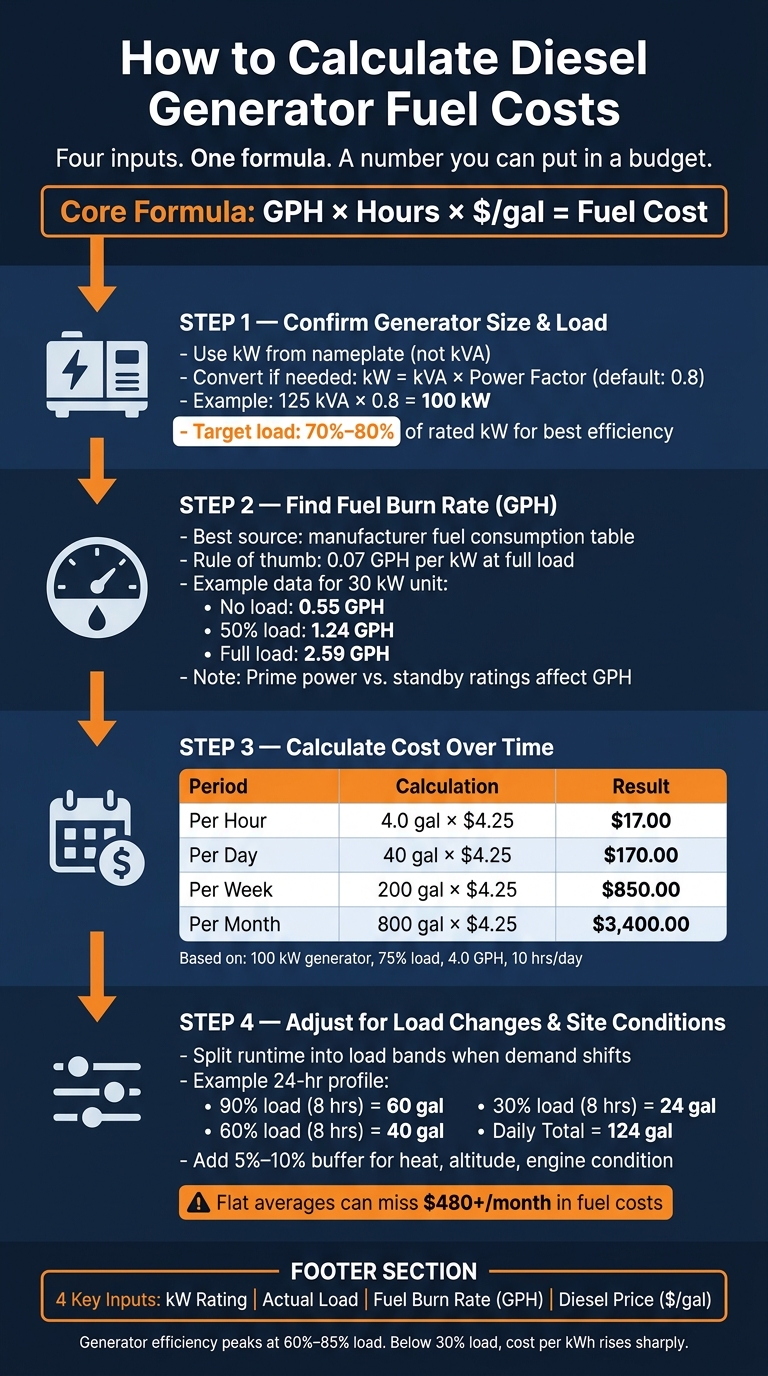
- Then use the core math: GPH × hours × $/gal = fuel cost
- If load changes during the day, split it into load bands. That gives you a tighter estimate than using one flat average.
- Add a 5% to 10% cushion for heat, altitude, and engine condition.
A simple example: if a generator burns 4.0 GPH and diesel costs $4.25/gal, fuel cost is $17.00 per hour. Run it 200 hours per month, and fuel cost is $3,400.00 per month.
Use this article if you want to move from a rough guess to a number you can put into a job budget, site plan, or facility cost sheet.
How to Calculate Diesel Generator Fuel Costs: 4-Step Formula
Step 1: Confirm Generator Size and Expected Load
Now that you know tank size by itself doesn't tell the whole story, start with the generator's rated output and the load you expect to run.
Use the generator's rated output in kW from the nameplate, spec sheet, or rental contract. Fuel use follows kW, not kVA.
How to Convert kVA to kW
Some generators are listed in kVA. That's the electrical rating. kW is the usable output.
Use this formula:
kW = kVA × power factor
Most diesel generators use a 0.8 power factor. If the spec sheet doesn't show one, 0.8 is a solid default.
| kVA Rating | Power Factor | Real Power (kW) |
|---|---|---|
| 125 kVA | 0.8 | 100 kW |
Once you have the number in kW, compare it with the load you expect the generator to carry.
Use Load Percentage Instead of Assuming Full Output
Base fuel use on the actual load, not the rated output. The nameplate shows the maximum, not the level the unit will usually run at. Manufacturers publish fuel-use data at 25%, 50%, 75%, and 100% load bands, so use the band that sits closest to your actual usage.
Here’s what that looks like:
- A 100 kW generator running at 60 kW is at 60% load
- The same generator running at 15 kW is at 15% load
Lower load means lower fuel burn, but that doesn't mean the generator is running well. Very light loads can hurt efficiency per kWh and may lead to wet stacking.
For steady operation, aim for 70% to 80% of rated kW. That gives you a more realistic cost basis and still leaves room for load spikes.
With rated kW and load percentage set, the next step is to find the fuel burn rate.
sbb-itb-501186b
Step 2: Find the Generator Fuel Burn Rate
Once you’ve confirmed the kW and load, the next step is fuel burn in gallons per hour (GPH). This number drives every cost calculation that comes after it.
Check Manufacturer Fuel-Consumption Data First
Start with the spec sheet or datasheet. Look for a Fuel Consumption table. You’ll usually see fuel use listed at no load, 50%, 75%, and full load.
For example, one 30 kW unit lists:
- 0.55 GPH at no load
- 1.24 GPH at 50% load
- 2.59 GPH at full load
That gives you a direct GPH number that lines up with your actual load range.
Also, check whether the table is based on prime power or standby ratings. Prime power is for continuous use. Standby is for emergency backup.
Use a Rule-of-Thumb or SFC Method When Exact Data Is Unavailable
If you don’t have the datasheet, use a simple rule of thumb: 0.07 GPH per kW at full load, then scale it based on your load percentage.
If you want a closer estimate, use the Specific Fuel Consumption (SFC) method:
GPH = (BSFC in g/kWh × load in kW) ÷ fuel density in g/gal
Modern diesel engines often land between 200 and 250 g/kWh at their best load range. At low load, fuel use per kWh goes up, which means higher cost.
Once you have GPH, multiply it by runtime and diesel price to work out your hourly, daily, weekly, and monthly cost.
Step 3: Convert Fuel Burn Into Daily, Weekly, and Monthly Fuel Cost
Now take the GPH from Step 2 and turn it into gallons and dollars. The math is simple:
- Fuel used (gal) = fuel burn rate (GPH) × operating hours
- Total fuel cost = fuel used (gal) × diesel price ($/gal)
Calculate Total Gallons From Runtime
For a 100 kW generator at 75% load with a 4.0 GPH burn rate, here’s what runtime looks like in gallons:
- Daily: 4.0 gal/hr × 10 hrs = 40 gal/day
- Weekly: 4.0 gal/hr × 50 hrs = 200 gal/week
- Monthly: 4.0 gal/hr × 200 hrs = 800 gal/month
This is the part where fuel use starts to feel concrete. Ten hours a day might not sound huge at first, but over a month, it adds up to 800 gallons.
Calculate Cost Per Hour, Day, Week, and Month
Once you know the gallons for each time period, multiply by your local diesel price. Using $4.25/gal for the same 100 kW example:
| Metric | Formula | Result |
|---|---|---|
| Cost per hour | 4.0 gal × $4.25/gal | $17.00/hr |
| Cost per day | 40 gal × $4.25/gal | $170.00/day |
| Cost per week | 200 gal × $4.25/gal | $850.00/week |
| Cost per month | 800 gal × $4.25/gal | $3,400.00/month |
Use the current diesel price as a live input.
These totals assume a steady load. In practice, demand usually shifts over time, so the next step adjusts the estimate for changing loads and operating limits.
Step 4: Adjust for Load Changes, Efficiency, and Operating Limits
If the load stays flat, Step 3 does the job. But when demand moves up and down, your estimate needs to move with it.
Here’s why: generator efficiency usually tops out around 60%–85% load. Once you get below 30%–40%, fuel use per kWh climbs fast. So a generator idling along at a light load can burn more fuel, relative to the power it makes, than many people expect.
It also helps to add a 5%–10% buffer when you don’t have site-corrected data. That extra room covers things like high heat, altitude, or an engine that isn’t in top shape.
Use a Load Profile When Demand Changes During the Day
When demand changes during the day, split runtime into load bands. Then use the fuel burn rate for each band and add up the gallons.
Take a 100 kW generator on a mixed 24-hour schedule: 8 hours at 90% load during heavy production, 8 hours at 60% load during normal operation, and 8 hours at 30% load overnight.
| Load Band | Fuel Burn Rate | Hours | Gallons |
|---|---|---|---|
| 90% load | 7.5 gal/hr | 8 hrs | 60 gal |
| 60% load | 5.0 gal/hr | 8 hrs | 40 gal |
| 30% load | 3.0 gal/hr | 8 hrs | 24 gal |
| Daily total | - | 24 hrs | 124 gal |
That kind of breakdown matters. If you used a flat 60% average, you’d miss 4 gallons per day. At $4.00 per gallon, that’s about $480 per month. Small gap on paper, sure. But over time, it adds up fast.
Conclusion: How to Build a Practical Fuel-Cost Estimate
A practical fuel-cost estimate comes down to four inputs:
- kW rating
- Actual load
- Fuel burn rate
- Diesel price
If demand changes during the day, build a load profile by breaking runtime into bands and applying the right GPH to each one. Then add a 5%–10% buffer for engine condition and site factors that manufacturer test data may not fully reflect. Electrical Trader can help verify rated output and fuel-consumption figures from product listings.
FAQs
What if I only know the generator’s kVA?
If you only have the kVA rating, convert it to kilowatts (kW) first. That tells you how much usable power the generator can deliver.
For most industrial generators, use this formula:
kW = kVA × 0.8
Once you have the kW figure, you can estimate fuel use with a simple rule of thumb: about 0.1 gallons per hour for each kW of output.
If you want the closest estimate, check the manufacturer’s documentation.
How accurate is a fuel estimate without the spec sheet?
Without the manufacturer’s spec sheet, a fuel estimate is just that: an estimate, not an exact calculation.
A common rule of thumb is about 0.1 gallons per hour for each kilowatt of output. That can help with a rough ballpark figure. But actual fuel use can change quite a bit based on the model’s design, engine condition, load swings, maintenance status, and day-to-day operating conditions.
For planning that needs to be accurate, use the official documentation.
Why split usage into load bands?
Breaking usage into load bands makes fuel cost estimates more accurate because diesel burn doesn't rise in a straight line as load goes up. A generator's efficiency shifts based on how much of its rated capacity you're using.
For example, running at 25% to 30% load is often inefficient and can increase the risk of wet stacking. By contrast, 70% to 80% load is usually the sweet spot for efficiency. Load bands let you match the right fuel consumption rate to each range, which helps avoid big errors in cost estimates.