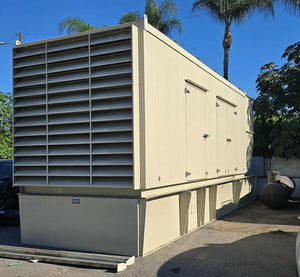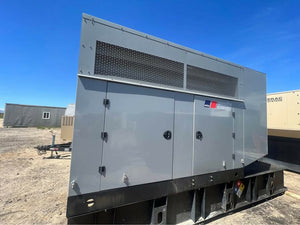


Best Materials for Soundproof Generator Enclosures
Generators are noisy - often reaching levels comparable to heavy traffic. To reduce this noise, soundproof enclosures are essential. The best materials for these enclosures combine noise reduction, durability, and proper ventilation. Here’s what works:
- Mass Loaded Vinyl (MLV): Dense, flexible, and effective for blocking airborne noise.
- Medium-Density Fiberboard (MDF): Affordable and great at blocking sound when layered.
- Damping Compounds (e.g., Green Glue): Converts vibrations into heat, reducing noise.
- Acoustic Foam or Mineral Wool: Absorbs internal sound reflections.
- Rubber Mounts or Isolation Pads: Prevent vibrations from transferring to surfaces.
- Galvanized Steel: Durable and weather-resistant for permanent outdoor setups.
- Composite Panels: Combine sound-blocking and absorption in one material.
When designing an enclosure, prioritize layering: combine mass (e.g., MLV), damping, and sound-absorbing materials for maximum noise reduction. Ensure proper ventilation with baffled ducts to maintain airflow without compromising soundproofing. Costs for DIY setups range from $1,000 to $1,500, while professional-grade solutions can go higher.
Want a quieter generator? Start with these materials and techniques for an effective soundproof enclosure.
How to Build a Generator Quiet Box (DIY) | Ultimate Stealth Enclosure
How to Choose Soundproofing Materials
When it comes to building a generator enclosure, finding the right materials means striking a balance between reducing noise, ensuring durability, and staying within budget. It's all about picking materials that can handle the unique challenges of minimizing sound while standing up to outdoor conditions and daily wear.
Noise-Blocking Performance
The ability of soundproofing materials to block noise largely depends on their density and mass. For instance, Mass Loaded Vinyl (MLV) is a high-density material that can increase wall mass by 50–100%, effectively blocking airborne sound waves. Meanwhile, materials like acoustic foam or fiberglass are designed to absorb sound, reducing the internal echo inside the enclosure. Together, these materials can achieve impressive results: barriers can reduce airborne noise by 15–20 decibels, while absorption layers can cut internal reverberation by an additional 5–7 decibels.
As Second Skin Audio explains:
"Foam is not dense enough to block sound, but it can be added inside an enclosure to absorb sound waves that would otherwise reflect off hard surfaces".
Reducing vibration noise is just as important. Generators often produce structure-borne noise when vibrations travel through their metal or plastic housings. Specialized mats, such as Damplifier Pro (which can handle temperatures up to 450°F), are highly effective at reducing this type of noise. The best results come from layering: applying a vibration damper to the housing, adding a high-mass barrier like MLV to the walls, and finishing with an absorption layer facing the generator.
Of course, noise reduction isn’t the only consideration - these materials also need to withstand outdoor environments.
Weather Resistance and Durability
Outdoor generator enclosures face tough conditions, from moisture and UV exposure to extreme temperatures. Galvanized steel is a popular choice for permanent installations because it offers excellent durability and resists corrosion over time.
Fire safety is another critical factor. Materials should meet ASTM E-84 Class A fire standards, which limit flame spread and smoke production in case of overheating. Additionally, heat resistance is essential since generators produce a lot of thermal energy.
Maintaining proper airflow while soundproofing can be tricky. As AcoustiGuard-Wilrep Ltd. points out:
"The more we try to reduce the sound, the more we restrict the air movement. The rad fan only has so much power to move the air before it’s not able to adequately cool the engine".
To address this, acoustic louvers and external baffles are often used. These features allow air to circulate freely, prevent rain from entering, and block direct sound paths.
Once you've evaluated performance and durability, the next step is to consider costs and availability.
Material Costs and Availability
Building a custom soundproof enclosure in the U.S. typically costs between $1,000 and $1,500, depending on the size and quality of the materials. Here's a breakdown of material options by price range:
| Material Tier | Price Range (USD) | Examples |
|---|---|---|
| Budget/Temporary | $20–$150 | Waterproof running covers, small rubber mats, foam panels |
| Midrange/DIY | $200–$650 | MLV rolls, soundproofing composites, soundproof coatings |
| Premium/Professional | $1,300–$1,500+ | Engineered aluminum quiet boxes with cooling fans |
Budget-friendly materials like MDF and plywood are easy to find at local hardware stores. For better performance, midrange options like MLV and Green Glue provide excellent noise reduction at a reasonable price. If durability is your top priority, premium solutions like modular galvanized steel panels are ideal for industrial setups.
Suppliers like Soundproof Cow, Second Skin Audio, and Metal Form Manufacturing offer free domestic shipping on specialized materials, which can help cut down costs for heavy items like MLV. For larger projects, bulk purchases of modular acoustical panels can further reduce unit costs, making it easier to source high-performance materials.
Best Materials for Soundproof Generator Enclosures
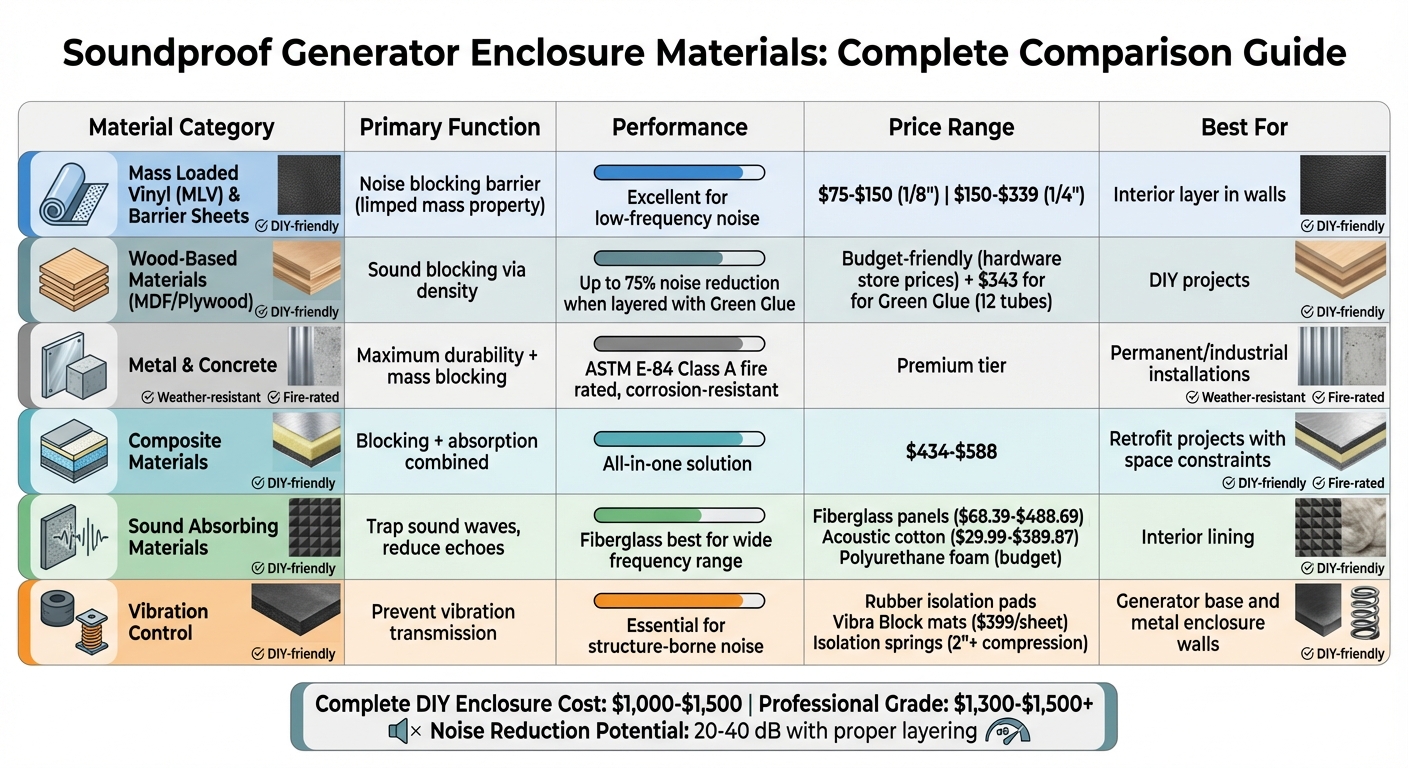
Soundproofing Materials Comparison: Properties, Performance, and Costs
When it comes to soundproofing a generator, the materials you choose can make a huge difference in reducing noise levels. Whether you're crafting a DIY enclosure or opting for a professional-grade setup, understanding the strengths of different materials is key.
Mass Loaded Vinyl (MLV) and Barrier Sheets
Mass Loaded Vinyl (MLV) is often considered one of the best materials for blocking noise. This dense, flexible material, available in 1/8" or 1/4" thickness, is packed with calcium carbonate to add weight without bulk. For reference, the 1/8" version weighs about 1 lb per square foot, while the thicker 1/4" version doubles that at 2 lbs per square foot.
What makes MLV so effective? Its "limped mass" property, as explained by Steve Snider:
"Limped mass makes the assembly more effective with some larger soundwaves because it allows some 'give' ensuring optimal soundproofing performance".
Unlike rigid materials that reflect sound, MLV absorbs sound energy, much like how a loose net slows down a baseball. It’s a go-to choice for blocking low-frequency noise, such as the hum of a generator. Prices range from $75 to $339 depending on thickness.
For optimal results, use MLV as an interior layer in your enclosure walls. Pair it with rigid panels and sound-absorbing materials for a well-rounded solution. Just remember to leave enough ventilation for cooling and safety.
| Material | Thickness | Weight per sq. ft. | Primary Function | Price Range (USD) |
|---|---|---|---|---|
| MLV (1/8") | 1/8" | 1 lb | Noise blocking barrier | $75–$150 |
| MLV (1/4") | 1/4" | 2 lbs | Heavy-duty noise blocking | $150–$339 |
| Composite Foam | 1-3/8" | Varies | Blocking + absorption | $434–$588 |
Next, let’s look at wood-based options for those taking the DIY route.
Plywood and MDF Panels
For DIY enthusiasts, Medium-Density Fiberboard (MDF) and particle board are affordable choices that also happen to be great at blocking sound. These engineered wood products are denser than standard plywood, which makes them better at stopping sound waves. As David Watkinson from Acoustical Solutions puts it:
"Heavy things stop sound. Particle board is pretty heavy stuff".
To maximize their effectiveness, use two layers of 5/8" MDF or particle board with a damping compound like Green Glue sandwiched between them. Green Glue works by converting sound energy into heat, reducing vibrations. A case of 12 tubes costs roughly $343, which should cover a medium-sized enclosure.
MDF and plywood are easy to find at local hardware stores and straightforward to work with. If your enclosure will be outdoors, apply a weatherproof coating or paint to protect the wood. When combined with MLV and foam, a well-constructed wooden enclosure can cut noise by up to 75%.
For more permanent or industrial setups, metal, concrete, or advanced composites may be better options.
Metal, Concrete, and Composite Materials
For industrial or long-term installations, materials like galvanized steel, concrete, and composites are excellent choices. Galvanized steel stands out for its durability and safety. According to Metal Form Manufacturing:
"Fire safety begins with Metal Form's galvanized steel acoustical panels, known for their non-combustible properties. These panels meet ASTM E-84 Class A fire standards".
Galvanized steel is also low-maintenance, corrosion-resistant, and capable of withstanding extreme conditions. Concrete, on the other hand, offers unmatched mass and noise-blocking capabilities, making it ideal for permanent generator pads or bunker-style enclosures. However, concrete walls need internal foam lining to prevent sound from echoing inside.
Composite materials are another option, combining layers like MLV with foam or other absorptive materials. Products such as PrivacyShield® Soundproofing Composite Foam, priced between $434 and $588, provide an all-in-one solution. These are particularly useful for retrofit projects where space is tight.
Each of these materials has its own strengths, so your choice will depend on your specific needs, budget, and whether you’re tackling the project yourself or hiring professionals. With the right combination of materials, you can significantly reduce generator noise while keeping safety and functionality intact.
sbb-itb-501186b
Additional Materials to Improve Soundproofing
Sound Absorbing Foams and Panels
After constructing the outer shell of your generator enclosure with dense materials like mass loaded vinyl (MLV) or plywood, the next step is reducing noise reflections inside. Without proper sound absorption, the noise inside can bounce around, amplifying the overall sound.
One of the best options for this is fiberglass panels. Their dense, porous structure effectively traps sound waves across a wide range of frequencies, from low rumbles to high-pitched noises. They also install easily without frames, offering broad coverage. Hayden Saunders, an Acoustical Sales Consultant at Acoustical Solutions, highlights their effectiveness:
"Fiberglass is my top choice for sound absorbing material... this characteristic allows sound to enter and get trapped within".
For example, AlphaSorb® Fabric Wrapped Acoustic Panels are available at prices ranging from $68.39 to $488.69.
If you're looking for a more budget-friendly option, open-cell polyurethane foam can help reduce echoes and reverberation. However, it’s not as effective as fiberglass for managing low-frequency sounds. For those interested in recycled materials, acoustic cotton panels like Echo Absorber™ are worth considering. These panels, often used in industrial settings, range in price from $29.99 to $389.87.
Fire safety is crucial when selecting materials, as generators generate significant heat. Always choose fire-rated options, such as fire-resistant foams or mineral wool, to ensure safety inside the enclosure. Once sound absorption is in place, the next focus should be on reducing vibration noise.
Vibration Damping and Isolation Materials
Addressing vibration is just as important as managing internal sound reflections. When a generator is placed directly on concrete or metal, vibrations can travel through the structure, turning walls and floors into amplifiers. Ken Lovorn, PE, President of Lovorn Engineering Associates, explains:
"Vibration is transmitted through integral isolators to the skid-base and from there to the housekeeping pad, genset foundation, or building structure".
The key is to isolate the generator from its base. Rubber mounts or isolation pads are effective solutions for this. For managing low-frequency vibrations, isolating springs are a better choice, but they need at least 2 inches of compression under load to work properly. Additionally, layered pads made from materials like neoprene and cork perform better than single-material pads, as their varying densities absorb a wider range of vibrations.
If you're working with a metal enclosure, applying butyl-based damping mats to the walls can prevent them from resonating like a drum. A good option is Vibra Block Sound Deadening Material, which costs around $399.00 per sheet. To further minimize vibration transmission, consider using flexible, metallic braided connections for fuel lines and electrical conduits.
For high-performance setups, an inertia base - a steel frame filled with reinforced concrete - provides additional stability. It should weigh at least 150% of the generator’s total weight to effectively counteract motion. It’s worth noting that achieving noise reduction levels of 35 dB for a two-megawatt generator can cost around $110,000, while reaching 55 dB may exceed $750,000.
Weatherproof and Portable Solutions
If your generator setup needs to handle outdoor conditions or remain portable, there are specialized solutions to consider. Acoustic blankets are a great choice for temporary or outdoor use. These blankets combine MLV with an acoustical absorber and are wrapped in durable, weather-resistant vinyl. They’re easy to attach using grommets or Velcro and can reduce noise by 20 to 40 decibels.
For permanent outdoor enclosures, BlocknZorbe panels are a solid option. They block airborne noise while absorbing internal reflections, and they’re both waterproof and UV-resistant. If moisture or heat is a concern, hydrophobic melamine foam like Mega Zorbe is a smart choice. It’s water-resistant, fire-rated, and ideal for lining the interior of enclosures.
Dylan, a customer who used Second Skin Audio products on his Sprinter Van, shared his results:
"I started the generator and it is now possible to have a whispering conversation".
To achieve similar results, ensure the generator is decoupled from the ground using a rubber mat, seal any air gaps with acoustical sealant or foil tape, and direct exhaust away from living areas. For ventilation, consider building external baffles with plywood and sound-absorbing panels. These baffles create a "maze" that traps sound while still allowing airflow.
Conclusion: Building an Effective Soundproof Generator Enclosure
Layering Materials for Maximum Noise Reduction
Creating a soundproof generator enclosure that effectively minimizes noise starts with a smart layering strategy. A triple-layer approach works best: start with a sturdy outer shell to provide mass and protect against weather, add a dense barrier layer like mass-loaded vinyl (MLV) to block airborne noise, and finish with an interior lining of sound-absorbing materials such as acoustic foam to reduce echoes. To further enhance noise control, use damping agents like Green Glue between the layers, which convert sound energy into heat. Additionally, mount the generator on rubber isolators to stop vibrations from traveling [4, 22, 17, 3].
Proper ventilation is just as critical. Place intake and exhaust vents on opposite sides of the enclosure to allow for effective airflow. Use baffled ducts with multiple bends - forcing air through S-shaped curves helps sound waves dissipate as they encounter the absorbent lining. Seal every gap with acoustic caulk, as even tiny openings can undermine the enclosure's performance [4, 17]. By combining these techniques, you can achieve a noise reduction of 20 to 40 decibels while ensuring the enclosure is durable and safe for U.S. generator setups.
Finding Generator Equipment on Electrical Trader
Once your soundproof enclosure design is ready, head to Electrical Trader to source the generator equipment and components you need. This platform offers a wide selection of new and used power generation gear, including emergency standby diesel generators, transformers, breakers, and power distribution tools. With options tailored to residential, commercial, and industrial requirements, it’s a one-stop shop for all your power generation needs.
FAQs
What materials work best for soundproofing a generator enclosure?
When it comes to soundproofing a generator enclosure, the key is using materials that both block and absorb noise effectively. Mass-loaded vinyl (MLV) is a standout option thanks to its dense structure, which makes it excellent at stopping sound waves. Another great material is Rockwool acoustic insulation, which not only soaks up sound but also offers thermal insulation. You might also consider acoustic foam panels or composite sound-deadening barriers to significantly lower noise levels.
To tackle vibrations, look into vibration-damping sheets or specialized noise-control coatings. By combining these materials, you can build an enclosure that keeps noise and vibrations to a minimum, allowing your generator to run smoothly and quietly.
How do I keep my soundproof generator enclosure ventilated and cool?
To keep a soundproof generator enclosure well-ventilated while minimizing noise, start by making sure there’s enough space around the generator. Aim for 3 to 6 inches of clearance on all sides. Install a low intake vent near the bottom of the enclosure and a high exhaust vent on the opposite side to allow warm air to escape naturally as it rises. For enclosures that are tightly sealed, consider adding a powered exhaust fan to help circulate air and prevent overheating. Make sure to select fans designed for outdoor or high-temperature conditions, and connect them to operate whenever the generator is running.
To limit noise from escaping, use louvered or acoustic-rated vent grilles and line the vent openings with materials like acoustic foam or mass-loaded vinyl. If possible, opt for a double-wall enclosure design with a 1- to 2-inch air gap between the inner and outer walls. This setup enhances both soundproofing and ventilation.
Before sealing everything up, test the system by running the generator and monitoring surface temperatures. The enclosure should remain well below the generator’s maximum operating temperature, which is generally under 200°F for most portable models. Don’t forget to regularly check the vents for blockages and keep the exhaust path clear to ensure safe and efficient operation.
How much does it cost to build a DIY soundproof generator enclosure?
When building a DIY soundproof generator enclosure, costs can vary widely - from as little as $36 to as much as $650. The price largely depends on the materials you decide to use. For instance, basic sound-deadening sheets are available for around $36, while more advanced options, like specialized soundproof coatings, can reach up to $650 for a 5-gallon container.
Your choice of materials should align with both your budget and the level of noise reduction you’re aiming for. Popular options include acoustic foam, mass-loaded vinyl, and soundproofing paint, each offering different levels of soundproofing performance at varying price points.