

Arc Flash Incident Reporting Steps
Arc flash incidents are dangerous electrical explosions that demand immediate attention and thorough reporting. Here's what you need to know:
- What is an arc flash? A sudden electrical explosion caused by current jumping between conductors or to the ground, producing extreme heat (up to 35,000°F), light, and pressure waves.
- Why report incidents? Reporting helps identify causes, improve safety, and comply with OSHA and NFPA 70E standards.
-
Key steps after an incident:
- Secure the area: De-energize equipment, implement lockout/tagout (LOTO), and restrict access.
- Call for medical help: Contact EMS immediately, even for minor injuries.
- Preserve the scene: Document everything without altering the site.
- What to document: Include details about the incident, equipment, worker actions, and safety protocol compliance.
- OSHA compliance: Prepare for investigations by maintaining updated records like hazard analyses, training certifications, and energized work permits.
- Updating safety measures: Reassess risk factors, update warning labels, and ensure accurate arc flash hazard analyses.
Proper incident reporting and regular safety updates are crucial for protecting workers and minimizing risks. The article provides a detailed guide on handling arc flash incidents, from immediate response to long-term safety improvements.
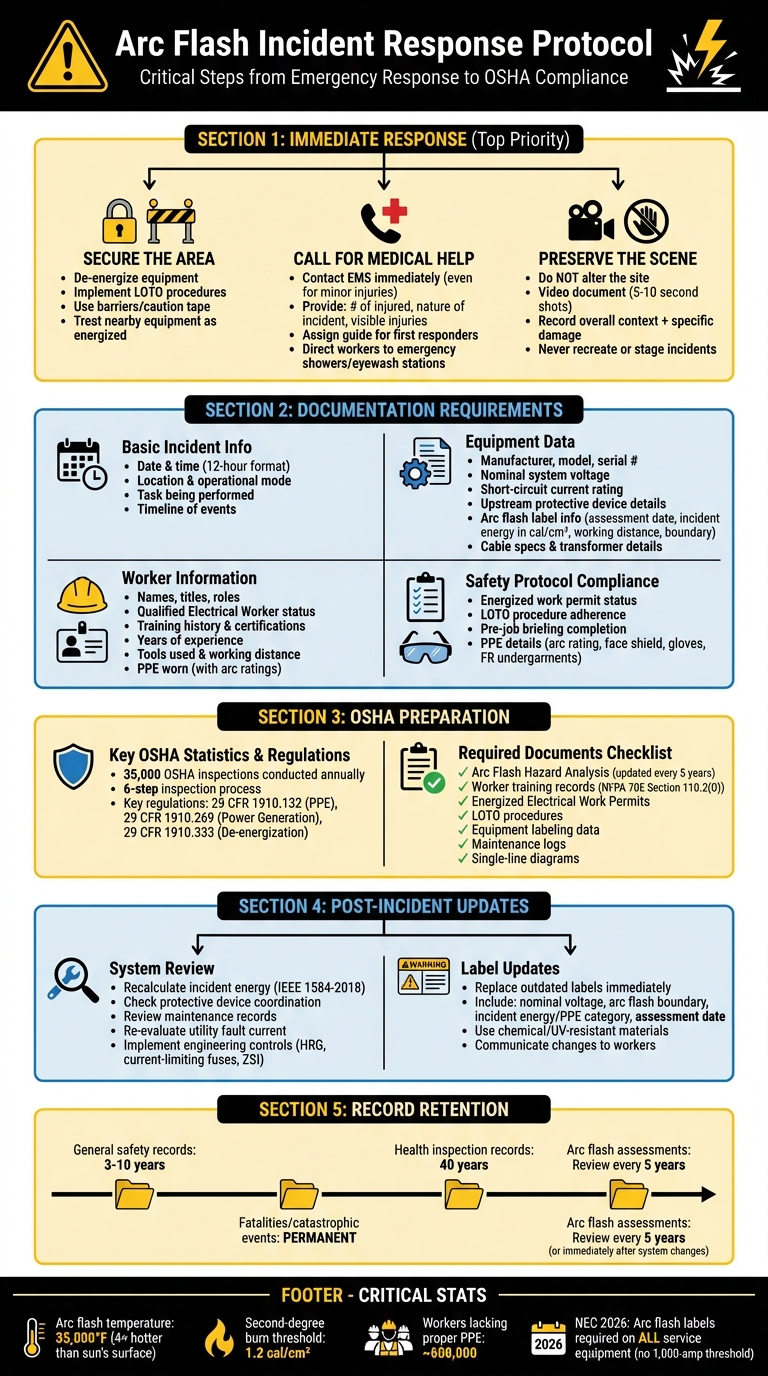
Arc Flash Incident Response: Critical Steps and Documentation Requirements
NEW Arc Flash Report Template with less narrative and more SKM report generation

sbb-itb-501186b
Immediate Steps After an Arc Flash Incident
Responding promptly and effectively to an arc flash incident is crucial for ensuring safety and setting the stage for a thorough investigation.
Secure the Area
The first step is to isolate all power sources. Ensure that proper lockout/tagout (LOTO) procedures are fully implemented before approaching the area. As OSHA 29 CFR 1910.333 states, "Conductors and parts of electric equipment that have been deenergized but have not been locked out or tagged ... shall be treated as energized parts".
Use barriers or caution tape to secure the site and prevent unauthorized access. Follow your facility’s emergency action plan, making sure all personnel evacuate through designated routes and gather at the assigned assembly points. Since arc flash incidents can damage electrical systems beyond the immediate area, treat all nearby equipment as potentially energized until it has been inspected and confirmed safe.
Call for Medical Help
Immediately contact emergency medical services (EMS), even if injuries appear minor. Arc flash incidents often result in hidden injuries, such as internal trauma or respiratory issues, that may not be immediately obvious. When calling 911, provide detailed information about the situation: the number of injured individuals, the nature of the arc flash, and any visible injuries, such as burns or signs of blast trauma.
Assign someone to guide first responders directly to the scene. While waiting for EMS, trained personnel should administer basic first aid or CPR if it can be done safely. If workers have been exposed to debris or thermal hazards, direct them to emergency showers or eyewash stations. Remember, even lower-voltage systems, like 120/208V, "can create arcs with more than enough energy to burn exposed skin, ignite flammable clothing and cause catastrophic or fatal injuries", as OSHA highlights.
Once medical help is on the way, shift your focus to preserving the site for investigation.
Protect the Scene for Investigation
Do not alter the incident site. Preserve the area exactly as it was at the time of the event. Use video to document the scene, capturing both the overall context and specific damage points. Before recording, double-check that your camera’s date and time settings are accurate. Take 5-to-10 second shots of key areas, such as the point of employee exposure or damaged equipment.
If narrating the footage, record audio on-site and avoid editing it later, following OSHA Instruction CPL 2.98. Never attempt to recreate or stage any part of the incident. Keep all original recordings secure in a climate-controlled environment, and provide investigators with copies while retaining the master files.
What to Document in Your Incident Report
Once the incident site is secured, capturing detailed documentation becomes a top priority. This step is crucial for investigating the causes of the arc flash and improving safety measures going forward. A thorough report should cover the technical details, human actions, and procedural elements that played a role in the event. Every piece of information helps investigators understand what happened and guides updates to safety protocols.
Basic Incident Information
Start with the essential facts. Record the date, time (use the 12-hour AM/PM format), location, and the operational mode (e.g., utility, backup, or bypass) when the arc flash occurred. Include a precise timeline of the events leading up to the incident. Be specific about the task being performed - whether it was closing a switch, troubleshooting, or something else - and describe what immediately preceded the arc flash.
Equipment Information
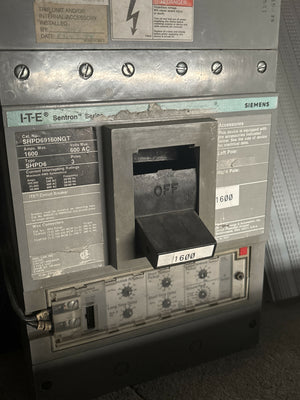
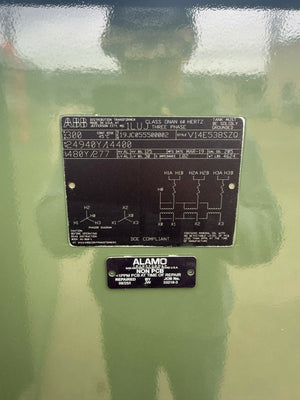
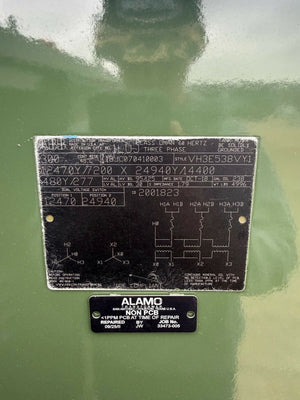
Documenting the equipment involved is key to understanding technical failures and improving safety measures. Include the manufacturer, model, and serial number for all affected components, such as switchgear, Motor Control Centers (MCCs), Variable Frequency Drives (VFDs), and panelboards. Record the nominal system voltage and the short-circuit current rating listed on the equipment's nameplate.
For protective devices, note the upstream circuit breaker or fuse that cleared the fault. Be specific about the manufacturer, model, and trip settings (thermal and magnetic). If fuses were used, include the size, type, manufacturer, and model. High-resolution photos of nameplates and labels can ensure accuracy.
Don’t forget to document arc flash label details: the assessment date, incident energy (in cal/cm²), working distance, and boundary. Corey Hannahs, Senior Electrical Specialist at NFPA, highlights the importance of dates on labels:
"The new requirement [for assessment dates on labels] provides better context for when the data was current, serving as a reminder for periodic reviews".
The 2026 edition of the National Electrical Code (NEC) now mandates arc flash labels on all service equipment and feeders, eliminating the previous 1,000-amp threshold.
Additionally, record cable specifications, including size, type (copper or aluminum), length, and the number of conductors per phase. For transformers, note the primary and secondary voltage, kVA rating, impedance, and grounding configuration. Look for signs of wear, such as insulation damage, moisture intrusion, carbonized tracking, or corroded connections.
Worker Information
Understanding the human element is just as important as the technical data. Document the names, job titles, and roles of everyone involved, including operators, supervisors, and witnesses. Verify whether each individual meets OSHA and NFPA’s definition of a "Qualified Electrical Worker." Include details about their training history, certifications (e.g., NFPA 70E compliance), and years of experience.
Describe the workers’ movements and actions leading up to and during the arc flash. Note the tools they were using (e.g., a 9-inch torpedo level or a non-insulated screwdriver) and whether those tools were suitable for energized work. Record the working distance - the space between the worker and the source of the arc.
For example, an incident at the Stanford Linear Accelerator Center revealed that using improper tools without adequate PPE can result in catastrophic outcomes. A worker using a non-insulated screwdriver applied extra force to a screw, causing a bus jumper bar to deflect and trigger an arc flash. The worker suffered third-degree burns to the face, chest, and legs.
It’s estimated that about 600,000 workers lack the proper PPE to protect against arc flash hazards. By documenting worker data thoroughly, you can connect human factors to procedural gaps and strengthen safety reviews.
Safety Protocol Compliance
Reviewing adherence to safety protocols can uncover procedural failures that contributed to the incident. Document whether an energized work permit was issued and if lockout/tagout procedures were followed. Confirm whether the worker participated in a pre-job briefing and had the necessary work authorization.
Detail the PPE worn by each worker, including the arc rating of clothing (in cal/cm²), face shields, gloves, and flame-resistant undergarments. Note any required PPE that was missing. For reference, an incident energy level of 1.2 cal/cm² is the threshold for second-degree burns, while arc flash temperatures can soar to 35,000°F - four times hotter than the surface of the sun .
In one notable case from September 2009 at the Savannah River Site, two mechanics troubleshooting a 480V breaker triggered an arc flash. A 9-inch torpedo level fell and lodged between a moving contact and a support brace, causing the flash. The mechanic was not wearing a flash suit or flame-retardant coveralls and sustained severe burns.
| Worker Information Category | Specific Data Points to Record |
|---|---|
| Identification | Name, Job Title, Department, Supervisor Name |
| Qualifications | "Qualified Person" status, Years of Experience, Last Training Date |
| Task Context | Work Order #, Authorization Source, Pre-job Briefing completion |
| Actions | Tools used, specific sequence of movements, distance from equipment |
| PPE Status | Arc rating of clothing (cal/cm²), use of face shield, gloves, and undergarments |
How to Prepare for OSHA Investigations
After an arc flash incident, OSHA will conduct a detailed investigation to ensure safety compliance. With approximately 35,000 inspections conducted annually across the U.S., preparation can make a big difference in the outcome of these reviews. OSHA's inspection process involves six steps: presenting credentials, holding an opening conference to outline the scope, conducting a physical walkaround, interviewing employees privately, reviewing documentation, and concluding with a summary conference. Having well-organized records and clear answers ready can help avoid hefty citations.
OSHA enforces arc flash safety under 29 CFR 1910.132 (PPE), 29 CFR 1910.269 (Power Generation), and the General Duty Clause. It often references NFPA 70E as the benchmark standard. This means your documentation must reflect adherence to recognized safety practices, not just the bare minimum.
Questions OSHA Will Ask
Inspectors will zero in on why work was performed on energized equipment. According to 29 CFR 1910.333, equipment must be de-energized unless the employer can demonstrate that doing so would create additional hazards or is not feasible due to equipment design or operational needs. NFPA 70E Section 130.2 mandates an energized electrical work permit that justifies why de-energization was not performed.
Expect inspectors to ask about worker qualifications and hazard assessments, including specifics like the equipment's incident energy level and the extent of the arc flash boundary. They’ll also verify whether workers were aware of these details and if their PPE matched the calculated hazard. A common question might be: "What is the incident energy level for this specific piece of equipment?". These inquiries help connect the incident report to the required documentation.
Keep your hazard analysis current - update it every five years or after significant system changes. Common issues during audits include outdated engineering studies and missing equipment labels.
Required Documents
The incident report lays the groundwork for the documentation OSHA will review. Organize these records ahead of time to ensure a smooth process. Start with a current Arc Flash Hazard Analysis that includes short-circuit and coordination calculations showing incident energy levels for each piece of equipment. This analysis should be updated at least every five years or whenever significant changes occur, such as replacing transformers or adjusting utility fault current levels.
Have worker training records ready to prove employees are "qualified" and have received training on electrical safety and PPE selection, as required by NFPA 70E Section 110.2(D). Include certificates, training dates, and documentation of hazard recognition skills. Inspectors will cross-check these records during private employee interviews.
Make sure to have energized electrical work permits and lockout/tagout (LOTO) procedures available. OSHA considers any equipment not properly locked or tagged out as energized, making LOTO documentation critical. As outlined in OSHA 29 CFR 1910.333:
"Conductors and parts of electric equipment that have been deenergized but have not been locked out or tagged ... shall be treated as energized parts".
| Document Category | Specific Records to Prepare |
|---|---|
| Engineering | Arc Flash Hazard Analysis (less than 5 years old), Single-line diagrams, Short-circuit/coordination studies |
| Administrative | Energized Electrical Work Permits, Emergency Action Plan (EAP), Injury/Illness records (OSHA 300 logs) |
| Personnel | Qualified worker training certificates, PPE hazard assessments, PPE maintenance/inspection logs |
| Equipment | Maintenance logs for protective devices (breakers, fuses), Equipment-specific LOTO procedures |
Also, prepare equipment labeling data showing arc flash warning labels with details like assessment date, nominal voltage, arc flash boundary, and calculated incident energy or PPE category. Include maintenance and engineering records such as single-line diagrams, transformer kVA ratings, impedance values, and protective device settings for breakers, fuses, and relays. Storing these documents in a centralized "establishment file" for each facility ensures they’re easy to access during inspections.
Updating Risk Assessments After an Incident
After an arc flash incident, it’s crucial to revisit and update your safety assessments. Although NFPA 70E mandates reviews at least every five years, incidents often highlight flaws in your original calculations. These gaps could stem from outdated equipment ratings, incorrect protective device settings, or utility fault current changes that weren’t factored in. Reassessing these elements is essential for improving safety measures and ensuring accurate reporting.
Check System Settings
Work with power-system engineers to recalculate incident energy using IEEE 1584-2018 standards. Pay close attention to factors like bolted fault current, bus gap, and electrode configuration. These recalculations help determine the actual energy released at specific locations and often expose discrepancies in older studies.
Examine protective device coordination by reviewing the clearing times of all relays and breakers involved. This is critical because even small changes in clearing time can drastically affect incident energy levels. For instance, a relay set to clear a fault in 2 cycles (0.033 seconds) generates much less energy than a breaker that takes 30 cycles. Additionally, check if any equipment is "over-dutied" - meaning it’s rated below the available fault current - which could have contributed to the incident.
Review maintenance records as well. As noted in Plant Engineering:
"Insufficient maintenance of an overcurrent-protection device can lead to an increased operating time, which could result in higher arc-flash-incident energy than the values determined by an arc-flash-incident energy analysis".
Ensure that maintenance conditions are accurately reflected in your risk assessment. Also, re-evaluate the utility fault current at the service entrance, as upstream changes can render previous studies obsolete. To minimize hazards at the source, consider implementing engineering controls such as high-resistance grounding (HRG), current-limiting fuses, or zone-selective interlocking (ZSI). These measures, combined with updated protective settings, help reduce risks before relying solely on PPE. Use these findings to guide updates to hazard labels and overall safety protocols.
Update Warning Labels
Once system checks and recalculations are complete, update equipment labels immediately. If the updated study reveals new hazard levels, the old labels must be replaced to ensure workers aren’t misled. The 2026 National Electrical Code now requires arc flash labels on all service equipment and feeders, including panelboards and motor control centers.
Every updated label should include key details like the nominal system voltage, the arc flash boundary (where incident energy reaches 1.2 cal/cm²), and either the calculated incident energy or the required PPE category. Don’t forget to include the assessment date - this provides a clear reference for when the data was last validated. Corey Hannahs, Senior Electrical Specialist at NFPA, emphasizes:
"The new requirement [to include assessment dates] provides better context for when the data was current, serving as a reminder for periodic reviews".
Labels should be placed on equipment exteriors for visibility before workers access energized parts. In environments like food and beverage facilities, use materials that resist chemicals and UV exposure to maintain label legibility over time. Once labels are updated, communicate these changes to workers through safety meetings and revised work procedures. Make sure they understand the new PPE requirements and how these updates impact their daily tasks.
How to File and Store Incident Reports
Once on-site actions are completed and documentation is detailed, the next step is to compile and securely store these records according to compliance guidelines.
Write the Final Report
Start with an executive summary that outlines the scope of the incident, key findings, and the methodology used. This summary allows stakeholders to quickly grasp the situation without diving into complex technical details.
Include an updated arc flash spreadsheet that details fault currents, protection device settings, and short-circuit analyses. Be sure to document all assumptions, such as cable lengths and transformer impedances, to ensure clarity for future reviews. Keep single-line diagrams up-to-date to validate the arc flash study.
Your report should also feature advisory statements about how potential system changes could influence incident energy levels in the future. Document the specific software manufacturer, version, and configuration settings used for calculations to maintain consistency during future updates. If you're working with an engineering firm, ensure your facility has ownership of the native engineering model files (e.g., SKM, ETAP, or EasyPower). Without these files, updating the report later can become much more complicated and costly.
Once the incident is fully documented, carefully compile all related records for storage.
Maintain Records
Organize incident reports into "Compliance Case Files", keeping all materials related to a specific incident together from start to finish. A complete file should include pre-incident preparations, field notes, process information, interviews, and post-incident records like settlement documents, penalty payments, and abatement verification. Include multimedia evidence alongside paper documents in one unified file.
Pay attention to retention periods, as these differ depending on the type of incident. General safety records should be kept for 3–10 years, while records involving fatalities or catastrophic events must be stored permanently. Health inspection records with sampling data require a 40-year retention period. Arc flash risk assessments should be reviewed and updated at least every five years. However, significant changes - such as modifications to utility service, new transformers, or adjusted breaker settings - should prompt immediate updates.
For permanent records, avoid relying solely on digital storage. While CD-ROMs or similar electronic formats work for general record-keeping, they are not suitable for permanent retention. Instead, use archival-quality materials like paper or specific archival electronic tapes. Magnetic media, such as videotapes, have an approximate lifespan of 10 years in non-climate-controlled environments, so store audiovisual evidence in climate-controlled conditions.
Label folders with the establishment name, a unique case ID, and the closure year. To streamline organization, consider integrating records into a Computerized Maintenance Management System (CMMS). This allows you to tag assets and directly link incident reports to equipment records, creating a clear audit trail. Additionally, maintain a separate log of all "Energized Electrical Work Permits" as part of your permanent safety records.
Conclusion
Accurate arc flash incident reporting plays a crucial role in protecting workers and reducing future risks. The process starts immediately after an incident by securing the area, seeking medical assistance, and preserving evidence. From there, detailed documentation of equipment, worker actions, and safety protocols becomes essential for OSHA investigations and internal evaluations. Once the final report is complete, ensure all records are stored securely and retained for the required duration.
Ongoing risk assessments are just as critical. According to NFPA 70E, risk assessments must be reviewed at least every five years. However, any system changes - like transformer replacements or adjustments to breaker settings - should prompt an immediate re-assessment. Failing to update labels or PPE ratings can lead to severe consequences, underscoring the importance of consistent reviews to maintain worker safety.
The choice of reliable equipment is another key factor. High-performance protective devices, such as current-limiting fuses and circuit breakers, can significantly reduce clearing times, which in turn lowers the thermal energy released during faults. As one expert explains, "Arc flash severity is governed by two primary variables: available fault current and protective device clearing time. Higher fault current and longer clearing times exponentially increase incident energy". Using components with verified specifications ensures more accurate arc flash analysis and better protection for workers.
Platforms like Electrical Trader (https://electricaltrader.com) provide access to new and used breakers, transformers, and other power distribution equipment. These come with manufacturer data that can be integrated into engineering software to calculate trip times and PPE requirements. This transforms general warnings into actionable safety measures tailored to your team.
FAQs
Who should complete the arc flash incident report?
The arc flash incident report needs to be filled out by the individual or team tasked with documenting the event. This usually includes the affected worker, their supervisor, or safety personnel involved in handling the incident. Make sure every relevant detail is recorded thoroughly to meet compliance requirements and for future review.
When is energized work allowed after an arc flash event?
Energized work is generally not allowed right after an arc flash incident. Before any work resumes, it's crucial to conduct a detailed incident energy assessment and hazard evaluation. On top of that, all necessary safety precautions, including the use of suitable PPE, must be in place to prioritize worker safety and meet compliance standards.
How long should arc flash incident records be kept?
Arc flash incident records need to be kept for at least five years or until the next arc flash assessment review takes place - whichever comes first. This helps maintain proper documentation and ensures compliance with safety regulations.