Amorphous vs Silicon Steel: Efficiency Comparison
If your transformer stays energized all day, an amorphous core will usually waste less power and cost less over its life. In many cases, it cuts no-load loss by 70% to 80%, but it also costs more up front, takes more space, and can run louder.
Here’s the short version:
- Amorphous core: lower no-load loss, lower lifetime energy cost, higher purchase price
- Silicon steel core: lower purchase price, smaller size, better fit for high-load service
- For a 1,000 kVA unit, lifetime savings can exceed $22,000 over 30 years at $0.10/kWh
- Amorphous units often cost 30% to 50% more at purchase
- The choice mostly comes down to load factor, hours energized, space, and budget
If I were buying for a lightly loaded, always-on distribution system, I’d lean toward amorphous. If I needed lower first cost, a smaller footprint, or a unit that runs hard most of the time, I’d look at silicon steel.
Quick Comparison
| Factor | Amorphous Core | Silicon Steel Core |
|---|---|---|
| No-load loss | Much lower | Higher |
| Upfront cost | Higher | Lower |
| Lifetime loss cost | Lower | Higher |
| Size and weight | Larger, heavier | Smaller, lighter |
| Best load range | Low to mid load | High load |
| Best use case | 24/7 energized distribution | Tighter space, heavier use |
| Noise | Often higher | Often lower |
This article compares efficiency, losses, payback, total owning cost, and use cases so you can match the core type to how the transformer will run.
Why Amorphous Core Transformers Are More Efficient? | CRGO vs Amorphous
sbb-itb-501186b
Core Material Basics: Amorphous vs Silicon Steel
Those efficiency differences start with the core itself. The big split comes down to structure: silicon steel is crystalline, while amorphous metal has a disordered atomic arrangement. That one difference drives the gap in core loss.
How Amorphous Cores Are Built and What They Deliver
Amorphous metal is made by ultra-rapid quenching of molten alloy, fast enough to stop crystals from forming. What you get is an ultra-thin ribbon, usually 0.025 to 0.03 mm thick. That's about one-tenth the thickness of a standard silicon steel lamination.
That thin ribbon helps cut eddy currents. On top of that, the disordered structure makes magnetization easier and reduces hysteresis loss. Put simply, less energy gets burned off inside the core.
There is a tradeoff, though. The ribbon is brittle, and the lower saturation flux density means the core has to be larger for the same job. That also makes assembly harder.
How Silicon Steel Cores Are Built and Where They Are Used
Silicon steel, especially cold-rolled grain-oriented (CRGO) steel, is common in transformer cores. Its laminations are usually 0.23 to 0.30 mm thick and stacked tightly, with a stacking factor of about 0.96 to 0.97.
Because it has a higher saturation flux density, it can handle the same rating in a smaller footprint.
The table below shows the main practical differences.
| Parameter | Silicon Steel (CRGO) | Amorphous Metal |
|---|---|---|
| Typical Thickness | 0.23–0.30 mm | 0.025–0.03 mm |
| Core Loss at 1.5 T | ~0.8–1.3 W/kg | ~0.2–0.4 W/kg |
| Saturation Flux Density | ~1.9–2.03 T | ~1.56–1.6 T |
| Stacking Factor | ~0.96–0.97 | ~0.85–0.87 |
These material-level differences set up the loss gap covered next.
Efficiency and Core Losses: Where Amorphous Cores Have the Edge
No-Load Loss, Hysteresis Loss, and Eddy Current Loss Explained
The biggest difference between these two core materials shows up in no-load loss.
A transformer uses power any time it stays energized, even when it is not serving load. That constant power draw is called no-load loss. You may also see it called core loss or iron loss. It includes two main parts: hysteresis loss and eddy current loss.
Hysteresis loss is the energy used to reverse magnetic domains as alternating current changes direction. On the U.S. grid, that happens 60 times per second. Silicon steel puts up more resistance during that reversal, so more energy turns into heat.
Eddy current loss comes from circulating currents that form inside the core material itself. Amorphous ribbon is much thinner and has higher electrical resistance, which cuts down those currents.
That’s why amorphous cores can cut total no-load losses by 70% to 80% versus standard silicon steel. If a site keeps transformers energized all day, every day, that gap can show up on the power bill month after month.
When the Efficiency Gap Between the Two Materials Is Most Noticeable
This edge stands out most in 24/7 distribution applications. In these setups, the transformer stays energized all the time but often runs well below full load.
That matters because many U.S. distribution transformers operate at an average load of only about 20%. When load stays that low, no-load core loss makes up most of the total loss. During low-demand hours, core loss becomes the main thing driving wasted energy, and that is where amorphous cores pull ahead.
Here’s a concrete example:
A 50 kVA comparison showed no-load loss dropping from 126 watts to 40 watts with an amorphous core, a 68.25% reduction.
That kind of drop matters most when the transformer stays energized for long stretches.
At higher load, the picture shifts. Winding loss starts to dominate, so the choice of core material has less effect on total loss. In some cases, amorphous transformers can have slightly higher load losses than silicon steel units because the larger core volume can lead to longer winding turns.
| Factor | Amorphous Core | Silicon Steel (CRGO) |
|---|---|---|
| No-Load Loss | 70%–80% lower | Higher no-load loss |
| Lifecycle Savings | High; lower Total Owning Cost (TOC) | Lower; higher long-term operating costs |
| Best Fit | Continuously energized distribution systems | High-load or intermittent-duty industrial applications |
Once the load profile is clear, the next issue is cost: do the lower losses offset the higher upfront price? That’s where operating hours start to drive the decision.
Cost and Lifecycle Tradeoffs
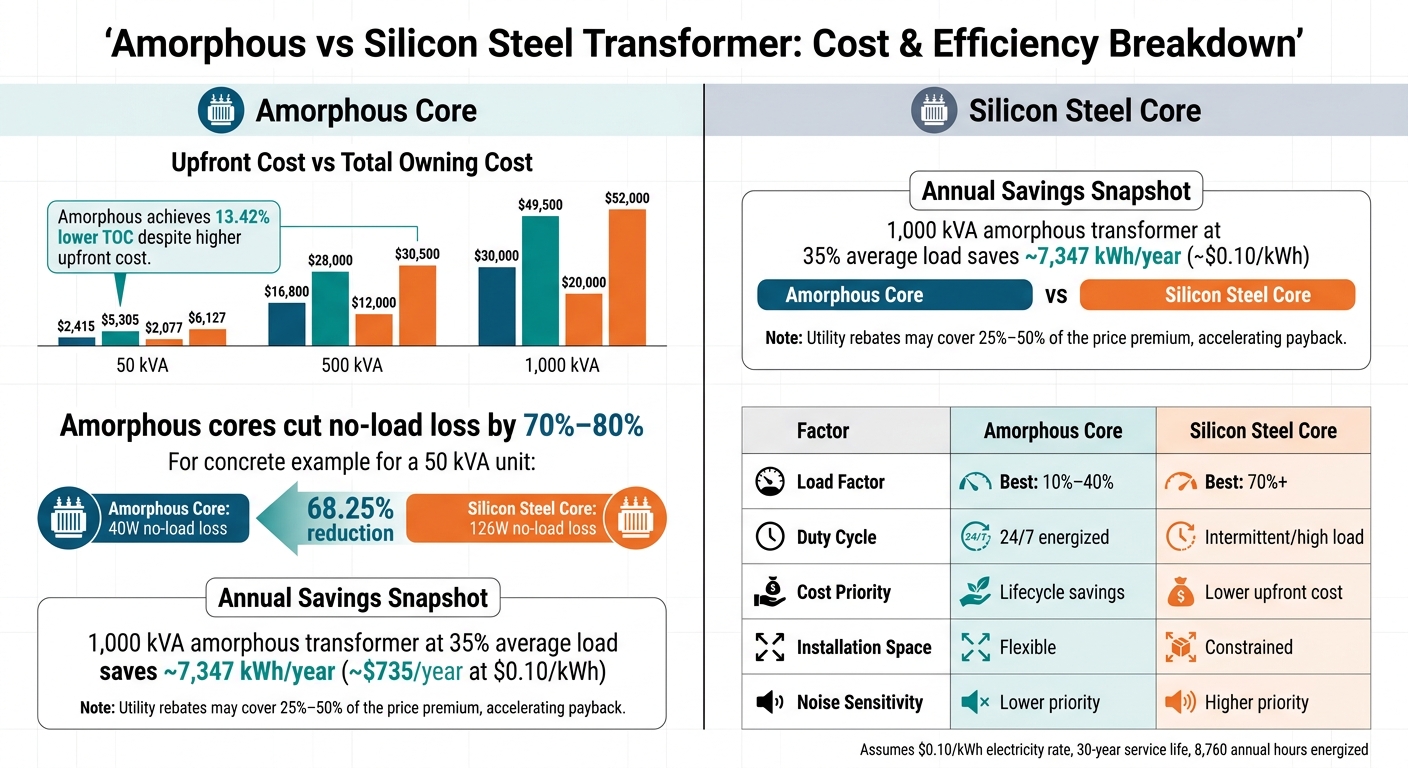
Amorphous vs Silicon Steel Transformer: Total Owning Cost & Efficiency Comparison
Upfront Price vs Long-Term Operating Savings
After you see the difference in core loss, the next issue is simple: does an amorphous transformer earn back the higher purchase price?
Upfront, amorphous units usually cost 30% to 50% more than similar silicon steel models. For a 500 kVA unit, that looks like about $16,800 vs. $12,000. For a 1,000 kVA unit, it's about $30,000 vs. $20,000.
But sticker price doesn't tell the whole story. The metric that matters is Total Owning Cost (TOC): the purchase price plus the discounted cost of future energy losses over a service life that usually spans 20 to 40 years.
Once you look at TOC, the gap gets much smaller across all three sizes:
| Capacity | Core Type | Initial Cost | Lifetime Loss Cost | Total Owning Cost |
|---|---|---|---|---|
| 50 kVA | Silicon Steel | $2,077 | $4,050 | $6,127 |
| 50 kVA | Amorphous | $2,415 | $2,890 | $5,305 |
| 500 kVA | Silicon Steel | $12,000 | $18,500 | $30,500 |
| 500 kVA | Amorphous | $16,800 | $11,200 | $28,000 |
| 1,000 kVA | Silicon Steel | $20,000 | $32,000 | $52,000 |
| 1,000 kVA | Amorphous | $30,000 | $19,500 | $49,500 |
Even with the higher upfront price, the amorphous unit ends up with a 13.42% lower TOC.
There is a tradeoff, though. Amorphous transformers are larger and heavier than silicon steel units with the same kVA rating, so it's smart to plan for bigger pads, larger enclosures, and more handling capacity. That can affect project cost, but in most cases the economics still come down to operating hours.
How U.S. Buyers Can Estimate Payback Period
TOC gives you the long-range view. Payback tells you how soon the extra upfront spend comes back.
That payback depends on five inputs:
- Annual hours energized
- Average load factor
- Local electricity rate in $/kWh
- Expected service life
- Price premium over the silicon steel option
In the U.S., distribution transformers often run at an average load of 30% to 40%, and in some places that figure can be as low as 20%. At those load levels, the amorphous core's 70% to 80% reduction in core loss turns into solid yearly savings.
At 35% average load, a 1,000 kVA amorphous transformer saves about 7,347 kWh per year, which is roughly $735 per year at $0.10/kWh.
A simple way to estimate annual loss cost is:
Cost = (NLL + LL × LF²) × 8,760 × electricity rate
Here, NLL means no-load loss, LL means load loss, and LF is the load factor. Plug in your own utility rate and load profile, and you get a payback estimate that's tied to your site instead of a rough industry average.
Utility rebates can also change the math in a big way. In some cases, they can cover 25% to 50% of the premium, which can shorten the payback period a lot.
For replacements, amorphous core units often make the most sense at end of life, when the lower loss profile can help offset the upgrade cost. At that point, the main question isn't just price. It's whether the application fits.
Best Applications and How to Choose Between the Two
Once you’ve looked at losses and payback, the next step is simple: match the core type to the way the transformer will actually run.
When Amorphous Core Transformers Are the Best Choice
Amorphous core transformers make the most sense in always-on systems that spend a lot of time at light load. Think residential feeders, rural grids, and renewable interconnections.
This shows up most clearly at low load factors. A 1,000 kVA transformer running at 25% load drops total losses from 1,825 W with silicon steel to 956 W with an amorphous core. That gap is hard to ignore. So if long-term efficiency matters more than purchase price, amorphous units often come out ahead.
When Silicon Steel Is Still a Sound Choice
That advantage shrinks once the transformer runs at high load for most of its operating cycle.
Silicon steel is a good fit for high-load sites, overload-prone service, or installations where space is limited. It also works well where loads spike often or short overload periods are part of normal operation. Amorphous units are usually larger and heavier, and they can be 3 to 8 dB louder because of magnetostrictive effects. So when footprint or noise matters, silicon steel is often the simpler pick.
Conclusion: Matching Core Type to Loss Profile and Budget
The rule of thumb is pretty clear. Amorphous fits always-on systems with low average load. Silicon steel fits heavier, steadier loads where first cost and physical size carry more weight.
| Decision Factor | Favor Amorphous | Favor Silicon Steel |
|---|---|---|
| Load factor | 10%–40% | 70%+ |
| Duty cycle | 24/7 energized | Not continuously energized |
| Cost priority | Lifecycle savings | Lower upfront cost |
| Installation space | Flexible | Constrained |
| Noise sensitivity | Lower priority | Higher priority |
If you're comparing specific units, it helps to look at the actual datasheets, loss values, and pricing side by side. Buyers can review transformer listings on Electrical Trader as part of a broader procurement evaluation.
FAQs
How do I calculate payback for my site?
Calculate payback using Total Owning Cost (TOC), not just the purchase price.
TOC includes:
- the upfront capital cost
- the capitalized future cost of no-load losses
- the capitalized future cost of load losses over the transformer's expected 20- to 30-year life
Here’s the key formula:
Annual loss cost = (No-Load Loss + (Load Factor² × Load Loss)) × Electricity Rate.
Then compare the TOC of an amorphous unit with a silicon steel unit. That shows whether the lower core losses are enough to make up for the higher initial cost.
Does an amorphous core always save money?
No. Amorphous cores can cut no-load energy losses by 70% to 80%, but they usually cost 2 to 3 times more upfront than silicon steel.
They make the most sense when transformers run at low load, stay on around the clock, or spend a lot of time idle. In high-load industrial settings, silicon steel is often the more practical, budget-friendly option.
The best way to compare them is with a total cost of ownership analysis. That shows which one is likely to save more over time.
What matters more: load profile or upfront cost?
When choosing between amorphous core and silicon steel transformers, the load profile usually matters more than the upfront price.
Amorphous cores cost more at the start. But they can cut no-load losses by 70%–80%. That makes them a strong fit for equipment that stays energized 24/7 and often runs at low loads.
If you only compare purchase price, you can miss the bigger picture. A Total Owning Cost (TOC) approach gives a clearer view of long-term value across a 25–30-year service life.