AI Algorithms for Predictive Maintenance Explained
Predictive maintenance uses AI and real-time sensor data to monitor equipment health and predict failures before they happen. Unlike reactive or preventive maintenance, it ensures repairs occur only when necessary, saving costs and reducing downtime. AI excels by analyzing subtle patterns - like changes in vibration or temperature - that traditional methods might miss.
Key Takeaways:
- Benefits: Up to 35% lower maintenance costs, 75% fewer breakdowns, and early fault detection (6–18 months ahead for some equipment).
- Data Sources: Electrical, mechanical, thermal, and chemical signals from sensors like accelerometers and IoT devices.
- AI Algorithms: Supervised learning (e.g., Random Forest, ANN) for fault classification; unsupervised learning (e.g., Autoencoders) for anomaly detection; and LSTMs for predicting Remaining Useful Life (RUL).
- Challenges: Poor data quality, lack of trust in AI outputs, and disconnected systems reduce effectiveness.
- Solutions: Use explainable AI (e.g., SHAP), integrate systems like CMMS, and start with pilot programs targeting high-value assets.
AI-powered maintenance transforms how industries manage equipment, offering precise fault predictions and actionable insights to reduce costs and improve reliability.
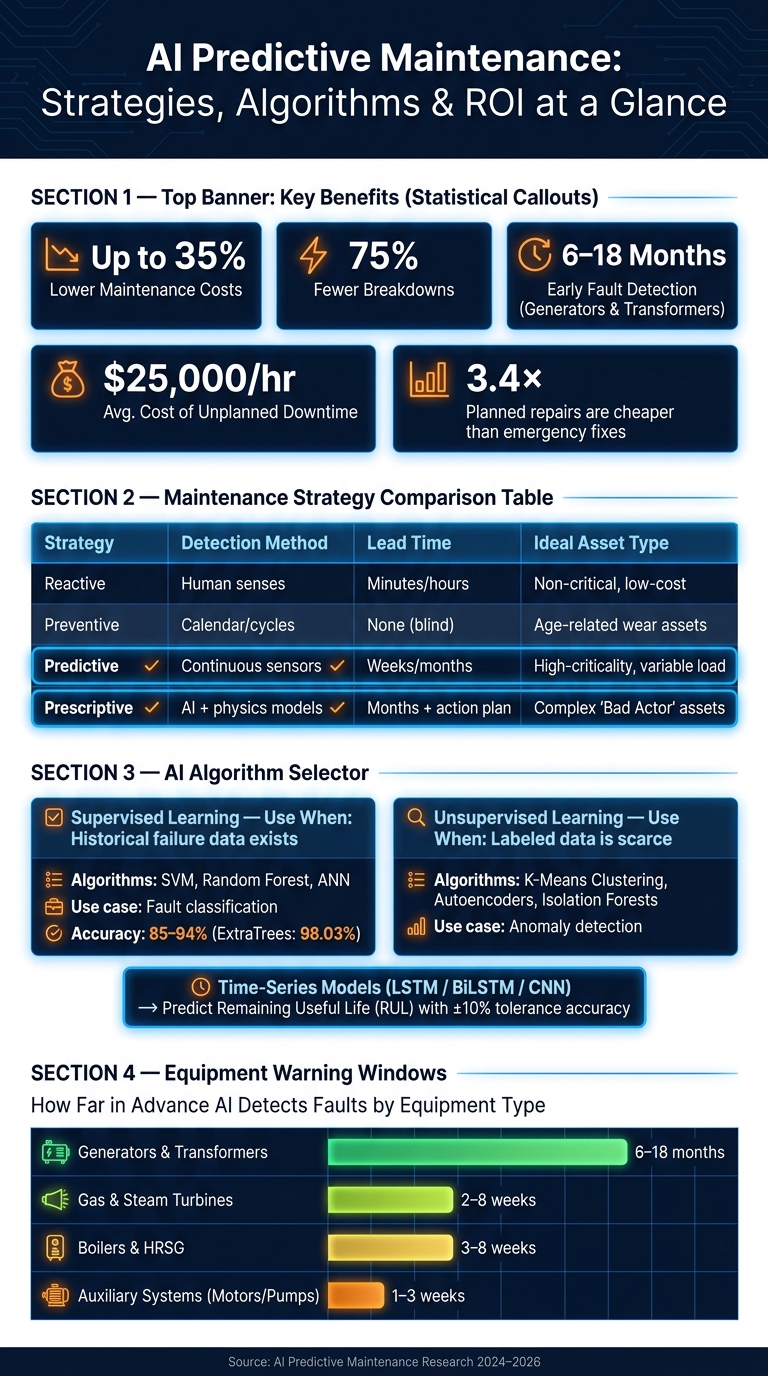
AI Predictive Maintenance: Strategies, Algorithms & ROI at a Glance
Data AI Uses in Predictive Maintenance
Types of Data AI Models Analyze
AI relies on a variety of data streams to assess the health of equipment. When it comes to power generation and electrical systems, these streams fall into four key categories.
Electrical signals are a primary focus. By monitoring factors like current draw, voltage, load current, and partial discharge (PD) levels, AI can detect early signs of insulation wear and winding faults in generators and transformers. Mechanical signals - such as vibration, acoustic emissions, RPM, and shaft speed - are just as critical, particularly for rotating machinery. Vibration analysis, in fact, serves as the main indicator for more than 80% of failures in rotating equipment. Thermal signals provide another layer of insight. Readings of oil temperature, winding temperature, and exhaust gas temperature can reveal overheating issues and cooling system failures before they become critical.
The fourth category involves chemical and fluid data. For instance, Dissolved Gas Analysis (DGA) of transformer oil can uncover overheating issues as early as 3 to 18 months before a failure. Other metrics, like moisture-in-oil levels, pressure drops, and coolant flow rates, offer a glimpse into the internal workings of equipment - areas where external sensors simply can’t reach.
| Equipment | Key Signals Monitored | What AI Detects | Warning Window |
|---|---|---|---|
| Generators & Transformers | Partial discharge, winding temp, DGA, load current | Insulation degradation, winding faults, cooling failure | 6–18 months |
| Gas & Steam Turbines | Vibration, bearing temp, exhaust gas temp, shaft speed | Bearing degradation, rotor imbalance, compressor fouling | 2–8 weeks |
| Boilers & HRSG | Tube metal temp, steam flow, flue gas O2, pressure drop | Tube fouling, thermal fatigue, attemperator valve wear | 3–8 weeks |
| Auxiliary Systems | Motor current, pump discharge pressure, flow rate, vibration | Bearing wear, impeller degradation, pump cavitation | 1–3 weeks |
Identifying these data streams is just the first step. The real challenge lies in processing and preparing the data for AI analysis.
How Data is Collected and Prepared
Gathering data is only part of the equation. The real work begins when preparing it for AI analysis.
On the hardware side, sensors like piezoelectric accelerometers play a vital role. These devices convert mechanical movements into electrical signals, often capturing frequencies as high as 20 kHz to detect early-stage issues like microscopic pitting on bearings. However, raw data at such high frequencies is noisy and consumes a lot of bandwidth. To address this, edge processing comes into play. Algorithms like Fast Fourier Transform (FFT) are applied directly at the sensor level to convert raw time-domain data into frequency-domain "signatures", making fault patterns easier to detect before the data is sent to the cloud.
Industrial gateways step in to standardize the data. They handle different communication protocols - like MQTT for wireless IoT sensors, OPC-UA for PLCs and SCADA systems, and Modbus for older equipment - creating a unified, clean data stream. Before AI models can interpret this information, preprocessing steps are applied. Missing data points are filled using methods like mean imputation, and sensor readings are normalized to ensure consistency across varying magnitudes. Typically, AI models require a learning phase of 2 to 4 weeks to establish a baseline for what constitutes normal behavior for each piece of equipment.
"A machine learning model is only as good as the signal-to-noise ratio of the sensors feeding it." - Tim Cheung, CTO and Co-Founder, Factory AI
Proper installation of sensors is equally important. A sensor that’s loosely mounted or attached with a magnetic clip instead of being bolted directly to the bearing housing can reduce vibration amplitude by 30%–50%, potentially causing critical faults to go undetected. In the end, the effectiveness of the data pipeline hinges on every physical component working as intended.
sbb-itb-501186b
AI-Driven Predictive Maintenance: Boosting Industrial Automation Efficiency
Common AI Algorithms Used in Predictive Maintenance
Once data is preprocessed, choosing the right AI algorithm becomes a key step in identifying potential faults. These algorithms take sensor data and transform it into actionable information, helping teams maintain equipment proactively.
Supervised and Unsupervised Learning Algorithms
With data prepared, AI algorithms analyze sensor patterns. The choice of algorithm often depends on the availability of historical failure data.
Supervised learning is ideal when past failures are well-documented. Algorithms such as Support Vector Machines (SVM), Random Forests, and Artificial Neural Networks (ANN) are trained to link specific sensor patterns to known equipment issues. For instance, SVM and Random Forest models can achieve fault classification accuracies between 85% and 94%. The ExtraTrees algorithm demonstrated an impressive 98.03% accuracy on the Intelligent Maintenance Systems (IMS) dataset.
On the other hand, unsupervised learning is useful when labeled failure data is sparse, which is often the case with newer machinery or rare faults. Algorithms like k-means clustering and autoencoders focus on identifying normal operating behavior and flagging deviations. While these methods don’t specify the exact fault, they provide an early warning for further investigation.
| Approach | Data Needed | Primary Use | Common Algorithms |
|---|---|---|---|
| Supervised Learning | Labeled historical failure data | Fault classification, RUL prediction | SVM, Random Forest, ANN |
| Unsupervised Learning | Unlabeled normal operating data | Anomaly detection | K-means clustering, Autoencoders |
While supervised methods classify faults, time-series and reliability models take it a step further by predicting when these faults might occur.
Time-Series and Reliability Models
Classification models focus on identifying fault types, but time-series and reliability models predict when failures are likely to happen.
Long Short-Term Memory (LSTM) networks are particularly suited for sequential data, as they can track how sensor readings change over time. This makes them a strong choice for predicting Remaining Useful Life (RUL). A study from March 2026 demonstrated that a multi-layer bidirectional LSTM (BiLSTM) model outperformed CNN and Transformer-based models on NASA/IMS Bearing datasets. It achieved better MAE and RMSE metrics while maintaining a ±10% tolerance accuracy for RUL predictions. Meanwhile, Convolutional Neural Networks (CNNs) work well for processing raw, high-dimensional data, like vibration waveforms, to identify embedded fault signatures.
For reliability assessments, survival analysis models estimate the likelihood that a component will fail within a specific time period. These models are invaluable for creating maintenance schedules across multiple pieces of equipment.
"PHM enables a transition from traditional 'post-failure maintenance' to proactive 'predictive maintenance' by integrating real-time monitoring of equipment status, early prediction of potential faults, and intelligent optimization of maintenance strategies." - Energy Informatics
How AI Reaches Maintenance Decisions
Using these algorithms, AI integrates real-time data with historical patterns to make informed maintenance decisions. Sensor data feeds into the model continuously, and the system compares this data to established baselines. When an anomaly is detected, the AI calculates the Remaining Useful Life (RUL), assigns a confidence score, and recommends a course of action - ranging from closer observation to immediate repairs.
One challenge is the "black box" nature of AI, where operators may not fully understand why the system flagged an issue. This has led to the rise of Explainable AI (XAI) tools like SHAP (SHapley Additive exPlanations). SHAP breaks down AI predictions, showing which sensor inputs contributed most to an alert. Between 2023 and 2025, roughly 33% of AI maintenance research has focused on explainability, federated learning, and edge deployment, reflecting the growing need for systems that engineers can trust and act on confidently.
AI Predictive Maintenance for Power Generation Equipment
AI is reshaping the way power generation equipment is maintained, with deep learning models and multi-source data fusion at the core of this transformation. By analyzing critical grid equipment, AI helps identify issues early and ensures optimal performance. Here's how AI is applied to some of the key components in power generation.
AI for Generators and Transformers
Transformers generate a wealth of operational data, which AI uses to detect faults that might otherwise go unnoticed. By processing inputs like dissolved gas analysis (DGA), partial discharge signals, voltage and current waveforms, and infrared thermal imaging, AI can identify both internal and external issues.
For example, in April 2026, researchers working on 1000 kV ultra-high voltage (UHV) main transformers at Dongwu Station in the East China Power Grid implemented a 2DCNN-BiLSTM model. This system analyzed seven combustible gases, three-phase currents, and even voiceprint data to classify five distinct health states, such as winding overheating and insulation deterioration. The result? More accurate and stable diagnostics compared to single-modal models.
Other hybrid frameworks, like SSA-CEEMDAN-Transformer-BiGRU, focus on oil temperature data to track long-term degradation. One model achieved an impressive R² of 0.9721 and a Mean Squared Error (MSE) of 0.031 on test datasets, enabling precise maintenance planning.
If you're in need of replacement transformers or breakers, platforms like Electrical Trader provide a wide range of options, from new to used power distribution equipment.
AI for Turbines and Rotating Machinery
Rotating machinery - such as turbines, motors, and gearboxes - produces vibration data that AI models can analyze effectively. By combining vibration, current, and torque signals, these models enhance fault detection capabilities.
In January 2026, researchers at Kutahya Dumlupinar University tested a CNN-based data fusion model on a 1.5 kW three-phase induction motor. The model, which fused spectrograms of three-axis vibration, three-phase current, and torque signals, achieved an astounding 99.75% accuracy in identifying bearing faults. Meanwhile, BiLSTM architectures proved superior for long-horizon remaining useful life (RUL) forecasting.
Physics-informed self-supervised diagnosis (PI-SSD) takes this a step further by integrating mechanical principles like Jeffcott rotor dynamics. It achieved a Macro-F1 score of 0.91 on the NASA PHM'09 Gearbox dataset and demonstrated zero-shot domain transfer - applying knowledge from healthy rotor data to fault-labeled gearbox data without additional training. This adaptability is particularly useful for diverse turbine fleets.
"The proposed framework provides an interpretable, statistically validated, and computationally feasible approach for predictive maintenance and life-cycle management of rotating machinery." - A. Ghavidel, Old Dominion University
AI for Switchgear and Breakers
Switchgear faults are not only common but also expensive, with around 37% of faults in power distribution systems linked to multi-physics coupling effects - where thermal, electrical, and fluid dynamics interact.
Digital twin technology is revolutionizing fault diagnosis for switchgear. In May 2026, researchers developed a high-precision 3D digital twin for the KYN28-12(Z) high-voltage switchgear. Using an ANFIS-OCT hybrid diagnostic framework and RBF interpolation, the system monitored electric, thermal, and fluid fields in real time. It identified issues like abnormal internal heating due to contact resistance and partial discharge faults in cable joints, achieving a fault recognition rate of 93.4%. Additionally, AI-driven dimensionality reduction made real-time simulations computationally efficient, cutting 3D spatial nodes by 90% while keeping field extreme value errors under 5%.
"Digital twin (DT) technology has become essential for accurately mapping equipment states, diagnosing faults, and enhancing operational efficiency by creating dynamic virtual replicas of physical systems." - Scientific Reports
| Fault Type | AI Detection Method | Key Data Analyzed |
|---|---|---|
| Abnormal Internal Heating | Thermal-Electric Field Analysis | Contact resistance, eddy currents, hysteresis losses |
| Insulation Degradation | ANFIS-OCT Hybrid Model | Partial discharge and insulation aging features |
| Post Insulator Discharge | Digital Twin Surrogate Model | Contamination levels, electric field distribution |
| Cable Joint Defects | Multi-Sensor Data Fusion | Partial discharge faults in insulation |
(Source:)
Benefits and Challenges of AI in Predictive Maintenance
Key Benefits of AI Algorithms
AI-driven predictive maintenance has transformed how industries manage their assets. Instead of reacting to unexpected failures, these systems rely on continuous monitoring to predict issues well in advance. For example, rather than waiting for a motor or transformer to break down, AI models analyze condition data in real time, flagging potential problems weeks or even months before they occur.
The financial impact is massive. Unplanned downtime in industrial environments costs an average of $25,000 per hour. Avoiding just one major failure - like that of a high-voltage transformer - can offset the cost of years of investment in sensors and software. Beyond cost savings, AI ensures maintenance happens at the right time, avoiding the pitfalls of fixed schedules, which often lead to either unnecessary repairs or missed issues. This approach not only reduces costs but also extends the lifespan of critical equipment.
However, while the benefits are clear, implementing AI-based maintenance systems comes with its own set of challenges.
Challenges in Implementing AI for Maintenance
Introducing AI into maintenance workflows is not without obstacles. The most significant challenge? Data. Poor-quality data - whether noisy, inconsistently sampled, or incomplete - undermines even the best algorithms. For instance, a 15% false-positive rate caused by noisy sensors can lead to $500,000 in operational losses. Worse, outdated models might fail to detect 20% of faults, potentially resulting in $1.2 million in damages.
Another issue is trust. If operators don’t understand why the AI flagged a specific piece of equipment, skepticism sets in. This is where explainable AI (XAI) tools like SHAP come into play, helping make AI decisions more transparent. Additionally, there's the problem of disconnected systems - alerts generated by AI that aren’t integrated with tools like Computerized Maintenance Management Systems (CMMS) often go ignored, creating a "data-action gap."
"Predictive maintenance works when it is treated as an engineering discipline rather than a software purchase." - Tim Cheung, CTO and Co-Founder, Factory AI
To ease adoption, one effective strategy is to disable notifications during the initial 30–60 days. This allows the AI to establish a baseline for equipment behavior before generating actionable alerts.
Matching the Right Algorithm to Your Goals
Addressing these challenges starts with choosing the right AI model based on your specific needs. Key factors include asset criticality, data availability, and lead time requirements.
For assets with historical failure data, supervised models like Random Forest or SVM are effective for classifying fault types. However, for critical assets where failures are rare and data is limited, unsupervised models such as Autoencoders or Isolation Forests are better suited. These models can establish a "normal" baseline and detect deviations. A comprehensive system often layers these approaches: anomaly detection at the first level, fault classification at the second, and Remaining Useful Life (RUL) forecasting at the third, using advanced models like LSTMs or Transformers.
Here’s a quick breakdown of how different strategies align with detection methods and asset types:
| Strategy | Detection Method | Lead Time | Ideal Asset Type |
|---|---|---|---|
| Reactive | Human senses | Minutes/hours | Non-critical, low-cost |
| Preventive | Calendar/cycles | None (blind) | Assets with age-related wear |
| Predictive | Continuous sensors | Weeks/months | High-criticality, variable load |
| Prescriptive | AI + physics models | Months + action plan | Complex "Bad Actor" assets |
(Source:)
To start, focus on "Bad Actor" assets - the 5% of machines responsible for 50% of downtime. Begin with a 90-day pilot program: monitor these assets for 30 days to establish a baseline, then validate the AI’s alerts through manual inspections. This cautious approach builds trust in the system while minimizing initial risks and costs.
Conclusion: Using AI to Make Smarter Maintenance Decisions
AI-powered predictive maintenance transforms how facilities approach planning, budgeting, and sourcing equipment. Instead of sticking to rigid, calendar-based schedules, condition-based strategies like Intelligent Prognostics and Health Management (iPHM) allow teams to focus on assets that actually need attention. For example, predictive models can detect a transformer’s declining health index 20 to 30 days before failure, providing enough time to source a replacement. Planned interventions based on predictive data are 3.4 times cheaper than emergency repairs, making this approach both cost-effective and efficient.
Platforms like Electrical Trader make sourcing easier when AI detects asset issues. If a transformer shows signs of wear, teams can quickly search Electrical Trader’s inventory for an exact match, whether it’s new, used, or refurbished. For instance, a reconditioned 2,000 kVA substation transformer is available for $75,000.00 - far less than the combined costs of emergency sourcing and downtime.
However, without a well-integrated strategy - including procurement planning, CMMS connectivity, and a clear sourcing process - these potential savings can slip through the cracks. Facilities that maximize predictive maintenance treat it as a comprehensive discipline, seamlessly connecting sensor data to actionable steps, like ordering replacement parts. This complete integration - from identifying issues to having the right part in hand - represents the future of smarter maintenance.
FAQs
What sensors do I actually need to start predictive maintenance?
To get started with predictive maintenance, you'll need a few key tools. Vibration sensors (accelerometers) are essential for detecting issues tied to an asset's fault frequencies. Temperature sensors help monitor critical components like bearings and motors, ensuring they aren't overheating. Lastly, current sensors are used for electrical signature analysis, which can reveal hidden electrical issues. Together, these tools allow you to spot potential problems early and keep your equipment running smoothly.
How do I choose between supervised, unsupervised, and LSTM models?
Choosing the right model hinges on your specific data and objectives. If you have a wealth of labeled data, supervised models are your go-to for tasks like fault classification and Remaining Useful Life (RUL) prediction. On the other hand, unsupervised models shine in anomaly detection, especially when failure labels are scarce. For time-series data, LSTM models are highly effective. They can pinpoint degradation trends and forecast RUL, provided you have access to ample historical or high-frequency data.
How can we trust AI alerts and reduce false positives?
AI alerts can become more reliable and reduce false positives by implementing a few key strategies. Threshold filtering helps ensure that only the most relevant alerts are flagged, cutting down on unnecessary noise. Pairing this with data correlation within an operational context allows the system to better understand the bigger picture, improving decision-making.
Using transparent platforms for validation is another critical step. These platforms allow teams to verify and trust the AI's outputs. Additionally, continuous system training, informed by feedback from actual maintenance outcomes, refines the AI's accuracy over time. This approach also strengthens confidence scoring, making the alerts more dependable.