AFDD Technology: Fire Prevention Features Compared
Electrical fires caused by arc faults are a serious risk in homes, offices, and industrial spaces. Arc Fault Detection Devices (AFDDs) are designed to detect these faults early and prevent fires by shutting down the circuit. This article breaks down three types of AFDDs used in the U.S.:
- DSP-based AFDDs: Use high-speed processors to analyze electrical signals and detect arc faults with precision.
- Microcontroller-based AFDDs: Rely on algorithms for fault detection and offer diagnostic tools like trip memory and LED indicators.
- Integrated AFDDs: Combine arc fault detection with overcurrent and overvoltage protection in a compact unit, saving space and simplifying installation.
Each type has strengths and trade-offs in areas like detection performance, resistance to nuisance tripping, ease of installation, and added features. Here's a quick comparison:
Quick Comparison
| Feature | DSP-based AFDDs | Microcontroller-based AFDDs | Integrated AFDDs |
|---|---|---|---|
| Arc Fault Detection | High precision | Advanced algorithms | Multi-layered protection |
| Nuisance Tripping | Advanced filtering | Intelligent algorithms | Overvoltage threshold |
| Installation Complexity | Moderate | Easy | Simplified (single unit) |
| Space Efficiency | Requires separate MCBs | Modular design | Compact (2-module width) |
| Additional Protection | Arc faults only | Overvoltage monitoring | Overcurrent, short circuit, earth faults |
Choosing the right AFDD depends on your needs. For precise arc detection, DSP-based models are ideal. If space-saving and multi-functionality are priorities, integrated AFDDs offer an all-in-one solution.
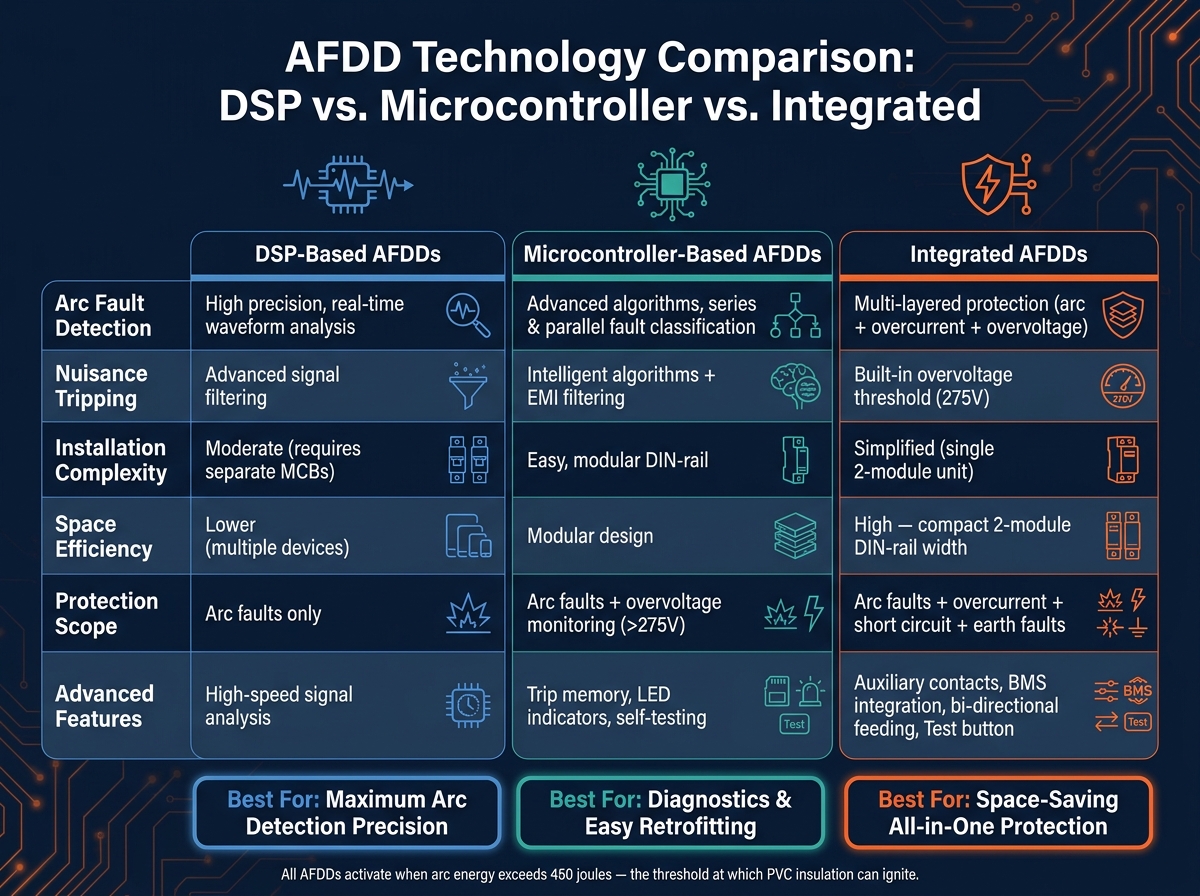
AFDD Technology Comparison: DSP vs Microcontroller vs Integrated
What Every Electricity Professional Needs to Know About Arc Fault Devices | Schneider Electric

sbb-itb-501186b
1. Digital Signal Processing AFDDs
DSP-based AFDDs represent a cutting-edge solution in arc fault detection. These devices rely on high-speed microprocessors to evaluate current and voltage waveforms in real time. By identifying high-frequency patterns and non-sinusoidal distortions - often referred to as "shoulders" - they can effectively pinpoint arc faults. This capability sets a strong foundation for later comparisons with other AFDD technologies.
Arc Detection Performance
The strength of DSP technology lies in its ability to analyze multiple signal characteristics at once and at lightning-fast speeds. This allows for quick and accurate identification of hazardous arc faults, reducing the risk of fire or electrical damage.
Nuisance Tripping Mitigation
One of the main challenges in arc fault detection is telling the difference between dangerous arcs and harmless electrical noise from everyday appliances like vacuum cleaners, dimmer switches, or power tools. DSP-based devices tackle this by using advanced signal filtering to separate harmful arc signatures from routine electromagnetic interference. This approach minimizes unnecessary tripping while maintaining a high level of fire safety.
2. Microcontroller-Based AFDDs
Microcontroller-based AFDDs rely on embedded algorithms to analyze circuit behavior, offering an alternative approach to DSP-based designs. By utilizing advanced signal analysis, these solutions provide additional diagnostic capabilities for improved performance.
Arc Detection Performance
These devices monitor current and voltage waveforms, specifically looking for high-frequency signatures and unique patterns near the zero crossing point. For example, the DS-ARC1 can distinguish between series and parallel arc faults using sophisticated classification algorithms, as each fault type presents a different risk profile.
Nuisance Tripping Mitigation
Microcontroller-based models tackle nuisance tripping through intelligent algorithms rather than purely relying on signal processing. These algorithms help differentiate between normal operational arcs and hazardous fault arcs. They also filter out electromagnetic interference, reducing false alarms. Additionally, many of these devices include overvoltage protection, monitoring voltage levels that exceed 275V.
Integration and Installation
Designed for easy installation, the DS-ARC1 supports modular DIN-rail mounting. It can work alongside existing MCBs or as a combined AFDD+MCB unit. This modular design makes it easier to retrofit into existing distribution boards, especially in setups with limited panel space.
Advanced Features
The device includes a trip memory with LED indicators that specify whether the trip was caused by a series arc, a parallel arc, or an overvoltage event. It also performs continuous internal self-tests to ensure the detection logic and components are functioning properly - all without disrupting the power supply.
3. Integrated AFDDs with Combination Protective Functions
Integrated AFDDs (Arc Fault Detection Devices) merge arc fault detection with overcurrent protection, effectively combining an AFDD and an MCB (Miniature Circuit Breaker) into one compact unit. These devices enhance safety while simplifying installation by managing arc faults, overloads, short circuits, and overvoltage - all in a single device.
Arc Detection Performance
Just like standalone AFDDs, these integrated units detect both series and parallel arc faults. However, what sets them apart is the multi-layered protection they offer in a single package. For instance, some models not only monitor arc fault signatures but also keep an eye on overcurrent and voltage spikes exceeding 275V.
Nuisance Tripping Mitigation
To minimize unnecessary trips, these devices include a built-in overvoltage threshold. This feature helps distinguish between genuine faults and brief voltage fluctuations, ensuring smoother operation.
Integration and Installation
One of the most practical advantages of integrated AFDDs is their space-saving design. With a two-module DIN-rail width, they are perfect for retrofits in compact, space-limited boards. Additionally, their bi-directional feeding capability allows installation flexibility, enabling connections via cable or busbar at either terminal.
The table below highlights how integrated AFDDs stack up against standalone devices:
| Feature | Integrated AFDD (e.g., DS-ARC1) | Standalone AFDD |
|---|---|---|
| Built-in MCB protection | Yes | No - requires separate MCB |
| DIN-rail footprint | 2-module width | Larger (AFDD + MCB combined) |
| Overvoltage protection | Yes (trips at 275V) | Varies by model |
| Bi-directional feeding | Yes | Not always available |
Advanced Features
Integrated AFDDs go beyond basic functionality by offering additional features that enhance usability. Many models include auxiliary contacts, signal contacts, or shunt trips, making it possible to connect to building management systems for remote monitoring. Built-in LED indicators help differentiate between arc fault and overvoltage trips, which can save time during troubleshooting. Plus, a "Test" button allows users to easily verify the detection circuit during installation and routine checks.
These advanced features make integrated AFDDs a practical and efficient choice for modern electrical systems.
Pros and Cons
When it comes to selecting Arc Fault Detection Devices (AFDDs), it's important to weigh their strengths and limitations. Here's a breakdown of the trade-offs between the two main types: Digital Signal Processing (DSP) AFDDs and Integrated AFDDs.
Digital Signal Processing (DSP) AFDDs
DSP AFDDs are designed specifically to detect arc faults, which are a major cause of electrical fires. However, they don't address other electrical issues like overloads or short circuits on their own. This means you'll need additional devices to cover those risks, which increases both the cost and the complexity of wiring. While effective for fire prevention, the extra components can make installation more cumbersome.
Integrated AFDDs
Integrated AFDDs, on the other hand, combine multiple protective features into a single unit. These devices not only detect arc faults but also provide protection against overloads, short circuits, and earth faults. This all-in-one design simplifies wiring, saves space on the DIN rail, and reduces the chance of installation errors. While the initial cost is higher, the savings in labor and fewer components often make them more cost-effective in the long run.
Key Differences at a Glance
| Feature | DSP AFDDs | Integrated AFDDs |
|---|---|---|
| Fire Prevention Focus | Arc fault detection only | Multi-hazard protection (arc faults, overloads, short circuits, earth faults) |
| Installation Complexity | Moderate to high (requires separate devices) | Low (single unit simplifies wiring) |
| DIN-rail Efficiency | Lower - multiple devices take more space | High - compact unit saves rail space |
| Protection Scope | Arc fault only | Comprehensive - covers multiple hazards |
Choosing the Right Option
The decision between DSP and integrated AFDDs often comes down to space and installation needs. If you have enough board space, standalone DSP units might work fine. But in cases where space is tight or retrofitting is required, integrated AFDDs are the more practical and streamlined choice. Balancing these considerations with safety priorities will help ensure the best solution for your setup.
Conclusion
The AFDD technologies reviewed here provide specialized protection against arc faults, each designed to meet specific needs. DSP and microcontroller-based AFDDs analyze complex signals across multiple parameters to differentiate between normal operational arcs and dangerous fault arcs. Meanwhile, integrated AFDDs merge arc fault detection with overcurrent protection into a single DIN-rail unit, making them well-suited for commercial distribution boards. These integrated solutions often feature automated self-testing and modular designs, which streamline retrofitting in commercial setups.
An important standard across the industry is that all AFDDs activate when arc energies exceed 450 joules - the threshold where PVC insulation can catch fire.
Selecting the right AFDD technology ultimately hinges on the demands of the specific commercial application. For those seeking reliable options, Electrical Trader provides a range of commercial-grade AFDD units from top manufacturers like ABB and Hager. These are available as both new and used equipment, catering to projects of all sizes.
FAQs
Do I need an AFDD if I already have breakers?
Deciding whether to install an Arc Fault Detection Device (AFDD) depends on your installation's safety needs and local building codes. While standard breakers are effective at handling overcurrent and residual currents, they can't detect arc faults - one of the leading causes of electrical fires. AFDDs step in to fill this gap by identifying and addressing arc faults before they can lead to a fire.
If fire prevention ranks high on your list of priorities or if regulations in your area mandate their use, adding an AFDD is a smart choice - even if you already have standard breakers in place.
Which AFDD type is best for retrofits in tight panels?
Compact AFDDs with integrated protection, like the S-ARC1 or DS-ARC1 series, are a great choice for retrofits in tight panels. The S-ARC1 combines overcurrent protection with an MCB in just two modules. Meanwhile, the DS-ARC1 provides more comprehensive protection, including coverage for earth fault currents, in three modules. Their compact designs make installation easier in confined spaces, making them ideal for retrofit projects.
How can I reduce AFDD nuisance tripping?
To reduce the chances of nuisance tripping in Arc Fault Detection Devices (AFDDs), focus on correct installation and setup. Opt for devices equipped with advanced filtering and discrimination features that can differentiate between actual arc faults and normal load waveforms. Place the AFDD at the start of a single final circuit, steer clear of areas with excessive electrical noise, and perform regular testing and maintenance. Additionally, clearing the device's memory of past faults can help improve its overall performance.