

Warranty vs. Return Policy: Key Differences
Understanding the difference between a warranty and a return policy can save you time, money, and hassle when buying products - especially expensive ones like electrical equipment. Here's the breakdown:
- Return Policy: Lets you return or exchange a product (usually within 30 days) if it doesn’t meet your needs, even if it works perfectly. Refunds depend on the retailer’s terms, and items must often be unused and in original packaging.
- Warranty: Covers defects or failures in materials or workmanship for a specified period (e.g., 1–10 years). It doesn’t apply to buyer error or normal wear and tear.
Key Differences:
- Purpose: Return policies address buyer satisfaction; warranties focus on product performance and defect resolution.
- Duration: Return policies usually last 30–100 days; warranties offer longer-term protection.
- Costs: Returns may involve restocking fees and shipping costs; warranties may require you to pay for shipping or labor under limited terms.
For buyers of high-cost items like transformers or generators, understanding these protections ensures you’re prepared for issues like compatibility or defects. Always review terms before purchasing.
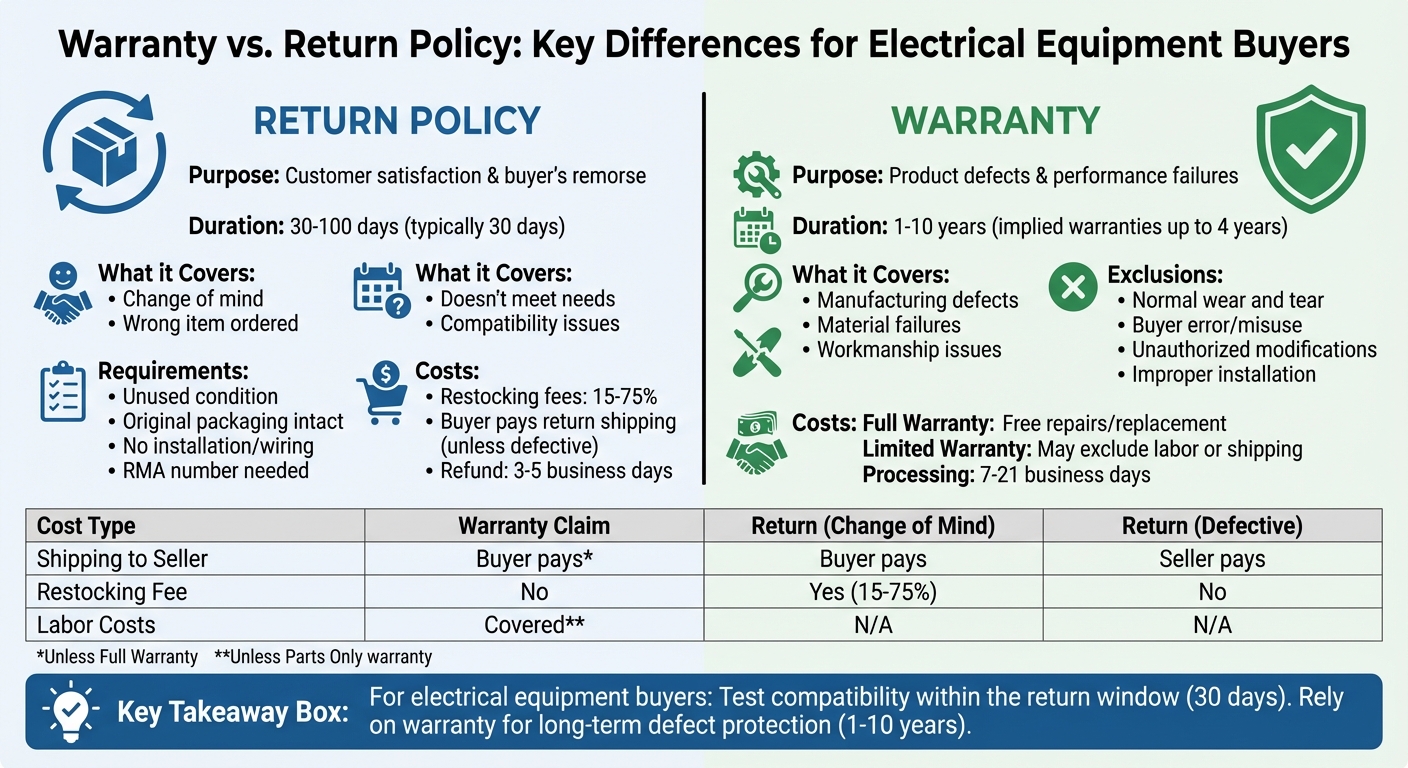
Warranty vs Return Policy Comparison Chart for Electrical Equipment
Avoid Costly Mistakes: Understanding Warranties and Return Policies on Your Appliances! | FIX.com
sbb-itb-501186b
What Is a Warranty?
A warranty is essentially a promise from a manufacturer or seller about the quality and performance of a product. It lays out the terms under which a product can be repaired, replaced, or refunded if it doesn’t work as expected. As Investopedia puts it:
"A warranty is a guarantee or promise from a manufacturer or seller about the condition and quality of their product. It outlines the terms under which repairs, refunds, or exchanges will be made if a product fails to perform as intended" - Investopedia
Under the Magnuson-Moss Warranty Act, manufacturers are required to clearly disclose written warranties for products priced over $15. For high-cost items like electrical equipment - where a single breaker might cost hundreds of dollars or a transformer even more - this level of transparency is critical.
While warranties provide important protections, they also come with limits. They usually don’t cover normal wear and tear, accidental damage, or unauthorized modifications. For example, tampering with the internal components of a circuit breaker or neglecting routine maintenance on a generator could void your warranty claim.
Types of Warranties
Warranties generally fall into two categories: express and implied.
- Express Warranties: These are clear, often written (but sometimes verbal) promises about how a product will perform. For instance, a manufacturer might guarantee that a circuit breaker will trip at a specific amperage or that a generator will produce a certain kilowatt output. If the product doesn’t meet those standards, the warranty becomes legally enforceable.
-
Implied Warranties: These are automatic protections established by state law under the Uniform Commercial Code. The Federal Trade Commission (FTC) explains:
The most common type is the implied warranty of merchantability, which ensures that a product will perform its basic function - like a transformer stepping down voltage or a breaker interrupting current. Another type is the implied warranty of fitness for a particular purpose, which applies when a seller recommends a product for a specific need. These protections can last up to four years from the purchase date in many states, but they can be waived if the seller sells the product "as is" or "with all faults.""Implied warranties are unspoken, unwritten promises, created by state law, that go from you, as a seller or merchant, to your customers" - Federal Trade Commission
Federal law also differentiates between full and limited warranties:
- Full Warranty: Requires the manufacturer to provide free repairs or replacements within a reasonable timeframe and doesn’t limit the duration of implied warranties.
- Limited Warranty: Common for electrical equipment, this type may only cover parts (not labor), exclude certain costs like shipping, or place other restrictions. By law, products costing more than $10 must clearly indicate whether the warranty is "Full" or "Limited".
What Warranties Cover
Most warranties specify a coverage period (e.g., 90 days, one year, or five years), detail what’s included (like parts and labor), and list exclusions. For example, a warranty for electrical equipment might cover defects in control boards or coils but exclude damage caused by improper installation, power surges, or external factors like extreme heat or moisture.
Here’s an example: Suppose a technician replaces a generator’s control board under a 90-day parts warranty (with a 30-day labor warranty). If the board fails on day 45, the replacement part would still be covered, but you might have to pay for labor. This kind of split coverage is common in the electrical repair industry.
Another key issue in warranty disputes is causation. As the Consumer Repair Authority explains:
"The central decision boundary in repair warranty disputes is causation: did the failure occur because of the repair, or despite it?" - Consumer Repair Authority
For instance, if a generator fails because it was operated beyond its rated capacity, the manufacturer might deny the claim - even if the equipment is still under warranty.
Additionally, federal law protects consumers from "tie-in provisions." According to the FTC:
"Federal law says a manufacturer can't require you to use specific parts or services to keep the warranty coverage unless it gives you the parts and services for free or gets a waiver from the FTC to make that requirement" - Federal Trade Commission
This means manufacturers can’t force you to use their branded replacement parts unless they provide those parts at no cost.
To make the most of your warranty, always keep your receipt and warranty documentation as proof of purchase. If a salesperson makes verbal promises about extended coverage or better performance, insist on getting those promises in writing - verbal agreements are typically not enforceable. If your equipment fails, notify the manufacturer or seller in writing (certified mail is a good option) to create a clear record of your claim.
Next, we’ll look at how return policies differ in their purpose and process.
What Is a Return Policy?
A return policy spells out the terms a retailer sets for customers to return or exchange items [3,12]. Unlike warranties, which cover defects or mechanical failures, return policies are all about customer satisfaction. They allow you to send back an item that doesn’t meet your needs, whether it was ordered by mistake, doesn’t match your expectations, or simply isn’t the right fit [3,12].
Here’s the key difference: a warranty ensures the product works as promised, while a return policy lets you get your money back even if the product is functioning perfectly. As Antlion Audio explains:
"A return will refund you the price you paid for your purchase... In the event of a defect or failure of the product during regular use [a] Warranty will either supply replacement parts or supply a new unit." - Antlion Audio
This distinction is particularly important for electrical equipment. For example, you might buy a circuit breaker that works fine but doesn’t have the amperage rating you need. A return policy would let you return it, even though it isn’t defective, while a warranty wouldn’t cover this kind of mismatch.
How Return Policies Work
Most retailers offer a standard 30-day return window, though some extend it to 60 days for trade account holders [15,16]. For example, Amazon generally provides 30 days for returns, with some refurbished electronics qualifying for an extended 90-day period.
Return policies typically accept a variety of reasons for returns, such as buyer remorse, incorrect orders, or simply no longer needing the item [12,13,14]. However, there are usually strict conditions. Items must be in new or resalable condition, with all original packaging, manuals, and inserts intact [15,16]. Products that show signs of use - like scratches, holes, or modifications - are often ineligible for return [15,16]. Filling out a manufacturer’s warranty card can also disqualify an item from being returned.
Restocking fees are another factor to consider. For instance, Standard Electric charges a minimum of 15% to cover inspection and repackaging. Electram may waive fees for account customers returning standard items but could charge up to 30% or more for special orders. Non-account customers might face fees as high as 50% for standard items and 75% for special orders. Additionally, return shipping is usually the buyer’s responsibility unless the retailer made an error [12,15,16].
Before returning an item, you’ll likely need a Return Merchandise Authorization (RMA) number to ensure the process goes smoothly [14,16]. Once the retailer receives and inspects the item, refunds are typically processed within 3–5 business days. This is much faster than warranty claims, which can take anywhere from 7 to 21 business days [13,15].
These policies are especially important when dealing with expensive electrical equipment.
Return Policies for Electrical Equipment
Clear return policies are crucial for buyers of electrical components, especially when ensuring technical specifications are met. For high-cost items like transformers, breakers, or generators, return policies give you a chance to confirm compatibility within the return window. For instance, you might need to verify that a transformer steps down voltage correctly or that a breaker integrates seamlessly with your panel. Even if the product works perfectly, you can often return it if it doesn’t suit your application.
Make sure to test components right away, as installation or wiring typically voids return eligibility [15,16].
Some items, such as cut wire, custom materials, and clearance items, are usually non-returnable [15,16]. Also, report damaged items within 30 days and notify the retailer of any missing components within 60 days to avoid losing your chance for reimbursement.
To protect your return claim, document the product’s condition with clear photos of serial numbers, UPCs, and other details. Keep all original packaging, including plastic bags and ties, as missing pieces can lead to partial refunds or even a denied return [3,15]. Finally, when buying large electrical equipment, check who covers return shipping costs - logistics for heavy electronics can be pricey.
Main Differences Between Warranties and Return Policies
Purpose and What They Cover
Warranties and return policies are designed for entirely different purposes. A warranty is essentially a legal assurance from a manufacturer or seller that a product will perform as expected and be free from defects in materials or workmanship. For example, if a breaker stops functioning due to a manufacturing defect, that falls under a warranty issue.
On the other hand, return policies cater to buyer dissatisfaction or unmet needs rather than product defects. For instance, you might return a fully operational transformer simply because it doesn’t meet your voltage requirements. While warranties often exclude issues caused by misuse, unauthorized repairs, or improper usage, return policies usually require the item to be in a condition that allows it to be resold.
These distinctions lay the groundwork for understanding the differences in their duration and claims processes.
How Long They Last
The time frames for warranties and return policies vary based on their purpose. Return policies typically offer a window of 30 to 100 days, allowing you to return a product if it doesn’t suit your needs. Warranties, however, provide longer-term protection. Some implied warranties can last up to four years in certain states, and extended warranties - purchased separately - can stretch that coverage even further.
How to File Claims
The process for addressing issues also sets warranties and return policies apart. For returns, you’ll need to contact the retailer and follow their specific procedure. Warranty claims, however, involve reaching out to the manufacturer or an authorized repair center and providing the necessary documentation. As Investopedia explains:
"File the claim by contacting an authorized repair center, the seller, or shipping the product to the manufacturer."
Warranty claims often take longer to process, and under a limited warranty, you might have to cover shipping or labor costs. Federal law mandates that written warranties for products priced over $15 must disclose all terms clearly before purchase.
Who Pays for What
Understanding who covers costs in warranty and return situations can save you from surprise expenses. For warranty claims, buyers typically pay for shipping to the manufacturer, but if the claim is approved, the manufacturer usually covers return shipping. Under the Magnuson-Moss Warranty Act, a "Full Warranty" requires the warrantor to fix defects at no cost to you. However, under a "Limited Warranty", you might be responsible for shipping or labor costs.
Return policies depend on the reason for the return. If you simply changed your mind, you’ll likely have to cover return shipping - only the largest retailers consistently waive this cost. On the other hand, if the product is defective or damaged, the seller generally pays for return shipping or reimburses you after confirming the defect. For large items like transformers or installed appliances, businesses often handle collection costs when the product is faulty.
Restocking fees can apply to items returned without their original packaging, but defective items are usually exempt. Online returns often come with shipping fees ranging from $7.50 to $11.99 per package. To save on these fees, consider returning items in-store whenever possible.
Here’s a quick breakdown of cost responsibilities:
Cost Breakdown Table
| Cost Category | Warranty Claim | Return Policy (Change of Mind) | Return Policy (Defective) |
|---|---|---|---|
| Shipping to Seller/Manufacturer | Buyer (unless "Full" warranty) | Buyer | Seller (or reimbursed) |
| Return Shipping to Buyer | Seller (if covered) | N/A (Refund issued) | N/A (Refund/Replacement) |
| Labor Costs | Covered (unless "Parts Only") | N/A | N/A |
| Restocking Fees | No | Often Yes (for electronics) | No |
| Large Item Collection Costs | Seller/Manufacturer | Buyer | Seller |
To avoid unexpected charges, always keep receipts for postage or transport when returning faulty items - you may need them for reimbursement after the defect is confirmed. For high-value products, try to get a prepaid shipping label from the manufacturer before paying out of pocket for warranty returns. Knowing these details can help you navigate warranty claims and return policies more effectively when buying electrical equipment.
What This Means for Electrical Equipment Buyers
Knowing the difference between warranties and return policies can have a big impact on the total cost of owning electrical equipment. A return policy usually offers a short window - often 30 days - to test whether a breaker or switch meets your voltage, capacity, and compatibility needs before it's permanently installed. Warranties, on the other hand, offer long-term protection against manufacturing defects. These two safeguards not only protect your investment but also help manage unexpected costs over time.
As Repairs.Live points out:
"Price is only part of the deal. The return logistics and warranty response will determine the actual total cost of ownership" - Repairs.Live
For instance, if you're buying a $23,000 pole mount transformer or a $12,799 diesel generator, it's critical to understand who pays for shipping, restocking, and labor. These costs can add up quickly if you're not prepared.
Why Warranties Matter on Electrical Trader
Warranties are essential for protecting your investment in high-value equipment. Items like transformers, generators, and power distribution systems often cost anywhere from $10,000 to over $23,000 and are expected to perform reliably for years. Manufacturer warranties typically last anywhere from 1 to 10 years, covering material defects and issues with factory workmanship.
When buying from Electrical Trader, it's important to confirm whether the warranty is provided by the manufacturer or a third-party seller. This determines who will handle repair claims if something goes wrong. For heavy equipment, check if the warranty includes on-site service. Shipping something like a multi-ton transformer back to the manufacturer can be incredibly expensive. Also, be aware that warranties often require licensed installation. If the work isn’t permitted or inspected, you could lose your coverage entirely. As Electricians Authority warns:
"Work performed without the required electrical permit and inspection may void both manufacturer and contractor coverage" - Electricians Authority
Another key detail is whether the warranty covers just parts or both parts and labor. Limited warranties often exclude labor, meaning you'll have to pay for technician time even if the part itself is replaced for free. For costly equipment, it’s worth calculating whether extended coverage makes financial sense. If the cost of the coverage is less than the expected repair cost (based on the likelihood of failure multiplied by the repair expense), it’s usually a smart choice.
Why Return Policies Matter on Electrical Trader
Return policies are your safety net during the testing phase of a purchase. Electrical components like breakers, switches, and AFCI devices should be tested as soon as they arrive to ensure they meet your installation needs.
When buying from Electrical Trader, make sure to document everything. Take photos of the serial number and UPC when the item is delivered, and keep all original packaging. This helps avoid restocking fees if you need to return the item. Testing compatibility immediately is crucial, as the return window is limited. Once it closes, your only option will be the manufacturer’s warranty, which won’t cover compatibility issues.
Return policies are especially important when dealing with large or specialized equipment, where compatibility problems might not be obvious right away. If a component doesn’t meet your voltage or capacity needs, a solid return policy allows you to exchange it without taking a financial hit. However, keep in mind that if you’re returning an item simply because you changed your mind, you’ll likely have to cover the return shipping costs yourself.
Conclusion
Understanding the distinction between return policies and warranties is key to protecting your investment and avoiding unexpected costs. Return policies typically allow a 30-day window to test compatibility before installation. On the other hand, warranties cover defects and can range from 1 to 10 years. Knowing these differences ensures you can make confident decisions when purchasing equipment.
If you're buying from Electrical Trader, take the time to review both policies thoroughly before completing your purchase. Pay attention to who provides the warranty - whether it's the manufacturer or a third-party seller - and check if it covers just parts or includes labor as well. For return policies, confirm the timeframe, any applicable restocking fees, and who bears the cost of return shipping. This is especially important for heavier equipment like transformers or generators.
Legal regulations require clear disclosure of warranty terms. To stay protected, document essential details like serial numbers and packaging, and test your equipment as soon as possible. Additionally, if your installation requires a licensed electrician or permits, ensure you have the proper documentation, as failing to do so could void your warranty coverage entirely.
FAQs
Should I use a return or a warranty if the item works but doesn’t fit my application?
If the product functions correctly but doesn't fit your needs, opting for a return is usually the best route. Returns let you secure a refund when the item works as intended but isn't right for your specific application. On the other hand, warranties are designed to address defects or failures that occur during regular use. Since the product isn't faulty, a return is the proper way to handle the situation.
What can void a warranty on electrical equipment after installation?
A warranty could become invalid if the equipment is misused, altered, poorly maintained, or installed in a way that violates applicable codes and standards, like the National Electrical Code (NEC). To keep your warranty intact, it's crucial to stick to proper installation procedures and follow regular maintenance practices.
Who usually pays shipping, labor, and fees for returns vs. warranty claims?
When it comes to warranty claims, customers are usually responsible for the cost of shipping the product back to the manufacturer or seller. However, once the warranty is confirmed, the seller or manufacturer typically takes care of the repair or replacement costs. For returns caused by defects or seller errors, shipping costs are often covered by the seller as a gesture of goodwill.
Labor costs, on the other hand, are seldom included in warranty coverage unless explicitly stated. Additionally, any return processing fees tied to warranty repairs are generally the customer’s responsibility.