

Voltage Irregularities in Industrial Systems
Voltage irregularities disrupt industrial systems by causing equipment damage, production downtime, and safety risks. These issues range from sags, swells, and transients to overvoltages and undervoltages, each with specific effects on operations and machinery. For instance, a single incident can lead to dozens of motor failures in hours or material losses worth thousands of dollars. Key causes include internal load variations, transformer issues, and grid instability.
Key Takeaways:
- Common Issues: Sags (10–90% voltage drop), swells (110–180% rise), transients (up to 20 kV spikes), and prolonged over/undervoltages.
- Impact: Motors overheat, transformers fail, and sensitive electronics like PLCs malfunction.
- Prevention: Use tools like Dynamic Voltage Restorers, UPS systems, and proper grounding.
- Monitoring: Power quality analyzers and thermal cameras help identify and address problem areas.
Power Quality Issues Explained | Part 1 | TheElectricalGuy

sbb-itb-501186b
Types of Voltage Irregularities
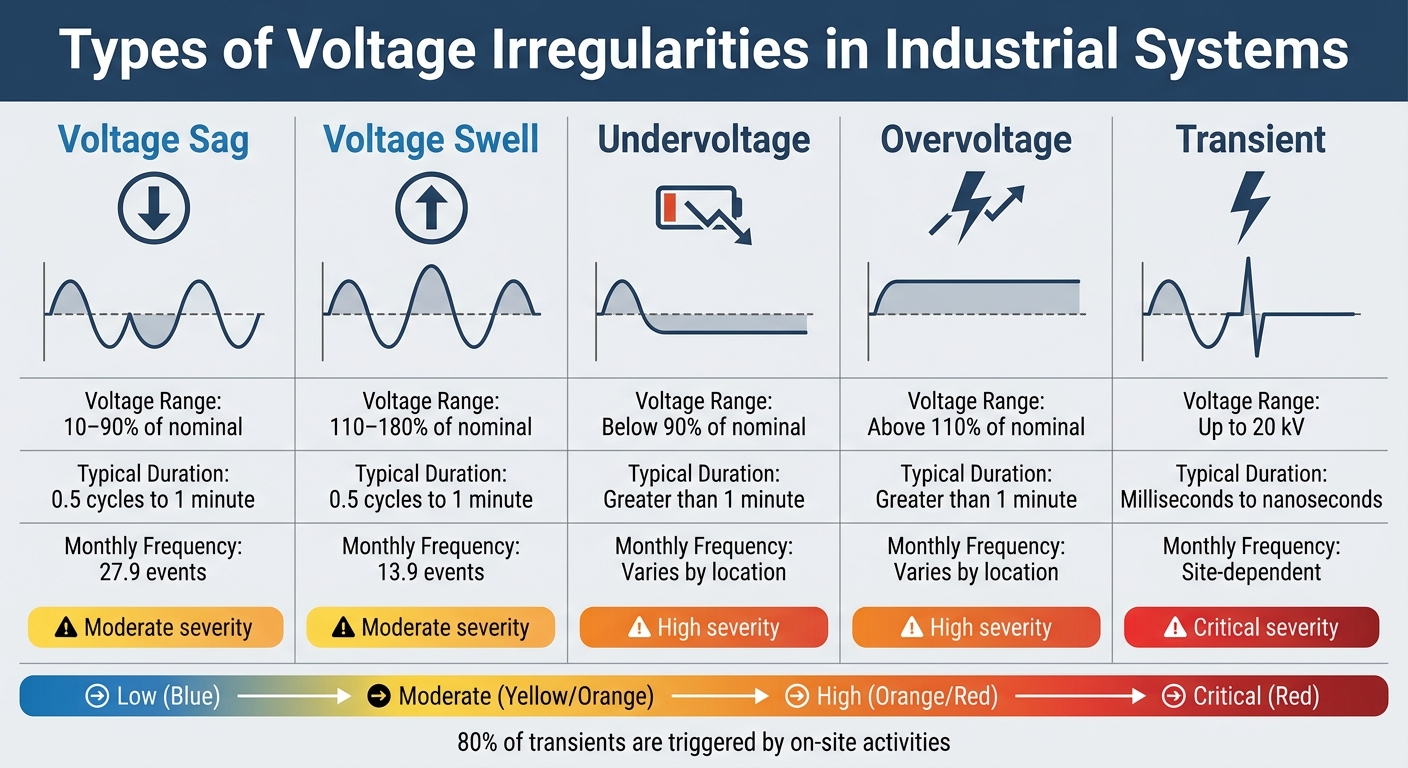
Types of Voltage Irregularities in Industrial Systems: Comparison Chart
Industrial electrical systems often encounter various voltage irregularities, each with specific traits and effects. Recognizing these irregularities is key to diagnosing issues and ensuring equipment runs smoothly. By understanding these categories, maintenance teams can quickly pinpoint problems and take corrective action.
Voltage Sags and Swells
Voltage sags, sometimes called dips, are among the most common power disturbances in industrial settings. The IEEE 1159 standard defines a sag as a drop in RMS voltage to between 10% and 90% of the nominal value, lasting anywhere from 0.5 cycles to one minute. A four-year study across 112 North American sites recorded an average of 27.9 sag events per month.
"Single line-to-ground faults on the utility system are the most common cause of voltage sags in an industrial plant." – IEEE 1159
On the flip side, voltage swells occur when RMS voltage rises to between 110% and 180% of the nominal value for a similar duration. These swells average 13.9 events per month and can lead to gradual equipment damage over time. Common causes include single line-to-ground faults that raise voltage on unfaulted phases, sudden drops in large loads, or the activation of large capacitor banks.
Next, let’s explore how brief fluctuations and transients disrupt system performance.
Voltage Fluctuations and Transients
Voltage fluctuations, often referred to as flicker, are small, rapid variations in voltage. These are typically caused by cyclical loads like arc furnaces, compressors, or pumps that frequently turn on and off. Even minor fluctuations can cause visible flickering in lighting and disrupt sensitive electronics.
Transients, on the other hand, are sudden and short-lived voltage spikes. These disturbances, which can peak at 20 kV, last only milliseconds - or even nanoseconds. About 80% of transients are triggered by on-site activities, such as heavy equipment switching or arc welding, rather than external utility issues.
Overvoltages and Undervoltages
Some voltage irregularities persist over longer periods. Undervoltages happen when voltage drops below 90% of the nominal value for an extended time, while overvoltages occur when it exceeds 110%. These deviations are often linked to factors like improper transformer tap settings, distant rural locations, or long cable runs that increase impedance. Unlike short-term sags or swells, prolonged undervoltages and overvoltages can lead to motor overheating, lighting inconsistencies, and equipment malfunction over time.
| Irregularity Type | Voltage Range | Typical Duration | Monthly Frequency |
|---|---|---|---|
| Voltage Sag | 10–90% of nominal | 0.5 cycles to 1 minute | 27.9 events |
| Voltage Swell | 110–180% of nominal | 0.5 cycles to 1 minute | 13.9 events |
| Undervoltage | Below 90% of nominal | Greater than 1 minute | Varies by location |
| Overvoltage | Above 110% of nominal | Greater than 1 minute | Varies by location |
| Transient | Up to 20 kV | Milliseconds to nanoseconds | Site-dependent |
This breakdown of voltage irregularities lays the groundwork for understanding their underlying causes.
Main Causes of Voltage Irregularities
Understanding what causes voltage irregularities can help facilities prevent expensive disruptions. Studies reveal that around 80% of power quality and reliability problems originate within the end-user's facility, not the utility grid. These issues often arise from internal operations, equipment choices, and maintenance practices.
Load Variations and Demands
In industrial settings, sudden changes in load are the most common cause of voltage irregularities. For example, starting large motors draws significant inrush currents, leading to voltage drops or sags. Similarly, switching heavy or reactive equipment - like transformers, motor drives, or power factor correction devices - can result in voltage spikes or dips.
Unbalanced loads in three-phase systems are another source of voltage inconsistencies, while equipment like arc welders or intermittent switches can create electromagnetic interference. The consequences are severe: a study of 15 multinational companies in Nigeria revealed that 60% of them lose an average of five variable speed (AC) drives annually due to poor power quality. In industries like semiconductor manufacturing, even a brief voltage sag to 75% of the nominal level, lasting less than 100 milliseconds, can lead to material losses worth thousands of dollars.
"In industry, power quality is very low on the list of priorities and so very little attention is given to it, until something goes wrong." – Norbert Edomah, Industrial Co-ordinator, Institute for Industrial Technology
These load-related challenges often lead to further complications with transformer operations and distribution systems.
Transformer and Distribution Issues
Transformers and distribution networks play a significant role in voltage irregularities. When transformers start up, they require high inrush currents, which can cause voltage sags. Nonlinear loads exacerbate the problem by generating harmonics, which distort voltage and overheat transformers. Weak distribution networks or systems with high source impedance allow these sags to spread further than they would in stronger networks. Additionally, routine utility-side switching operations can introduce transients and voltage spikes into industrial systems.
Grid Instabilities
External events on the grid also impact voltage stability. Utility protection devices often interrupt power for approximately 12 cycles to address disturbances such as lightning strikes. Environmental factors, like strong winds, ice storms, or falling trees, can lead to voltage sags and outages. Human activities, including construction mishaps involving underground cables or vehicle accidents with utility poles, also disrupt grid performance. A single-line-to-ground fault can have widespread effects, potentially impacting industrial users within a 100-mile radius of the incident.
"Frequency of the supply power is one of the major determinants of power quality, which affects the equipment performance very drastically. Even the major system components such as Turbine life and interconnected-grid control are directly affected by power frequency." – Shafqat Mughal, Neeten Sharma, and Pankhuri Kishore
How Voltage Irregularities Affect Industrial Equipment
Now that we’ve explored what causes voltage irregularities, let’s dive into how they directly affect industrial equipment. The consequences can be severe, often leading to damaged motors, transformers, and even complete equipment failure.
Damage to Motors and Transformers
Motors are particularly vulnerable to voltage fluctuations. When over-voltage occurs, it can lead to core saturation, causing the motor to draw excessive current, which then gets converted into heat. On the flip side, under-voltage weakens the motor's magnetic field. Since torque depends on the square of the voltage, even a small drop - say 10% - can reduce torque by around 19%. To compensate, the motor draws more current, increasing thermal stress and the likelihood of insulation breakdown.
"Motors shall operate successfully [within ±10% of rated voltage]... but 'successful' doesn't mean efficient or reliable operation." - NEMA Standard MG1
Transients, or sudden spikes in voltage, add another layer of risk. They can cause arcing between windings, which weakens insulation over time. Transformers also suffer under these conditions. Harmonic distortions, often caused by non-linear loads, increase losses in copper, the core, and stray components, leading to overheating and early failure. Ultimately, these issues create a ripple effect of operational disruptions.
Production Downtime and Cost Implications
When equipment performance falters due to voltage irregularities, the impact goes beyond just the machinery - it halts production. Sensitive components like Variable Speed Drives (VSDs) and Programmable Logic Controllers (PLCs) are designed to shut down during voltage dips to protect themselves, but this safeguard often stops entire production lines. For instance, a 10% voltage drop lasting just 100 milliseconds can disrupt paper machine operations. In semiconductor manufacturing, a 75% voltage dip over a similar duration can lead to material losses worth thousands of dollars.
As previously mentioned, poor power quality is a major contributor to equipment failures in industrial settings. These failures not only result in unplanned maintenance but also drive up costs due to downtime and lost productivity.
Mitigation Strategies for Voltage Irregularities
Voltage irregularities can wreak havoc on industrial operations, causing costly disruptions. To prevent these issues, a combination of stabilization equipment, backup power solutions, and proper grounding can significantly reduce the risks.
Voltage Stabilization Solutions
Dynamic Voltage Restorers (DVRs) and PWM-based DSTATCOM are highly effective at managing voltage sags and swells in real time through dynamic compensation. For steady-state voltage drops, electronic tap changing transformers can handle reductions of up to 50%, provided the system maintains a short circuit power-to-load ratio of at least 10:1.
Another option is thyristor-based static switches, which protect against approximately 85% of interruptions and voltage sags by switching in capacitors, filters, or alternate power sources. For control circuits, constant-voltage transformers (CVTs) offer a three-cycle ride-through capability, ensuring relays and AC contactors remain functional during brief voltage dips.
When it comes to harmonics, a 12-pulse or higher transformer connection is preferred over tuned harmonic filters, which can create complex resonance issues.
These stabilization measures work best when paired with reliable backup power systems to ensure uninterrupted operations during voltage events.
Uninterruptible Power Supply (UPS) Systems
UPS systems act as a safeguard against voltage sags, swells, and outages by storing energy in batteries and converting it to AC power through an inverter. When a voltage irregularity is detected, the UPS instantly switches the load to battery power, maintaining smooth operation. This is especially critical in the U.S., where the average electric customer experiences 40 to 60 sag events annually.
"A UPS protects equipment from voltage sags, momentary power loss, and extended power outages for up to several minutes." - Plant Engineering
UPS systems are ideal for constant electronic loads like computers, PLCs, and process controllers. However, they struggle with dynamic loads, such as the high inrush currents needed to start large motors. To manage costs, focus UPS protection on your most sensitive components rather than the entire facility. Additionally, ensure the UPS provides a pure sine wave output, as some models produce square wave outputs that can interfere with factory automation equipment.
Grounding Techniques
Proper grounding complements stabilization and UPS systems by addressing both transient and sustained irregularities. Start with correct wiring and grounding practices to avoid masking power quality issues. Isolation transformers are particularly effective for common mode shielding, as they separate primary and secondary circuits, creating a new power source without a direct current path between windings. This is a key advantage over auto-transformers, which lack isolation capabilities.
For protection against voltage spikes, Transient Voltage Surge Suppressors (TVSS) use components like metal oxide varistors to divert excess energy to the ground before it damages sensitive equipment. This is crucial, as asymmetrical faults - such as single-line-to-ground faults - account for over 80% of fault cases and are a major cause of voltage unbalance.
To reduce high-frequency noise, use shielded isolation transformers specifically designed for this purpose. Standard unshielded transformers only handle low-frequency common mode noise. Additionally, system stability relies on eliminating common impedance coupling, where shared ground impedance causes voltage drops in one circuit to affect others.
Monitoring and Diagnostic Methods
Once mitigation strategies are in place, ongoing monitoring becomes crucial to spot any lingering issues that could threaten system reliability. Using specialized diagnostic tools and adhering to strict maintenance routines can help avoid equipment failures. Among these tools, power quality analyzers (PQAs) stand out, offering detailed insights into voltage disturbances. These analyzers provide waveform graphics, which are essential for diagnosing tricky problems like oscillatory transients.
True RMS digital multimeters (DMMs) are another vital tool, delivering precise spot measurements. In contrast, "Peak" or "Averaging" meters can be off by as much as 40% when measuring distorted waveforms. True RMS meters excel in measuring the heating value of non-sinusoidal signals, making them a reliable choice for initial diagnostics. Additionally, thermal imaging cameras are invaluable for identifying overheating in equipment like motors and transformers. For example, a 2.3% voltage unbalance in a 230V motor can result in an 18% current unbalance, raising temperatures by 54°F. These tools collectively enable effective diagnostics and timely corrective actions.
Voltage Analyzers and Recorders
Voltage analyzers cater to two key measurement types: disturbances (triggered by abnormalities surpassing preset thresholds) and steady-state variations (tracked over time to monitor harmonics and unbalance). To get accurate readings, placement matters - monitor near the affected load first, then trace upstream toward the Point of Common Coupling (PCC) if the source remains unclear. Modern web-enabled analyzers allow engineers to oversee multiple industrial sites from a central hub, offering real-time alerts and detailed insights into problematic equipment.
"Power quality monitoring has advanced from strictly problem solving to ongoing monitoring of system performance." – Christopher J. Melhorn and Mark F. McGranaghan, Electrotek Concepts, Inc.
By correlating event timestamps with equipment failures, engineers can zero in on root causes. For a broader view, long-term data loggers are invaluable. These devices collect performance data over weeks, providing summaries like 24-hour voltage profiles and harmonic distortion trends - patterns that short-term monitoring might miss.
Routine Maintenance Protocols
Real-time monitoring is essential, but so is scheduled maintenance. Keeping updated one-line diagrams that outline AC power sources, load ratings, and distribution paths ensures smoother power quality studies. Regular wiring and grounding audits should address issues like bad terminations, poor grounding, or improperly connected loads. Additionally, balancing load distribution across panelboard phases is critical; voltage variation between phases should stay below 2% to avoid equipment damage.
For backup power systems, battery testing is a must. Batteries should maintain at least 80% of their original capacity - replacement is typically recommended below this threshold. Use the MIN/MAX functions on DMMs to detect sags lasting 100 milliseconds or longer when loads are energized. Before investing in costly mitigation hardware, analyzers can help confirm whether voltage issues stem from internal wiring or load imbalances that need correction.
Conclusion
Voltage irregularities impose a hefty financial burden on American industries, with an estimated cost of $188 billion each year. Addressing these issues begins with understanding that power quality challenges stem from the interplay between the electric supply and the sensitivity of connected equipment. As Bill Howe, PE, Director of Technology Information Businesses at EPRI PEAC Corp., aptly states:
"Knowledge, not technology, solves PQ problems".
Managing voltage irregularities effectively requires a comprehensive, plant-wide approach rather than focusing on isolated symptoms. Interestingly, many disturbances originate from internal loads rather than the utility supply. Modern equipment, far more sensitive to voltage fluctuations than older machinery, highlights the importance of proactive monitoring.
The key to overcoming these challenges lies in adopting targeted mitigation strategies. This includes combining load and line conditioning with solutions like uninterruptible power supply (UPS) systems and constant voltage transformers. When paired with thorough monitoring and diagnostic practices, these measures provide a clear path to reducing costly disruptions.
FAQs
How can I tell if my voltage problems are caused by the utility or my plant?
To effectively manage power quality issues, use power quality monitoring tools and position them wisely. Key areas include motors, transformers, distribution panels, or utility mains. These devices are invaluable for pinpointing the source of problems like voltage sags or transients, helping you determine whether they stem from internal systems or external sources. Typically, external issues show up at the utility connection point, while internal ones are limited to your plant's distribution system. Additionally, reviewing one-line diagrams and deploying power quality analyzers can provide further clarity.
What’s the fastest way to protect PLCs and VFDs from brief voltage dips and transients?
The fastest way to protect PLCs and VFDs from short voltage dips and spikes is by using surge protection devices and transient voltage suppressors. These tools work by quickly clamping voltage surges, shielding sensitive equipment from potential harm.
Where should I install a power quality analyzer to pinpoint the source of sags or swells?
To pinpoint the source of voltage sags or swells, place a power quality analyzer at strategic locations such as near the affected load, upstream of it, or at the point of common coupling (PCC). These spots offer the clearest insights into power disturbances, making it easier to identify the root cause.