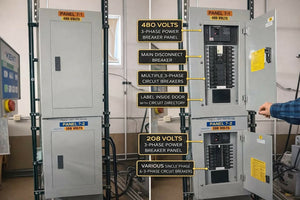
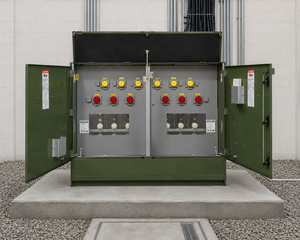
UL Certification for Low-Voltage Equipment: Key Steps
UL certification for low-voltage equipment isn't legally required in the U.S., but it's crucial for market access and safety assurance. It ensures your equipment meets safety standards, satisfies local codes (like NEC), and avoids insurance claims denials. The process involves six steps:
- Identify the Right UL Standards: Determine the applicable standard (e.g., UL 1558 for switchgear, UL 508A for control panels) based on your product and target market.
- Design for Compliance: Use UL-recognized components and follow UL's safety and performance guidelines during product design.
- Pre-Test Internally: Conduct in-house tests (e.g., dielectric, short-circuit) to catch issues early and reduce testing costs.
- Prepare Documentation: Submit detailed product specs, component data, and manufacturing details to UL.
- Undergo UL Testing: Work with UL for official testing, which typically takes 4–8 weeks and costs $3,000–$15,000.
- Maintain Certification: Participate in UL's Follow-Up Services with regular factory inspections to ensure continued compliance.
While the process may seem complex, early preparation and collaboration with UL can save time and money. Certification not only boosts marketability but also ensures safety and reliability for end users.
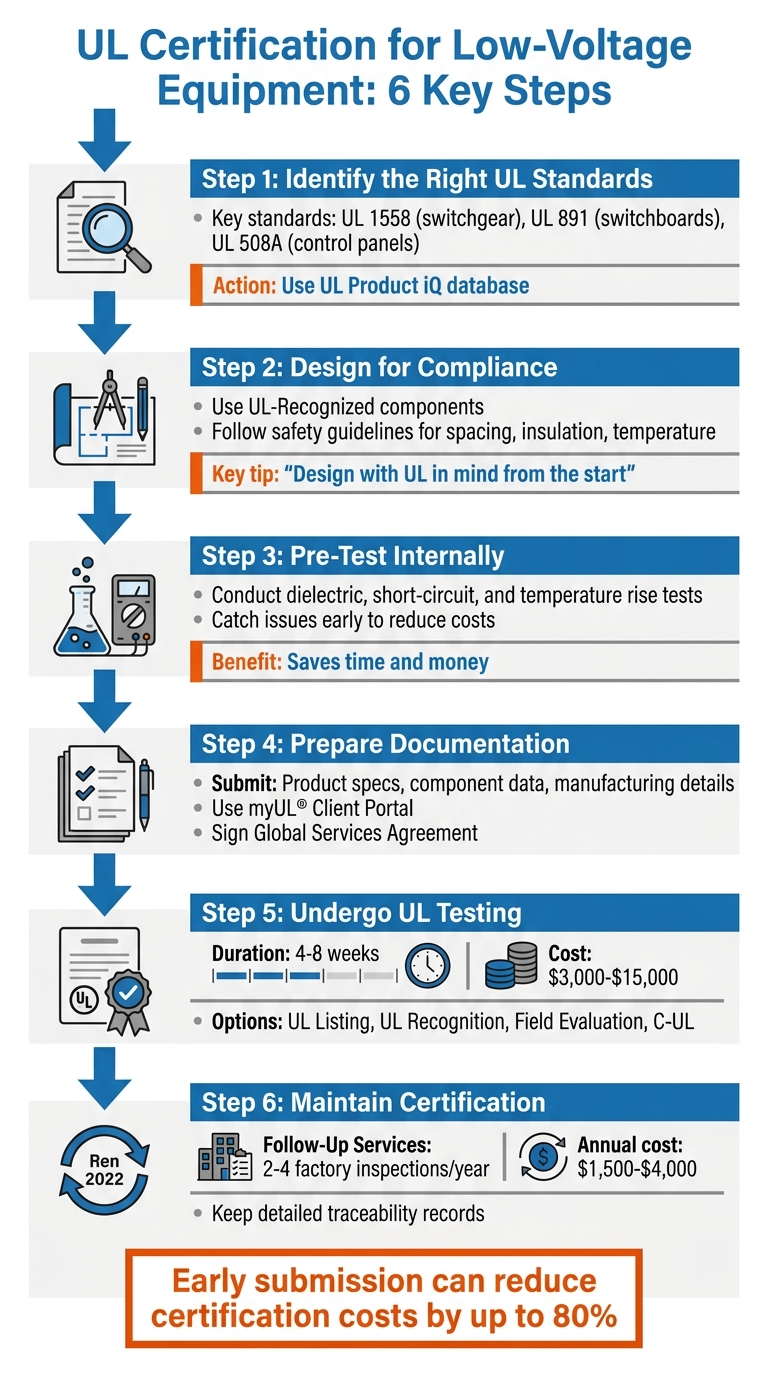
6-Step UL Certification Process for Low-Voltage Equipment
White Paper Video - UL Standards for Power Control System Equipment
sbb-itb-501186b
Step 1: Identify the Relevant UL Standards
The first step toward UL certification is to pinpoint the standard that applies to your equipment. Low-voltage equipment spans a wide variety of products, each governed by a specific UL standard based on its function and installation environment. Getting this step right can save you both time and money.
Main UL Standards for Low-Voltage Equipment
Here’s a breakdown of key UL standards for low-voltage equipment:
- UL 1558: This standard applies to metal-enclosed low-voltage power circuit breaker switchgear. It’s designed for critical environments like power plants, hospitals, and data centers. These systems handle up to 1,000 volts AC and require advanced safety features, including arc-flash protection, compartmentalization, and draw-out breakers. UL 1558 systems are among the priciest, with costs ranging from $50,000 to over $500,000 for a full setup.
- UL 891: Covering dead-front switchboards, this standard is common for commercial and light industrial setups. Unlike UL 1558, it doesn’t mandate arc-flash protection or rear access, making it simpler and more cost-effective for general use.
- UL 1066: Focuses on low-voltage AC power circuit breakers, specifically those used as components in UL 1558 switchgear.
- UL 489: Governs molded case circuit breakers (MCCBs), which are typically part of UL 891 switchboards and panelboards.
- UL 508A: Applies to industrial control panels used in factory automation and machinery control.
| Standard | Equipment Type | Primary Application |
|---|---|---|
| UL 1558 | Low-Voltage Power Circuit Breaker Switchgear | Data centers, power plants, heavy industry |
| UL 891 | Dead-Front Switchboards | Commercial buildings, light industrial |
| UL 1066 | Low-Voltage AC Power Circuit Breakers | Components for UL 1558 systems |
| UL 489 | Molded Case Circuit Breakers (MCCBs) | Components for UL 891/panelboards |
| UL 508A | Industrial Control Panels | Factory automation and machinery control |
Determine Your Market and Compliance Needs
Your target market plays a big role in deciding which standard applies. For example, equipment intended for hospitals or data centers typically requires UL 1558, given the need for higher safety and reliability. On the other hand, UL 891 is often sufficient for office buildings or retail spaces.
To narrow down the standards for your product, use the UL Product iQ database. This tool allows you to search by product type and find the "guide information", which details the standards used for certification. If you’re unsure, UL Solutions offers support through their sales or regulatory services teams.
Keep your target market in mind from the start. This ensures UL can create a testing program that aligns with both local and global certification requirements. Once you’ve identified the right standard, you’re ready to design your equipment for compliance.
Step 2: Design Your Equipment for UL Compliance
Once you've identified the appropriate UL standard, the next step is to incorporate compliance into your equipment's design. Doing this early in the process can save time and money. As UL Solutions explains, "It is easier to design a product with UL Solutions requirements in mind than to redesign a product to meet a set of requirements". This involves carefully planning aspects like construction, component selection, and safety features before moving into prototyping.
Use UL-Recognized Components
Selecting UL-Recognized components simplifies the compliance process. Components such as breakers, busbars, transformers, and relays that are UL-Recognized come with pre-established ratings, which can reduce the amount of testing required for your final product. Always request and review UL documentation from your suppliers to ensure the components meet your needs. For further verification, you can use UL's Product iQ database, which provides up-to-date certification information.
For low-voltage control circuits, check if Class 2 transformers are appropriate. These transformers, with an output below 50V and 100VA, may qualify as "limited energy" components, which can streamline compliance in certain cases.
Ensure Your Design Meets Compliance Standards
After selecting suitable components, focus on ensuring the overall design aligns with the technical requirements of the relevant UL standards. Here's what to pay attention to:
- Spacing and Insulation: Adhere to UL's guidelines to minimize risks like electrical arcing or accidental contact.
- Temperature Management: For instance, UL 1558 specifies strict limits on temperature rise to protect conductors, insulation, and terminations during operation.
- Compartmentalization: For high-capacity equipment like UL 1558 switchgear, include physical barriers to isolate faults and allow for safer maintenance.
- Labeling and Enclosures: Ensure labels clearly display information such as voltage, current ratings, and short-circuit interrupting ratings. Outdoor enclosures should use corrosion-resistant materials, such as galvanized or powder-coated steel, to withstand environmental conditions.
Step 3: Conduct Pre-Testing and Internal Reviews
Before sending your equipment to UL for certification, it's smart to conduct in-house testing. Why? It can save you both time and money. As UL Solutions puts it:
"Bringing your product into compliance before submitting it to UL Solutions makes for a more cost-effective, faster testing process."
By performing internal assessments, you can catch design flaws, component issues, or safety concerns early - while fixes are still manageable. This step lays the groundwork for the more rigorous testing phases that follow.
Common Pre-Tests to Perform
During pre-testing, focus on two key areas: safety and electromagnetic compatibility (EMC). Start by reviewing the applicable UL Safety Standard to understand the specific requirements. Then, test your prototype to ensure it meets these criteria before moving into production.
Some essential internal tests include:
- Dielectric withstand tests: Check if the insulation can handle voltage stress without breaking down.
- Short-circuit tests: Confirm that the equipment won't fail under fault conditions.
- Temperature rise evaluations: Ensure that conductors, insulation, and terminations stay within safe temperature limits.
Additionally, verify the "conditions of acceptability" and ratings for all components to ensure they’re appropriate for their intended use. Thomas Smith, Product Compliance Manager at Fluke, emphasizes going the extra mile:
"We test beyond basic requirements. Additionally, our work in foreseeable misuse has led to the development of new standard requirements."
How Internal Testing Saves Time and Money
Thorough internal reviews can make a big difference when it comes to avoiding failed tests and costly delays during the formal UL evaluation. By identifying and addressing potential issues early, you can sidestep the expense of multiple UL testing cycles and the production delays caused by redesigning non-compliant equipment. These savings often outweigh the cost of your internal testing efforts.
You might also consider requesting a preliminary evaluation from UL Solutions during the early stages of development. This service allows UL engineers to review your prototype and flag any compliance concerns before mass production begins. Keeping an open dialogue with UL engineers during pre-testing can also help clarify technical requirements that might not be immediately obvious from the written standards.
Step 4: Prepare Your Documentation for UL
After completing your internal testing, it's time to gather all the required documentation. This step is crucial because detailed documentation helps UL engineers define the testing scope for your product. As UL Solutions emphasizes:
"The more information you provide to the engineering staff describing your product and its intended use, the easier it will be for the responsible engineer to respond to your request."
Providing comprehensive and clear documentation can make the UL evaluation process much smoother during testing and certification.
Required Documents for UL Submission
Start your submission with a Request for Quote or Request for Information form. This gives UL a clear overview of your product and its intended purpose. After that, assemble the following technical documents:
- Critical Component Information: Include details about component ratings and conditions.
- Physical Specifications: Provide measurements, enclosure design, and any openings.
- Electrical Data: Document power connections and electrical ratings.
- Markings and Labels: Attach copies or layouts of product labels.
- Manufacturing Details: Specify the manufacturing location and the factory test equipment used.
- Legal Agreements: Sign a Global Services Agreement and agree to participate in the Follow-Up Services (FUS) program before testing begins.
Once this documentation is complete, reach out to UL for the next steps and further instructions.
Contact UL for Support and Standards
Getting in touch with UL early in the process is a smart move. Their Customer Service team can confirm the specific UL Standard applicable to your low-voltage equipment. If any technical requirements feel unclear, you can consult directly with a UL project engineer for clarification.
To make the process even easier, UL offers digital tools for managing your documentation. The myUL® Client Portal allows you to organize project files and monitor updates securely. For those new to the process, FUStart provides guidance on Follow-Up Services and maintaining your certification.
Step 5: Work with UL for Testing and Certification
Once UL reviews your documentation, the formal testing process begins. A Project Handler (PH) will guide you through the test plan, sample requirements, and updates using the myUL® Client Portal. This phase ensures that all your design and documentation efforts result in a product that meets compliance standards, protecting both market access and user safety.
UL Certification Options
UL provides several certification options tailored to your equipment's intended use:
- UL Listing: Designed for fully finished products meant for retail, such as equipment sold directly to consumers or through major retailers. This certification allows your product to display the UL Mark.
- UL Recognition: Applicable to components or materials that will be part of a larger system, like power supplies or switches used in manufacturing.
- Field Evaluation: If your equipment is already installed at a facility and requires safety verification, UL can conduct an on-site assessment. Compliant products are marked with a "Field Evaluated Product Mark".
- C-UL Certification: For those targeting the Canadian market, this certification ensures compliance with Canadian safety standards.
Once you've determined the appropriate certification path, the next step is undergoing testing.
What Happens During UL Testing
No matter which certification path you choose, UL testing is thorough to ensure your product meets all safety standards. This process typically takes 4 to 8 weeks and includes evaluations focused on electrical safety, fire resistance, and mechanical risks. For low-voltage equipment, tests often involve short-circuit testing and mechanical endurance checks. Many of these tests are destructive, so it's important to provide additional samples. Sending extra parts and samples can also help avoid delays if any components fail during testing.
If your product doesn't meet the standards, UL will provide a detailed report outlining the issues. You’ll then have the opportunity to make modifications and resubmit for retesting. Once your product passes, compliance monitoring continues through UL's Follow-Up Services program.
Step 6: Maintain Your Certification with Follow-Up Services
Getting UL certification is just the start; keeping it requires ongoing effort. UL's Follow-Up Services (FUS) program ensures your low-voltage equipment continues to meet the required safety standards through regular factory inspections.
What is UL Follow-Up Service
The FUS program kicks off right after your product earns its initial certification. UL engineers visit your production facilities 2–4 times a year to conduct audits. These visits focus on examining both finished products and the individual components used in their construction. The goal? To confirm everything aligns with the specifications outlined in your Follow-Up Service Procedure.
The process begins with the Initial Production Inspection (IPI), which ensures your first production run matches the FUS documentation. Afterward, routine inspections emphasize component traceability - making sure all materials, especially UL Listed or Recognized components, are consistent with the approved documentation. Inspectors also verify that your dielectric voltage withstand test equipment is properly calibrated and meets UL standards.
The cost of the FUS program generally ranges from $1,500 to $4,000 annually, with individual inspection visits costing $2,000 or more. These fees cover the monitoring required to keep your certification valid and allow your products to display the UL symbol legally.
How to Stay Compliant Long-Term
Maintaining compliance requires a proactive approach to documentation and quality control. One helpful resource is UL's FUStart tool, which provides training (available in multiple languages) to help your manufacturing team understand inspection requirements and organize documentation before audits begin.
Here’s how to stay ahead:
- Keep detailed traceability records for all components. Every UL Listed or Recognized part should have clear markings and documentation that inspectors can easily verify.
- If you make changes to your product design or move production to a new location, submit a revision request to your local UL field engineer immediately. Be sure to format changes in Courier New 10 pt font with 1-inch margins, using bold for additions and an asterisk (*) in the left margin for removals.
Common reasons for inspection failures include using materials with incorrect flammability or temperature ratings, labeling mistakes (like missing warnings or improper UL Mark usage), and incomplete documentation. Conducting regular internal audits can help you catch and fix these issues before UL inspectors arrive, ensuring your certification remains intact and your products stay market-ready.
Source UL-Compliant Equipment on Electrical Trader
If you're looking for UL-recognized components to simplify certification, Electrical Trader (https://electricaltrader.com) is a go-to platform. They offer a wide range of new and used electrical equipment, including transformers, circuit breakers, switchgear, and motor control centers. One standout feature is the ability for sellers to list "Standards & Certifications" in the product details. This makes it easy to identify items that meet UL, CSA, NEMA, IEEE, ANSI, or IEC standards. By sourcing components here, you can streamline the connection between your design process and UL compliance.
Benefits of Using Electrical Trader
Choosing UL-recognized components can reduce the amount of final testing required. Electrical Trader provides detailed listings that include critical technical specs needed for UL compliance. These descriptions often feature compliance data such as test results, maintenance records, and certification documents.
To make things even simpler, the platform organizes equipment into "Collections" based on type, voltage class, and application. This setup helps you quickly find low-voltage components without wading through irrelevant options. You can also filter by condition (New, Used, or Refurbished) to match your budget and project needs. Considering that UL certification for new industrial control panels (UL 508A) can cost anywhere from $15,000 to $50,000, with annual maintenance fees between $5,000 and $15,000, sourcing verified components here can save both time and money while ensuring compliance.
Finding UL-Certified Products on the Platform
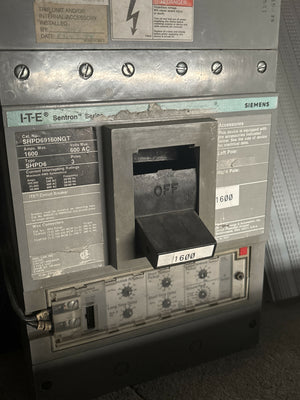
When searching for UL-certified products, pay close attention to the "Standards & Certifications" field in the product details. Additionally, review the listing images for clear shots of the equipment nameplate, as these often display UL file numbers and ratings for verification. For refurbished items, check the description for notes on professional testing to confirm the product still meets its original UL certification standards.
If the necessary details aren’t provided, use the platform’s contact feature to request UL file numbers or test reports directly from the seller. To double-check, cross-reference the manufacturer name and model number with resources like the UL Product iQ database or the Online Certifications Directory. Keep in mind that while UL safety Marks appear on over 22 billion products annually, counterfeit marks are a real issue - around 3.8 million counterfeit UL-marked products were seized in 2019 alone. This makes independent verification a critical step in your sourcing process.
Conclusion
Achieving UL certification for low-voltage equipment involves six key steps: selecting the right UL standards, designing with UL-Recognized components, conducting internal pre-testing, preparing detailed documentation, collaborating with UL for official testing, and maintaining compliance through follow-up inspections.
This process not only prioritizes safety but also helps manage costs effectively.
"Ideally, a product should be submitted as early as possible during its development." - UL Solutions
Submitting your product early in the development phase can significantly lower certification costs - by as much as 80% - especially if you use UL-Recognized components and partner with factories that already have UL files for similar products. Early collaboration with UL engineers minimizes the need for expensive redesigns and reduces the scope of testing.
Keep in mind, certification isn't a one-time task. It requires ongoing maintenance. Major retailers like Amazon, Walmart, and Home Depot consider UL certification a "market-mandatory" requirement. Partnering with suppliers like Electrical Trader makes compliance easier by providing access to components with verified Standards & Certifications listings, ensuring your products are built to meet market demands.
FAQs
Which UL standard applies to my low-voltage equipment?
The right UL standard for your low-voltage equipment varies based on its type and purpose. For instance, UL 508A is commonly used for industrial control panels, while UL 62368 applies to IT equipment. It's crucial to review the UL standards specific to your product's function to ensure it meets compliance requirements. For further guidance, check out resources related to low-voltage equipment certification.
How many samples should I send for UL testing?
The number of samples required for UL testing varies based on your product type and the scope of testing. It's essential to plan ahead with UL Solutions. Start by submitting your product details and requesting a quote to get a clear understanding of what's needed. UL will guide you through the submission process and specify the exact number of samples required for your particular situation.
What changes can void my UL certification?
Changes to your product's construction, components, or safety features after certification can invalidate its UL certification. To keep the UL mark intact, your product must stay aligned with the original design and specifications approved during the certification process. If any modifications are made, they need to be reviewed to ensure the product still meets UL standards.