




Transformer Sizing Guide: Step-by-Step
Choosing the right transformer size is critical for safety, efficiency, and reliability. Undersized transformers can overheat and fail, while oversized ones waste money. This guide simplifies the process into five clear steps:
-
Calculate Total Load: Add up the power needs (kW) for all devices and convert to apparent power (kVA) using the formula:
kVA = kW / Power Factor. -
Apply the Correct Formula: Use the single-phase formula
kVA = (V × I) / 1,000or the three-phase formulakVA = (V × I × 1.732) / 1,000based on your system. - Adjust for Power Factor and Safety Margins: Account for efficiency, real-world conditions, and future growth by adding a 10–25% buffer.
- Select a Standard Size: Round up to the nearest standard transformer size (e.g., 50 kVA, 75 kVA, etc.).
- Verify Calculations: Double-check all steps and consult a professional to ensure compliance with NEC and other standards.
This straightforward approach ensures you select a transformer that meets your current and future needs without overspending or risking failures.
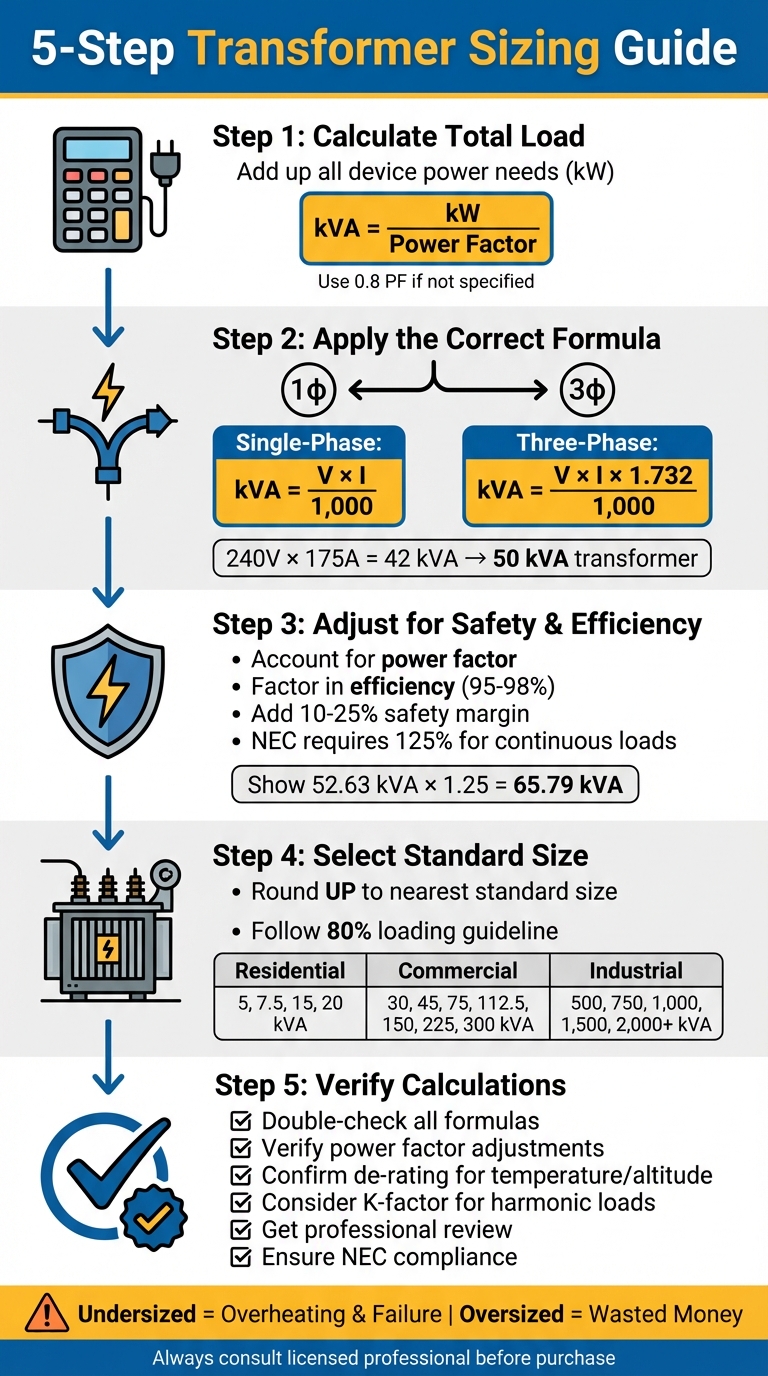
5-Step Transformer Sizing Process Guide
Transformer Sizing Basics
What Is a Transformer?
A transformer is a stationary electrical device that bridges your power supply and equipment, adjusting voltage levels to meet the specific needs of your facility. It works through primary windings (input side) and secondary windings (output side), transforming energy from the source into the form required for powering machinery, lighting, or electronics. As CSE Magazine explains:
"A transformer is a key component affecting system performance in both normal and disturbed conditions, such as a fault".
Before diving into transformer sizing, it’s essential to understand a few key terms.
Key Terms You Need to Know
Knowing these terms is crucial for selecting the right transformer for your setup. Load refers to the total power demand of all devices connected to the transformer.
Two other important concepts are power factor and efficiency. Power factor measures the ratio of real power to apparent power, with 0.8 being a common value used in calculations. Efficiency, on the other hand, is the percentage of input power that becomes usable output power. Most transformers operate at about 95% efficiency, meaning a small percentage of input power is lost as heat in the core and windings.
| Term | Definition |
|---|---|
| kVA | Kilovolt-amperes; indicates the transformer's apparent power capacity. |
| Voltage | Electrical pressure; primary voltage is the input, and secondary is the output. |
| Current | The flow of electricity, measured in Amperes (Amps). |
| Load | The total power demand of all devices connected to the transformer. |
| Power Factor | The ratio of real power to apparent power; 0.8 is a typical value for calculations. |
| Efficiency | The ratio of output power to input power; higher efficiency minimizes energy losses. |
With these terms in mind, it’s easier to understand why selecting the correct transformer size is so important.
Why Correct Sizing Matters
Choosing the right transformer size affects safety, cost, and reliability. Accurate measurements of kVA, voltage, and current are essential for proper sizing. An undersized transformer that operates at or near maximum capacity generates excessive heat, which can degrade insulation, activate protective relays, and shorten the equipment’s lifespan. Todd Benadum from ELSCO Transformers emphasizes:
"If not [correctly sized], you run the risk of frying your valuable equipment".
On the other hand, an oversized transformer can be an expensive mistake. You’ll pay more upfront for capacity you don’t need, and efficiency drops at partial loads due to increased "no-load losses", which are the energy costs of simply keeping the transformer energized. In critical settings like hospitals or data centers, poor sizing can lead to unexpected equipment failures or even safety hazards. Correct sizing also ensures compliance with industry standards from IEEE and IEC, as well as local utility requirements.
Transformer Size Calculation | Step by Step and Easy way
Step 1: Calculate Your Total Electrical Load
The first step in determining the right transformer size is figuring out how much power your system will need. This means listing every piece of equipment the transformer will support - motors, lighting, HVAC systems, control panels, and any other devices that consume electricity.
Finding Equipment Loads
Start by checking the nameplates and manuals for your equipment. These typically include details like voltage (V), amperage (A), frequency (Hz), and whether the device is single-phase or three-phase .
For devices that run continuously (three hours or more), the NEC recommends using 125% of their rated current to avoid overheating. Motors, in particular, can draw a lot more current when starting up. Todd Benadum from ELSCO Transformers suggests applying a 1.25 factor to account for this inrush current . If a power factor isn’t listed on the nameplate, you can safely estimate it at 0.8 .
Once you’ve identified the loads for all your equipment, the next step is converting real power (kW) into apparent power (kVA).
Converting Kilowatts to kVA
Transformers are rated in kVA, not kW, because their heat loss is determined by the total current they carry, regardless of the power factor of the load. The formula for conversion is simple:
kVA = kW / Power Factor
For example, Xuzhou Welldone Power Technology Co., Ltd. demonstrated this process for a 400V three-phase system. They calculated the loads for an 80 kW motor bank (0.85 PF), 20 kW lighting (1.0 PF), and 30 kW HVAC (0.90 PF), resulting in 94.12 kVA, 20.00 kVA, and 33.33 kVA, respectively. After factoring in a 20% growth margin, the total load increased to 176.94 kVA, leading to the selection of a standard 200 kVA transformer. Similarly, ELSCO Transformers’ 2024 guide suggests rounding up for safety. For instance, a 7.5 kW load with a 0.8 power factor converts to 9.375 kVA and should be rounded up to a 10 kVA or 15 kVA transformer.
Always round up to the next standard transformer size, and include an additional 10%–25% margin to account for future expansion . As Welldone Power explains:
"A transformer rated too small will overheat, trip protection, or fail early. Oversizing wastes capital and reduces operating efficiency".
Step 2: Use the Right Transformer Formula
Once you've calculated your total load in Step 1, it's time to apply the correct formula for your transformer. The approach differs depending on whether you're working with a single-phase or three-phase system.
Single-Phase Transformer Formula
For residential setups or smaller commercial loads - like lighting, appliances, and outlets - the single-phase formula is:
kVA = (V × I) / 1,000
In this formula:
- V represents voltage
- I represents current in amperes
- The division by 1,000 converts volt-amperes (VA) to kilovolt-amperes (kVA)
Here's an example: If you have a 240V system with a 175A load, the calculation is:
kVA = (240 × 175) / 1,000 = 42 kVA
This result rounds up to a 50 kVA transformer.
Three-Phase Transformer Formula
For larger industrial or commercial applications - like motor banks, manufacturing equipment, or heavy machinery - use the three-phase formula:
kVA = (V × I × 1.732) / 1,000
The constant 1.732 accounts for the 120-degree phase difference in three-phase systems. Let’s break it down with an example:
- A load requiring 208V and 175A would calculate as follows:
kVA = (208 × 175 × 1.732) / 1,000 ≈ 63.04 kVA
This rounds up to a 75 kVA transformer.
Another example from Electrical Technology: A transformer with a primary voltage of 7,200V and a current of 4A would yield:
kVA = (7,200 × 4 × 1.732) / 1,000 ≈ 49.88 kVA
This is roughly equivalent to a 50 kVA transformer.
Before performing these calculations, always check the voltage requirements on your equipment’s nameplate or manual. This ensures accuracy, especially when accounting for inrush currents (as discussed in Step 1). With these foundational calculations complete, you can move on to Step 3, where you'll refine for power factor, efficiency, and safety margins.
sbb-itb-501186b
Step 3: Adjust for Power Factor, Efficiency, and Safety Margins
Factoring in Power Factor and Efficiency
Once you've calculated the initial kVA, it's time to refine those numbers by accounting for power factor, efficiency, and safety considerations. The power factor (PF) measures how effectively electrical power is converted into useful work. It’s the ratio of real power (kW) to apparent power (kVA). A lower power factor means your system needs more current to deliver the same real power, which increases energy losses and may require a larger transformer.
To adjust for power factor, convert kW to kVA using the formula:
kVA = kW / PF
For example, if you have a 40 kW load and a power factor of 0.8, the required kVA would be:
40 / 0.8 = 50 kVA.
Next, factor in transformer efficiency. Even though many transformers operate at over 98% efficiency, internal losses still mean the input kVA needs to be slightly higher than the output. Typically, losses range from 1% to 5%. For instance, if your load requires 50 kVA and the transformer operates at 95% efficiency, the actual input requirement becomes:
50 / 0.95 ≈ 52.63 kVA.
Once you've adjusted for both power factor and efficiency, it's time to think about safety margins.
Adding a Safety Margin
To ensure reliable operation and accommodate unexpected demands, include a safety margin. This accounts for load spikes, motor starting currents (which can be up to six times the running current), and potential future expansions. For continuous loads - those operating for three or more hours - the National Electrical Code (NEC) mandates sizing at 125% of the full load. For critical applications, industry standards often recommend a 25% buffer.
To calculate the safety margin, multiply your adjusted kVA by 1.25. For example, if your adjusted load is 52.63 kVA, the final requirement becomes:
52.63 × 1.25 ≈ 65.79 kVA.
In this case, you would select the next standard transformer size, such as 75 kVA.
Environmental factors may also require additional adjustments. For instance:
- High temperatures: For every 10°C (18°F) above 40°C (104°F), dry-type transformers should be de-rated by 8%.
- High altitudes: Above 3,300 feet, reduce capacity by 0.3% for every 330 feet.
- Harmonic distortion: If harmonic distortion exceeds 15% - common with equipment like variable frequency drives or computers - consider derating to 90% of the transformer’s nameplate capacity or using a K-rated transformer.
These adjustments ensure your transformer can handle real-world conditions, and in some cases, may require selecting a larger transformer size to maintain performance and reliability.
Step 4: Select the Right Transformer Size
Matching Calculations to Standard Sizes
Once you’ve calculated the kVA from Step 3, the next step is to round up your result to the nearest standard transformer size. Transformers are manufactured in specific ratings based on industry norms, so rounding up ensures you select a size that can handle the load without being overburdened.
For instance, if your calculation gives you 52.5 kVA, you’d round up to the next available standard size, such as 75 kVA. This provides enough capacity to handle the load comfortably without pushing the transformer to its limits.
A key rule to follow is the 80% loading guideline, which helps extend the lifespan of the transformer and prevents overheating. To determine the recommended transformer size, use the formula:
Minimum calculated kVA ÷ 0.8 = Recommended transformer size.
Standard transformer sizes vary depending on whether you’re dealing with single-phase or three-phase units. Single-phase transformers range from 0.25 kVA to 333 kVA, with common residential sizes including 5, 7.5, 15, and 20 kVA. Three-phase transformers, on the other hand, start at 3 kVA and can exceed 10,000 kVA for industrial use. Common commercial ratings include 30, 45, 75, 112.5, 150, 225, and 300 kVA.
| Application | Common Standard kVA Sizes |
|---|---|
| Residential | 5, 7.5, 15, 20 |
| Commercial | 30, 45, 75, 112.5, 150, 225, 300 |
| Industrial | 500, 750, 1,000, 1,500, 2,000, 2,500, 3,000, 5,000, 10,000 |
Here’s a real-world example: In September 2025, engineers at a Welldone Power site calculated a total load of 147.45 kVA for a 400V system. This included an 80 kW motor bank, 20 kW lighting, and 30 kW HVAC. After factoring in a 20% growth margin, the calculation rose to 176.94 kVA. They selected a 200 kVA transformer, the nearest standard size, allowing for future growth and ensuring reliability.
Once you’ve matched your load to a standard size, the next step is to consider application-specific requirements.
Choosing for Specific Applications
Transformers need to meet the specific demands of their intended environment. Here are some considerations based on application:
- Industrial settings: Use Totally Enclosed Non-Ventilated (TENV) transformers to protect against contaminants. For motor loads, apply a 125% start factor to ensure adequate capacity, as discussed in Step 1.
- Commercial facilities: Ventilated dry-type transformers are common for lighting, HVAC, and general utilities. These typically range from 30 to 300 kVA and may meet DOE-2016 standards, achieving efficiencies of 97.0% to 98.9% at 35% load.
- Residential and hospitality applications: Noise reduction is critical. Install transformers at ground level or on rooftops to minimize disruption. For indoor dry-type transformers under 112.5 kVA, maintain at least 12 inches of clearance from combustible materials.
If harmonic distortion is a concern - common with equipment like variable frequency drives, computers, or LED lighting - consider a K-factor rated transformer or a Harmonic Mitigating Transformer (HMT). These options manage heat and protect insulation from damage caused by harmonics exceeding 15%.
"Starting a device generally requires more current than running it. To account for this additional current requirement, it's often helpful to add a start factor into your calculations." - Todd Benadum, ELSCO Transformers
Lastly, don’t overlook installation logistics. Transformers rated between 75 and 500 kVA typically require a concrete pad measuring about 5.5 x 6.5 feet and 10 inches thick. For larger units rated between 500 and 2,500 kVA, an 8 x 9 foot pad is usually needed. Always confirm the weight, dimensions, and available space before making a final decision.
Step 5: Verify Your Calculations
Review Your Work
After completing your sizing calculations, take the time to double-check everything. Even small mistakes can lead to costly downtime or repairs. While the math involved is generally simple, using the wrong formula can completely throw off your results.
Make sure you’ve applied the correct formula for your system - whether it’s single-phase or three-phase. As Mike Holt, Owner of Mike Holt Enterprises, explains:
"The math involved isn't particularly challenging, but if you select the wrong formula, your results will be wrong even if your math is right".
A helpful tip is to cross-reference the formula for the system type you’re not using. This ensures you haven’t accidentally mixed them up.
Next, confirm that you’ve correctly converted current (amps) to kVA, as outlined in Steps 1–4. Double-check that you’ve factored in the power factor accurately - a system with a 0.8 power factor, for example, will need a transformer that’s 25% larger than one with a unity power factor. Also, verify that you’ve included de-rating adjustments for temperature and altitude.
For systems with non-linear loads - like variable frequency drives, LED lighting, or computers - ensure you’ve considered whether a K-factor rated transformer is necessary to handle harmonic-related heat. To further validate your calculations, you can use software like ETAP to run load flow analysis and simulations, ensuring the transformer size aligns with your system’s needs.
Finally, have a licensed professional review your calculations before making a purchase. This step ensures compliance with NEC Article 450 for transformer protection and Article 310 for conductor ampacity. Emily Newton, Editor-in-Chief of Revolutionized Magazine, offers this advice:
"It's an especially good idea to get professional guidance before making your purchase if you're buying a transformer for the first time".
Getting a professional review not only helps avoid safety risks and regulatory issues but also saves you from the expense of replacing an incorrectly sized transformer. Missteps can cost 200-300% more due to labor and downtime. Once your calculations are verified, you’re ready to move on to sourcing the right transformer.
Where to Buy Transformers
After verifying your calculations, it’s time to purchase your transformer from a reliable supplier. Electrical Trader (https://electricaltrader.com) offers a wide selection of new and used transformers, catering to both small residential needs (starting at 5 kVA) and large industrial requirements (over 10,000 kVA). Their inventory includes single-phase transformers, three-phase transformers, dry-type units, and K-factor rated transformers designed for systems with heavy harmonic loads.
The platform connects you with equipment for standard applications or custom solutions tailored to unique installation conditions. It also features a resource center with detailed buying guides, helping you navigate technical specifications and match your transformer to your verified calculations.
Conclusion
Sizing a transformer accurately calls for a step-by-step approach: calculate the total kVA load, use the correct formula based on whether it’s a single-phase or three-phase system, and account for factors like power factor, efficiency, and safety margins. Once you have your result, select the next highest standard transformer size and double-check everything before making a purchase. This method ensures dependable performance and adherence to industry standards.
"Correct transformer sizing is an investment in long-term reliability, efficiency, and safety." - Meta Power Solutions
Getting the size right is critical to avoiding issues like overheating, insulation failure, fire hazards, or the wasted energy that comes with oversized units. A properly sized transformer stays within safe thermal limits, delivers stable voltage, and protects sensitive equipment. To accommodate demand spikes and future growth, experts recommend adding a safety margin of 15% to 25%, while the NEC mandates a 125% sizing factor for continuous loads.
Environmental factors and harmonic loads also play a role - adjust for high temperatures, altitude, or choose a K-rated transformer when needed to maintain reliable performance. Accurate calculations save you from expensive replacements down the line. After verifying your calculations with a licensed professional and ensuring compliance with NEC Article 450, you can confidently purchase a transformer that fits your needs. Electrical Trader (https://electricaltrader.com) offers a range of transformers designed to meet your verified specifications.
FAQs
What should I consider when deciding between a single-phase and a three-phase transformer?
When choosing between a single-phase and a three-phase transformer, it's important to think about the load type and power needs of your application. Single-phase transformers work well for smaller loads, such as residential settings or equipment that only needs single-phase power. They're simpler in design, more compact, and often a more budget-friendly option for these purposes.
On the flip side, three-phase transformers are designed for larger industrial or commercial applications that require higher power levels. They deliver more efficient and balanced power distribution, which is critical for running heavy machinery or large systems. That said, they tend to be more complex and can come with higher installation and maintenance costs.
To make the best decision, consider factors like the size of your load, the current electrical system in place, the voltage requirements, and your budget constraints. Taking the time to evaluate these details will help you choose a transformer that fits your needs effectively and reliably.
How do temperature and altitude impact transformer sizing?
Environmental conditions such as temperature and altitude significantly influence transformer sizing because they directly impact how well a transformer can manage heat and perform under load. For instance, higher temperatures reduce cooling efficiency, which increases the likelihood of overheating. To address this, the transformer's capacity often needs to be derated - or adjusted downward - to maintain safe and reliable operation.
Similarly, at higher altitudes, the air becomes thinner, which diminishes its ability to cool the transformer effectively. This also necessitates derating to prevent overheating and ensure consistent performance. Calculating these derating factors based on the specific environmental conditions of the installation site is crucial. It ensures the transformer can handle the required load without risking insulation damage, overheating, or system failures, ultimately supporting long-term safety and reliability.
Why should you include a safety margin when sizing a transformer?
Adding a safety margin when sizing a transformer is crucial for ensuring reliable performance and durability over time. This margin helps the transformer handle unexpected load spikes, fluctuating demand, or potential future expansions without the risk of overheating or failure.
By incorporating a safety margin, you not only improve the transformer's efficiency but also minimize the chances of expensive repairs or operational downtime. It's a smart move for maintaining performance and avoiding unnecessary costs in the long run.