Smart Circuit Breakers vs Standard: Cost Breakdown
Looking to upgrade your electrical panel but unsure whether to choose smart or standard circuit breakers? Here's the bottom line:
- Standard breakers are inexpensive ($5–$250 per unit), reliable, and last 25–40 years. Installed, they cost $318–$625 per circuit. They provide basic overload and short-circuit protection but lack advanced features.
- Smart breakers are pricier ($120–$500+ per unit) and cost $520–$1,300+ per circuit with installation. They offer features like Wi-Fi control, energy monitoring, and remote management but have a shorter lifespan of 15–25 years. They can save 5%–15% on energy bills, potentially offsetting costs over time.
Quick Comparison:
| Feature | Standard Breaker | Smart Breaker |
|---|---|---|
| Unit Cost | $5–$250 | $120–$500+ |
| Installation | $313–$375 | $400–$800 |
| Lifespan | 25–40 years | 15–25 years |
| Energy Savings | None | 5%–15% |
| Features | Basic protection | Remote control, monitoring |
Key Takeaway: Choose standard breakers for cost-effective, long-lasting protection. Opt for smart breakers if you're interested in energy management and modern features, especially for homes with EV chargers or solar panels.
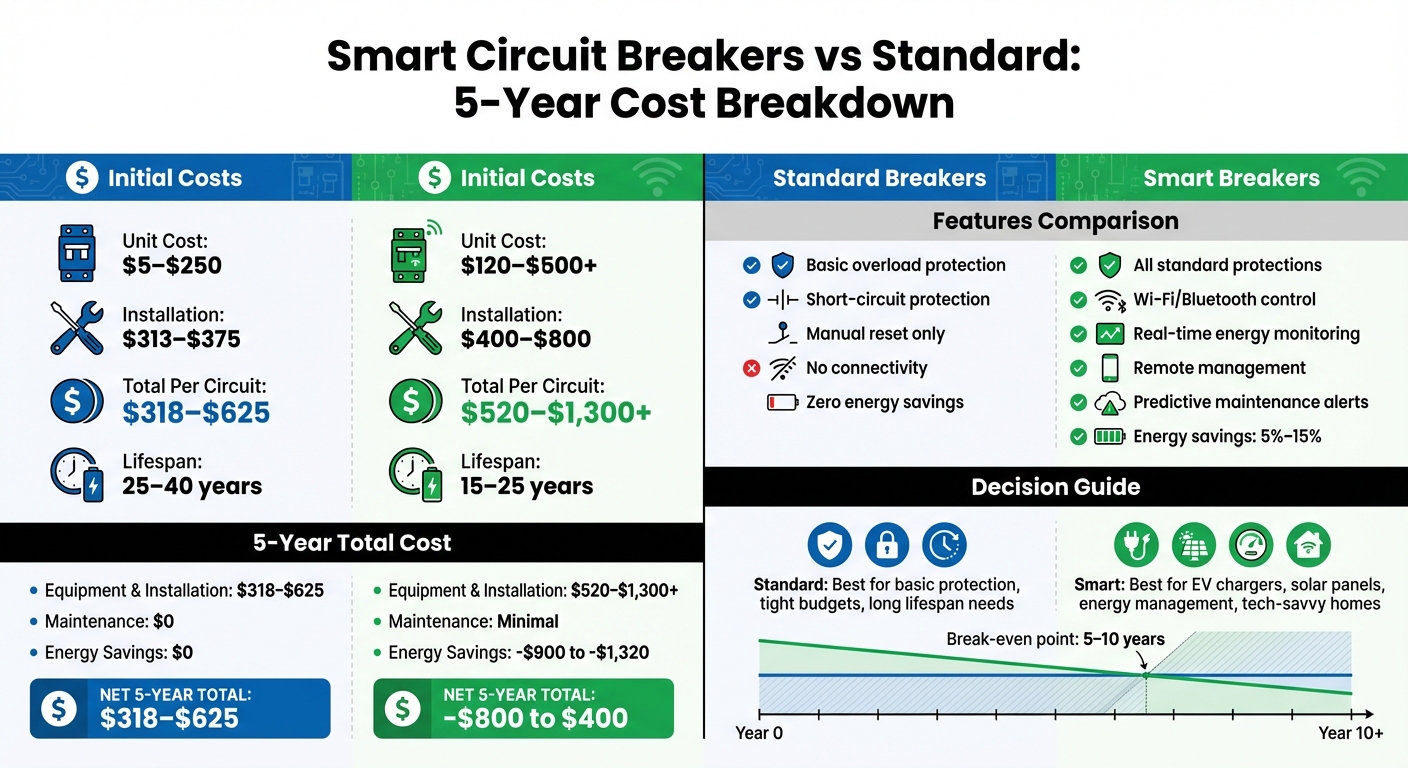
Smart vs Standard Circuit Breakers: Complete Cost Comparison Over 5 Years
SMART BREAKERS - Remotely Controlled Circuit Breakers
Standard Circuit Breakers: Overview and Costs
Standard circuit breakers are a crucial part of both residential and commercial electrical systems. These devices act as automatic mechanical switches, preventing damage to circuits caused by overloads or short circuits. When the current exceeds safe levels, the breaker "trips", physically separating its internal contacts to halt the flow of electricity.
Most homes rely on thermal-magnetic breakers, which combine two protective mechanisms. The thermal component, a bimetallic strip, responds to prolonged overloads, while the magnetic component activates during sudden surges or short circuits. These breakers are entirely mechanical and need to be reset manually after tripping. Their simplicity and durability make them the standard against which newer, more advanced (and pricier) smart breakers are compared. Let’s dive into the main features and costs associated with standard circuit breakers.
Key Features of Standard Circuit Breakers
Standard circuit breakers are valued for their straightforward design and long-lasting performance. Under typical conditions, they can last anywhere from 25 to 40 years, with some units even reaching up to 70 years before wear impacts their functionality.
They come in various configurations to suit different electrical needs:
- Single-pole breakers (15–20 amps): Commonly used for lighting and standard outlets.
- Double-pole breakers (30–200 amps): Designed for heavier appliances like dryers or electric vehicle chargers.
Installation is relatively simple for licensed electricians and typically takes about an hour per breaker.
Average Upfront Costs
The cost of standard circuit breakers depends on their amperage and type. For a basic 15- to 20-amp single-pole breaker, prices range from $5 to $50 per unit, while double-pole breakers are generally priced between $25 and $100. A heavy-duty 200-amp main breaker can cost around $250. Specialized breakers, such as GFCI (Ground Fault Circuit Interrupter) or AFCI (Arc Fault Circuit Interrupter), which provide added safety against electrocution and fires, typically cost between $30 and $150 per unit.
When factoring in installation, the national average materials cost for a single breaker is about $10.61. However, labor is the biggest expense. Licensed electricians charge anywhere from $40 to $120 per hour, bringing the total installation cost to approximately $150 to $300 for a single-pole breaker and $200 to $400 for a double-pole unit.
Smart Circuit Breakers: Overview and Costs
Smart circuit breakers bring a modern twist to the traditional circuit breaker, combining standard electrical protection with connectivity features like Wi‑Fi, Bluetooth, or Zigbee. These upgrades transform your electrical panel into a smart hub, enabling remote control, automated schedules, and instant notifications when a breaker trips. As Joe, an electrical expert at VIOX Electric, puts it:
"Smart circuit breakers offer more than just protection - they deliver real‑time data, remote control, and energy optimization, unlike traditional breakers that simply serve as safeguards against electrical overloads".
These advanced features are especially useful in homes with high-energy systems like EV chargers, solar panels, or battery storage. They also help identify "phantom" energy loads - devices that draw power even when turned off. Since these hidden drains can account for 6% to 23% of a home's electricity use, addressing them can lead to noticeable savings.
Key Features of Smart Circuit Breakers
Smart breakers pack sophisticated electronics into a compact design, including microprocessors, voltage sensors, and current transformers. These components work together to monitor and analyze electrical flow.
One standout feature is real-time energy monitoring. This allows you to track exactly how much power each circuit is using. The data is accessible through smartphone apps, which also provide historical usage trends and let you schedule circuits to minimize energy use during high-rate periods.
Remote control is another game-changer. Whether you're managing a rental property or simply want more control over your home's energy use, being able to toggle circuits from anywhere adds both convenience and safety. Daniel Carpenter, a licensed electrician from Integra Electrical, highlights the benefits:
"A smart electrical panel is a modern upgrade to your home's breaker box that lets you see exactly how much energy each circuit is using in real time".
Additional features include predictive maintenance alerts, which flag electrical stress before it leads to fires or equipment damage. Smart breakers also integrate with platforms like Samsung SmartThings, Home Assistant, and voice assistants like Alexa and Google Assistant.
However, the advanced electronics in these devices mean they typically last 15–25 years, shorter than the 25–40 years of standard mechanical breakers.
Average Upfront Costs
Smart breakers come with a higher price tag due to their advanced technology. While standard breakers generally cost $5 to $50, smart breakers range from $120 to over $500 per unit.
Here’s a breakdown of prices for popular models in 2026:
- Leviton 2nd Gen Smart Breakers: Start at $141 for a 20-amp basic model, $237 for a 20-amp GFCI version, and up to $356 for a 2-pole GFCI model.
- Eaton AbleEdge Smart Breakers: Cost between $220 and $320, depending on amperage and protection type.
- Generic/Tuya Smart Breakers: Priced around $20 to $60, though these often lack UL certification and may not comply with North American safety standards.
Installation costs are also higher. While a standard breaker installation typically costs $150 to $300, installing a smart breaker can range from $400 to $800 per unit. This reflects the extra work involved in setting up firmware, Wi‑Fi, and ensuring proper network integration.
When purchasing, always verify that the breaker is UL-listed or CSA-certified. While generic models may be cheaper, they often lack the safety certifications required for code compliance. Additionally, ensure your electrical panel has a strong Wi‑Fi or Zigbee signal to take full advantage of the smart features.
Though the upfront investment is higher, the ability to monitor and optimize energy use makes smart circuit breakers a forward-thinking choice for modern electrical systems.
Cost Comparison: Smart vs Standard Circuit Breakers
This section breaks down the financial differences between smart and standard circuit breakers, summarizing pricing and installation costs from earlier discussions.
Upfront Costs
The price gap between standard and smart circuit breakers is significant. Standard breakers range from $5 to $250 per unit, while smart breakers cost $120 to over $500 each. When factoring in additional protection features, the difference grows even more. For instance, a standard GFCI breaker costs $30 to $150, whereas a smart GFCI model averages around $237.
When combined with installation, the total cost per circuit can nearly double for smart breakers. Standard breakers, including labor, cost $318 to $625 per circuit. In contrast, smart breakers range from $520 to over $1,300 per circuit.
| Cost Component | Standard Circuit Breaker | Smart Circuit Breaker |
|---|---|---|
| Unit Price | $5 – $250 | $120 – $500+ |
| Installation Labor | $313 – $375 | $400 – $800 |
| Total per Circuit | $318 – $625 | $520 – $1,300+ |
Installation and Setup Costs
The installation process further highlights the cost differences. Standard breakers are relatively simple to install, typically requiring 1–2 hours of work by an electrician, with labor costs ranging from $313 to $375 per circuit. On the other hand, smart breakers involve additional steps like Wi-Fi pairing, app setup, and firmware updates, pushing labor costs to $400 to $800 per unit.
There are also potential extra costs for smart breaker setups. For example, accessories like Zigbee hubs or Wi-Fi signal boosters may add $50 to $150. Electrical permits and inspections, which are required for both types, can cost between $50 and $350 depending on local regulations. However, bundling multiple installations can help lower the cost per unit.
These installation differences also influence ongoing maintenance and operational costs, which will vary based on the complexity of the system.
sbb-itb-501186b
Long-Term Costs: Maintenance and Savings
Maintenance and Repair Costs
Standard circuit breakers are almost maintenance-free. They rely on mechanical components and typically last anywhere from 25 to 40 years. Routine upkeep involves little more than occasional inspections or cleaning, and over a five-year span, maintenance costs are minimal - often limited to a quick self-check or a brief visit from an electrician.
Smart breakers, on the other hand, require more attention due to their electronic components. They need firmware updates and rely on steady Wi-Fi or Bluetooth connections to function fully. While their physical protection features remain active during network outages, remote monitoring is temporarily unavailable. Additionally, they are more prone to software glitches compared to the mechanical simplicity of standard breakers. However, smart breakers come with a significant advantage: predictive maintenance alerts. These alerts, accessible via smartphone apps, flag potential problems like overheating, voltage irregularities, or unusual power consumption. By catching issues early, they help prevent costly damage to appliances and electronics, acting as a safeguard for your investment.
While smart breakers may require more upkeep, they also bring energy savings that can offset their higher initial price tag.
Energy Savings and ROI for Smart Breakers
Smart breakers provide more than just convenience - they can lead to noticeable energy savings. One of their standout features is the ability to detect and reduce phantom power waste, which accounts for 10% to 15% of electricity usage from devices left plugged in but not actively in use. Using real-time monitoring, they highlight energy-draining appliances and allow users to schedule high-demand devices like water heaters or EV chargers during off-peak hours. This optimization typically reduces electricity bills by 5% to 15%, translating to about $200 in annual savings on a $2,000 bill, with payback periods ranging from 5 to 10 years.
For instance, a homeowner using a $70 smart breaker on a circuit with a $150 monthly electricity bill managed to cut 10% to 15% of standby power consumption, saving around $20 per month. The hardware cost was recovered in just 3.5 months. In another case from 2024, a homeowner equipped a 1960s ranch house with a Span smart panel. By leveraging its load management capabilities, they avoided a $25,000 electrical service upgrade that would have been necessary with a standard panel.
On average, a smart breaker system saving 10% on a $2,000 annual electricity bill would result in $200 saved each year - amounting to $1,000 over five years and $2,000 over a decade. Additionally, homeowners might qualify for the Energy Efficient Home Improvement Credit, which reimburses 30% of upgrade costs up to $600 when the upgrade is part of a broader energy efficiency project.
Total Cost Breakdown Over 5 Years
Over a five-year period, standard circuit breakers cost between $318 and $625 per circuit, covering both equipment and installation costs. Since these breakers require minimal upkeep - usually just a quick visual inspection - their total cost over five years remains nearly identical to the upfront expense. However, standard breakers don’t help reduce energy consumption, so there’s no opportunity for savings on that front.
Smart circuit breakers, on the other hand, have an initial cost ranging from $520 to $1,300+ per circuit. While the upfront price is higher, they can help lower energy bills. By reducing standby power consumption, a smart breaker can save between $900 and $1,320 over five years, depending on usage patterns. After factoring in these savings, the net five-year cost of a smart breaker could range from saving you approximately $800 to adding an extra $400 to your expenses.
The break-even point for smart breakers usually falls somewhere between 5 and 10 years. This makes them a better fit for long-term homeowners with higher electricity usage. For those planning to move sooner or with lower energy demands, sticking with standard breakers might be the more cost-effective choice.
| Cost Category | Standard Breaker (5 Years) | Smart Breaker (5 Years) |
|---|---|---|
| Equipment | $5 – $250 | $120 – $500+ |
| Installation & Permits | $313 – $375 | $400 – $800 |
| Maintenance | $0 | Minimal (e.g., firmware updates) |
| Energy Savings | $0 | $900 – $1,320 |
| Net 5-Year Total | $318 – $625 | -$800 to $400 |
These calculations combine upfront costs with potential operational savings, emphasizing the need to match your breaker choice to your long-term energy usage and living plans.
2026 Market Trends for Circuit Breakers
The U.S. circuit breaker market is on a strong growth trajectory, with its value expected to climb from $3.6 billion in 2024 to over $6.5 billion by 2034. Smart circuit breakers, once seen as luxury items, are now becoming essential in modern homes. This shift is largely fueled by rising energy costs and the increasing need for real-time load management. In 2024, the low-voltage segment - which includes most residential smart breakers - accounted for 51.6% of the market and is growing at an annual rate of 6.9%. This trend highlights not only the demand for improved electrical safety but also the growing importance of smart features in managing energy usage.
Federal infrastructure projects and technological advancements are also playing a significant role in transforming the market. For example, the U.S. initiative to install 500,000 EV chargers by 2030 has created a demand for advanced circuit protection systems capable of managing high-voltage residential loads. In response, manufacturers like Leviton and Eaton are developing breakers that handle bidirectional power flow for systems like solar panels and battery storage. In October 2024, Schneider Electric introduced the MasterPacT MTZ Active low-voltage breaker, which features real-time energy tracking specifically designed for data centers. This innovation aims to minimize downtime and cut energy costs. Such advancements demonstrate how manufacturers are integrating predictive maintenance and energy tracking to enhance the functionality of smart breakers while addressing their cost concerns.
Smart breakers are also becoming more sophisticated, incorporating features such as AI-driven predictive maintenance and compatibility with Matter/Thread standards, ensuring seamless integration into smart home ecosystems. Some U.S. insurance providers have even started offering discounts for homes equipped with smart electrical monitoring systems capable of detecting arc faults or leaks early.
"The transition toward a smarter and more resilient power grid is accelerating across the US, driving large-scale investments in protective devices." – Research and Markets
Pricing, however, remains a critical factor. While more affordable generic models are available, they often lack UL certification, which is necessary for compliance in the U.S. Additionally, professional installation can add $400–$800 per circuit, making smart breakers a pricier upfront investment compared to standard options.
Conclusion: Choosing the Right Circuit Breaker for Your Needs
Smart breakers come with a higher price tag compared to standard ones. Standard breakers typically cost between $5 and $250 per unit, with installation fees ranging from $313 to $375. On the other hand, smart breakers are priced at $120 to $500 or more per unit, with installation costs falling between $400 and $800 per circuit. However, over five years, smart breakers can offset some of their initial expense by delivering 5%–15% in energy savings.
When deciding, it’s not just about the cost - it’s about your system’s specific needs. Standard breakers are ideal for basic setups, tight budgets, or locations where connectivity is limited. They’re known for their reliability, lasting anywhere from 25 to 40 years. In contrast, smart breakers shine in systems with solar panels, electric vehicle (EV) chargers, or the need for advanced features like real-time monitoring and remote control. Their lifespan typically ranges from 15 to 25 years.
"Traditional breakers remain an excellent choice for basic protection and cost-conscious projects, offering decades of reliable service."
- Joe, Electrical Industry Professional, VIOX Electric
Ultimately, your choice should reflect your energy priorities and technical requirements. Whichever option you choose, ensure compliance with safety standards and have the breaker installed by a licensed electrician.
If you're looking for competitive prices on both standard and smart circuit breakers, check out Electrical Trader. They offer a range of new and used components from trusted brands, making it easier to find the right breaker for your needs and budget.
FAQs
What advantages do smart circuit breakers have over standard ones?
Smart circuit breakers bring a range of benefits over traditional models, particularly when it comes to safety, energy management, and ease of use. Unlike standard breakers, which rely on mechanical operations, smart breakers incorporate advanced technology to offer real-time monitoring, fault detection, and even remote control. These devices can quickly detect problems like overloads or voltage fluctuations, send you instant alerts, and even shut off circuits remotely during emergencies to enhance safety.
Beyond improving safety, smart breakers can help you manage energy more effectively. They provide detailed insights into energy consumption, enabling you to monitor usage and potentially lower electricity bills. Many models also work seamlessly with renewable energy systems and can prioritize essential circuits during power outages. With features like smartphone app integration, managing your electrical system becomes simpler and more efficient, making smart circuit breakers a practical upgrade for homes and businesses alike.
How can smart circuit breakers help reduce energy costs?
Smart circuit breakers can cut down energy costs by providing real-time energy monitoring and control. They deliver detailed data on energy usage, helping you spot inefficiencies and adjust your consumption habits. By preventing overloads and fine-tuning energy use, these breakers have the potential to reduce electricity bills by up to 30% in certain scenarios.
Another perk? You can manage them remotely. This means you can switch off unused circuits or appliances no matter where you are, making it even easier to save energy and money.
Are smart circuit breakers worth the extra cost?
Smart circuit breakers might come with a higher upfront price tag, but they bring a lot to the table. Features like real-time monitoring, remote control, and energy management can help you cut down on energy waste and make better use of your power. Over time, these perks can translate into noticeable savings, potentially balancing out the initial cost.
On top of that, smart breakers add an extra layer of convenience and safety. Being able to monitor and control your electrical system remotely means you can address issues promptly, even when you're not at home. For many homeowners and businesses, these benefits make smart circuit breakers a practical and worthwhile investment over time.