Scalable Modular UPS: Energy Efficiency Explained
Scalable modular UPS systems are redefining energy efficiency in power protection. They offer a flexible, step-by-step approach to scaling power capacity, aligning closely with demand, and reducing energy waste. Unlike older systems, modular UPS designs achieve over 97% efficiency even at partial loads, cutting energy use and operational costs significantly.
Key Takeaways:
- Energy Efficiency: Modular UPS systems maintain 97% efficiency at 25-75% load, outperforming older designs that drop to ~85% at low loads.
- Scalability: Add capacity as needed with vertical (modules) or horizontal (racks) scaling, avoiding over-provisioning.
- Cost Savings: Save up to 50% on energy and cooling costs with improved load management and reduced heat output.
- Reliability: Features like hot-swappable modules and N+1 redundancy ensure continuous operation with minimal downtime.
- Lower TCO: While upfront costs are 10-15% higher, savings in energy, cooling, and maintenance lead to a reduced total cost of ownership.
Modular UPS systems are a smarter choice for facilities aiming to balance energy savings, reliability, and the ability to grow with demand.
Keor FLEX | High-Power Modular UPS by Legrand – Scalable, Resilient, Efficient

sbb-itb-501186b
Modular UPS Architecture Basics
A modular UPS is built on a chassis-based design that combines independent power modules into a shared frame. This setup allows facilities to start with a smaller system and expand it step by step as power demands grow. The modular structure not only adds adaptability but also helps optimize energy use as load requirements change.
Main Components of a Modular UPS
A modular UPS system is made up of five key components that work together seamlessly:
- Power modules: These are responsible for converting AC to DC and back to AC, delivering steady power to connected devices. Each module operates independently, with its own inverter and rectifier. For example, the Schneider Electric Easy UPS can scale from 50 kW to 250 kW using uniform 50 kW modules within a single frame.
- Control unit: This acts as the system's brain, monitoring all modules in real time, managing load distribution, and providing performance updates to operators. It ensures smooth operation by redistributing the load if one module encounters an issue.
- Static bypass switch: A critical safety feature, it automatically shifts the load to utility power if the UPS experiences a fault, ensuring uninterrupted operations during maintenance or emergencies.
- Battery modules: These provide instant backup power in the event of utility failures, keeping systems running without disruption.
- Scalable frame: Typically a standard 19-inch rack, this houses all components and includes internal busbars for power distribution. The frame supports hot-swappable modules, allowing technicians to add or replace components without shutting down the system. This feature significantly reduces Mean Time to Repair (MTTR) to about 30 minutes, compared to the six hours typically required for traditional systems.
| Component | Primary Function | Key Benefit |
|---|---|---|
| Power Module | AC/DC/AC conversion and power delivery | Ensures N+1 redundancy; shares load if one module fails |
| Control Unit | System monitoring and load management | Manages load sharing and alerts operators to potential issues |
| Static Bypass | Emergency power path | Maintains continuity by bypassing the UPS during faults |
| Battery Pack | Energy storage | Provides immediate power during outages |
| Scalable Frame | Physical housing and power distribution | Allows capacity expansion without additional wiring |
How Scalability Functions
Modular UPS systems operate on a pay-as-you-grow principle. Facilities can install a frame with ample capacity and add modules only as needed. This approach accommodates increasing power demands - whether due to digital upgrades, facility growth, or new equipment - without requiring a complete system overhaul.
By avoiding over-provisioning, this method is both efficient and cost-effective. Kenny Green, Technical Support Manager at KOHLER Uninterruptible Power Ltd, highlights the financial advantage:
A modular approach allows an enterprise to buy in only enough data processing resource for its immediate needs. Extra capacity can be added incrementally, with only incremental costs.
Standardized components make scaling even simpler. For instance, Schneider Electric uses interchangeable 50 kW modules across various UPS systems, reducing inventory challenges and ensuring consistent performance as operations expand. When planning for growth, facilities often implement N+1 redundancy - where "N" is the number of modules needed for the current load, and "+1" is a spare module that takes over if another fails. For example, a 200 kW load using 50 kW modules would require five modules: four to handle the load and one as backup.
How Scalability Improves Energy Efficiency
Scalability in UPS systems addresses energy inefficiency by aligning power modules with actual demand. When facilities install oversized systems to prepare for future growth, they often run equipment at a fraction of its capacity for extended periods. This underutilization wastes energy and increases operating costs.
Avoiding Oversized Systems
Traditional UPS setups force organizations into a tough choice: either install a system that fits current needs and face expensive upgrades later, or oversize from the outset and endure years of inefficiency. Modular systems solve this problem through vertical scaling - allowing facilities to add power modules gradually as demand grows, rather than overestimating future requirements.
Modern modular transformerless UPS systems achieve over 97% efficiency across a wide load range, from 25% to 75% of their nominal capacity. By comparison, traditional transformer-based systems see efficiency drop to around 85% when loads dip to 25%.
For example, a traditional N+1 configuration supporting a 200 kVA load requires two 200 kVA units, limiting each to 50% utilization. A modular system, on the other hand, can achieve the same redundancy with five 50 kVA modules - four actively handling the load and one as a backup. This setup allows the system to operate at 80% capacity, cutting energy costs by roughly 50% compared to traditional systems.
Smarter Load Management and Energy Savings
Advanced modular systems further boost efficiency with intelligent module management technologies, such as Xtra VFI. These systems adjust the number of active modules based on the current load while maintaining redundancy. Surplus modules enter standby mode with their inverters off, eliminating unnecessary energy use.
This feature is particularly effective during fluctuating demand. In virtualized environments, when servers go offline, the system consolidates the load onto fewer modules, ensuring each operates at peak efficiency. As Rehlko (formerly Kohler UPS) explains:
The result is improved energy efficiency, especially if the load has dropped to 25% or less of the UPS's full capacity.
Additionally, modular systems waste less energy as heat, which reduces cooling needs by about 50% compared to oversized traditional systems. This creates a ripple effect: the energy saved through efficient UPS operation lowers cooling demands, leading to even greater overall savings. These scalability-driven improvements pave the way for further advancements in UPS technology and performance optimization.
Modular UPS vs. Conventional UPS Systems
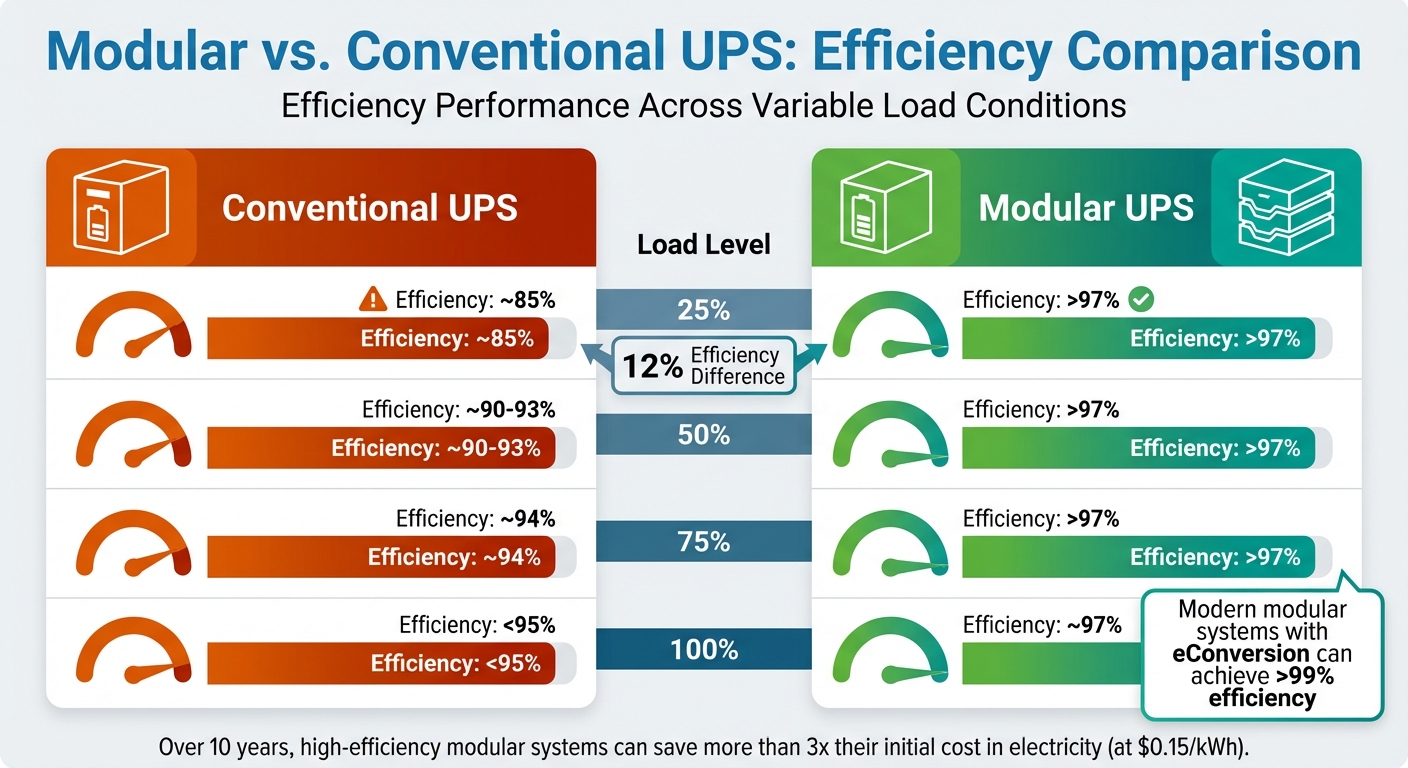
Modular vs Conventional UPS Efficiency Comparison at Different Load Levels
The performance gap between modular and conventional UPS systems becomes clear when you look at how they operate. Conventional systems, particularly older transformer-based models, often falter when handling fluctuating loads. In contrast, modular systems adapt seamlessly, maintaining high efficiency under varying conditions.
Efficiency at Different Load Levels
One of the most noticeable differences is how these systems perform at partial loads, which is where UPS systems typically operate. Modular systems consistently achieve efficiency levels above 97%, while conventional designs see significant drops as load levels decrease.
Here's a breakdown of efficiency at various load percentages:
| Load Percentage | Conventional UPS Efficiency | Modular UPS Efficiency |
|---|---|---|
| 25% Load | ~85% | >97% |
| 50% Load | ~90–93% | >97% |
| 75% Load | ~94% | >97% |
| 100% Load | <95% | ~97% |
Modern modular systems, equipped with advanced features like eConversion, can push efficiency beyond 99%. Over a decade, these high-efficiency systems can save more than three times their initial cost in electricity alone, even with energy prices as low as $0.15 per kWh. This scalability and energy efficiency make modular systems a standout choice.
Impact on Power Usage Effectiveness (PUE)
The efficiency of modular UPS systems also contributes to better Power Usage Effectiveness (PUE), a key metric for facility energy performance. PUE is calculated by dividing total facility power consumption by the power used by IT equipment - a lower PUE means greater efficiency. Modular systems improve PUE by minimizing energy losses and reducing cooling demands. For example, when a UPS operates at 97% efficiency instead of 94%, less energy is wasted as heat. This directly lowers the cooling load, which is one of the biggest energy expenses for facilities. The result? Both the UPS and the cooling system consume less energy.
Another advantage of modular designs is their compact size. Over the last two decades, the footprint of a 1MW UPS has shrunk dramatically - from 8 meters (about 26 feet) to less than 1.7 meters (about 5.6 feet). This nearly 80% reduction frees up valuable floor space for IT equipment, allowing facilities to prioritize revenue-generating operations over bulky power infrastructure. This space-saving design further boosts the system’s overall energy and operational efficiency.
Technologies That Improve Energy Efficiency in Modular UPS Systems
Modular UPS systems already offer scalable energy savings, but advanced control technologies take this efficiency to the next level. These innovations focus on optimizing power flow and coordinating modules effectively under different load conditions, ensuring energy and cost savings.
Smart Load Management
Smart load management systems adjust the number of active modules based on real-time demand. By concentrating power delivery on fewer modules operating at their most efficient range - typically between 50% and 100% capacity - these systems significantly reduce energy waste.
For example, KOHLER Uninterruptible Power's Xtra VFI technology uses this approach by placing surplus modules into a "ready" standby mode while keeping active modules within their efficiency sweet spot. Alex Emms, Operations Director at KOHLER Uninterruptible Power, highlights the impact:
The efficiency improvements are particularly significant when the load is less than 25 percent of full capacity.
This is crucial because UPS systems lose efficiency when loads fall below 30%. Smart load management avoids this by idling unnecessary modules, reducing fixed losses.
The results can be dramatic. At Exelon Corp's data center in Joliet, Illinois, replacing two outdated 1,000 kVA UPS units with four 750 kVA modular units improved load factors. Combined with other measures, the facility's Power Usage Effectiveness (PUE) dropped from 1.96 to 1.146. Despite a five-fold increase in computing capacity over five years, total energy consumption stayed flat.
Energy Saver System (ESS) Modes
ESS mode, also known as Eco mode, bypasses the double-conversion process (AC-to-DC-to-AC) when utility power is stable, delivering power directly to the load. This eliminates conversion losses and boosts efficiency to as high as 99%.
However, there’s a trade-off. Alex Emms explains:
While this can increase efficiency to 99%, most data centre operators avoid using it because it exposes the load to any incoming mains problems throughout most of its operational life.
Switching from mains to inverter during power fluctuations introduces a brief delay, measured in milliseconds. Before adopting ESS mode, it's essential to confirm that IT equipment power supplies can handle this transition.
For facilities requiring uninterrupted power or those in areas with unstable utility supply, standard double-conversion mode with transformerless technology remains a safer option. This mode achieves up to 97.6% efficiency for individual modules and 97.4% for entire systems.
High Power Factor Design
Modern modular UPS systems feature transformerless designs with booster rectifiers and IGBT semiconductors. These technologies bring the power factor closer to unity, meaning the system consumes real power more effectively while minimizing reactive power losses.
Additionally, these designs cut input current harmonic distortion (THDi) from 30% to under 3.5%, reducing the size of upstream cabling and switchgear. This not only lowers installation costs but also reduces ongoing energy expenses. Advanced filtering techniques further enhance efficiency by minimizing switching frequencies and reducing the need for passive filters.
These high power factor designs maintain efficiency across variable loads. Over a 10-year lifespan, even a modest 5 kW efficiency improvement can save more than $65,000, assuming an electricity rate of $0.15 per kWh.
Cost Savings and Return on Investment (ROI)
Energy Cost Reductions
Modular UPS systems are designed to lower energy consumption and cooling demands. For instance, a modular transformerless UPS can save over $47,500 in operating and cooling costs over five years for a 120 kVA load. These systems operate at 97% efficiency, even at just 25% load, delivering considerable savings over time.
This high efficiency also means less heat output, which directly reduces cooling energy needs. Considering that energy typically makes up about 60% of a data center's overall operating costs, even small improvements in efficiency can lead to noticeable financial benefits. Compared to older transformer-based designs, transformerless modular technology boosts overall energy efficiency by approximately 5%.
KOHLER Uninterruptible Power Ltd highlights this advantage:
Although initial investment is slightly higher, the cost is recovered within a year.
For a 36 kW system, the total cost over five years (including purchase and installation) is roughly $32,950 for a modular system versus $35,500 for a traditional UPS. This scalable design not only reduces energy expenses but also ensures smarter capital allocation over time.
Lower Total Cost of Ownership (TCO)
Beyond energy savings, modular UPS systems offer additional financial advantages in ownership and maintenance. Hot-swappable modules reduce the mean time to repair (MTTR) from 6 hours in legacy systems to just 30 minutes, significantly cutting downtime and labor costs. Furthermore, these modules simplify logistics, lowering inventory expenses by up to 50%, as a single spare can cover multiple units.
Installation costs are another area where modular systems shine. Eaton’s preconfigured modular systems, for example, can save around 50% on initial installation costs thanks to their plug-and-play designs, which reduce contractor hours. Matt Yorston, Data Center Manager, explains this simplicity:
If you need to add another power module, you just put it in and it automatically discovers itself. It's easy.
Additionally, some regions offer tax incentives for energy-efficient UPS systems, which can further accelerate the recovery of initial capital investments.
Conclusion
Scalable modular UPS systems are changing how organizations approach power protection and energy management. By allowing businesses to adjust capacity and add modules as needed, these systems eliminate the inefficiencies of over-provisioning. Their ability to maintain high efficiency across varying loads helps reduce energy waste, avoiding the performance dips seen in traditional systems.
The financial benefits are hard to ignore. Modular systems can cut energy and cooling costs by roughly 50% compared to older N+1 setups. Plus, transformerless technology boosts UPS energy efficiency by about 5%, leading to noticeable savings through reduced heat loss and lower energy consumption.
Beyond the cost and energy savings, modular UPS systems offer operational perks that enhance their appeal. Hot-swappable modules minimize downtime and reduce infrastructure expenses, while their pay-as-you-grow design ensures businesses can align power capacity with actual demand.
As data centers edge closer to consuming 20% of the world’s electricity by 2025, adopting modular UPS technology is more than just a smart financial move - it’s a step toward responsible energy management. These systems deliver the efficiency, scalability, and cost-effectiveness needed to meet today’s power challenges while preparing for tomorrow’s growth.
FAQs
How do I size a modular UPS for today’s load and future growth?
When choosing a modular UPS, it's smart to go for a system with a capacity well above your current load - ideally around double. This ensures you're ready for future expansion without needing a complete system overhaul. Modular designs are particularly useful because they let you add extra modules as your needs grow. Plus, running at a lower load percentage can boost energy efficiency while keeping your system prepared for what's ahead.
When is Eco/ESS mode safe to use in a data center?
When the power system in a data center has been thoroughly assessed, using Eco/ESS mode can be a safe and effective option. To ensure this, several factors need careful consideration:
- Critical load's power limits: Understanding these limits helps maintain system stability.
- Age and durability of IT equipment: Older or less robust equipment might be more sensitive to power fluctuations.
- History of power quality at the site: A consistent record of reliable power quality reduces risks.
By addressing these elements, energy savings can be achieved without sacrificing the reliability of the system.
How does N+1 redundancy work with modular UPS power modules?
N+1 redundancy guarantees uninterrupted power by incorporating one additional power module beyond what the critical load requires. This setup ensures that even if one module fails or undergoes maintenance, the system continues to function seamlessly, maintaining power and making maintenance more straightforward.