Modular UPS Systems: Benefits for Industry
Modular UPS systems are reshaping power backup solutions for industries by offering flexibility, reliability, and cost savings. Unlike fixed-capacity units, these systems use plug-and-play modules that can be added or replaced without downtime, making them ideal for sectors like data centers, healthcare, and manufacturing. Here's why they matter:
- Scalability: Start with the capacity you need and expand incrementally as demand grows, avoiding over-provisioning and reducing upfront costs.
- Hot-Swappability: Replace faulty modules without shutting down operations, ensuring uninterrupted power.
- Cost Efficiency: Save up to 50% on installation costs and reduce total ownership costs over five years.
- Energy Efficiency: Operate at over 97% efficiency, cutting energy and cooling expenses.
- Reliability: N+1 redundancy ensures continuous operation even if one module fails.
These systems address modern power challenges caused by fluctuating demands from technologies like AI and IoT. For industries where downtime is not an option, modular UPS systems provide a compact, efficient, and scalable solution.
Modular vs Traditional UPS Systems: Cost, Efficiency and Scalability Comparison
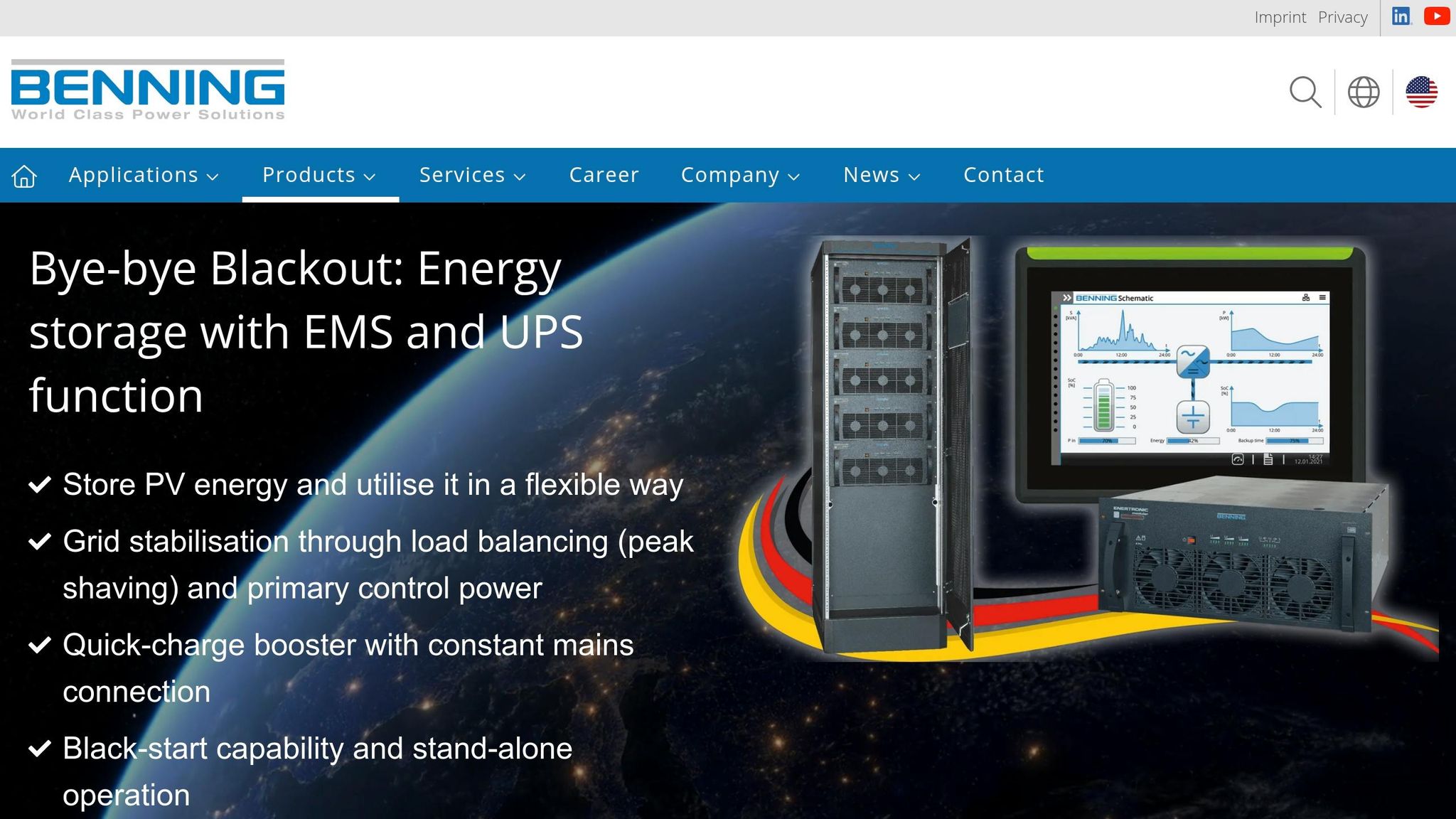
UPS-Systems with Modular Hot-Plug Design – ENERTRONIC modular SE
Scalability and Cost Efficiency
One of the standout benefits of modular UPS systems is their pay-as-you-grow approach. Instead of overcommitting to future capacity needs, businesses can start with the exact capacity required and scale up as demand increases. Schneider Electric highlights this by stating that such systems allow companies to "avoid over-provisioning, buying only the capacity they need upfront, and adding power modules later as capacity requirements grow". This not only prevents waste from over-engineering but also avoids locking up capital in underutilized equipment.
The financial advantages kick in right from the start. Modular systems can reduce initial installation costs by up to 50% compared to traditional UPS models. Their plug-and-play design significantly cuts down on contractor labor time. Matt Yorston, a Data Center Manager, explains this simplicity:
"It's a plug-and-play machine. If you need to add another power module, you just put it in like you would put a tape into a VCR or a CD into a CD ROM. You just throw it in and it automatically discovers itself. It keeps your operations costs down until you need it".
This design not only minimizes upfront costs but also ensures hassle-free system expansion.
When it's time to scale, modular systems offer unparalleled flexibility. Capacity can be increased in small, precise increments - such as 12 kW or 50 kW modules - without the need to replace the entire unit or expand the physical footprint. For instance, Schneider Electric's Easy UPS can scale from 50 kW to 250 kW within the same chassis. Hot-swappable modules ensure that expansions can occur without any downtime, keeping operations running smoothly.
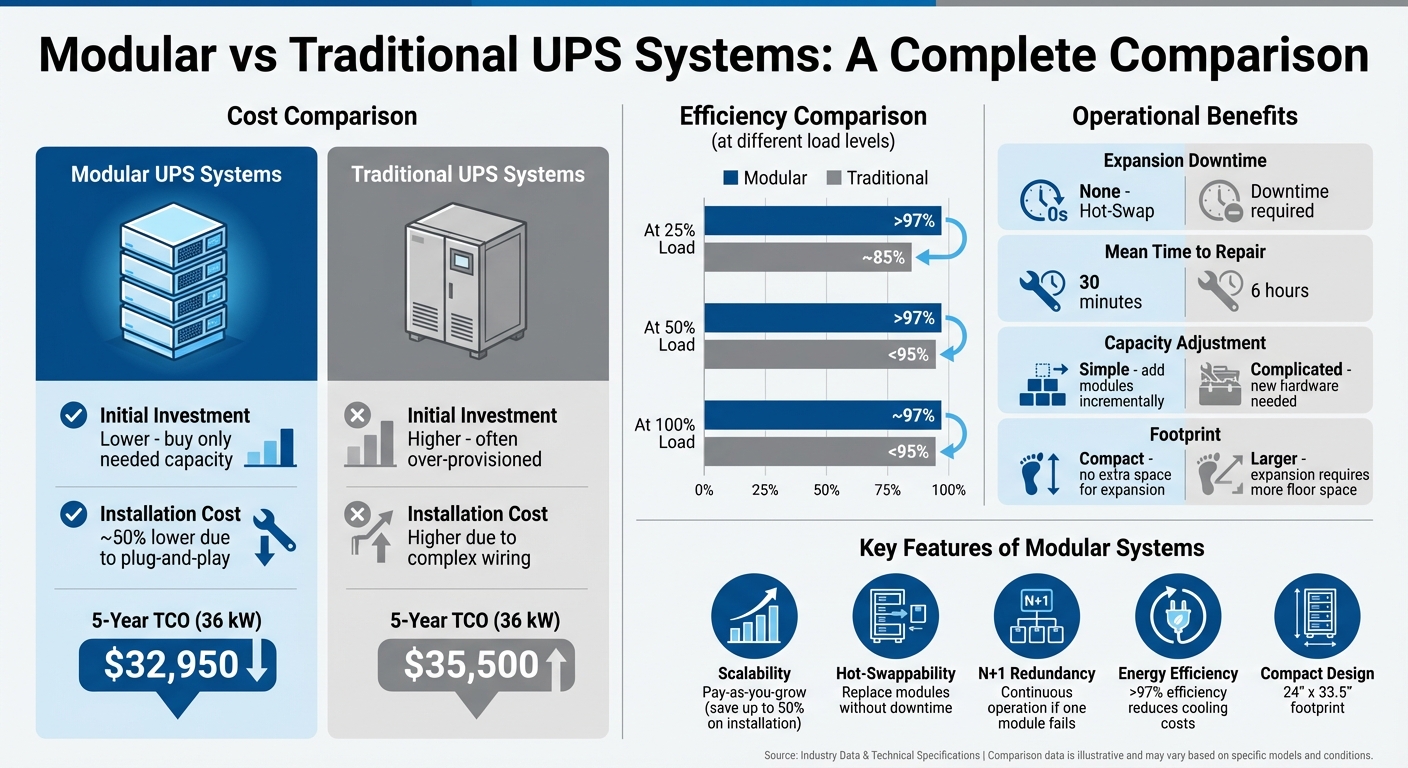
Beyond immediate savings, modular systems also deliver long-term cost benefits. For example, a 36 kW modular system has a projected five-year total cost of ownership (TCO) of approximately $32,950 - about $2,550 less than a traditional UPS, even before factoring in future expansion costs.
Scalability Comparison: Modular vs. Traditional UPS
| Feature | Modular UPS | Traditional UPS |
|---|---|---|
| Initial Investment | Lower (buy only needed capacity) | Higher (often over-provisioned) |
| Installation Cost | ~50% lower due to plug-and-play | Higher due to complex wiring/contractor hours |
| Expansion Downtime | None (Hot-Swap) | Downtime required (maintenance bypass/shutdown) |
| Capacity Adjustment | Simple (add modules incrementally) | Complicated (new hardware/re-engineering needed) |
| 5-Year TCO (36 kW) | ~$32,950 | ~$35,500 |
| Footprint | Compact; no extra space for expansion | Larger; expansion often requires more floor space |
Reliability and Redundancy
When it comes to industrial operations, reliability isn’t just important - it’s non-negotiable. These environments rely on uninterrupted power to function smoothly. Modular UPS systems meet this demand with N+1 redundancy. This design uses multiple smaller modules to handle the load, with one extra module on standby. Unlike the bulkier 2N configuration, which requires a fully duplicated UPS unit, N+1 redundancy delivers the same level of reliability in a compact, space-efficient setup.
Here’s where modular systems shine: if one module fails, the system isolates the fault and redistributes the load among the remaining modules automatically. For instance, a system supporting a 250 kW load with six 50 kW modules (300 kW total) can continue running at full capacity even if one module goes offline.
Another major advantage? Faster repairs. Modular UPS systems slash Mean Time to Repair (MTTR) from around 6 hours to just 30 minutes. Kohler Uninterruptible Power explains it best:
"Availability can be optimised by minimising Mean Time to Repair (MTTR) as well as by maximising MTBF... modular UPS systems can offer the best availability because their reduced MTBF is more than offset by the reduction in MTTR realised by hot-swap modularity".
Features like Live Swap, certified by third parties, allow modules to be replaced without shutting down the system. Plus, touch-safe designs minimize maintenance risks.
For industries that never sleep - like manufacturing and finance - these benefits translate to better uptime. Whether it’s ensuring secure banking transactions or keeping production lines running smoothly, modular UPS systems provide dependable protection, with repairs completed quickly during regular working hours.
Hot-Swappability and Maintenance Benefits
Modular systems bring a major advantage to maintenance processes through hot-swappability, also known as Live Swap. This feature allows technicians to replace modules without shutting down the entire system. Unlike traditional UPS systems, which require transferring the load to a maintenance bypass or battery operation during servicing - leaving equipment vulnerable to utility power - modular systems ensure uninterrupted load protection throughout the process.
Modern modular systems are designed with independent DSP (Digital Signal Processor) control, enabling technicians to swap modules in less than 10 minutes. This significantly lowers Mean Time to Repair (MTTR) while increasing overall system availability.
Safety is also a priority. Advanced touch-safe designs and self-contained module circuitry ensure that faulty modules can be isolated and replaced without impacting the load. This allows technicians to perform live swaps securely and efficiently.
sbb-itb-501186b
Energy Efficiency and Operating Cost Reduction
Modular UPS systems are designed to optimize energy use through load-matched operation. Instead of running a single large unit inefficiently at low loads, modular systems activate only the necessary modules to meet demand. Any extra modules remain in a standby "sleeping" mode but are ready to step in immediately if power needs increase or mains power fails. This approach ensures active modules operate within their peak efficiency range - typically between 25% and 75% of their nominal capacity - achieving efficiency levels over 97%. Traditional UPS systems, on the other hand, face significant hurdles in maintaining efficiency.
Conventional systems are often oversized to accommodate future growth or N+1 redundancy, which causes them to operate inefficiently at low loads. For instance, at just 25% load, a traditional UPS may only reach about 85% efficiency, compared to the modular systems' 97%. Even at full capacity, traditional systems generally stay below 95% efficiency.
"For transformer-based monolithic systems, [low loading] severely impacts operating efficiency and increases the cooling load." - Alex Emms, Operations Director, KOHLER Uninterruptible Power
The higher efficiency of modular UPS systems also means lower cooling requirements. With less energy wasted as heat, facilities can reduce their air conditioning needs to maintain safe operating temperatures. This not only cuts down on energy consumption but also lowers cooling-related costs.
These efficiency gains translate into tangible financial savings. For example, a 36 kW modular system like the Eaton BladeUPS has a five-year total cost of ownership (TCO) of approximately $32,950. This is nearly 50% lower in installation and expansion costs compared to the $35,500 TCO of traditional UPS systems. Over time, these savings add up, making modular systems an attractive option for industrial facilities looking to manage tight budgets.
Efficiency Comparison: Modular vs. Traditional UPS
| Load Level | Modular UPS (Transformerless) | Traditional UPS (Transformer-based) |
|---|---|---|
| 25% Load | >97% | ~85% |
| 50% Load | >97% | <95% |
| 100% Load | ~97% | <95% |
| 5-Year Total Cost (36 kW) | $32,950 | $35,500 |
Industrial Applications
Modular UPS systems have become a cornerstone in industries where power reliability and operational flexibility are non-negotiable. Take manufacturing facilities, for example - these systems help safeguard machinery from electrical instability, preventing costly production stoppages. But their importance doesn't stop there. They are equally vital in data centers and other high-demand environments.
Data centers, in particular, rely on these systems to maintain constant uptime for critical IT operations. Similarly, hospitals, logistics hubs, and other essential facilities depend on modular UPS systems for redundancy. This ensures that even if one component needs servicing, the rest of the system keeps running smoothly, avoiding any interruptions.
The growing adoption of digital technologies like IIoT, AI, and augmented reality has added complexity to industrial power needs. Modular systems address this challenge by offering scalable capacity. For instance, facilities can start with 50 kW and expand to 250 kW as their needs grow, avoiding the pitfalls of over-provisioning and cutting down upfront costs. This adaptability ties back to the scalable approach highlighted earlier.
Another standout feature is space efficiency. With compact designs - typically around 24 inches by 33.5 inches - these systems free up valuable floor and rack space, which is critical in space-constrained setups like industrial facilities and edge computing sites. Their "build up, not out" design makes them a practical choice where every square foot matters, offering flexibility that traditional systems simply can't match.
These technical perks also translate into smarter purchasing decisions for industrial buyers. Platforms like Electrical Trader make it easier for facilities to find modular UPS systems tailored to their specific needs. Whether you're outfitting a manufacturing plant, an oil and gas site, or expanding a data center, these platforms provide access to scalable, reliable, and space-saving power solutions that meet the demands of modern industry.
Conclusion
The features discussed above come together to provide an efficient and scalable power solution for industrial applications. Modular UPS systems stand out by offering flexibility, reliability, and cost savings. Their pay-as-you-grow approach helps facilities avoid unnecessary over-provisioning, ultimately lowering the total cost of ownership compared to traditional systems.
From an operational perspective, these systems shine. Hot-swappable modules minimize downtime by allowing maintenance without halting operations, and built-in N+1 redundancy ensures continuous functionality even during servicing. Faulty modules can often be replaced in less than an hour, keeping critical processes uninterrupted. Smart load management further enhances efficiency by optimizing power usage and cutting operating costs. Additionally, their compact design - measuring around 24 inches by 33.5 inches - makes them ideal for industrial environments where space is limited.
As industries continue to digitize, the need for scalable power solutions like modular UPS systems grows. Their adoption across sectors such as manufacturing, healthcare, logistics, and data centers highlights their ability to meet evolving demands. For facilities planning to upgrade or expand their power infrastructure, platforms like Electrical Trader provide access to modular UPS systems from top manufacturers, making it easier to find the right fit for specific needs. Explore Electrical Trader for a wide range of modular UPS solutions designed for industrial applications.
FAQs
How do I size a modular UPS for today and future growth?
When sizing a modular UPS, the first step is to assess your current power requirements. Choose a system that can handle these needs effectively. Modular UPS systems are designed to be flexible, allowing you to add or remove power modules as your requirements change.
Make sure the initial configuration can manage your present load comfortably, while also opting for a setup that simplifies future expansion. This way, you can avoid overspending on capacity you don't yet need, while still having the ability to grow cost-efficiently as your power demands increase.
What do I need to enable hot-swap module replacement safely?
To perform a hot-swap module replacement safely, you need a system built with hot-swap or safe-swap capabilities. These systems are designed to let you remove or replace modules quickly and securely without shutting everything down, keeping operations running smoothly and ensuring safety during maintenance.
When does N+1 redundancy make more sense than 2N?
N+1 redundancy offers a practical solution for those aiming to balance reliability with cost efficiency. Instead of duplicating the entire system like 2N redundancy, N+1 ensures there's a backup for any single point of failure. This approach works well in scenarios where the chance of multiple failures happening at the same time is minimal, making it a smart choice for industries that need dependable systems without overspending.