

Scalable EMS-BAS Integration: Key Benefits
Managing buildings efficiently requires more than just automation; it demands integration. Combining Energy Management Systems (EMS) with Building Automation Systems (BAS) creates smarter, cost-effective solutions. Here's why it matters:
- Energy Savings: Integrated systems can reduce energy use by 10%-25%, cutting utility bills and achieving ROI in 2-4 years.
- Eliminates Inefficiencies: Disconnected systems waste energy and increase costs. Integration ensures systems work together, avoiding problems like overlapping operations.
- Future-Ready: Open protocols (e.g., BACnet/IP) allow easy expansion - whether adding EV chargers, solar panels, or new buildings.
- Compliance: Integrated platforms simplify reporting for regulations like NYC’s Local Law 97, avoiding penalties of up to $268 per excess metric ton of CO₂.
- Lower Costs: Scalable systems work with existing equipment, avoiding the expense of full replacements.
This approach ensures buildings operate smarter, save money, and stay ready for future upgrades.
Difference between BMS, BAS & EMS Explained in Detail!
Problems with Non-Scalable EMS-BAS Integration
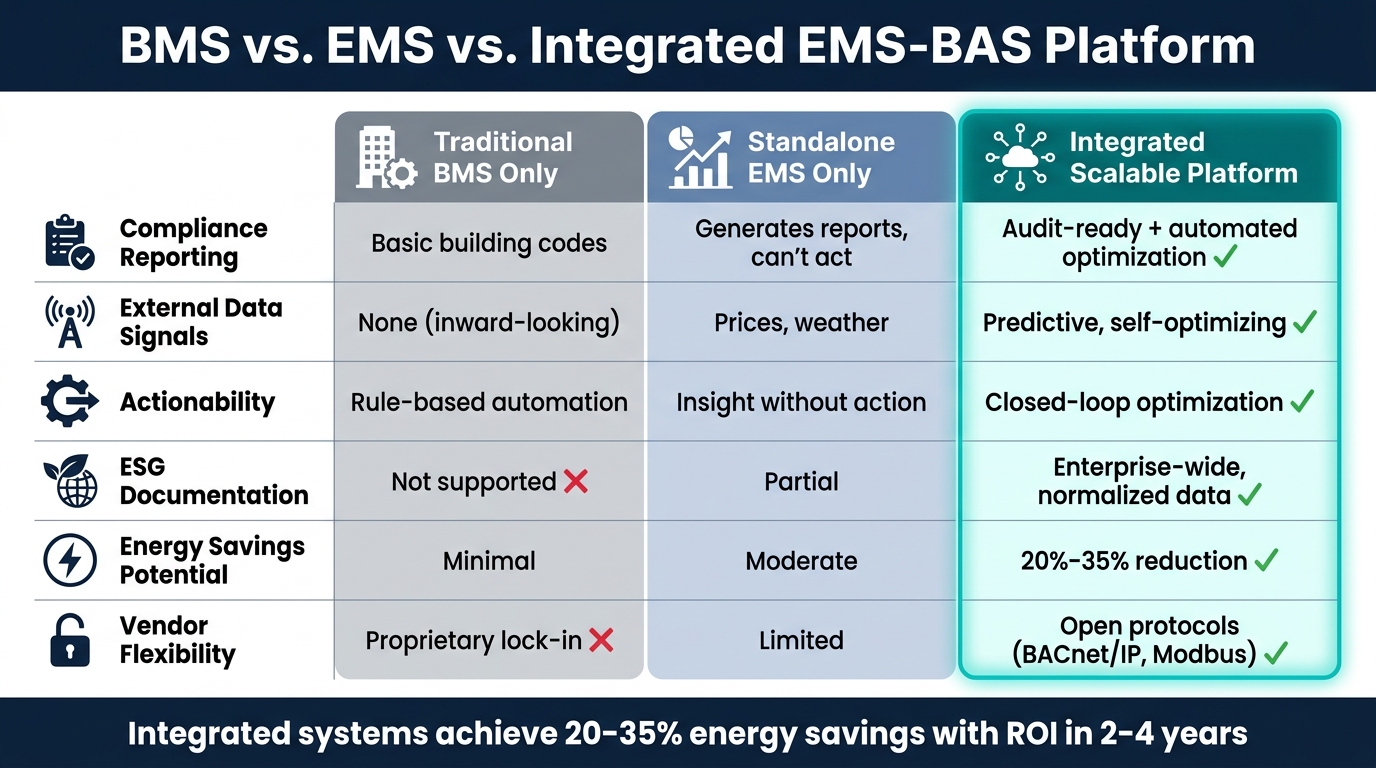
BMS vs EMS vs Integrated EMS-BAS: Feature Comparison
When systems fail to integrate, a building's operations may seem automated on the surface but function inefficiently in reality. A BAS unable to share data with an EMS - or an EMS that can’t act on its findings - leaves facility managers with a disconnected and underperforming setup.
Data Silos and Fragmented Systems
When HVAC, lighting, meters, and access control exist in separate systems, facility managers are left juggling multiple dashboards to understand what’s happening. This fragmented approach creates a situation where the building appears automated, but the operations remain disjointed.
For example, a standalone BMS can manage equipment but doesn’t provide insights into energy cost drivers. Meanwhile, an EMS might identify inefficiencies but lacks the ability to make real-time changes.
"A building with only a BMS is operationally capable but analytically blind." - 75F
This lack of coordination often causes on-site systems to work against each other. Imagine solar production being reduced just as EV charging ramps up, or heat pumps operating during expensive grid peaks - all because no integrated system is managing the bigger picture.
Not only does this disconnected approach reduce efficiency, but it also increases costs when upgrades are eventually required.
High Costs of Upgrades and Expansions
Proprietary BAS ecosystems often lead to long-term financial headaches. When a single vendor controls the system, expanding to new technologies or facilities means relying on that vendor - at their price and on their timeline.
"Expanding into new technologies or data domains under this [vendor lock-in] model is slow, expensive and often incomplete." - Consulting-Specifying Engineer
The architecture itself can also become a problem. Point-to-point connections create fragile systems, turning temporary fixes into long-term technical debt. Moreover, these legacy setups often exclude smaller equipment, as they were designed to monitor only major loads to save on integration costs. As portfolios grow, these gaps become even more pronounced.
"A tool that works for 10 buildings will rarely deliver the same quality on 100 buildings." - Enersee
Compliance and Sustainability Risks
Beyond financial concerns, non-scalable systems also create risks tied to compliance and sustainability. For instance, 68% of U.S. cities with populations over 250,000 now require commercial buildings to disclose energy performance. In New York City, Local Law 97 imposes fines of up to $268 per metric ton of CO₂ emissions exceeding the limit for buildings over 25,000 square feet.
While a standalone BMS might meet basic code requirements, it fails to track carbon metrics or produce audit-ready sustainability reports. It also doesn’t account for external factors like real-time grid CO₂ intensity or market pricing, which are becoming essential for grid-interactive building requirements. As regulations shift from simple comfort control to measurable energy performance, these outdated systems are falling further behind.
| Capability | Traditional BMS Only | Standalone EMS Only | Integrated Scalable Platform |
|---|---|---|---|
| Compliance Reporting | Basic building codes | Generates reports, can't act | Audit-ready + automated optimization |
| External Data Signals | None (inward-looking) | Prices, weather | Predictive, self-optimizing |
| Actionability | Rule-based automation | Insight without action | Closed-loop optimization |
| ESG Documentation | Not supported | Partial | Enterprise-wide, normalized data |
Key Benefits of Scalable EMS-BAS Integration
Scalable integration addresses common challenges like wasted energy, vendor lock-in, and compliance issues. The result? Lower utility bills, streamlined maintenance, and the ability to expand or modify systems without a complete overhaul. These advantages lead to smoother operations and improved long-term performance.
Cost Efficiency and Long-Term Savings
One of the biggest financial perks of scalable systems is their ability to evolve without requiring a full system replacement. Instead of starting from scratch, a scalable Energy Management System (EMS) can work seamlessly with existing Building Automation System (BAS) hardware - no need to rip out functioning equipment.
"A well-designed EMS layers on top of an existing BAS, pulling data from it and using BAS controls to enforce energy strategies. You don't need to rip out a working BAS to gain energy management capability." - FSG Smart Buildings
This approach delivers real savings. On average, implementations see energy savings of 10%-25%, with a return on investment (ROI) in just 2-4 years. Automated fault detection also reduces service calls by about 15%. Additionally, scalable systems can manage high-demand assets like EV chargers and battery storage within existing capacity limits, helping facilities avoid costly utility infrastructure upgrades.
Flexibility for Facility Growth and Change
Legacy systems often struggle to adapt to changing needs, but scalable, modular architectures are built to grow with your facility. Whether you're adding HVAC zones, EV chargers, or new metering tools, these systems expand without requiring a full overhaul. Open protocols like BACnet/IP and Modbus TCP ensure seamless integration of new devices into your existing network.
Modern systems support up to 1,000 IP devices - offering 60% more capacity than older setups - while cutting infrastructure costs by as much as 60% compared to traditional expansion methods. With edge computing, real-time decisions can happen locally, while cloud-based orchestration handles growing data streams without the need for expensive on-site hardware upgrades. This flexibility ensures your system can handle today's needs while preparing for tomorrow's demands.
Future-Proofing for New Technologies
Scalable integration prepares facilities for emerging advancements like solar PV, battery storage, AI-driven optimization, and grid-interactive controls.
"A smart building isn't defined by a single technology... It is defined by its ability to integrate data and orchestrate outcomes across systems." - Sal Bonetto and Eric Larsen, CannonDesign
Traditional BAS platforms often focus internally, monitoring factors like temperature and occupancy, but they miss external data like real-time utility rates or grid carbon intensity. Scalable systems, on the other hand, integrate these external signals, enabling smarter, self-optimizing operations. A study by the National Renewable Energy Laboratory (NREL) found that integrated IoT-native systems can cut energy use in medium offices by up to 31%.
As AI optimization becomes more advanced, scalable systems’ structured data pipelines allow for building-wide orchestration, moving beyond basic scheduling. This forward-thinking design ensures that facilities remain equipped to adopt new technologies and continue evolving alongside industry advancements.
sbb-itb-501186b
Design Principles for Scalable EMS-BAS Integration
Building a scalable EMS-BAS integration requires thoughtful planning and solid design principles. The key often lies in a few critical decisions made early in the process.
Open Protocols and Interoperable Systems
The foundation of scalable integration is open, non-proprietary communication standards. Protocols like BACnet (ASHRAE 135) and Modbus (RTU/TCP) allow equipment from different manufacturers - such as Honeywell chillers alongside Schneider lighting controls - to coexist on the same network. This approach avoids being locked into a single vendor's ecosystem and helps control future upgrade costs.
"BACnet's primary value is Interoperability. Because most frameworks natively support BACnet, facility managers can break through vendor lock-in." - Milesight
For larger setups, like campus environments, keep in mind that BACnet broadcasts don’t naturally cross IP subnets. To handle inter-subnet communication, you’ll need a BACnet Broadcast Management Device (BBMD). Alternatively, upgrading to BACnet/SC (Secure Connect), which uses TLS 1.3, simplifies broadcast management and enhances compatibility with modern IT firewalls.
Older equipment, like chillers or generators, that lack native BACnet support can still be integrated using protocol gateways. These gateways map Modbus registers to BACnet objects, eliminating the need for costly hardware replacements.
It’s also smart to standardize naming conventions from the outset. A format like [System]-[Location]-[Parameter] (e.g., AHU-1.SAT) keeps your data organized and searchable as the system grows.
Layered and Modular Architecture
Effective EMS-BAS integration relies on a layered architecture, with each layer serving a distinct purpose and upgrade path:
| Layer | Function | Protocols |
|---|---|---|
| Supervisory | Enterprise integration, alarms, trends, cloud | BACnet/IP, BACnet/SC, MQTT, REST API |
| Automation/Panel | Control logic, PID loops, schedules | BACnet/IP, BACnet MS/TP, Modbus TCP |
| Field | Physical sensing and actuation | 0–10V, 4–20mA, Modbus RTU, Zigbee |
This modular design ensures that each layer can be upgraded independently, reducing system interdependencies. As Gerald Zingraf of GlacierGrid explains:
"The BAS keeps running the real-time control loops. The integrated platform sits above it, observing, analyzing, and occasionally adjusting."
Avoid direct, point-to-point integrations between systems, as these create fragile dependencies that are difficult to scale and troubleshoot. Instead, opt for an integration hub or event-driven architecture where systems publish data to a central broker. This method reduces system coupling and supports real-time analytics without introducing unnecessary complexity.
Additionally, plan for future growth by designing spare capacity into your controllers. A good rule of thumb is to reserve 30% of program memory and 40% of network bandwidth for future logic and traffic increases.
Once the software structure is in place, the next focus should be on securing reliable hardware.
Sourcing Quality Electrical Components
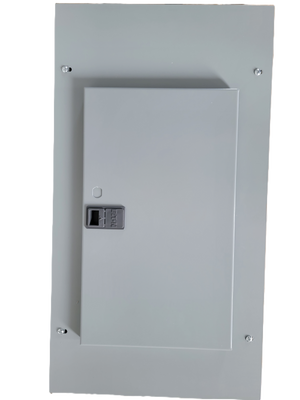
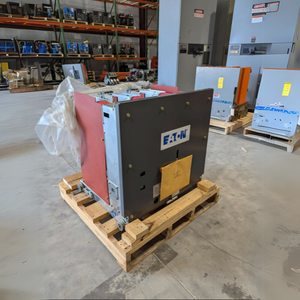
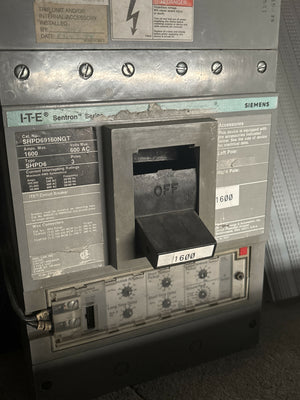
While software architecture is critical, the system's reliability ultimately depends on robust hardware. The physical layer - comprising meters, breakers, transformers, and power distribution equipment - forms the backbone of the entire integration. A faulty meter, for instance, can send inaccurate data upstream, corrupting energy models and triggering unnecessary alarms. No software, no matter how advanced, can compensate for poor hardware.
When selecting components for EMS-BAS integration, prioritize equipment that natively supports open communication protocols. For BACnet devices, always check for BTL (BACnet Testing Laboratories) certification to ensure proper interoperability.
For projects with tight budgets or unexpected component shortages, platforms like Electrical Trader offer a marketplace for new and used electrical equipment, including breakers, transformers, and metering hardware. This can help procurement teams find the right components quickly, avoiding long lead times and inflated prices.
Conclusion: Getting the Most from Scalable EMS-BAS Integration
Scalable EMS-BAS integration offers three key advantages: lower costs, operational flexibility, and the ability to expand without needing a complete overhaul. Integrated systems can cut energy consumption by 20% to 35% compared to standalone setups, often achieving a return on investment within 2 to 4 years for commercial portfolios. These benefits form the foundation of every design decision in scalable EMS-BAS integration.
As Christian Montgomery from 75F explains:
"The BMS vs. EMS debate is, in many ways, a legacy framing. It made sense when the technology required separate systems. Today, it's a false choice - one that costs buildings money, compliance standing, and operational efficiency every day."
Key design principles like open protocols and modular architectures ensure systems remain adaptable as regulations evolve and energy assets grow. For example, NYC Local Law 97 imposes steep penalties - up to $268 per metric ton of excess CO₂ annually - for buildings larger than 25,000 square feet.
Hardware also plays a critical role in the integration process. Even the most advanced software cannot compensate for poor-quality hardware. To avoid setbacks, ensure all components meet strict quality standards, such as BTL certification, and source equipment from trusted platforms like Electrical Trader.
Scalable integration is not a one-time task but an ongoing strategy. Start with high-impact systems like HVAC and lighting, which account for 60% to 70% of a building's energy consumption, and expand gradually. By designing with spare capacity from the beginning, your system will be equipped to handle future demands seamlessly.
FAQs
Where should I start integrating EMS and BAS first?
Start by zeroing in on your operational needs rather than getting bogged down in technical details. If your facility already uses a Building Automation System (BAS), consider adding an Energy Management System (EMS) on top of it. This approach focuses on analytics without the hassle of replacing your current controls.
Take the time to inventory all devices in your system. This will help you map out connection points and ensure everything communicates effectively. For older, legacy equipment, wireless sensors can be a game-changer. They make integration easier, eliminate the need for extensive rewiring, and provide detailed energy data to fine-tune your operations.
How do open protocols prevent vendor lock-in?
Open protocols ensure that devices from various manufacturers can work together within a single system. This approach gives building owners the freedom to select the most suitable technology for specific applications, such as HVAC or lighting, without being restricted to a single supplier. It also encourages competitive bidding for upgrades, simplifies IoT integration, and allows for infrastructure growth without requiring expensive system overhauls.
What do I need for BACnet across IP subnets?
To make BACnet work across IP subnets, you’ll need a BACnet/IP Broadcast Management Device (BBMD) or use Foreign Device Registration (FDR) to manage broadcast messages. Since standard IP routers can’t handle these broadcasts, a BBMD is typically required on each subnet to route messages effectively. Alternatively, devices using FDR can register with a BBMD located on a different subnet. Don’t forget to configure UDP port 47808 correctly across your network to ensure everything runs smoothly.