

PEM vs Alkaline Electrolysis: Tradeoffs
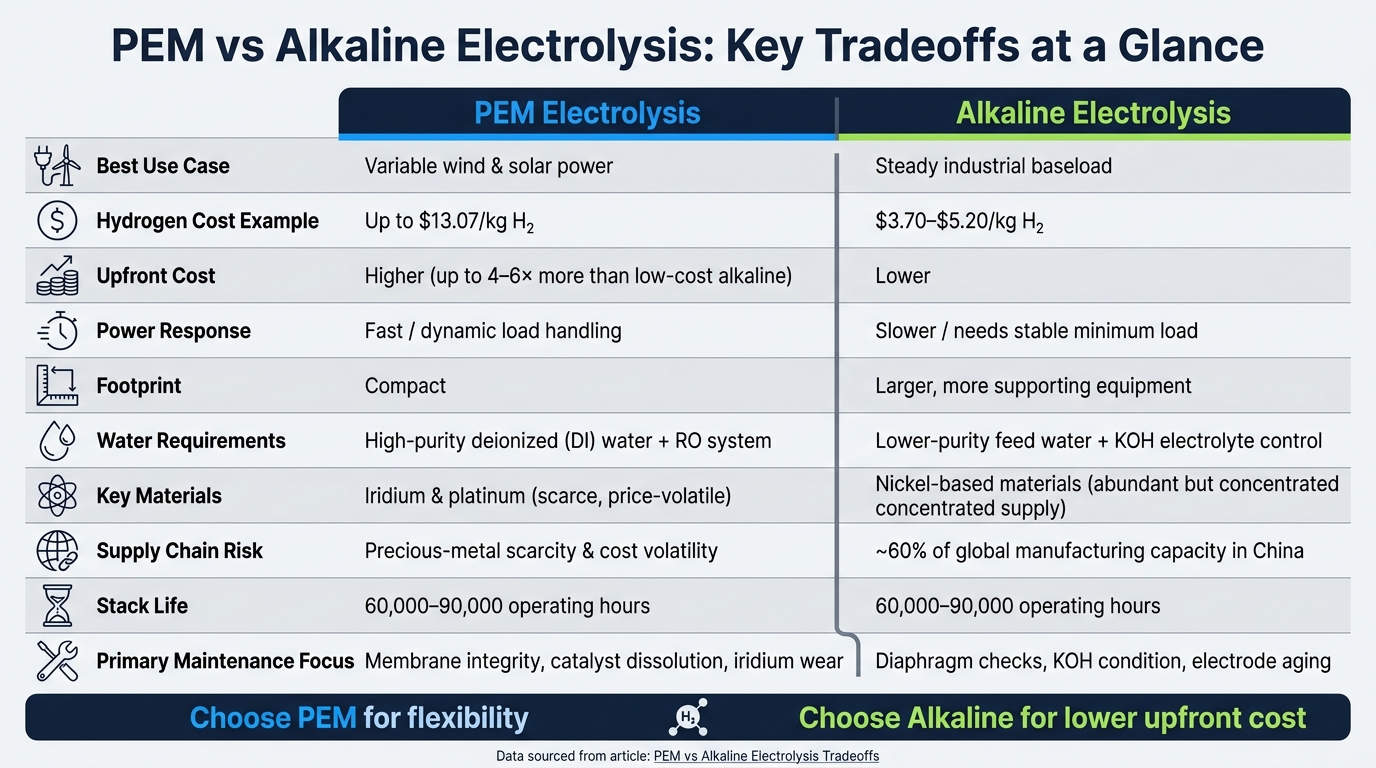
If you need fast load changes, a smaller footprint, or higher outlet pressure, I’d lean PEM. If you need lower upfront cost for steady production, I’d lean alkaline.
Here’s the short version:
- PEM fits wind- and solar-linked plants better because it handles changing power well.
- Alkaline fits steady baseload use better and can cost 4 to 6 times less than Western PEM systems.
- Reported hydrogen cost can vary a lot: one example in the article puts PEM at up to $13.07/kg H₂, while low-cost alkaline projects may target $3.70 to $5.20/kg H₂.
- PEM often needs high-purity deionized water and uses iridium and platinum.
- Alkaline uses KOH electrolyte, needs chemical handling, and has sourcing risk tied to China’s roughly 60% share of global manufacturing capacity.
- Both can land in the 60,000 to 90,000 hour stack-life range, but cycling, water quality, and upkeep can shift that.
If I were making the call, I’d look at five things first:
- Power profile: changing renewables or flat baseload
- Site space: compact layout or more room
- Pressure needs: how much downstream compression I want
- Water setup: DI water system or electrolyte handling
- Maintenance plan: membrane/catalyst watch or KOH/diaphragm care
PEM vs Alkaline Electrolysis: Side-by-Side Comparison
Electrolyzer Selection: How to Choose the Right Technology
sbb-itb-501186b
Quick Comparison
| Criteria | PEM | Alkaline |
|---|---|---|
| Best use case | Variable wind/solar power | Steady industrial output |
| Upfront cost | Higher | Lower |
| Power response | Fast | Slower |
| Footprint | Smaller | Larger |
| Output pressure | Higher when designed for it | Harder to control during cycling |
| Water needs | High-purity DI water | Lower-purity feed water with KOH control |
| Main materials | Iridium, platinum | Nickel-based materials |
| Main upkeep focus | Membrane and catalyst wear | Electrolyte, diaphragm, seals, electrodes |
| Supply-chain concern | Precious-metal cost and scarcity | Manufacturing concentration |
Put simply: PEM buys flexibility. Alkaline cuts upfront spend. Your site conditions usually decide the winner faster than the spec sheet does.
Operating Performance: Power Response, Footprint, and Output Pressure
Variable renewable output is the first big operating test for PEM and alkaline systems. In practice, the best fit comes down to three things: how each system deals with changing power, how much site space it needs, and what happens to outlet pressure.
| Feature | PEM Electrolysis | Alkaline Electrolysis |
|---|---|---|
| Power Response | Rapid; handles dynamic loads well | Best for stable, steady-state operation |
| Load Range | Wide; highly flexible | Narrower; often needs a stable minimum load |
| Renewable Fit | Strong fit for solar and wind integration | Better suited to steadier operating profiles |
| Output Pressure | Can support higher outlet pressure when the system is designed for it | Pressure control becomes harder during frequent cycling |
PEM systems are usually more compact. Alkaline systems often need more floor space and more supporting equipment. That gap matters when renewable power swings up and down. On space-constrained U.S. sites, footprint and pressure can shape the plant layout before efficiency even enters the picture.
Power Response Under Variable Renewable Generation
Fast ramping can cut curtailment risk, but it also adds cycling stress. That trade-off is hard to ignore. Alkaline systems tend to work best with stable, flat power input.
Some operators use a "hybrid" minimum-load strategy: keep the electrolyzer running at a steady floor and respond only to larger price or supply signals.
That matters because a project built ONLY around cheap power can still miss the lowest lifetime hydrogen cost.
Frequent cycling also speeds up wear. PEM stacks face iridium catalyst dissolution and membrane thinning, while alkaline stacks deal with electrode aging and gas purity fluctuations during dynamic operation.
The operating profile also shapes pressure control, compression load, and the rest of the plant layout. A system that looks good on paper at one load point may behave very differently once wind and solar start moving around hour by hour.
Output Pressure and Compression Requirements
Pressure choice should be modeled across the full gas-handling train, not just at the electrolyzer.
Higher outlet pressure can reduce downstream compression load, shrink compressor size, and cut electrical demand. Alkaline systems can run into pressure management issues when cycling happens often, which can make downstream equipment sizing harder if the operating profile is not steady.
Model pressure early. It affects equipment sizing, compressor duty, and day-to-day operating complexity.
Daily Operating Requirements: Water Quality, Maintenance, and Stack Life
Water quality and maintenance affect uptime just as much as energy cost. After power response and pressure, these day-to-day operating needs often decide how smoothly a system runs. In U.S. projects, the utility-water connection can also shape the pretreatment setup from the start.
| Feature | PEM Electrolysis | Alkaline Electrolysis |
|---|---|---|
| Water Purity | High-purity deionized water | Lower-purity feed water; KOH electrolyte still requires control |
| Water Pretreatment | RO system + continuous deionization | Electrolyte concentration monitoring and filtration |
| Electrolyte Handling | None | Caustic KOH management required |
| Primary Maintenance | Membrane integrity, catalyst dissolution | Diaphragm checks, seal integrity, electrolyte condition |
| Common Failure Points | Pinhole formation, gas crossover, membrane thinning | Electrode aging, gas purity fluctuations, electrolyte contamination |
| Stack Life Range | 60,000–90,000 operating hours | 60,000–90,000 operating hours |
Water Treatment and Utility Interfaces
PEM needs RO plus continuous deionization. Alkaline needs electrolyte monitoring and filtration. On municipal-water sites, that often means adding a dedicated pretreatment loop.
Alkaline systems bring a different kind of day-to-day workload. Operators have to handle and monitor a caustic potassium hydroxide (KOH) electrolyte safely. That calls for trained staff, clear procedures, and tight chemical-handling discipline.
Maintenance Workload and Replacement Cycles
The same operating profile that helps with flexibility can also increase wear. More cycling and other operating stresses can shorten service intervals and move replacement dates closer.
Manufacturers often cite 60,000–90,000 operating hours, but cycling and water quality can reduce that window. For PEM, maintenance centers on membrane and catalyst condition. Teams watch for thinning, pinhole formation, and iridium dissolution. For alkaline, the focus shifts to electrolyte condition, diaphragm wear, seal integrity, and electrode aging.
PEM systems more and more use digital monitoring tools, including sensor networks, to spot early degradation signals before they turn into costly failures. Replacement timing should be built into the O&M plan.
Procurement and Sourcing: Materials, Equipment, and Project Fit
What you can source, and what you’ll pay for it, often shapes the tech choice more than the spec sheet does. Once performance and maintenance are on the table, procurement risk becomes the next big filter.
| Feature | PEM Electrolysis | Alkaline Electrolysis |
|---|---|---|
| Primary catalysts / materials | Iridium and platinum, both precious metals | Nickel-based materials |
| Separator | Proton exchange membrane | Diaphragm |
| Supply Chain Risk | Precious-metal scarcity and cost volatility | Geographic concentration, with China controlling about 60% of global manufacturing capacity |
Material Sourcing and Long-Term Supply Risk
PEM stacks depend on iridium and platinum - scarce, expensive, and exposed to long-term price swings. Alkaline systems use nickel-based materials, which are more abundant, but the market is still tightly concentrated: China controls roughly 60% of global electrolyzer manufacturing capacity.
For U.S. developers, that price gap can be hard to ignore. But a lower upfront materials cost doesn’t erase supply-chain exposure. It just shifts where the risk sits.
Procurement teams should look closely at warranty structures, degradation guarantees, and stack replacement costs during vendor selection. Those details now play a big part in project bankability.
And the supply issue doesn’t stop at the stack. It reaches the power hardware around it too.
Electrical Equipment Coordination for U.S. Installations
Electrolyzer selection doesn’t happen on its own. The stack has to fit the site’s electrical setup - transformers, rectifiers, breakers, and switchgear - and mismatches here can lead to costly delays or retrofits.
PEM systems, with faster ramping, often need different power-electronics setups than the steady, high-current loads common in alkaline arrays. That difference matters early, not after equipment has already been ordered.
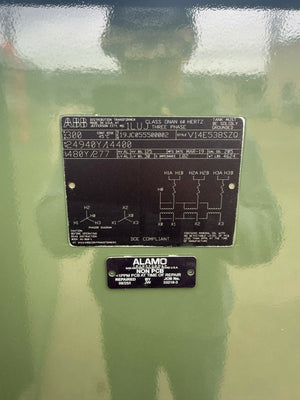
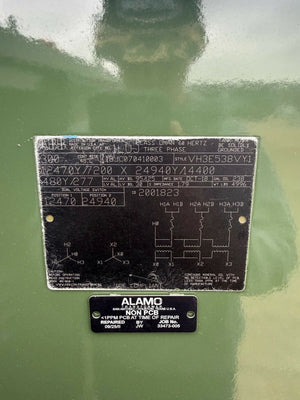
Source transformers, rectifiers, breakers, and switchgear early to cut lead-time delays. Electrical Trader offers a marketplace for new and used electrical equipment, including transformers, breakers, and power distribution gear, that can support balance-of-plant procurement.
Conclusion: Matching Each Technology to Your Project
After looking at performance, water demand, maintenance, and sourcing, the choice usually comes down to how the plant will run and what the site can handle.
PEM fits variable renewable power and space-limited, high-pressure sites. It costs more upfront and relies on scarce catalysts.
Alkaline fits steady industrial baseload with lower upfront cost. But manufacturing concentration still adds a sourcing risk that needs attention.
Before you commit, line up the basics: cycle frequency, site water, and maintenance capacity. In practice, those day-to-day operating conditions tend to narrow the options faster than any spec sheet ever will.
| Decision Factor | Lean PEM | Lean Alkaline |
|---|---|---|
| Power source | Variable renewables (wind/solar) | Stable industrial baseload |
| Site footprint | Compact | Larger |
| Operating mode | Dynamic / market-responsive | Baseload / continuous |
| Water treatment | High-purity DI water on-site | RO-treated water and electrolyte management |
| Condition monitoring | Predictive/digital monitoring | Routine industrial maintenance |
| Initial CAPEX | Higher | Lower |
Put simply: choose PEM for flexibility, and alkaline for steady output.
FAQs
Which electrolyzer is better for solar and wind projects?
PEM electrolysis is usually the better match for solar and wind projects because it can react fast when power output swings up or down. It can change output in seconds to track variable renewable generation. Alkaline systems, by contrast, tend to respond more slowly.
Alkaline electrolysis is more mature and often costs less for large, steady production. But PEM’s flexibility and smaller footprint make it a stronger fit for renewable energy sources that don’t produce a steady flow of power.
How much does water quality affect electrolyzer performance?
Water quality has a major impact on electrolyzer performance and lifespan. For PEM electrolyzers, ultrapure, deionized water is needed to protect membranes, catalysts, and electrodes from damage caused by impurities.
If water quality slips, electrolysis systems can wear down over time. And when that happens alongside temperature swings and load cycling, durability and efficiency can drop.
What supply-chain risks should buyers watch first?
Start with the availability and long-term cost of specialized materials, especially precious metal catalysts like platinum and iridium. Prices for these materials can swing a lot, and that can hit system costs and make replacement planning harder.
It’s also smart to look at how fragile centralized hydrogen supply chains can be. A safety incident or a logistics bottleneck can disrupt supply fast. Electrical Trader can help source related electrical equipment needed to support continuity.