

North America Solar Inverter Certification Guide
If an inverter is not certified the right way, you may not be allowed to install it, connect it, or turn it on. A failed inspection or denied utility approval can lead to replacement costs in the $1,000s, plus labor, delays, and lost export income.
Here’s the short version: before I buy, sell, or approve a solar inverter in the U.S. or Canada, I check four things:
- Safety certification: Usually UL 1741 in the U.S. and CSA C22.2 No. 107.1 for Canada-facing approval.
- Grid interconnection proof: For grid-tied systems, I look for UL 1741 SA or SB and proof tied to IEEE 1547-2018 and IEEE 1547.1-2020.
- Nameplate and marks: The label on the unit must match the approved model, ratings, market, and firmware.
- Project records: I keep the certificate, test summary, permit set, utility approval, and label photos on file.
A few points matter more than most:
- IEC 62109 alone is not enough for U.S. or Canadian permitting.
- A spec sheet is not proof. I need the listing record or certificate.
- A component mark is not the same as a full inverter listing.
- In Canada, a mark must tie back to a record that covers Canadian requirements.
- Some utilities ask for a certain IEEE 1547 performance category, such as Category B or Category III.
UL 1741 Standards: The Definitive Guide to Renewable Energy Inverters, Safety, and Certification
sbb-itb-501186b
Quick Comparison
| Check area | What I verify | Why it matters |
|---|---|---|
| Safety | UL 1741 / CSA C22.2 No. 107.1 record | Needed for inspection and code approval |
| Grid-tied use | UL 1741 SA or SB + IEEE 1547 test proof | Needed for utility permission to operate |
| Label | Model, ratings, country mark, firmware | Must match the approved product |
| File retention | Certificates, plans, approvals, photos | Helps with inspection, resale, service, and warranty |
That’s the whole job in one view: match the inverter, the paperwork, the utility rules, and the field label before money changes hands or installation starts.
Core Product Safety Certifications for North America
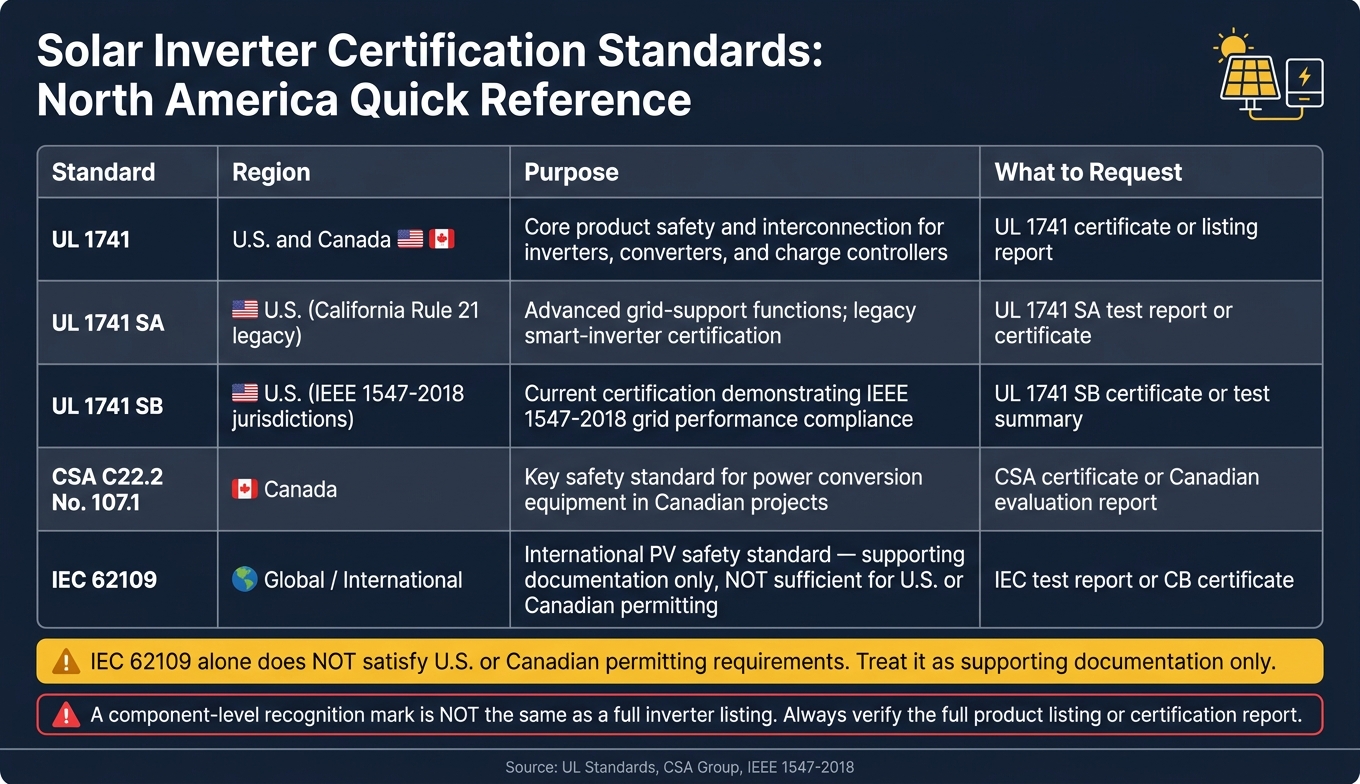
North America Solar Inverter Certification Standards Comparison
For most North American projects, the same three standards keep coming up: UL 1741, CSA C22.2 No. 107.1, and IEC 62109. Each one serves a different purpose and applies in a different place. The practical move is simple: start with the safety standard that fits the project's jurisdiction, then check the exact certification record.
UL 1741, UL 1741 SA, and UL 1741 SB
UL 1741 is the main safety and interconnection standard for inverters, converters, charge controllers, and interconnection system equipment used in stand-alone or grid-connected power systems. But here's the catch: seeing "UL 1741" on a spec sheet isn't enough by itself. You still need to confirm the exact edition, the certification scope, and the grid functions, because UL 1741 alone does not show that a product fits a specific project.
The two supplements - SA and SB - add grid-support testing.
- UL 1741 SA covers advanced grid-support functions that were first tied to California's Rule 21 utility requirements.
- UL 1741 SB is the newer supplement and lines up with IEEE 1547:2018 and IEEE 1547.1:2020.
One more point that trips people up: component-level recognition is not enough. It does not qualify the assembled inverter. You need the full product listing or the full certification report.
CSA C22.2 No. 107.1 and Canadian Acceptance
For Canadian projects, the key safety standard for power conversion equipment is CSA C22.2 No. 107.1. This is where teams sometimes get sloppy.
Marks like CSA, cUL, or cETL are not automatically interchangeable for code approval. In Canada, the mark has to connect to a certification record that covers Canadian requirements, not just a U.S. evaluation. If the paperwork doesn't show that link, the mark alone doesn't tell you much.
Where IEC 62109 Fits In
IEC 62109 is a common international safety standard for PV power converters, and it often shows up in documents for inverters sold in many markets. That's useful, and it can help support confidence in the product.
But it does not satisfy U.S. or Canadian permitting on its own. So if you're reviewing a file for a North American job, treat IEC 62109 as supporting documentation, not the final answer.
Once the safety standard checks out, the next step is to review interconnection rules and grid-support testing.
Use this quick reference to match each standard with the document you should request:
| Standard | Region | Request |
|---|---|---|
| UL 1741 | U.S. and Canada | UL 1741 certificate or listing report |
| UL 1741 SA | U.S. (California Rule 21 legacy) | UL 1741 SA test report or certificate |
| UL 1741 SB | U.S. (IEEE 1547-2018 jurisdictions) | UL 1741 SB certificate or test summary |
| CSA C22.2 No. 107.1 | Canada | CSA certificate or Canadian evaluation report |
| IEC 62109 | Global / international | IEC test report or CB certificate |
Interconnection Rules and Performance Standards
Once product safety is cleared, the next hurdle is simple: can the inverter legally connect to the grid? That’s a separate approval path. A safety certification does not automatically mean the unit is cleared for interconnection. In North America, that approval usually ties back to IEEE 1547 and IEEE 1547.1.
IEEE 1547 and IEEE 1547.1
IEEE 1547-2018 is the main North American grid-interconnection standard. It sets the operating rules for DERs connected to the grid. That includes voltage and frequency ranges, ride-through during grid disturbances, power quality limits, reactive power functions, and anti-islanding behavior.
IEEE 1547.1-2020 is the matching test standard. It lays out the lab procedures used to check whether an inverter meets the requirements in IEEE 1547-2018, including tests for ride-through, voltage response, and reactive power behavior. Those test results go into reports that utilities use during interconnection review.
The easiest way to think about it is this: IEEE 1547-2018 tells manufacturers what the inverter must do. IEEE 1547.1-2020 shows labs how to prove it.
| Standard / Certification | Role | Who Uses It | What It Verifies |
|---|---|---|---|
| IEEE 1547-2018 | Core interconnection standard | Utilities, regulators, manufacturers, testing labs | Voltage/frequency response, ride-through, power quality, islanding behavior |
| IEEE 1547.1-2020 | Test method standard | Testing labs, manufacturers; utilities review reports | Procedures that confirm DERs meet IEEE 1547-2018 performance requirements |
| UL 1741 SA | Safety and grid-function certification | Manufacturers, NRTLs, utilities, program administrators | Legacy smart-inverter certification tied to earlier grid-support requirements. |
| UL 1741 SB | Safety and grid-function certification | Manufacturers, NRTLs, utilities, program administrators | Current certification used to demonstrate IEEE 1547-2018 performance. |
Anti-Islanding and Grid Support Functions
Unintentional islanding happens when part of the distribution system is cut off from the main grid but keeps running on power from local DERs. That creates a serious safety risk for utility line workers and can also throw protection equipment out of sync. IEEE 1547-2018 requires DERs to detect that condition and stop exporting power to the isolated circuit within the required time.
Both UL 1741 SA and UL 1741 SB include standardized anti-islanding tests to confirm that the inverter reacts the right way. They also check grid-support functions like volt-VAR, volt-Watt, and frequency-Watt behavior. Utilities often ask for UL 1741 SA or SB listing because they want proof these functions were tested, not just listed on a spec sheet.
U.S. Utility Filings and Canadian Screening
For U.S. interconnection applications, utilities usually want the same core set of documents:
- the UL 1741 SA or SB listing certificate
- IEEE 1547.1-based test summaries from the NRTL
- a single-line diagram
- a settings sheet showing that the inverter’s programmed parameters match the utility’s published requirements
Before buying equipment, check with the utility to see whether its interconnection tariff points to a specific IEEE 1547-2018 performance category. IEEE 1547-2018 added utility-required categories, such as Category B or Category III, with tighter ride-through and voltage regulation rules for areas with higher DER penetration. If you skip that check, you can end up with delays - or worse, equipment that needs to be replaced.
Canadian screening follows much the same pattern, but the details can shift by region. Utilities and distributors in Canada usually want a CSA or UL listing accepted in Canada, a performance summary tied to IEEE 1547-2018, and any needed provincial program forms - not just a U.S.-only certification package. Some utilities go further. Hydro-Québec, for example, explicitly requires UL 1741 SB certification and directly references IEEE 1547-2018 Category B and III performance criteria.
Next, verify that the nameplate and certification marks match the documents on file.
Labeling, Nameplates, and Certification Marks to Check
Once interconnection approval is in place, the inverter label becomes the last field check. Specs sheets and approval documents only tell part of the story. The unit itself tells the rest.
Before you install, inspect, or buy an inverter, read what's printed on the enclosure. That's what inspectors, utilities, and AHJ staff use to confirm the equipment matches the approved scope.
Required Nameplate Data
The inverter in the field has to match the certified and approved unit. UL guidance on alternative energy equipment says inverter nameplates should include the manufacturer name, model number, DC input voltage range, maximum input current (AC or DC, as applicable), AC output voltage range, nominal output voltage and frequency, maximum continuous AC output current, maximum continuous AC output power, power factor rating, maximum ambient temperature rating if the product was evaluated above 77°F (25°C), installation environment, and utility-interactive wording where applicable.
If those nameplate ratings don't match the certified model and site design, the inverter can fail inspection or interconnection review. It's that simple.
| Nameplate Item | Why It Matters | Who Checks It |
|---|---|---|
| Manufacturer name & model number | Confirms the unit matches the certified product scope | Installer, inspector, buyer |
| DC input voltage range | Verifies compatibility with the array design | Installer, plan reviewer |
| AC output voltage, phase & frequency | Must match the service configuration; confirms 60 Hz North American operation | Inspector, utility |
| Maximum continuous AC output current & power | Used in interconnection sizing and field labeling | Plan reviewer, inspector, utility |
| Power factor rating | May be reviewed during utility interconnection checks | Utility |
| Maximum ambient temperature rating | Defines the certified operating temperature range | Inspector, installer |
| Installation environment (indoor/outdoor) | Determines whether the enclosure suits the location | Inspector, AHJ |
| Utility-Interactive designation | Confirms the inverter is intended for grid-tied use | Utility, inspector, AHJ |
| Certification mark (NRTL) | Shows the unit was tested to a recognized safety standard | Inspector, AHJ, utility, buyer |
For Canadian installations, CSA C22.2 No. 107.1 requires that maximum continuous output current in amperes be marked on the nameplate. For factory-derated units, those derated values must be marked at the factory, and any added field label must state at minimum the maximum continuous derated output current (A) and maximum continuous derated output power (kW). So if the installed unit carries a derated marking, don't lean on catalog specs.
After the rating data, the certification mark is the next thing to check.
NRTL Marks and Country Indicators
Look for an NRTL or Canadian certification mark such as UL, CSA, ETL, SGS, or QAI. AHJs and utilities use these marks to confirm the product was independently tested to a recognized safety standard.
For U.S.-Canada projects, use a dual-market mark. A single-market mark may not satisfy the other side of the border.
The mark also needs to be permanent and easy to read. Use permanent markings or evaluated pressure-sensitive labels.
How to Spot Label and Firmware Mismatches
Models can look almost identical and still have different voltage, phase, and certification scopes. Sometimes one small suffix on the model number changes everything.
Modern inverters depend heavily on firmware to control grid support functions, anti-islanding behavior, and ride-through settings. Those settings affect interconnection compliance. Before installation, verify that the installed firmware matches the certified version and approved operating scope.
A simple paper trail can save a lot of back-and-forth later:
- Photograph the full nameplate, certification mark, and firmware label before installation.
- Save those images with the datasheet, certification listing, and permit package.
- For used equipment, confirm the shipped inverter matches the certified model before it goes into service.
For used units, this matters even more. The paperwork doesn't always stay with the inverter, especially when equipment changes hands. Save photos of the nameplate, certification mark, and firmware label with the permit file. Those photos and labels become part of the file buyers and sellers should keep.
Documents Buyers and Sellers Should Keep on File
After certification, interconnection, and labeling are confirmed, save the records that prove it. This is the paperwork trail that shows the inverter met the rules after it was sold, installed, or resold. Keep the full compliance file with the inverter.
Core Certification Records
Keep records that identify the exact model and firmware, not just the brand family. If the inverter comes in more than one firmware or grid-support version, record the approved version.
For UL 1741 SB units, keep the signed or stamped NRTL certificate, the certified model list, and any covered model ranges.
For projects using UL 1741 SA or SB, keep the relevant test summary with the listing. That way, the approved configuration stays on file.
Once the product record is complete, archive the project record.
Interconnection and Permit Package Documents
Keep the product record and installation record together so anyone reviewing the file can verify the product and the install in one place. Installers should archive a full permit set for each project, including:
- Site plan
- Single-line diagram
- Equipment schedule
- Utility interconnection application
- Permit approval
- Inspection sign-off
- Permission to operate, or the utility's equivalent approval
If the project needed export limit settings or commissioning forms, include those too.
End users often miss this step, but the as-built file can save a lot of trouble later. When a system is sold or serviced years down the road, these records may be requested by buyers during resale, utilities during post-installation checks, insurers after a loss event, and warranty administrators.
Assign each document to the party that should keep it. The table below shows who should hold each record, which format makes sense, and who may ask for it.
| Role | Must Retain | Format | Who May Request It |
|---|---|---|---|
| Manufacturer | NRTL certificate or listing record, certification test reports, declaration of compliance, model control records, datasheet, serial and model notes | PDF, controlled archive | Buyers, utilities, warranty administrators |
| Distributor / Reseller | Listing details, model and rating information, purchase records, certification evidence used in the sale, nameplate photos | PDF, digital photos | Building departments, buyers, warranty administrators |
| Installer | Permit set, single-line diagram, equipment schedule, utility application, inspection approvals, commissioning notes, label photos | PDF packet, dated photos | Building departments, utilities, end users |
| End User | Final as-built file, interconnection approval, warranties, certificate copies, service records | PDF folder, signed paper copies | Utilities, insurers, future buyers, warranty administrators |
When several versions of a similar inverter exist, sort listings by model number, rating, and documentation completeness. That cuts down on mix-ups. Platforms like Electrical Trader can help buyers and sellers organize listings that way, so the compliance documents stay with the equipment instead of disappearing between transactions.
Conclusion: A Checklist for Compliant Inverter Transactions
Use one file for the certification record, installation record, and utility approval. Before any inverter changes hands or goes into service, confirm these four points:
- Verify the exact certification against the listing record, not just the product brochure.
- Confirm interconnection compatibility with the utility's and jurisdiction's current requirements.
- Match the nameplate on the unit to the certified model and approved site design.
- File the NRTL certificate, test summary, permit set, and utility approval before the transaction closes.
FAQs
How do I verify an inverter is truly certified?
Don’t stop at phrases like “compliant” or “designed to meet standards.” Those words sound good, but they don’t prove much on their own.
Instead, check the product datasheet and the nameplate for an official NRTL mark such as UL, CSA, or Intertek.
The label should also show a file or control number. You can look that number up in the official NRTL database to confirm the listing.
For smart inverter projects, look for UL 1741 SB in particular. If anything still feels unclear, contact the manufacturer.
What if the inverter has UL 1741 but not UL 1741 SB?
If an inverter has UL 1741 but not UL 1741 SB, it may fall short of current rules for many U.S. grid-tied installs.
UL 1741 covers basic safety. UL 1741 SB goes further and confirms compliance with IEEE 1547-2018. That matters because many states, including California and Hawaii, now require UL 1741 SB for new projects. In plain terms, a utility may reject an inverter with an older certification when you apply for interconnection.
Before installation, check the product’s status in an official Nationally Recognized Testing Laboratory directory. That extra step can help you avoid delays, paperwork headaches, or a denied interconnection request.
Can I install a used inverter without the original paperwork?
Installing a used inverter without the original paperwork is high-risk and usually a bad idea. In most cases, utility inspectors and local authorities want proof that the unit meets code before they’ll grant Permission to Operate.
Certification usually comes down to two things: a valid physical label on the inverter and documents that match it. If the paperwork is missing, check the manufacturer, model number, and UL file number in the UL Product iQ database.