

Ultimate Guide to Modern Solar Inverter Features
Modern solar inverters are the backbone of today's solar energy systems. They do more than convert DC electricity from solar panels into AC electricity for home and grid use. Here's what makes them stand out:
- Efficiency: Many inverters operate at 97–99% efficiency, ensuring minimal energy loss.
- Smart Energy Management: Advanced models use AI to manage energy flow - powering homes, charging batteries, or sending excess energy to the grid automatically.
- Maximum Power Point Tracking (MPPT): Boosts energy output by up to 30%, especially in shaded or variable conditions.
- Safety Features: Includes arc-fault detection, rapid shutdown, and anti-islanding to ensure safe and compliant operation.
- Battery Integration: Hybrid inverters simplify solar and battery setups, reducing energy conversion losses.
- Real-Time Monitoring: Wi-Fi and app connectivity provide performance insights and system alerts.
Modern inverters improve energy efficiency, grid reliability, and user control. Whether it's for residential, backup, or commercial use, choosing the right inverter ensures optimal performance and compliance with safety standards.
Core Electrical Functions of Modern Solar Inverters
DC to AC Conversion and Efficiency Ratings
The heart of a solar inverter's performance lies in its ability to convert DC electricity from solar panels into AC electricity for household or grid use. This process relies on semiconductor transistors that rapidly switch the DC current, shaping it into an AC sine wave. Since AC voltage fluctuates and crosses zero about 120 times per second, capacitors play a key role by temporarily storing energy to bridge these gaps.
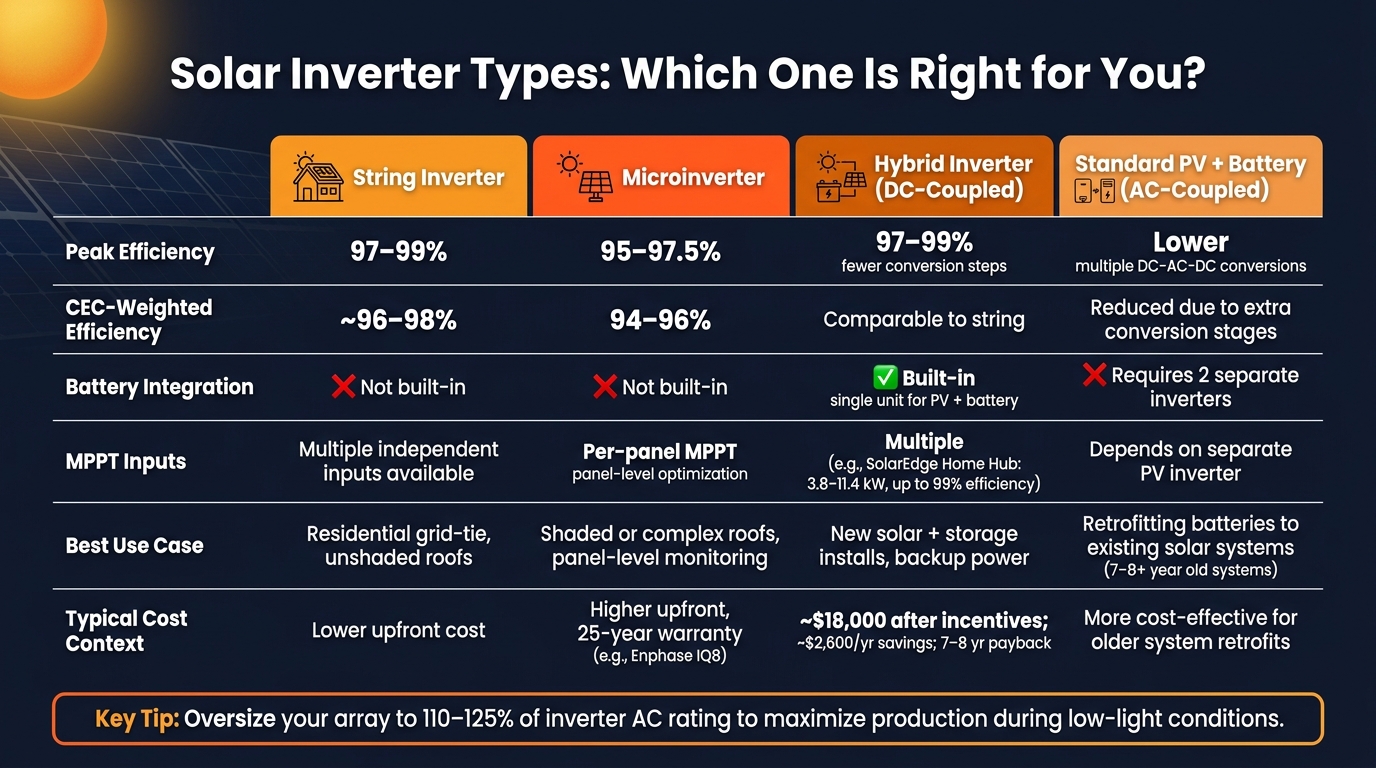
Today's inverters boast impressive efficiency levels. String and hybrid models typically operate between 97% and 99% efficiency, while microinverters achieve peak efficiencies ranging from 95% to 97.5%. Another important metric is the CEC-weighted efficiency, which reflects performance under varying real-world conditions. For microinverters, this rating generally falls between 94% and 96%. Comparing both peak and CEC-weighted efficiencies gives a clearer picture of an inverter's overall performance.
This reliable energy conversion paves the way for features like Maximum Power Point Tracking (MPPT).
Maximum Power Point Tracking (MPPT)
Modern inverters take energy optimization a step further with MPPT technology, ensuring they extract the maximum possible power even as conditions change. Factors like sunlight intensity, temperature, and shading constantly alter a solar panel's current-voltage (I-V) curve. MPPT algorithms, such as Perturb and Observe (P&O) or Incremental Conductance (IncCond), dynamically adjust to maintain optimal output.
This technology can boost system efficiency by 10–25% compared to older systems without optimization. Inverters with multiple independent MPPT inputs are particularly useful for setups with varying roof orientations or partial shading. These inputs allow the system to manage each string of panels separately, minimizing the impact of shading on one section while maximizing output from fully sunlit areas.
"This inverter-based optimization works periodically to verify that the array attached to each MPPT input channel is working at the highest power point, even if partial shade on any array is creating 'humps' on the current-voltage (I-V) or power-voltage (P-V) curve." - Mike Mahon, Solar Academy Manager, SMA America
However, adding too many MPPT channels can complicate utility-scale installations, potentially reducing reliability. For residential and light commercial systems, a few independent MPPT channels are usually sufficient to achieve excellent performance.
Power Quality and Grid Support
Inverters today go beyond just energy conversion; they also improve power quality and support grid stability. A high-quality inverter produces a pure sine wave with minimal total harmonic distortion (THD) and aligns perfectly with the grid's 60 Hz frequency and phase, which is mandatory for grid-tied systems in the U.S..
Advanced grid support features are now standard in modern inverters. Functions like Volt-VAR and Volt-Watt response allow the inverter to adjust reactive power or reduce output during voltage spikes, helping stabilize the local grid. These capabilities comply with IEEE 1547-2018 standards and are enforced through UL 1741 SA certification, required in many U.S. states. Another essential feature is anti-islanding protection, which ensures the inverter shuts down immediately during a grid outage to prevent backfeeding and protect utility workers.
Some newer models, like the Enphase IQ8 series, even include grid-forming capabilities. These inverters work with battery storage to create a standalone AC grid during outages while maintaining a safe connection to the utility grid. This combination of features makes modern inverters indispensable for both energy efficiency and grid reliability.
sbb-itb-501186b
Advanced Features in Modern Solar Inverters
Hybrid and Battery-Ready Inverters
Modern hybrid inverters combine solar energy conversion and battery management into a single unit, seamlessly handling power from solar panels, batteries, and the utility grid all at once. These inverters are typically DC-coupled, which means energy moves through fewer conversion steps between the panels and the battery. This reduces efficiency losses compared to AC-coupled systems.
| Feature | Hybrid Inverter (DC-Coupled) | Standard PV + Battery Inverter (AC-Coupled) |
|---|---|---|
| Equipment | Single unit for both PV and battery | Two separate inverters required |
| Efficiency | Higher (fewer conversion steps) | Lower (multiple DC-AC-DC conversions) |
If you're planning to add battery storage in the future, a battery-ready hybrid inverter can save you from expensive upgrades later on. However, it's important to ensure the hybrid inverter is compatible with your chosen battery brand and chemistry, especially for lithium-ion batteries and specific voltage requirements.
"The system control is easier and works better, you have a cheaper overall system because you only have one inverter for both PV and battery, and you have this DC-coupling so you have fewer conversion steps, so it should be more efficient as well." - Jenya Meydbray, CEO of PV Evolution Labs
For older solar systems (7–8 years or more), adding a separate AC-coupled battery inverter may be a more cost-effective solution than replacing the entire PV inverter.
These advancements in efficiency create opportunities for further optimization through smart monitoring features.
Smart Monitoring and Connectivity
Modern inverters have evolved into the central hub of solar systems, offering real-time insights into power output, energy usage, and system health through smartphone apps or web platforms. Features like panel-level monitoring, enabled by microinverters or power optimizers, allow you to identify specific underperforming modules instead of troubleshooting an entire string of panels.
Connectivity options such as Wi-Fi, 4G dongles, and Modbus enable remote firmware updates and integration with Home Energy Management Systems (HEMS). This connectivity ensures that real-time performance data can drive automated energy decisions across your entire system.
Safety, Protection, and Compliance
Modern solar inverters go beyond energy management with built-in safety features designed to protect both your system and your home. These include:
- Arc-Fault Circuit Interruption (AFCI): Detects and mitigates dangerous electrical arcs to prevent fires.
- Ground Fault Detection: Identifies leakage currents that could cause shocks or fires.
- Rapid Shutdown (RSD): Required by the National Electrical Code (NEC), this feature quickly halts electricity production during emergencies.
For regulatory compliance, ensure your system meets the following standards:
- UL 1741: For grid-tied inverters.
- UL 9540: For systems with energy storage.
- NEC Article 690: Covers PV systems.
- NEC Article 706: Applies specifically to systems with batteries.
Additionally, under the NEC's 120% rule, a standard 200-amp panel with a 200-amp main breaker can support about 7.68 kW (32 amps) of solar capacity. Upgrading the main breaker to a 175-amp unit increases this limit to approximately 12.48 kW.
These safety and compliance measures ensure your solar system operates reliably while meeting all necessary regulations.
How to Choose The Right Solar Inverter For Your Home
Selecting the Right Inverter for Your Needs
Solar Inverter Types Compared: Efficiency, Features & Best Use Cases
Choosing the best inverter depends on how you plan to use your system. Below, we break down the key considerations for residential, backup, and commercial applications.
Residential Grid-Tie Systems
For most U.S. homes, the first step is ensuring the inverter delivers a 120/240V split-phase output. This is essential for powering standard outlets and high-demand appliances like dryers and central air conditioners. Another critical factor is the number of MPPT (Maximum Power Point Tracking) inputs. If your roof has panels facing multiple directions, a single-MPPT inverter may not perform well. Models like the SolarEdge Home Hub (3.8–11.4 kW) are designed for these situations, offering optimized DC input and up to 99% efficiency.
Surge capacity is also key. Appliances like air conditioners and well pumps draw much more current when starting up than during regular operation. An inverter without adequate surge capacity may trip under these conditions. For outdoor installations, look for an IP65 rating or higher to protect against dust and moisture.
A helpful sizing tip: consider oversizing your array to 110–125% of the inverter's AC rating. This can boost energy production during early mornings, late afternoons, and cloudy days - common conditions across much of the U.S..
Solar Plus Storage and Backup Power
When it comes to backup power, a hybrid inverter is your best bet. Pay attention to features like islanding capability, switching speed, and surge capacity. For instance, the Solis S6-PRO offers UPS-grade switching within 10ms, ensuring sensitive electronics stay powered during brief grid outages.
Surge capacity becomes especially important if you need to run a central air conditioner during an outage. Many standard 10 kW hybrid inverters don’t have the capacity to handle the startup of a large compressor. The EG4 FlexBOSS21 (12–16 kW) addresses this with a 24 kW surge rating, making it capable of starting 5-ton AC units without tripping. If your inverter's surge capacity isn’t sufficient, installing a soft starter on the AC unit can help.
"If you are planning to run a 5-ton Central AC during a blackout, prioritize inverters with high LRA (Locked Rotor Amp) support... Most 'standard' 10kW hybrids lack the surge capacity to kickstart large compressors." - SolarVisionAI
From a financial perspective, hybrid systems make sense. In the U.S., a typical hybrid system costs around $18,000 after incentives and can save approximately $2,600 annually - compared to about $1,800 per year for a solar-only system. This results in a payback period of about 7–8 years.
Commercial and Light Industrial Systems
Commercial inverters typically feature three-phase output and are designed to match the building's electrical service voltage. Many modern designs now support 1,500Vdc on the input side, which helps lower overall system costs.
At this scale, meeting grid compliance standards is critical. Inverters must adhere to UL 1741 SB (IEEE 1547-2018) and, in California, CA Rule 21. These standards include requirements like reactive power support at night and the ability to handle frequency and voltage fluctuations. For outdoor installations in harsh conditions, a NEMA Type 4X enclosure is a smart choice.
Commercial systems also need to integrate with broader electrical infrastructure, including switchgear, medium-voltage transformers, and communication gateways. For compatible components, check out Electrical Trader. Below is a comparison of three commercial-grade inverters from CPS America, a leader in the U.S. market with over 10 GW installed across 20,000+ sites:
| Model | AC Voltage | Max DC Voltage | MPPTs | Peak Efficiency | Key Feature |
|---|---|---|---|---|---|
| CPS 200kW-480V | 480Vac | 1,500Vdc | 1 / 30 strings | 98.5% | Separable wirebox; DC enhanced protection |
| CPS 250kW-600V | 600Vac | 1,500Vdc | 1 / 30 strings | 98.83% | kVA headroom; smart grid functions |
| CPS 350kW-800V | 800Vac | 1,500Vdc | 15 / 2 per MPPT | 99.0% | PID mitigation; reactive power at night |
Practical Specification Checklist
This checklist is designed to ensure that inverter performance and system design align seamlessly by verifying compatibility across all components. It builds on the advanced features discussed earlier, focusing on practical parameters that directly impact functionality.
Key Parameters to Review
When evaluating inverters, it’s essential to compare specifications side by side. These parameters often shape both performance and design decisions:
| Specification | What to Look For | Why It Matters |
|---|---|---|
| AC Output Power (kW) | Sized to meet load demands with 10–25% extra capacity | Prevents overloading and allows for array oversizing |
| MPPT Voltage Range | Wide range (e.g., 200–1,000 Vdc) | Supports diverse string lengths and panel orientations |
| Peak Efficiency | 97%+ for standard models; 99%+ for high-end options | Impacts overall energy production over time |
| Surge Capacity | At least 2× the rated output | Essential for handling motor-driven loads like air conditioners or pumps |
| Communication Interface | Options such as Zigbee, PLC, CAN bus, or Ethernet | Enables monitoring, rapid shutdown, and grid interaction |
| Enclosure Rating | NEMA Type 4X / IP67 | Protects against moisture, dust, and corrosive elements |
| Certifications | UL 1741 SB, UL 9540 (for battery systems), NEC 690.12, UL 3741 | Ensures compliance with grid standards and safety regulations |
| Warranty | 10–25 years, with some microinverters offering 25 years | Indicates reliability, as seen with models like the Enphase IQ8 |
For U.S. grid-tied systems, make sure the inverter complies with UL 1741 SB, UL 9540 (if battery storage is included), NEC 690.12 for rapid shutdown, and UL 3741 for rooftop safety.
These specifications not only influence inverter performance but also affect the design and compatibility of the entire system.
How Inverter Specs Affect Other Electrical Components
An inverter’s specifications dictate the requirements for all connected components. For instance, a 250 kW+ string inverter usually requires dedicated AC switchgear and a medium-voltage transformer. These are sometimes bundled as pre-wired skidded solutions, helping to cut down on labor costs. On the DC side, the input voltage and current ratings determine the wire gauge, conduit size, and breaker capacity needed.
Communication protocols also play a role in shaping system design. For example:
- PLC-based rapid shutdown eliminates the need for separate signal wiring.
- Zigbee or CAN bus setups may require additional gateways or repeaters, depending on the site layout.
When sourcing components like breakers, transformers, and switchgear, platforms such as Electrical Trader offer a variety of options for residential and commercial solar projects. Ensuring all components align with the inverter’s specs leads to a well-integrated, efficient, and safe solar installation.
Conclusion
Modern solar inverters do much more than just convert DC to AC. They now act as the brains of solar energy systems, managing energy flow between panels, batteries, and the grid. With efficiency levels surpassing 97% and harmonic distortion kept under 3%, they ensure reliable and smooth operation. Features like MPPT (Maximum Power Point Tracking), anti-islanding protection, and smart connectivity are still essential for optimal performance over the long haul.
But the technology isn't standing still. Advances such as AI-driven predictive maintenance, integration with EV chargers, and bidirectional energy flow for net metering are quickly becoming standard features rather than high-end extras. Choosing an inverter equipped with these capabilities can help keep your system relevant and efficient as technology evolves.
"Hybrid solar inverters revolutionize energy systems by merging solar generation, storage, and intelligent grid management." - xrisesolar.com
To get the most out of these advancements, it's crucial to pair your inverter with the right system components. Properly matched breakers, transformers, switchgear, and wiring are key to avoiding bottlenecks and ensuring safety. For a wide range of electrical equipment - including breakers, transformers, and power generation tools - you can check out Electrical Trader. They offer both new and used options to suit your needs.
FAQs
Should I choose a hybrid inverter or add a separate battery inverter later?
When choosing between a hybrid inverter and a separate battery inverter, it all comes down to your specific needs and future plans. A hybrid inverter integrates solar and battery management into a single unit, making installation easier and saving space. This option works best if you're planning to include batteries right from the start. On the other hand, opting for a separate battery inverter later gives you more flexibility, but it can require more complicated wiring and may lead to higher costs over time. The right choice depends on what matters most to you.
How many MPPT inputs do I really need for my roof?
The number of MPPT (Maximum Power Point Tracking) inputs you’ll need hinges on how your solar panels are arranged. If all the panels face the same direction and shading is minimal, a single MPPT input is sufficient. However, for roofs with varying orientations, angles, or shading, having multiple MPPT inputs can significantly improve efficiency. This setup lets each section of your array function independently, ensuring better performance. For tailored advice, it’s best to consult a solar professional who can assess your specific roof layout.
Which inverter certifications are required for a US grid-tied system?
For a grid-tied system in the US, the inverter must have certifications like IEEE 1547-2018 and UL 1741. These certifications confirm that the inverter complies with safety standards and is suitable for connecting to the electrical grid.