How to Negotiate with Electrical Equipment Suppliers
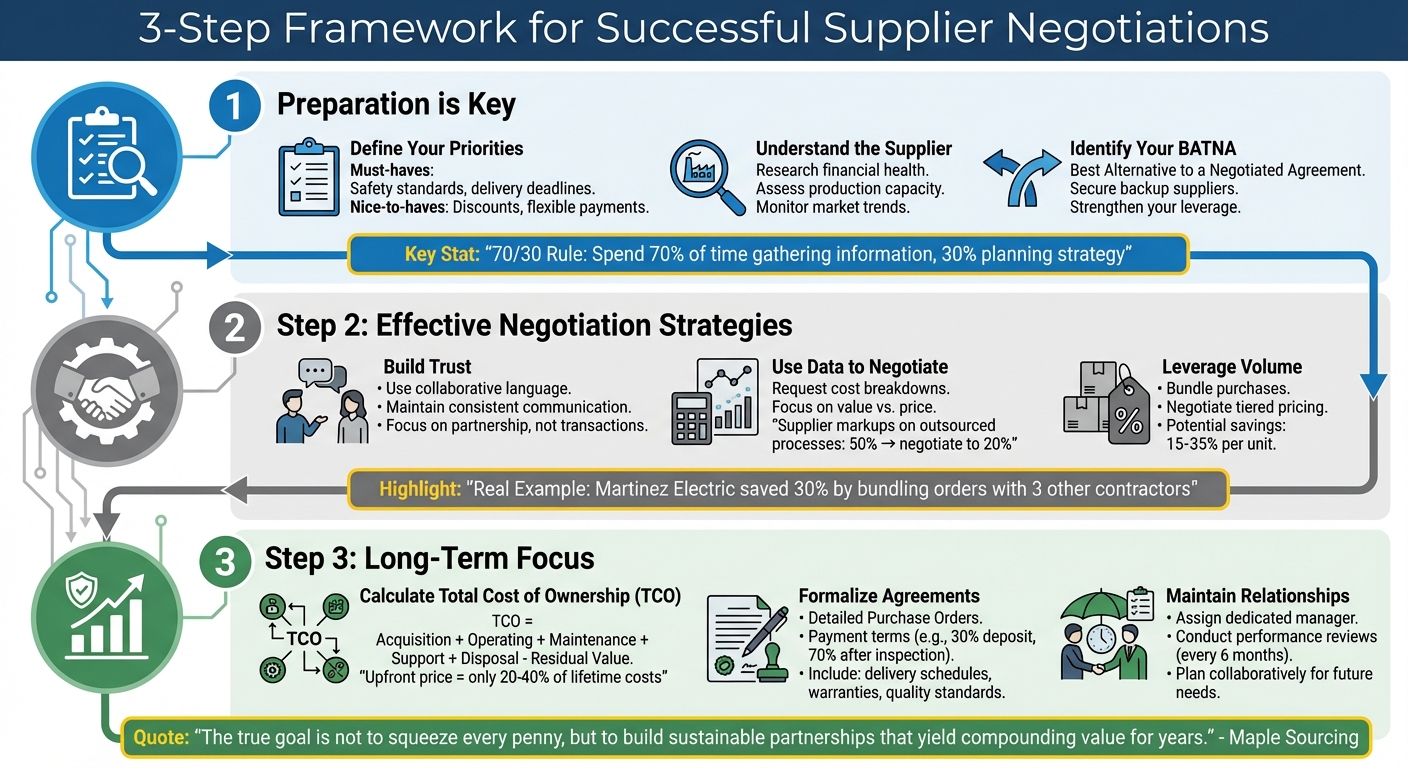
Negotiating with electrical equipment suppliers requires preparation, clear goals, and a focus on long-term value. Here's what you need to know:
-
Preparation is Key:
- Define your priorities: Separate "must-haves" (e.g., safety standards, delivery deadlines) from "nice-to-haves" (e.g., discounts, flexible payments).
- Understand the supplier's position: Research their financial health, production capacity, and market trends.
- Identify your BATNA (Best Alternative to a Negotiated Agreement): Always have a backup supplier to strengthen your leverage.
-
Effective Strategies:
- Build trust: Use collaborative language and maintain consistent communication.
- Use data to negotiate: Ask for cost breakdowns and focus on value instead of just price.
- Leverage volume: Bundle purchases or negotiate tiered pricing for bulk orders.
-
Long-Term Focus:
- Calculate Total Cost of Ownership (TCO): Include acquisition, operating, maintenance, and disposal costs.
- Formalize agreements: Document all terms in a detailed purchase order, including payment terms, delivery schedules, and warranties.
- Maintain relationships: Assign a dedicated manager, conduct performance reviews, and plan collaboratively for future needs.
3-Step Framework for Negotiating with Electrical Equipment Suppliers
Negotiation Strategies, Techniques & Skills in Procurement (2024)
sbb-itb-501186b
Preparing for Negotiations
Walking into negotiations without preparation can cost you opportunities and favorable terms. As Philip Ideson, Founder of Art of Procurement, puts it: "Planning... should clearly outline your negotiation objectives and must-have versus nice-to-have outcomes".
Begin by categorizing your priorities into two groups: must-haves and nice-to-haves. For instance, must-haves might include ensuring that equipment meets industry safety standards or that delivery schedules align with project deadlines. On the other hand, nice-to-haves could include perks like early payment discounts or flexible installment plans.
Once your priorities are clear, shift your attention to understanding your supplier's position. Suppliers are often well-informed about market rates, production costs, and pricing trends since they deal with these factors daily. Dive into their financial health, production capacity, and market standing to gauge your leverage. For example, knowing whether a supplier is at full production capacity or facing cash flow challenges can provide valuable insights.
Another key element of preparation is identifying your BATNA - your Best Alternative to a Negotiated Agreement. This serves as your fallback plan. Secure at least one dependable backup supplier for critical components. Not only does this give you options, but it also sets a clear walk-away point. As the Purchasing & Procurement Center explains, "Even if you can't switch now, researching options gives you mental and strategic leverage". Evaluate your alternatives carefully, refine them if needed, and select the strongest one as your BATNA.
To bring it all together, allocate your preparation time wisely. Follow the 70/30 rule: dedicate 70% of your efforts to gathering information and 30% to planning your negotiation strategy. Use tools like Electrical Trader to compare prices and benchmark market rates. Armed with this data, you can steer the conversation toward fact-based discussions, creating opportunities for both sides to reach a mutually beneficial agreement.
Negotiation Strategies for Electrical Equipment
Build Rapport and Establish Trust
Negotiations aren’t just about numbers - they’re about people. As Garrison Wynn wisely said, "People buy from people they trust, and they trust people they like". Building trust and fostering a sense of partnership with suppliers can lead to better terms, like flexible payment options or joint efforts to cut costs.
Start by doing your homework. Check out the supplier's team on LinkedIn to uncover shared connections or past collaborations in your industry. When discussing pricing, use collaborative language. Instead of saying, "Your price is too high", try, "Can you help me understand what’s driving this cost?" Sharing insights about your project timelines or specific workflow needs can open the door to more transparent conversations. Maintaining consistent communication and a track record of timely payments can also encourage suppliers to offer additional savings beyond the initial deal.
By focusing on trust and long-term value instead of just price, you’ll position yourself as a partner, not just a customer.
Use Objective Standards and Value-Based Negotiation
When you walk into negotiations with solid research and clear goals, you’re better equipped to discuss value - not just cost. For example, in 2019, a truck manufacturer slashed $250,000 annually by using digital simulations to eliminate expensive hand-polishing. In another case, a manufacturer cut the cost of a spacer component by 80%, from $4.80 to $0.85 per part, simply by switching from bar machining to laser cutting after analyzing the process with a cost-estimating tool.
Ask for detailed cost breakdowns, including material, labor, overhead, tooling, and transportation. This transparency can reveal areas for negotiation. For instance, suppliers who outsource processes like heat treatment or painting may add markups as high as 50%, but you can often negotiate these down to around 20%. If your order volume has grown significantly - say, from 1,000 to 15,000 units - request a re-quote. Larger orders might allow for more efficient manufacturing processes, potentially lowering costs.
By focusing on data and value, you can uncover opportunities for significant savings.
Leverage Volume and Bundling Opportunities
Volume can be a powerful bargaining chip. Buying in bulk often shifts pricing from retail to wholesale tiers, cutting per-unit costs by 15% to 35%. For example, Martinez Electric, a small Phoenix-based shop, teamed up with three other contractors to make quarterly purchases of electrical control devices. Together, they secured a 30% discount that none of them could have achieved individually.
Negotiate tiered pricing with clear thresholds, like automatic discounts for orders exceeding $10,000 or 100 units per quarter. Bundling related items - such as breakers, switches, and transformers - can also maximize value. Beyond price cuts, consider negotiating perks like free technical training, custom delivery schedules, or extended warranties. These add-ons can enhance your deal without significantly affecting the supplier’s margins.
Timing is another key factor. Keep an eye on commodity cycles for materials like copper and steel. Locking in agreements when raw material prices dip can lead to even better deals.
Using Total Cost of Ownership (TCO) in Negotiations
Present TCO Calculations
Incorporating Total Cost of Ownership (TCO) into negotiations provides a clearer picture of long-term value, going beyond just the upfront price. Often, the sticker price represents only 20–40% of the total lifetime costs. Focusing solely on purchase price can lead to spending 40–60% more over the equipment's lifetime compared to those who evaluate the full TCO.
The formula for TCO is straightforward:
TCO = Acquisition Costs + (Annual Operating Costs × Years) + (Annual Maintenance Costs × Years) + (Annual Support Costs × Years) + Disposal Costs – Residual Value.
For transformers, a related concept, Total Owning Cost (TOC), accounts for future energy losses. It includes the A Factor for no-load (core) losses and the B Factor for load (coil) losses.
Take this example from Olsun Electrics Corporation: they compared two 75-kVA transformers. The low-efficiency aluminum-wound unit cost $1,336 with 375W no-load losses, while the high-efficiency copper-wound unit cost $3,214 with 190W no-load losses. Over 15 years, assuming $0.070/kWh energy costs, the high-efficiency unit had a TOC of $14,084, saving $16,727 compared to the low-efficiency unit's TOC of $30,811.
"Since the operating cost of a transformer over its life may be many times its initial price, the only fair comparison with competing models must take operating costs into account." – Copper Development Association
To ensure fair comparisons, use a standardized TCO spreadsheet for all suppliers. Request specific no-load and load loss values (in watts) from bidders to make accurate calculations. Also, include site preparation costs like electrical modifications and ventilation in acquisition costs. When calculating costs over five or more years, apply a discount rate of 5–10% to determine Net Present Value, factoring in the time value of money.
This comprehensive approach ensures a well-rounded view of costs, preparing you to address technical and operational needs effectively.
Address Technical and Operational Requirements
Armed with TCO insights, you can tackle technical and operational challenges with precision. Instead of saying, "your price is too high", focus on specific performance metrics. For example, if voltage stability or compliance with U.S. electrical standards is essential, use TCO data to justify selecting higher-priced, more efficient equipment.
Ask suppliers for detailed cost breakdowns, including materials, labor, maintenance schedules, and energy usage rates. This level of transparency can highlight areas where technical upgrades might further reduce long-term costs. Engage cross-functional teams early to validate assumptions like discount rates, operating hours, and repair intervals. This helps balance technical requirements - like reliability and uptime - against financial considerations.
Additionally, running sensitivity analyses can reveal how factors such as a 20% increase in energy costs or extended equipment lifespan might impact overall expenses. These steps ensure you're making informed decisions that align with both operational needs and financial goals.
Closing the Deal and Maintaining Supplier Relationships
Finalize Key Terms and Agreements
Once pricing and specifications are agreed upon, it’s time to formalize everything. Start by documenting all terms in a detailed Purchase Order (PO). This document acts as a legally binding contract and must be signed and stamped by both parties. A well-structured PO should outline payment terms - common arrangements include a 30% deposit with the remaining 70% due after pre-shipment inspection, or milestone-based payments for more complex projects (e.g., 15% upfront, 20% after mold approval, and 30% post in-line inspection).
Address logistics and delivery specifics by setting clear lead times, "must-ship-by" dates, and applicable Incoterms. For instance, shifting from EXW (Ex Works) to FOB (Free on Board) can transfer risks and local logistics costs to the supplier. Additionally, include a detailed product specification sheet covering materials, dimensions, and technical standards. Make expectations clear by defining quality standards, inspection protocols, and warranty details (including length and scope). For more advanced equipment, outline after-sales support, maintenance plans, and training requirements.
Before finalizing, confirm that the supplier representative signing the agreement has the authority to make binding commitments on behalf of their company. Share all negotiated terms with your legal team to ensure the contract accurately reflects the agreements made. After finalizing the price, it’s worth asking for small extras, such as free custom printing or upgraded packaging, as a final gesture from the supplier.
With the contract in place, the next step is to focus on building a relationship that delivers value beyond the transaction.
Build Long-Term Partnerships
The real work begins after the contract is signed. Assign a dedicated relationship manager to serve as the go-to person for coordination and problem resolution. This role is crucial for maintaining smooth operations and addressing potential issues before they escalate. Build on the trust developed during negotiations by fostering collaboration through regular performance reviews and strategic discussions. Conduct mutual performance evaluations to assess both the supplier’s delivery and your own commitments, working together to address challenges and uncover opportunities for improvement.
"The true goal of learning how to negotiate with suppliers is not to squeeze every last penny out of a single transaction, but to build a strong, sustainable, and mutually beneficial partnership that yields compounding value for years to come." – Maple Sourcing
Create formal processes for joint strategic planning. Sharing your long-term business objectives allows suppliers to align their innovations and investments with your future needs. Encourage them to propose improvements in products or processes, and recognize their contributions when they successfully reduce costs or enhance efficiency. Maintain trust by relying on objective data, such as "should-cost" models, rather than engaging in adversarial price negotiations. Strong partnerships can also provide a safety net during disruptions, as trusted suppliers are more likely to prioritize reliable clients during raw material shortages or geopolitical challenges.
Conclusion
Negotiation success starts long before you sit down at the table. It’s all about preparation - setting clear goals, understanding the supplier's position, and having a solid BATNA (Best Alternative to a Negotiated Agreement). These steps lay the groundwork for meaningful, fact-driven discussions that work for both sides.
By focusing on long-term value rather than quick wins, you can achieve outcomes that benefit your business over time. Consider the Total Cost of Ownership (TCO), which includes factors like shipping, logistics, warehousing, and risk management. This approach ensures you're fully accounting for what the equipment will cost your business in the long run.
"Our role isn't to win at all costs. Instead, we should aim to create long-term value for everyone involved." – Philip Ideson, Founder and Managing Director, Art of Procurement
But negotiation doesn’t stop when the contract is signed. Building and maintaining strong partnerships is key to ongoing success. Set clear KPIs in your agreements, conduct performance reviews every six months, and keep communication lines open. These efforts pay off, especially during times of disruption, as trusted suppliers are more likely to prioritize dependable customers when resources are limited.
Tools like Electrical Trader can enhance your BATNA by giving you access to a wide range of reliable vendors and both new and used electrical components. With the right preparation and dependable supplier networks, you’ll be well-positioned to negotiate agreements that deliver mutual value for the long haul.
FAQs
What should I ask for in a supplier cost breakdown?
When asking for a supplier cost breakdown, zero in on the key elements that drive the price of the product or service. Request detailed information about materials, labor, overhead costs, logistics expenses, and profit margins. This breakdown gives you a clear picture of what makes up the total cost, making it easier to negotiate with confidence.
How do I calculate Total Cost of Ownership for electrical equipment?
To figure out the Total Cost of Ownership (TCO) for electrical equipment, you need to account for all expenses tied to the equipment over its entire lifespan. This goes beyond just the purchase price and includes factors like energy consumption, upkeep, repairs, and eventual disposal. Here's how to approach it:
- Start with the purchase price: This is your upfront cost when acquiring the equipment.
- Add energy and maintenance costs: Estimate the ongoing expenses for running and maintaining the equipment.
- Include end-of-life costs: Don’t forget to factor in disposal or retirement expenses when the equipment is no longer usable.
Taking this all-encompassing approach ensures better, more informed choices when it comes to buying and managing equipment.
What terms must be included in a purchase order with a supplier?
A purchase order needs to lay out essential contractual terms to provide clarity and ensure it holds up legally. Key components typically include:
- Buyer and supplier details: Names and contact information for both parties.
- Product or service specifics: Detailed descriptions, including specifications and quantities.
- Price and payment terms: Agreed-upon costs and payment schedules.
- Delivery information: Timeline and location for delivery.
- Terms and conditions: Covers warranties, legal provisions, and other critical terms.
- Acceptance clause: Acknowledgment indicating agreement to the outlined terms.
These details establish clear roles and expectations, reducing the risk of misunderstandings or disputes.
Related Blog Posts
- How to Find Deals on Electrical Equipment Online
- How Poor Planning Leads to Procurement Delays
- How Bulk Purchasing Cuts Electrical Costs
- Key Factors for Buying Medium Voltage Switchgear