Modular UPS System Design Basics
Modular UPS systems are a flexible solution for modern power needs, offering scalability, efficiency, and easy maintenance compared to fixed-capacity systems. Here's what you need to know:
- Scalability: Add or remove power modules as your energy demands grow, avoiding oversizing and underutilization.
- Redundancy: Achieve N+1 redundancy with minimal extra hardware, ensuring uninterrupted operation even if a module fails.
- Efficiency: Operate at over 97% efficiency across varying loads, reducing energy waste and costs.
- Maintenance: Hot-swappable modules allow repairs or upgrades without downtime, cutting Mean Time to Repair (MTTR) to under 10 minutes.
- Compact Design: Saves up to 50% floor space compared to traditional systems.
Key components include power modules for double conversion, intelligent control systems for load management, and modular battery systems for runtime support. These features make modular UPS systems a reliable and scalable choice for data centers and critical infrastructure.
Quick Comparison: Monolithic vs Modular UPS
| Feature | Monolithic UPS | Modular UPS |
|---|---|---|
| Capacity Scaling | Requires new units | Add modules to chassis |
| Redundancy | Full second system (2N) | N+1 with fewer modules |
| Maintenance | Requires shutdown | Hot-swappable modules |
| Efficiency | Lower at light loads | High across all loads |
| Footprint | Larger | Compact |
For growing businesses or critical systems, modular UPS systems offer the flexibility and reliability needed to keep operations running smoothly.
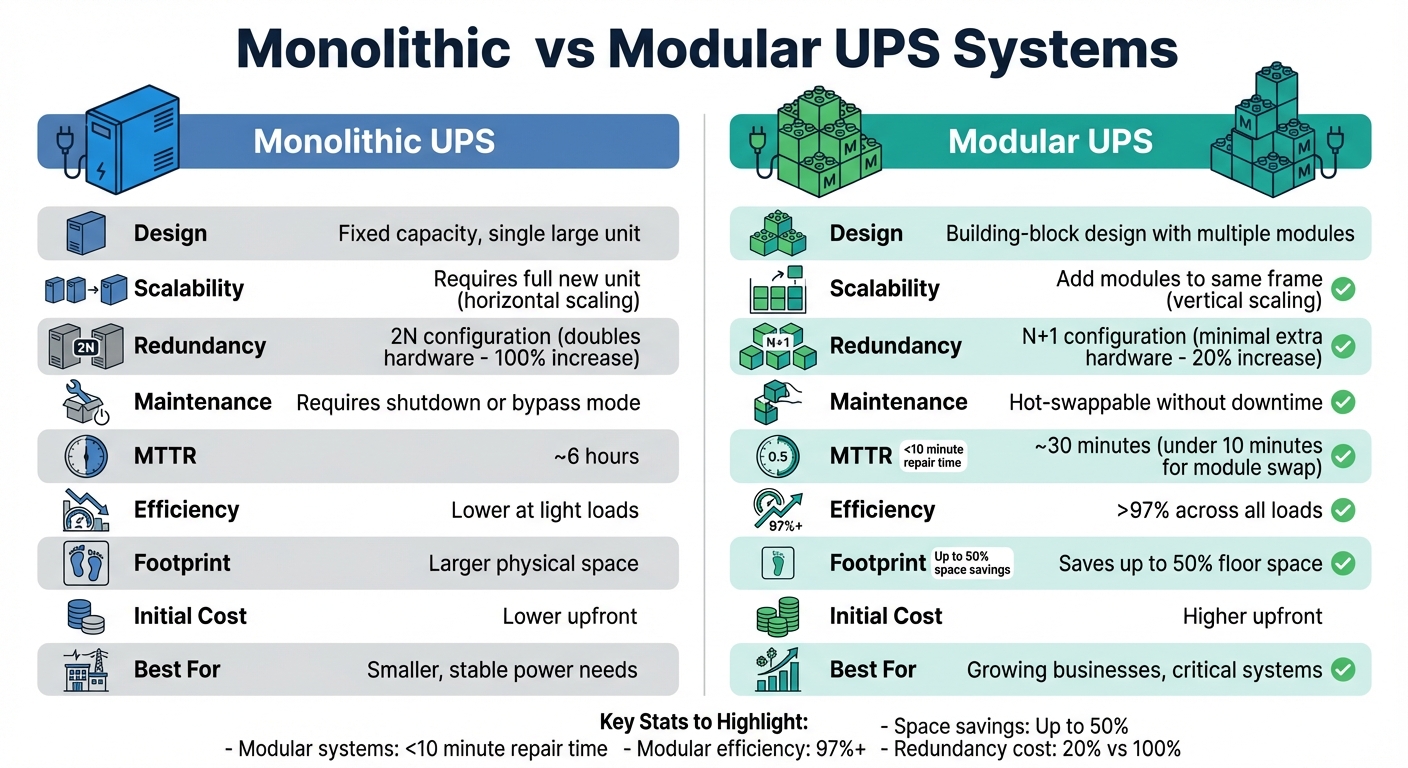
Monolithic vs Modular UPS Systems Comparison Chart
Core Components of Modular UPS Architecture
Power Modules and Frames
At the heart of a modular UPS system is the chassis, which holds all the modules and provides a shared busbar and communication pathways. Depending on your data center setup, you can choose between a standalone cabinet or a standard 19-inch rack-mountable unit.
Power modules handle the critical task of double conversion (AC-to-DC-to-AC), featuring their own rectifiers, inverters, chargers, and DSP controllers to isolate potential failures. These modules are designed for hot-swapping, meaning you can replace them without disrupting the load.
"The power module is central to UPS operation... the main benefits are the reduction of the mean time to repair/replace (less than 10 minutes) and N+1 redundancy."
A static bypass module is another key component, instantly transferring the load to utility power during UPS events. Depending on your redundancy setup, this functionality can either be centralized for the entire frame or distributed within each power module.
All these hardware components work alongside intelligent controls to ensure optimal performance.
Control Systems and Connectivity
The intelligence module serves as the brain of a modular UPS system, managing load distribution and monitoring the system's overall health. Some advanced systems even include redundant intelligence modules to eliminate the risk of a single point of failure.
Modern control systems utilize protocols like RS-485, Modbus RTU/TCP, and SNMP to integrate seamlessly with Building Management Systems (BMS). This enables real-time monitoring of critical metrics, such as voltage levels, load percentages, and battery status. Some systems go a step further, incorporating environmental sensors to detect smoke, water, and humidity through the same interface.
When power modules are added or removed, the control system automatically adjusts to the change, redistributing the load across the remaining modules. This ensures the system remains flexible and easy to maintain.
Battery Systems
Battery systems are equally important, providing the necessary runtime support during outages. These modules store DC energy and are often housed in cartridges or trays, allowing independent scaling from the power modules. For extended runtime, additional battery modules (EBMs) can be installed without modifying the power conversion setup.
The type of battery used plays a big role in performance. Traditional VRLA (valve-regulated lead-acid) batteries last around 3 to 5 years with 500 to 800 discharge cycles. In contrast, lithium-ion batteries can last over 10 years and handle 1,500 to 3,000 cycles, while LiFePO4 (lithium iron phosphate) batteries can manage 3,000 to 6,000 cycles.
Modern systems also include a Battery Management System (BMS) to monitor key parameters like voltage, temperature, and charging profiles at the module level. To maximize battery lifespan, it's recommended to maintain ambient temperatures between 59°F and 77°F (15°C–25°C).
Monolithic vs Modular UPS Systems
Main Differences Between Monolithic and Modular Systems
Monolithic UPS systems come with a fixed capacity, meaning if you need to scale up, you’ll have to add an entirely separate UPS unit. This design limitation highlights the flexibility offered by modular systems.
Modular UPS systems use a "building-block" setup, where multiple smaller power modules are housed within a single chassis. As power demands grow, you can simply add more modules to the same frame. This approach not only saves physical space but also makes expansion much easier.
One of the biggest differences lies in redundancy. In monolithic systems, achieving N+1 redundancy requires doubling the hardware with a full second unit. Modular systems, on the other hand, achieve the same level of protection by adding just one extra module. For example, in a system with five modules, adding one more only increases the capacity by 20%, not 100%.
Maintenance is another area where these systems differ greatly. Repairs on monolithic systems often require switching to a maintenance bypass. As Luke Eiland, Service Manager at SolarEdge Critical Power Division, puts it: “In a monolithic system, failure of one component could cause failure of the entire system. But in true modular units, if one module fails, it's separated from the rest of the system and the other modules pick up the slack”.
Repair times are also worth noting. Monolithic systems typically average around 6 hours for Mean Time to Repair (MTTR), while modular systems can be serviced in just 30 minutes thanks to their hot-swappable components.
Comparison Table: Monolithic vs Modular UPS
Here’s a side-by-side look at the key differences between monolithic and modular UPS systems:
| Feature | Monolithic UPS | Modular UPS |
|---|---|---|
| Design Concept | Fixed capacity with a single large unit | Building-block design with multiple modules |
| Scalability | Horizontal (requires a full new unit) | Vertical (add modules to the same frame) |
| Redundancy | Requires 2N (doubles the hardware) | Achieves N+1 (minimal extra hardware, ~20%) |
| MTTR | High (around 6 hours) | Low (around 30 minutes) |
| Maintenance | May need system shutdown or bypass | Hot-swappable without downtime |
| Initial Cost | Lower upfront cost | Higher upfront cost |
| Footprint | Larger, especially with redundancy | Compact and often rack-mountable |
| Efficiency | Lower when oversized for future needs | Higher due to right-sizing |
Monolithic systems are a better fit for smaller, stable power needs where minimizing the initial investment is the main priority. However, if you’re dealing with critical power availability, anticipating future growth, or facing space constraints, modular systems provide a more efficient and scalable solution in the long run.
Scalability and Redundancy in Modular UPS Design
How Scalability Works
Modular UPS systems take a "building-block" approach, letting you add or remove power modules as your needs evolve. This flexible "pay-as-you-grow" model means you can start with just enough capacity for today and expand incrementally without needing to overhaul the entire system.
Power modules typically range from 10 kVA to 500 kW. Robert McFarlane, Principal at Shen Milsom & Wilke LLC, highlights this advantage:
"Modular UPS systems bring flexibility to backup power... ability to grow capacity as needed and reduced maintenance cost".
One key benefit is that UPS efficiency peaks when operating near maximum capacity, so modular systems allow you to match capacity closely to your load. Modern designs can achieve efficiencies of 97% or higher across a wide range of loads. You can scale vertically by adding modules to a single rack or horizontally by linking multiple UPS frames in parallel.
This approach reduces upfront costs because you only purchase the capacity you need immediately. However, when choosing a frame, it’s smart to plan ahead: select one that can support your projected growth over the next 5 to 10 years, even if you only install a few modules at first.
In addition to scalability, modular UPS systems offer various redundancy configurations to ensure uninterrupted power protection.
Redundancy Configurations: N+1, 2N, and Distributed Redundant
Redundancy options are essential for modular systems, as they safeguard against power interruptions in case of module failure.
N+1 redundancy involves having at least one additional module beyond what’s needed to support the load. If a module fails, the remaining ones automatically take over without any disruption. For instance, in a three-module N+1 setup, each module operates at roughly 33% load to maintain redundancy.
2N redundancy employs two separate, parallel UPS systems. Each system runs at no more than 50% capacity, ensuring that if one fails, the other can handle the full load. This setup offers the highest fault tolerance, protecting against total system or feed failures, but it comes with significant infrastructure costs. Additionally, efficiency is lower because both systems must operate below 50% load.
Distributed redundant configurations, commonly used in hyperscale data centers, combine modules of different sizes and unequal loading to provide redundancy at a lower cost. This setup allows capacity to be "borrowed" from idle systems, offering flexible protection against multiple failure scenarios.
For 2N configurations, it’s critical to monitor loads closely. If a single system exceeds 50% capacity, it risks a complete system failure. To mitigate this, maintain extra module capacity in under-utilized frames.
Comparison Table: Redundancy Configurations
| Redundancy Configuration | Cost | Load Protection | Fault Tolerance | Efficiency |
|---|---|---|---|---|
| N+1 | Lower | High – protects against single module failure | High (can run near capacity) | High |
| 2N | Higher | Very High – protects against entire system/path failure | Very High (must stay <50% load) | Lower |
| Distributed Redundant | Medium | High – flexible protection against various failure points | High (depends on load matching) | Variable |
Hot-Swappability and Maintenance
Hot-Swappable Power Modules
Modular UPS systems come with a major advantage: their hot-swappable design. This feature lets you add or remove modules - like power modules, intelligence modules, or static bypass switches - without shutting down the system. In other words, the system keeps running smoothly, even during maintenance or upgrades.
Hot-swappable modules make repairs fast and efficient. Instead of spending hours troubleshooting individual components, you can replace an entire module in minutes. Many modular systems are designed to be user-friendly, so your facility staff can handle replacements or upgrades without needing to call in outside technicians. To keep things running seamlessly, it's a good idea to have at least one spare power module on hand for immediate use if a failure occurs.
If your system is set up in an N+1 configuration, you can remove a module for servicing while the remaining modules continue to handle the full load. This ensures uninterrupted operation during maintenance - a major improvement over older systems that often require switching to bypass mode or even shutting down entirely for repairs.
This ability to perform live maintenance extends to modular battery setups, offering consistent performance without downtime.
Distributed Battery Systems
Just like the hot-swappable power modules, modular UPS systems use a distributed battery design to simplify maintenance and reduce service interruptions. Instead of relying on a single large battery string, these systems house batteries in modular trays or cartridges. This setup improves fault tolerance - if one battery module fails, the others continue to provide runtime, and you can quickly replace the faulty unit without disrupting operations.
With modular battery cartridges, faults are isolated, making replacements straightforward while ensuring the system keeps running. Additionally, modular static bypass switches can be serviced independently, often in under 10 minutes, compared to traditional designs that require shutting down the entire UPS.
These features not only enhance maintenance efficiency but also complement the scalability and redundancy that modular systems are known for, ensuring maximum uptime and reliability.
| Feature | Monolithic (Traditional) UPS | Modular UPS |
|---|---|---|
| Repair Process | Requires technician to troubleshoot and replace individual parts | Simple swapping of pre-assembled modules |
| Downtime for Service | Often needs bypass mode or full shutdown | Modules can be replaced while the system stays online |
| Repair Time (MTTR) | Can take hours or even days | Typically under 10 minutes |
| Battery Module Replacement | A single cell failure can affect the entire string | Modular cartridges allow isolated replacement and maintain redundancy |
sbb-itb-501186b
Design Best Practices for Modular UPS Systems
Calculating Proper Load Sizing
Accurate load sizing is the backbone of a dependable modular UPS design. Start by listing all critical equipment, noting details like supply voltage, phase count, load current, and power consumption (in watts and kVA). As Mike Elms, Technical Manager at KOHLER Uninterruptible Power Ltd, explains:
"Sizing a UPS correctly for a specific site takes more than just a knowledge of the site's kVA load requirement".
It's also important to monitor how loads vary throughout the day. Pay close attention to the power factor - calculated as watts divided by volts times amps - since modern transformerless modular systems perform better with unity or leading power factors compared to older transformer-based units. Keep in mind that certain devices, like motors or laser printers, can demand 15 to 20 times their steady-state current during startup, so these inrush surges must be factored in.
After determining your total power draw, add a 20–25% safety margin to accommodate peak conditions and future growth. For battery capacity, multiply the total load (in watts) by the desired runtime (in hours), then add 10–20% to account for inefficiencies in the UPS system. For three-phase systems, ensure that no single phase is loaded beyond 33% of the UPS's total rating.
The modular design approach allows you to size your system precisely from the beginning. For example, if you have a 120kVA load and need redundancy, you could use four 40kVA modules in an N+1 setup instead of oversizing with two 120kVA monolithic units. This approach not only ensures redundancy but also keeps the system running more efficiently from day one.
Balancing Redundancy and Scalability
To strike the right balance between redundancy and scalability, design your UPS frame and bypass capacity with future growth in mind, even if you're only installing a fraction of the modules initially. Plan for your anticipated load over the next 5–10 years, but start with just 20% of the modules to match current needs.
For most setups, N+1 redundancy offers the ideal mix of protection and efficiency. Robert McFarlane from TechTarget highlights:
"A UPS system runs at highest efficiency when near maximum rated capacity; efficiency drops when the load level decreases".
In an N+1 configuration, you include one extra module instead of duplicating the entire system. This allows the modules to operate closer to their optimal efficiency range.
For mission-critical applications requiring a 2N configuration, each UPS must run below 50% capacity to ensure the system remains functional if one side fails. Although this reduces efficiency, it provides the highest level of reliability. Additionally, distributed architectures - where the facility is divided into zones, each with its own modular UPS - can minimize the impact of a single failure and allow for targeted scalability based on actual needs.
Sourcing Components from Reliable Suppliers
Once you've addressed sizing and redundancy, the quality of your components becomes the next priority. Modular systems inherently involve more components than monolithic designs, making it essential to select well-engineered modules to maintain high Mean Time Between Failures (MTBF) rates.
Look for suppliers offering standardized, hot-swappable modules with Mean Time to Repair (MTTR) under 10 minutes. These modules should be interoperable, ensuring you can add or replace power, intelligence, and battery modules without compatibility issues. High-quality systems from established manufacturers often achieve over 97% efficiency across varying load levels and deliver power factors as high as 0.95.
Cybersecurity is another critical consideration. Choose suppliers that integrate secure networking cards and remote management tools to protect your UPS system from digital threats. If you're exploring lithium-ion batteries for their compact size and high discharge cycle capabilities, prioritize reputable vendors. These batteries require specialized fire protection and packaging to ensure safety.
Platforms like Electrical Trader can simplify the process of sourcing reliable UPS modules, transformers, and other power distribution equipment. When evaluating suppliers, check for features like front-access designs for easier maintenance, flexible thermal management for high-density setups, and detailed documentation for installation and servicing.
Conclusion
Key Takeaways
Modular UPS systems have reshaped the way we think about power protection. By moving away from traditional, rigid designs to hot-swappable power modules, these systems offer three major benefits: scalability that aligns with your actual needs, N+1 redundancy at a more manageable cost, and uninterrupted operation during maintenance. As Schneider Electric explains:
"By using modular design, a UPS offers benefits that may include increased redundancy (internal N+1), scalability, and reduced time to repair".
These systems stand out for their efficiency, fast repair times, and dependable power factors. A key advantage lies in their ability to match installed capacity to current demand. You can deploy only the modules you need now while keeping the infrastructure ready for future expansion.
Whether you're safeguarding a small server room with 4–20 kW units or managing 20–400 kW systems for larger data centers, modular UPS systems adapt seamlessly to your environment. This adaptability is a hallmark of the design principles discussed throughout this guide.
Choosing the right components is crucial for success. Focus on high-quality, interoperable modules from reputable suppliers. Look for standardized designs with documented MTBF rates and secure networking capabilities that comply with standards like IEC-62443-4-2 or UL2900-1. Platforms such as Electrical Trader offer a range of new and used UPS modules, transformers, and power distribution equipment, providing reliable options for system expansion or upgrades.
The modular architecture's flexibility ensures your power infrastructure evolves alongside your IT systems. It adapts to changes, expansions, and relocations without the limitations of fixed-capacity designs. This approach keeps your power protection strategy as agile and forward-thinking as the technology it supports.
ABB Advances in Modular UPS

FAQs
What makes modular UPS systems more scalable than monolithic UPS systems?
Modular UPS systems stand out for their ability to grow with your needs. By adding extra power or battery modules, you can increase capacity step by step, avoiding the hassle of replacing the entire system. On the other hand, monolithic UPS systems come with fixed capacities, meaning scaling up often involves installing additional parallel units and infrastructure - a process that can quickly become expensive and complicated.
The modular approach not only adjusts to evolving power demands but also helps save space and reduce initial costs. This adaptability makes modular UPS systems a smart choice for businesses seeking a power solution that can evolve over time.
What advantages do hot-swappable modules offer in modular UPS systems?
Hot-swappable modules are a standout feature of modular UPS systems, letting you replace or add power, intelligence, or battery modules without shutting everything down. This means the system keeps running smoothly, even during maintenance or upgrades, cutting downtime to just minutes. If a module fails, the rest continue to operate, offering built-in redundancy and eliminating the hassle of planned outages.
These modules also help cut costs and boost efficiency. By shutting down unused modules to match the current load, energy waste is reduced. Plus, businesses can scale their power capacity as needed, skipping the expense of over-provisioning and adopting a pay-as-you-grow model. Maintenance becomes a breeze, too - repairs can happen during normal working hours without disrupting operations.
In short, hot-swappable modules make repairs quick, scaling easy, and costs lower, offering a dependable and efficient solution for facilities that can’t afford power interruptions.
What is N+1 redundancy, and why is it crucial for modular UPS systems?
N+1 redundancy is a design approach that adds an extra power module to a modular UPS system. This spare module acts as a backup, ensuring the system can manage the full power load even if one module fails.
This setup is essential for guaranteeing uninterrupted power supply, particularly in settings where downtime is unacceptable. It also enables maintenance or repairs on individual modules without affecting the overall power delivery, combining reliability with operational flexibility.