




Low vs. High Voltage: Energy Efficiency Comparison
When deciding between low and high voltage systems, the choice largely depends on your specific energy needs and the distance electricity must travel. Here's the core takeaway:
- High voltage systems are better for long-distance power transmission. They reduce energy losses, use lighter conductors, and deliver power more efficiently. For example, transmitting 100 MW over 124 miles at 220 kV results in only 2.07 MW of losses (about 98% efficiency). High-voltage direct current (HVDC) systems are even more efficient, with losses under 3% over 620 miles.
- Low voltage systems are ideal for short-distance applications like homes and offices. They have lower upfront costs and are safer for human interaction, but they experience higher energy losses and require larger, more expensive conductors for high power loads.
Quick Overview:
- High voltage is efficient for bulk power over long distances.
- Low voltage is safer and cost-effective for local distribution.
Key Comparison:
| Feature | Low Voltage Systems | High Voltage Systems |
|---|---|---|
| Energy Efficiency | Higher resistive losses | Minimal resistive losses |
| Transmission Losses | Significant over long distances | Very low over long distances |
| Costs | Lower upfront, higher long-term | Higher upfront, lower long-term |
| Safety | Safer for human environments | Requires more precautions |
Ultimately, high voltage systems are best for large-scale, long-distance power needs, while low voltage systems are suited for smaller, local applications.
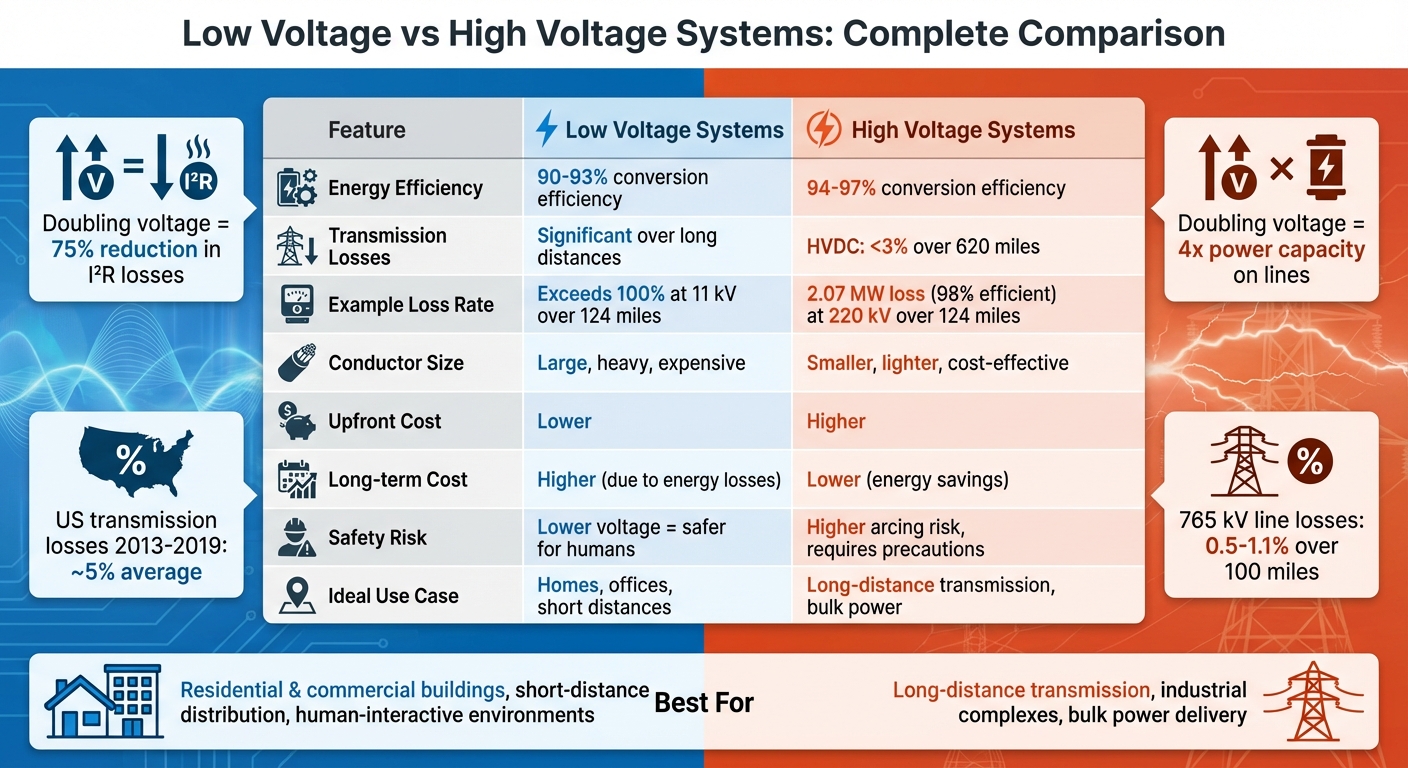
Low Voltage vs High Voltage Systems: Efficiency, Cost, and Safety Comparison
Power Transmission: High Voltage vs Low Voltage Comparison
1. Low Voltage Equipment
Low voltage equipment, which operates at much lower levels than high voltage transmission systems, faces unique challenges when handling high power loads. The main issue stems from the relationship between voltage and current: delivering the same amount of power at a lower voltage requires drawing a much higher current. This increase in current leads to greater resistive losses, driving up operational costs. Since low voltage systems are widely used in homes and offices, understanding these efficiency challenges is essential to optimizing their performance.
Energy Efficiency
One of the biggest hurdles for low voltage systems is the rise in resistive heating, or I²R losses, which escalate quickly as current increases. As technical expert Ahmed Sheikh explains:
"conventional low-voltage transmission is impractical over vast distances due to high power losses and the need for large, costly conductors".
Raising the voltage can significantly reduce these losses. For instance, doubling the voltage halves the current, which cuts I²R losses by a factor of four. When it comes to energy storage systems, low voltage setups typically achieve conversion efficiencies of 90–93%, while high voltage systems perform slightly better, ranging from 94–97%.
Transmission Losses
Distance amplifies the efficiency issues in low voltage systems. Over long distances, these systems experience greater transmission losses and voltage drops, which can destabilize voltage levels. This instability poses risks to sensitive electronics and motors, potentially leading to damage.
Costs
While low voltage transformers may have lower upfront costs, their long-term expenses can be significantly higher. The increased energy losses and the need for thicker, heavier conductors to handle higher currents drive up material costs. On the plus side, installation costs for low voltage systems are often lower. These systems are typically easier to install, sometimes even suitable for DIY projects, and they require less specialized labor.
Safety
One of the standout advantages of low voltage equipment is its safety. Operating at around 120 V or lower in residential settings, these systems pose a much lower risk of electrical arcing and severe shocks. This makes them ideal for environments where human contact is frequent, such as homes, offices, and control systems. However, the higher currents needed to deliver equivalent power can cause significant thermal stress on components. To prevent issues like insulation failure, these systems often require robust cooling solutions or oversized materials. Despite these trade-offs, low voltage systems remain a practical choice where safety and human interaction are top priorities.
2. High Voltage Equipment
High voltage systems are the cornerstone of long-distance power transmission, operating at elevated voltages to reduce the current needed for the same power output. This approach minimizes resistive losses (I²R), heat buildup, and energy waste, making these systems highly efficient for delivering electricity over vast distances.
Energy Efficiency
When voltage is doubled, the current is halved, cutting I²R losses by a striking 75%. For example, a 765 kV line carrying 1,000 MW over 100 miles experiences losses as low as 0.5%–1.1%. High-Voltage Direct Current (HVDC) systems take efficiency even further, with transmission losses typically staying under 3% over a distance of 620 miles (1,000 km) - a 30% to 40% improvement compared to AC systems of similar voltage. As highlighted by Electrical Technology:
"Transmitting electrical power at high voltage and low current is a more efficient and economical approach for long-distance power transmission, as it helps reduce resistive losses, minimizes the need for expensive conductors, and improves overall system efficiency".
This efficiency not only reduces energy waste but also ensures more reliable power delivery, as explored below.
Transmission Losses
High voltage systems are designed to maintain stable and efficient power delivery across long distances. Between 2013 and 2019, transmission and distribution losses in the United States averaged around 5%. To put this into perspective, transmitting 100 MW over 124 miles (200 km) at 220 kV achieves an efficiency of approximately 97.93%, losing only 2.07 MW. In contrast, transmitting the same power at just 11 kV would result in losses exceeding the total power generated. Lower current also reduces voltage drops over distance, ensuring consistent and reliable power delivery.
Costs
While high voltage systems require significant upfront investment in specialized equipment like transformers, insulators, and switchgear, they offer substantial savings over time. Lower current allows for the use of lighter conductors, such as ACSR, which reduces material and support structure costs. As Paul Denholm from the National Renewable Energy Laboratory explains:
"If you double the voltage, you don't double the power you can put on the lines. You actually quadruple the power".
This increased capacity reduces the need for additional transmission lines, cutting down on land acquisition costs and minimizing the size of rights-of-way. Long-distance transmission costs can range from $0.005 to $0.02 per kWh, and over decades, the energy savings can amount to millions of dollars.
Safety
High voltage systems come with unique safety challenges. Higher voltages increase the risk of arcing, necessitating taller towers, larger insulators, and wider safety clearances. At voltages of 345 kV and above, corona losses can waste several megawatts of power. HVDC systems face additional challenges with DC arcs, which are harder to extinguish than AC arcs due to the absence of a natural zero-crossing point. These challenges drive ongoing innovations in design, enhancing the safety and reliability of high voltage systems, especially for bulk power transmission over long distances.
For those seeking to leverage the efficiency and capacity of high voltage transmission, Electrical Trader offers a wide range of components tailored for high-performance applications.
sbb-itb-501186b
Pros and Cons
This section dives into the practical trade-offs between low and high voltage systems, helping you weigh the options based on your project’s needs, distance requirements, and budget.
When deciding between these systems, it’s important to consider efficiency, cost, and safety. These factors influence not just the initial setup but also the long-term operational expenses.
Low voltage systems are a great fit for short-distance applications, such as residential or commercial buildings, where safety and simplicity take priority. They come with the advantage of lower costs for insulation and switchgear while posing a reduced risk of arcing. However, they’re not as efficient over long distances due to high resistive losses. For example, low voltage systems experience significant energy loss when transmitting power over extended distances. Additionally, high current demands in these systems require oversized and expensive conductors.
High voltage systems, on the other hand, shine in long-distance power transmission. By reducing the current, they minimize I²R losses, which improves efficiency. This also allows for smaller and lighter conductors - often aluminum instead of copper - cutting down on material and support structure costs. As Paul Denholm from the National Renewable Energy Laboratory explains:
"If you double the voltage, you don't double the power you can put on the lines. You actually quadruple the power".
This increased power capacity reduces the need for extra transmission lines, making high voltage systems a smart choice for bulk power delivery over long distances.
Here’s a quick comparison of the two systems:
| Feature | Low Voltage Systems | High Voltage Systems |
|---|---|---|
| Energy Efficiency | Higher I²R losses reduce overall efficiency | Lower current minimizes resistive losses |
| Transmission Losses | Significant losses over distance | Minimal; HVDC losses under 3% per 620 miles |
| Conductor Requirements | Large, heavy, and costly conductors | Smaller, lighter, and less expensive conductors |
| Upfront Cost | Lower due to simpler components | Higher due to specialized transformers and insulation |
| Voltage Regulation | Poor stability with noticeable drops | Stable delivery with minimal voltage drop |
| Safety Risks | High current can lead to heating or fire hazards | High voltage increases arcing and insulation risks |
| Ideal Use Case | Short-distance distribution (homes, offices) | Long-distance bulk power transmission |
These differences highlight how each system is tailored to specific applications. For instance, low voltage systems are better suited for local distribution, while high voltage systems excel in transmitting power over greater distances.
If your project demands high-performance transmission equipment, Electrical Trader offers a range of both low and high voltage solutions to meet your efficiency and safety requirements.
Conclusion
When weighing the options between low and high voltage systems, the right choice depends largely on your specific energy needs and the application at hand.
High voltage systems excel in scenarios like long-distance power transmission and large-scale power distribution. By reducing current flow, they minimize resistive energy losses and allow for the use of lighter, more cost-efficient conductors. This makes them the go-to option for transmitting power across vast distances or supplying energy to industrial complexes.
On the other hand, low voltage systems are better suited for local distribution in residential and commercial environments. Their simpler installation process, lower initial costs, and safer operation make them perfect for powering everyday appliances and electronics. Though they’re less efficient over long distances, their ease of maintenance and accessibility make them a practical choice for final-stage power distribution.
Ultimately, your decision should align with your power demands and the distance the electricity needs to travel. High voltage systems offer long-term efficiency and savings for large-scale operations, while low voltage systems prioritize safety and simplicity for smaller, local applications.
Additionally, choosing equipment that adheres to current efficiency standards, such as DOE 10 CFR 431 for transformers, can help reduce operational costs. Electrical Trader provides a wide selection of low and high voltage equipment, including breakers, transformers, and power distribution tools, ensuring you find the right solution tailored to your efficiency and safety needs. By matching your system to your specific requirements, you can achieve optimal performance and reliability.
FAQs
Why are high-voltage systems more efficient for transmitting power over long distances?
High-voltage systems play a key role in making long-distance power transmission more efficient. Here's why: when voltage is increased, the current needed to deliver the same amount of power drops. This reduction in current significantly cuts down on resistive losses (also known as I²R losses), which occur as heat in the transmission lines.
Smaller currents also mean thinner and lighter conductors can be used, which not only improves efficiency but also helps lower costs. By minimizing energy loss and ensuring more power reaches its destination, high-voltage systems have become essential for long-distance power distribution.
What safety precautions should you take when using low-voltage systems in your home?
Low-voltage systems, running at 50 volts or less, are a staple in many U.S. homes, powering things like landscape lighting, security setups, and smart-home gadgets. While these systems are generally safer than the standard 120-volt circuits, following proper safety practices is still critical to ensure smooth and hazard-free operation.
Start by using UL-listed components and transformers that are properly rated to meet fire-resistance and electrical safety standards. In areas prone to moisture - like outdoor spaces or bathrooms - install ground-fault circuit interrupters (GFCIs) to minimize the risk of electric shock. Keep low-voltage wiring clearly labeled and separate from standard circuits to prevent any cross-connections that could lead to issues.
Because low-voltage systems often draw higher currents, they may need thicker wires to prevent overheating. Make sure to choose the right wire size for your setup. Regular inspections of wires and connections are a must - look for any signs of damage or wear, and replace compromised parts as soon as possible. If you have kids or pets at home, double-check that all enclosures and connections are securely fastened to avoid accidental contact with live components.
For sourcing reliable parts, Electrical Trader offers a variety of low-voltage breakers, transformers, and wiring accessories that comply with U.S. safety standards. It's a convenient way to find the components you need for your home projects.
What are the cost differences between low-voltage and high-voltage systems, both upfront and long-term?
The initial expense of low-voltage systems (typically ≤ 48V) can be higher because they require thicker, more expensive wiring and extra components to manage the higher current they demand. On the other hand, high-voltage systems (100V–400V+) use thinner wires and fewer materials, which can help lower the upfront installation costs. That said, high-voltage setups usually involve pricier components like inverters and advanced safety systems.
In the long run, high-voltage systems often prove to be more cost-effective. Low-voltage systems lose more energy due to the higher current, which not only raises electricity costs but also increases the need for maintenance. In contrast, high-voltage systems operate with lower currents, minimizing energy losses, reducing energy bills, and decreasing wear and tear. While the initial investment for high-voltage systems might be slightly higher, their long-term efficiency often makes them the smarter financial choice.