




Lithium-Ion vs. Flow Batteries: Energy Density Comparison
Which battery is better for grid-scale storage? It depends on your needs. Here's a quick breakdown:
- Lithium-ion batteries offer high energy density (200–350 Wh/kg), making them compact and efficient for short-term storage (1–4 hours). They're ideal for tasks like frequency regulation and peak shaving, especially in space-constrained areas. However, they have a shorter lifespan (7–10 years) and require cooling systems to manage safety risks like thermal runaway.
- Flow batteries, while having lower energy density (~10% of lithium-ion), excel in long-term storage (6–12+ hours) with lifespans of 20–25 years. They are safer, with non-flammable electrolytes, and allow easy scaling of energy capacity by increasing tank size. These are great for large-scale renewable energy projects or areas needing extended discharge durations.
Quick Comparison
| Metric | Lithium-Ion Batteries | Flow Batteries |
|---|---|---|
| Energy Density | 200–350 Wh/kg | ~10% of lithium-ion |
| Round-Trip Efficiency | 90–95% | 65–85% |
| Cycle Life | ~7,000 cycles | 10,000+ cycles |
| System Lifespan | 7–10 years | 20–25 years |
| Safety | Risk of thermal runaway | Non-flammable |
| Storage Duration | 1–4 hours | 6–12+ hours |
Key takeaway: Choose lithium-ion for compact, short-term storage and flow batteries for long-term, scalable solutions. Both have strengths suited to specific grid-scale applications.
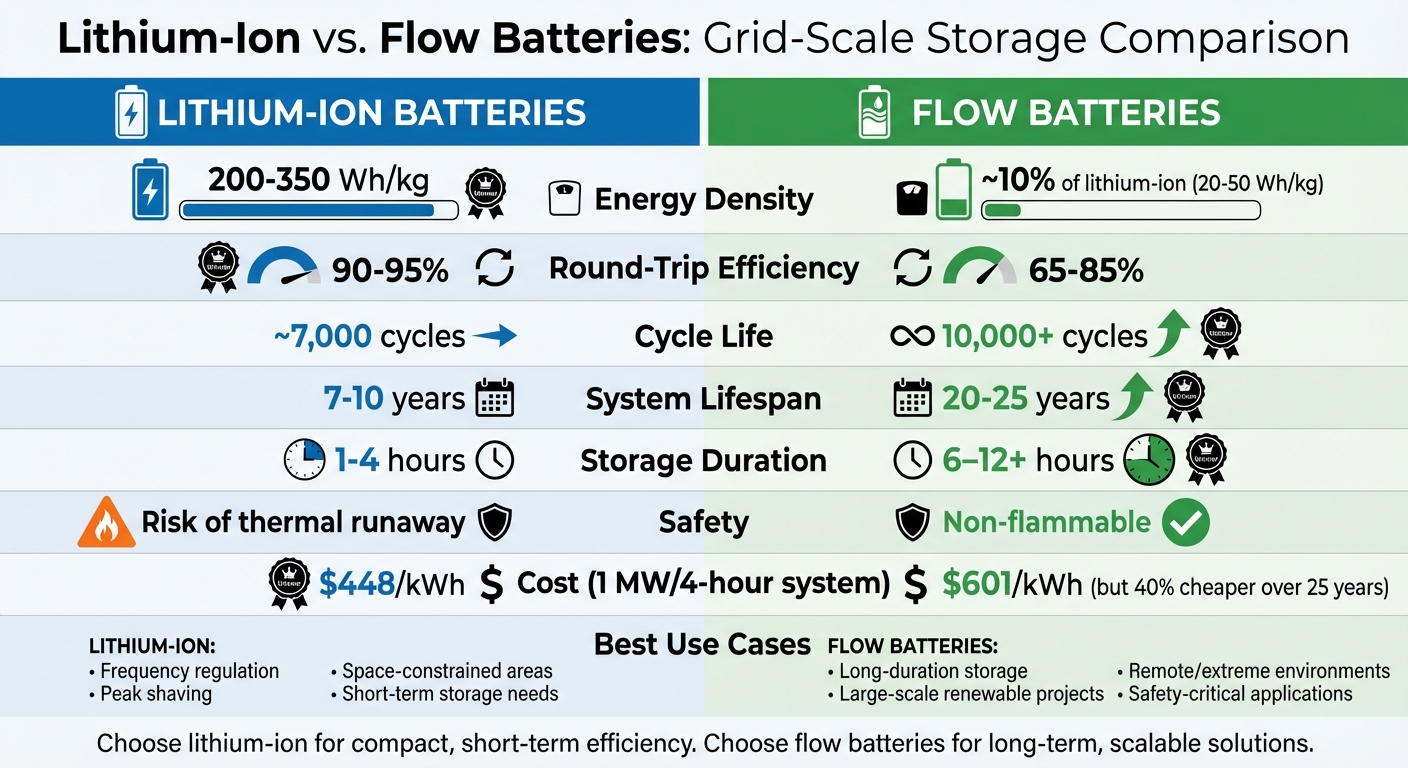
Lithium-Ion vs Flow Batteries: Complete Performance Comparison for Grid-Scale Energy Storage
Lithium-Ion Batteries: Energy Density Performance
Gravimetric and Volumetric Energy Density
Lithium-ion batteries pack a punch when it comes to energy density. Their gravimetric energy densities range from 150–250 Wh/kg, depending on the chemistry. For instance, NCM/NCA batteries deliver 150–240 Wh/kg, while LFP batteries fall between 90–160 Wh/kg. This compact design helps cut down on construction costs, simplifies wiring, reduces cooling needs, and minimizes structural support requirements. These factors make lithium-ion batteries an excellent choice for urban areas or tight spaces like existing substations where land is scarce.
Over the years, lithium-ion technology has made impressive strides. Back in the early 1990s, energy density hovered around 80 Wh/kg. By 2025, it's expected to hit 300 Wh/kg. In an exciting development, researchers at the Chinese Academy of Sciences set a new benchmark in early 2023 with a record-breaking 711.30 Wh/kg gravimetric density and a volumetric density of 1,653.65 Wh/L. While this achievement is still confined to laboratory experiments, it showcases the potential for future advancements.
Advantages and Limitations
To truly assess the value of lithium-ion batteries for large-scale energy storage, it's essential to weigh their strengths and weaknesses. Their high energy density makes them versatile, powering everything from handheld devices to massive grid-scale storage systems. With round-trip efficiencies between 85%–95%, they're particularly well-suited for short-duration tasks like frequency regulation.
However, their cycle life can be a limiting factor. LFP batteries offer between 2,000–7,000 cycles, whereas NCM/NCA batteries provide 1,000–2,000 cycles. The good news? Adjusting the state-of-charge range - like reducing the depth of discharge from 100% to 40% - can significantly extend their lifespan, potentially increasing cycles from roughly 300 to over 3,000.
That said, higher energy density comes with its own set of challenges. It increases the risks of flammability and thermal runaway, which means advanced cooling systems and battery management systems (BMS) are a must. Chemistries like NCM/NCA, while offering better energy density, have lower thermal stability compared to LFP. This makes LFP batteries a safer and more reliable option for grid-scale storage.
sbb-itb-501186b
Flow Batteries: Energy Density and Scalability
Energy Density Metrics
Flow batteries operate differently from traditional energy storage systems. Their gravimetric energy densities typically range between 20–50 Wh/kg, with volumetric densities around 25–35 Wh/L. This relatively lower energy density is a result of their unique design: they store energy in liquid electrolytes contained in external tanks rather than in solid electrode materials. The energy capacity of a flow battery is tied to the size of these tanks, while power output depends on the electrode stack size. However, this material-intensive design requires a larger physical footprint to achieve the same energy capacity as some other technologies. Despite these limitations, flow batteries make up for it with exceptional durability and scalability.
Long-Term Performance Benefits
Where flow batteries truly shine is in their longevity. These systems can typically handle 10,000–20,000 cycles, with certain iron flow batteries exceeding 20,000 cycles without significant capacity loss. Vanadium flow batteries, for instance, commonly achieve 15,000–20,000 cycles and are engineered to last more than 30 years. Their design - where energy and power are decoupled - makes them ideal for long-duration energy storage (LDES) applications, which often require discharge durations of 10 hours or more. By simply increasing the size of the electrolyte tanks or expanding the cell stacks, both energy and power can be scaled independently, offering unmatched flexibility.
This scalability is evident in large-scale installations. In 2022, China’s city of Dalian deployed a 400 MWh, 100 MW vanadium flow battery - the largest of its kind at the time - designed to rival the output of a natural gas plant for grid balancing. Earlier, in 2016, the Chinese government approved a 200 MW / 800 MWh vanadium redox flow battery (VRFB) project to bolster grid stability and enable energy trading. Sumitomo Electric has also been active in this space, with installations like a 60 MWh facility in Hokkaido, Japan (2015), followed by a 51 MWh system in the same region in 2022.
Flow batteries also stand out for their safety. Their use of non-flammable aqueous electrolytes eliminates the risk of thermal runaway, making them a safer option for large-scale grid applications where reliability and safety are critical.
Performance Metrics Comparison
Side-by-Side Performance Data
This section takes a closer look at the performance differences between lithium-ion and flow batteries. When it comes to energy density, lithium-ion batteries take the lead with a range of 200–350 Wh/kg, while flow batteries manage just about 10% of that. This makes lithium-ion batteries the go-to choice for applications where space is limited. However, flow batteries make up for this with impressive durability. While lithium-ion systems typically manage around 7,000 cycles, flow batteries can exceed 10,000 cycles, with some iron flow models offering nearly unlimited cycle life over a 25-year span.
Efficiency is another key differentiator. Lithium-ion batteries achieve a round-trip efficiency of about 95%, whereas flow batteries range between 65–85% due to inherent energy losses. Cost comparisons reveal that for a 1 MW/4-hour system, lithium-ion batteries cost around $448/kWh, while vanadium flow batteries come in at $601/kWh. However, over a 25-year period, iron flow batteries can end up being up to 40% cheaper due to their minimal degradation and reduced operating costs.
| Metric | Lithium-Ion Batteries | Flow Batteries |
|---|---|---|
| Energy Density | 200–350 Wh/kg | ~10% of Li-ion |
| Round-Trip Efficiency | 90–95% | 65–85% |
| Cycle Life | ~7,000 cycles | 10,000+ to unlimited |
| System Lifespan | 7–10 years | 20–25 years |
| Safety Profile | Risk of thermal runaway | Non-flammable |
| Typical Duration | Up to 4 hours | 6–12+ hours |
These metrics highlight the strengths of each technology, helping users determine which is better suited for their specific needs.
Grid-Scale Application Suitability
The decision between lithium-ion and flow batteries comes down to what the application demands. Lithium-ion batteries excel in scenarios requiring high power over short durations. This includes tasks like frequency regulation, peak shaving, or grid balancing, where energy is needed for up to four hours. Their compact size and high efficiency make them an excellent choice for locations where space is limited and rapid response times are essential.
On the other hand, flow batteries shine in long-duration energy storage applications, typically offering 6–12+ hours of storage. A standout example of this is ESS Inc.'s project in Patagonia, where a 300-kW/2-MWh iron flow battery was deployed to cut diesel fuel use by 75% in a microgrid while providing long-term energy storage without degradation. Eric Dresselhuys, CEO of ESS Inc., explains:
A flow battery has a tank with an electrolyte - think of it as salt water to be simple - and it puts it through a process that allows it to store energy in the iron, and then discharge that energy over an extended period of time
This unique design, where tank size controls capacity and stack size determines output, gives flow batteries the flexibility to seamlessly integrate renewable energy and stabilize the grid.
Flow batteries vs. li-ion - Modo: The Podcast (ep. 28: ESS Inc.)
Conclusion: Choosing the Right Technology for Grid-Scale Storage
When deciding between lithium-ion and flow batteries for grid-scale storage, it all comes down to the specific needs of the project. If your priority is compact design, high round-trip efficiency (about 95%), or short-duration storage (1–4 hours) for tasks like frequency regulation or peak shaving, lithium-ion batteries are a strong choice. Their space-saving design and relatively lower upfront costs make them a practical option for projects with tight budgets or limited space.
Flow batteries, however, shine in scenarios requiring long-duration storage (6–12+ hours), extended lifespans of 20–25 years, and enhanced safety features. Their modular design allows for easy energy capacity expansion by increasing the size of electrolyte tanks. This makes them particularly well-suited for large-scale renewable energy projects. Plus, their non-flammable nature adds a layer of safety, especially for installations near populated areas or sensitive ecosystems.
From a cost perspective, while lithium-ion systems may have lower initial expenses, flow batteries often offer up to 40% lower levelized costs over 25 years. This is due to their minimal degradation and lower ongoing maintenance needs.
The operating environment also plays a critical role. Flow batteries can handle a wide temperature range (roughly 14°F to 140°F) without needing complex HVAC systems, which keeps maintenance costs down and ensures reliable performance in extreme or remote conditions. In contrast, lithium-ion systems require careful climate control to avoid thermal runaway risks, adding to their operational complexity.
Ultimately, the choice boils down to your project’s priorities: lithium-ion batteries are ideal for space-efficient, high-efficiency, short-term applications, while flow batteries are better suited for long-term, safety-focused projects with extended lifespans. Understanding these trade-offs is essential for successful grid-scale energy storage planning.
FAQs
How much space does a flow battery need versus a lithium-ion system?
Flow batteries take up much more space compared to lithium-ion systems for storing the same energy. This is because flow batteries have a lower energy density, meaning they need larger electrolyte tanks to operate. On the other hand, lithium-ion batteries are much more compact, delivering high energy storage in a smaller, more efficient footprint. When it comes to grid-scale projects, the substantial size of flow battery systems can make space an important factor to evaluate.
What drives the 65%–85% efficiency range in flow batteries?
Flow batteries typically operate within an efficiency range of 65% to 85%, and this largely depends on running at high current densities (≥ 100 mA/cm²). Operating at these levels helps cut down on internal crossover and allows for a smaller stack size, which ultimately translates to reduced costs.
How do you estimate 25-year total cost for lithium-ion vs. flow batteries?
To calculate the total cost over 25 years, you need to account for both initial capital costs and operational expenses throughout the system's lifespan. For example, lithium-ion batteries generally come with lower upfront costs - estimated at $147-$339 per kWh for 4-hour systems by 2025 - but their shorter cycle life means you'll likely face replacement costs down the line. On the other hand, flow batteries may require a larger initial investment, but their extended cycle life and slower degradation can help minimize replacements over time. To get an accurate estimate, rely on cost models that include factors like maintenance, replacement cycles, and anticipated price trends for each type of technology.