

IEC 60079 Parts: Comparison for Installers
If you work on U.S. hazardous-location jobs, the short answer is this: IEC 60079-10-1 classifies the area, 60079-14 covers selection and installation, 60079-17 covers inspection, and 60079-19 covers repair; the other parts define how the equipment itself is built and marked.
I’d boil the article down to four checks before any item goes in service:
- Match the area: Zone 0, 1, 2 for gas, or the dust zone in the job file
- Match the marking: protection type, EPL, gas/dust group, and temperature class
- Match the accessories: glands, plugs, seals, entries, and fasteners
- Match the paperwork: certificate, instructions, and any “X” special-use condition
That’s the core issue. Most field trouble does not start with a bad-looking enclosure. It starts with missing documents, wrong glands, changed entries, loose hardware, or a nameplate that does not fit the classified area.
A few points stand out:
- IEC 60079-0 sets the base marking and certificate rules for all Ex equipment
- IEC 60079-1, -2, -7, -11, and -31 cover the protection methods installers see most: Ex d, Ex p, Ex e, Ex i, and Ex t
- IEC 60079-14 now includes the initial inspection before startup
- IEC 60079-17 says periodic inspection intervals are risk-based, and often should not exceed 3 years
- For portable gear, checks can be tighter, including 12-month close inspections and 6-month detailed inspections for often-opened enclosures
- On some jobs, a wrong area classification can push material cost up by as much as 50%
14 | IEC 60079-14 Design and Installation
sbb-itb-501186b
Quick Comparison
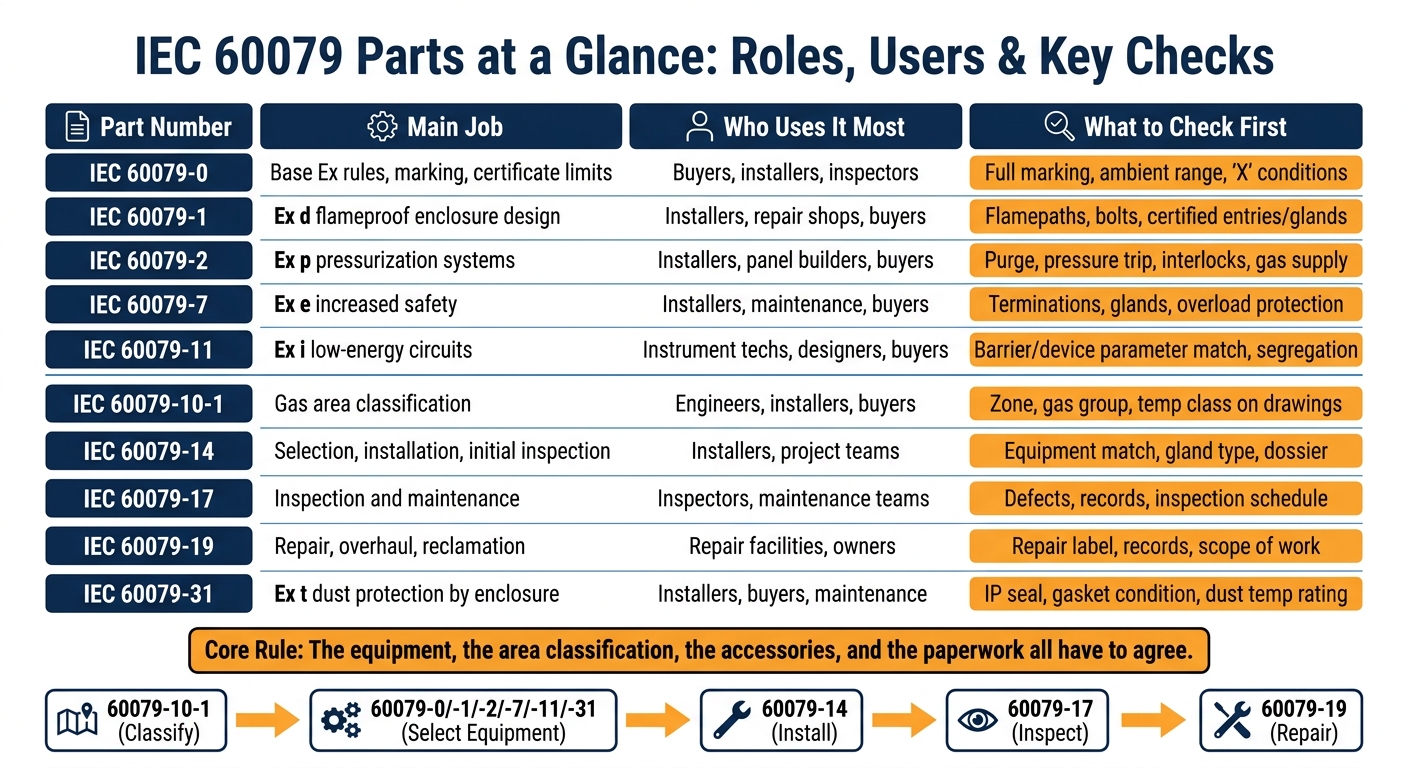
IEC 60079 Parts at a Glance: Roles, Users & Key Checks
| IEC 60079 Part | Main Job | Who uses it most | What I’d check first |
|---|---|---|---|
| -0 | Base Ex rules, marking, certificate limits | Buyers, installers, inspectors | Full marking, ambient range, “X” conditions |
| -1 | Ex d flameproof enclosure design | Installers, repair shops, buyers | Flamepaths, bolts, certified entries/glands |
| -2 | Ex p pressurization systems | Installers, panel builders, buyers | Purge, pressure trip, interlocks, gas supply |
| -7 | Ex e increased safety | Installers, maintenance, buyers | Terminations, glands, overload protection |
| -11 | Ex i low-energy circuits | Instrument techs, designers, buyers | Barrier/device parameter match, segregation |
| -10-1 | Gas area classification | Engineers, installers, buyers | Zone, gas group, temp class on drawings |
| -14 | Selection, installation, initial inspection | Installers, project teams | Equipment match, gland type, dossier |
| -17 | Inspection and maintenance | Inspectors, maintenance teams | Defects, records, inspection schedule |
| -19 | Repair, overhaul, reclamation | Repair facilities, owners | Repair label, records, scope of work |
| -31 | Ex t dust protection by enclosure | Installers, buyers, maintenance | IP seal, gasket condition, dust temp rating |
If I had to sum up the whole article in one line, it would be this: the equipment, the area classification, the accessories, and the paperwork all have to agree.
That is the lens I’d use for the rest of the article.
1. IEC 60079-0: General Requirements
Lifecycle role
IEC 60079-0 sets the base rules for construction, testing, marking, and documentation across the IEC 60079 series. So if a product is certified to a protection-specific part like Ex d, Ex e, or Ex i, it must first meet these general requirements.
It also sets the reference ambient conditions, pressure range, and oxygen conditions used for certification. On top of that, it defines Equipment Protection Levels (EPLs): Ga, Gb, Gc for gas atmospheres, and Da, Db, Dc for dust. Installers and buyers use those EPLs to match equipment to the right zone classification. These rules come first, before any protection method like Ex d, Ex e, or Ex i is checked.
Installer duties
Installers use 60079-0 to check the nameplate data, use-condition limits, and the full Ex marking. That includes the protection type, EPL, gas or dust group, temperature class, ambient temperature range, and any "X" suffix.
That "X" suffix matters. It points to specific conditions of use, such as approved cable entries, ambient limits, or mounting restrictions. IEC 60079-0 does not lay out the installation steps themselves. Instead, it affects installation through the conditions tied to the certificate.
Procurement impact
Before buying, purchasers should confirm compliance with IEC 60079-0, along with the protection-type standard, gas or dust group, temperature class, and ambient range. When you review a listing, make sure the nameplate or data sheet shows compliance with IEC 60079-0 as well as the related protection-type parts.
Edition 8 (IEC 60079-0:2026) adds two points that deserve close attention. It makes ambient-temperature marking mandatory, and it tightens electrostatic rules for nonmetallic parts in Zone 0 and Group IIC service. That can affect older certified stock, so it’s smart to check which certificate edition applies. In practice, certificate review belongs in procurement, not after delivery.
Documentation and compliance
Manufacturers must supply a certificate of conformity and user instructions that cover installation limits, environmental conditions, specific conditions of use, and maintenance. The Ex marking shows that the equipment meets the applicable standard and passed the required tests.
Keep the certificate and instructions on-site. That way, inspectors can compare the installed setup with the approved conditions.
With that baseline in place, the next step is to look at how Ex d deals with containment.
2. IEC 60079-1: Flameproof Enclosures (Ex d)
Lifecycle role
IEC 60079-1 sets the construction and type-testing rules a manufacturer has to meet before an Ex d product can be certified.
Here’s the key idea: Ex d does not stop ignition from happening inside the enclosure. Instead, it keeps an internal explosion contained and cools any escaping gases through certified flamepaths before those gases can ignite the surrounding atmosphere. Those flamepaths can be threaded, spigot, or flanged joints. Their gap sizes and minimum lengths are tightly controlled and change by gas group, with the toughest limits applied to Group IIC gases such as hydrogen.
Certification testing is strict. Overpressure tests require the enclosure to withstand 1.5× the reference internal explosion pressure without permanent deformation. Flame transmission tests require multiple back-to-back ignitions without causing ignition outside the enclosure. That testing defines exactly what the enclosure is certified to contain.
From there, the job shifts to the installer. In the field, the certified boundary has to stay exactly as approved. So joints, entries, and fasteners need to remain as certified. No shortcuts. No “close enough.”
Ex d equipment is often used in Zone 1 (EPL Gb) and Zone 2 (EPL Gc) gas atmospheres for gear that contains ignition sources, including contactors, relays, switchgear, and motors. The default ambient temperature range is −4 °F to +104 °F (−20 °C to +40 °C) unless the nameplate says otherwise.
Installer duties
The installer rule is simple: do not damage the flamepath.
That means no paint over joints, no replacement hardware that wasn’t approved, and no uncertified stopping plugs in cable entries. Most Ex d failures in the field trace back to altered entries, damaged joints, or missing hardware. And that’s what makes this risky: a small shortcut can wipe out the flameproof function even when the enclosure still looks fine from the outside.
Use only the entry types and stopping plugs listed on the certificate. Do not drill or modify the enclosure on site. For direct cable entries, use only device-certified Ex d glands or sealing fittings that match the enclosure certification, thread type, and cable construction. If someone adds entries on site, that is a modification, not normal installation work, and it falls under IEC 60079-19.
Missing or loose bolts on Ex d enclosures are treated as critical defects and must be fixed before the equipment goes into service.
That’s why buyers can’t look at the enclosure by itself. The enclosure and its accessories have to be checked as one certified system.
Procurement impact
With Ex d, purchasing choices matter just as much as field installation because the enclosure only performs as certified when the accessories match it.
When sourcing Ex d equipment, confirm:
- the Ex d designation
- the gas group
- the certified entry system
- any special conditions of use
One practical buying decision is the gas group rating. Buying IIC-rated enclosures across the board can make spare-parts inventory easier, but it usually costs more upfront than using a mix of IIB and IIC units where the process permits it.
When buying used or surplus Ex d equipment through Electrical Trader, ask for clear nameplate photos, intact flamepaths, and complete certificates before purchase. A missing certificate or an unreadable nameplate is not just a paperwork nuisance. It is a compliance gap that cannot be fixed in the field.
Also check that cable glands and stopping plugs are explicitly certified to IEC 60079-1 for use with Ex d enclosures and that they match the enclosure’s thread type and cable construction. These parts are not interchangeable with standard industrial fittings.
Documentation and compliance
Manufacturers have to provide user instructions for commissioning, installation, maintenance, overhaul, and repair, along with the applicable standards.
On site, the file should include copies of certificates for the enclosure, cable glands, and any associated apparatus. It should also include installation records that note torque checks and part replacements.
After any disassembly, even for routine internal work, document an inspection of flamepath gaps, threads, and fasteners before the enclosure is closed again. Repair reports prepared under IEC 60079-19 should include flamepath gap measurements checked against the IEC 60079-1 tolerances. Start by checking for corrosion and cable-entry damage, since both are common Ex d failure points.
3. IEC 60079-2: Pressurized Enclosures (Ex p)
Lifecycle role
Ex p keeps the hazardous atmosphere out by maintaining positive pressure inside the enclosure. A small overpressure of protective gas stops flammable gas from getting in. And if the gas stays out, it can't ignite anything inside.
This method works well for large assemblies like motor control centers, analyzer shelters, VFD panels, and control cabinets filled with PLCs, HMIs, and relays. You can use standard components, but only inside the certified pressurized system.
For installers, Ex p is mostly about commissioning and interlocks. For buyers, it's a system-cost call.
IEC 60079-2 sets three pressurization levels, and each one affects where the equipment can be used:
| Designation | Protection Level | Suitable Zone |
|---|---|---|
| Ex pxb | High | Zone 1 (EPL Gb) |
| Ex pyb | Intermediate | Zone 1 (EPL Gb) |
| Ex pzc | Lower | Zone 2 (EPL Gc) |
The marking must line up with the zone and gas group.
Installer duties
Ex p relies on one complete system: the enclosure, purge controller, pressure monitoring, gas supply, interlocks, alarms, and cable entries. So the installer's main job is to commission that system the right way.
The enclosure must be fully purged before energization. Use the certified purge volume and purge time. Don't guess. Power must trip if pressure drops below the certified minimum. Door and cover interlocks must be installed and working, because they stop people from opening an energized enclosure in the hazardous area.
One common field failure is a defeated door interlock. Staff may bypass it while trying to troubleshoot a live panel. That might seem like a shortcut, but during inspection it's a serious nonconformity, since the interlock is part of the protection method.
Procurement impact
Buyers usually have two paths. They can purchase a complete certified Ex p cabinet as one unit, or they can buy a pressurization kit plus a certified enclosure and then integrate their own components inside. Complete systems bring less engineering risk. Kits give more flexibility, but they also put more of the checking burden on the buyer to make sure the final assembly still fits the certification assumptions.
Ex p also comes with a steady operating cost. The system needs a continuous supply of clean, dry protective gas, usually instrument air or an inert gas. That means compressors, drying equipment, filters, and routine maintenance. Those support costs should be part of the decision before choosing Ex p instead of options like moving the equipment to a safe area.
When sourcing Ex p enclosures or pressurization parts through Electrical Trader, check that the IEC 60079-2 certificate is present and easy to read, that the type designation - pxb, pyb, or pzc - matches the zone, and that the gas group and temperature class fit the installation. A used cabinet without the original certificate and purge calculations needs reassessment before reuse.
Documentation and compliance
The Ex p file should include the enclosure certificate, purge controller certificate, internal volume calculations, purge time and flow calculations, protective gas specifications, and control logic diagrams that show interlock and alarm conditions. Commissioning records must include the measured purge duration and the functional test results for every interlock and alarm. If internal components, volume, or cable entries change, the assembly needs reassessment against the original certification.
Next, IEC 60079-7 moves to increased safety, where protection comes from limiting arcs, hot surfaces, and loose connections.
4. IEC 60079-7: Increased Safety (Ex e)
Lifecycle role
IEC 60079-7 covers the design and certification of Ex e equipment for explosive gas atmospheres. If Ex d contains an internal explosion and Ex p keeps the hazardous atmosphere out, Ex e takes a different path: it lowers the chance of ignition during normal service. In plain terms, Ex e aims to stop ignition from happening in the first place, instead of containing it or purging it away.
It does this with added safeguards that reduce the risk of arcs, sparks, and high surface temperatures in normal operation and defined abnormal conditions. That makes Ex e a good fit for equipment that does not normally spark, such as terminal boxes, junction boxes, squirrel-cage motors, luminaires, transformers, and solenoids. It is not meant for equipment that produces arcs in normal use, like switches and contactors, unless those sparking parts have their own separate protection.
| Designation | Protection level | Typical use |
|---|---|---|
| Ex eb | Higher protection | Zone 1 |
| Ex ec | Lower protection | Zone 2 |
Installer duties
For installers, Ex e is all about termination quality and keeping the original build intact. Small field changes can ruin the protection. In practice, Ex e depends on factory-set geometry and clean, correct terminations far more than field rework.
Do not drill extra holes, add terminals, or swap internal parts inside the enclosure. Those kinds of changes can void the Ex certification. Use only certified cable glands and stopping plugs that keep the enclosure's IP rating in place. Before energizing, check the marking - such as Ex eb IIC T4 Gb - and make sure the gas group, EPL, and temperature class match the classified area.
With Ex e motors, overload protection has to be matched correctly. A time-current relay or PTC thermistor should disconnect the motor during locked-rotor and overload conditions before winding temperatures pass the certified T-class limit.
Procurement impact
For buyers, Ex e can be a low-maintenance option, but only if the certificate, glands, terminals, and spare parts all line up with the installation. Check that the certificate points to IEC 60079-7 and that the marking shows the protection level, gas group, temperature class, and fit for the classified area.
If you're sourcing Ex e parts through Electrical Trader - whether that means new or used terminal boxes, motors, or luminaires - ask for the original certificate and instruction manual. Then verify any used equipment against those documents before installation. It also helps to check whether certified spare terminals and glands will still be available over the life of the installation.
Documentation and compliance
Keep the Ex e compliance file tied to the certificate, nameplate photo, cable-entry drawing, and initial inspection record. Periodic inspections under IEC 60079-17 should look at termination tightness, enclosure condition, seal integrity, and the IP rating. If defects show up, record them and correct them before the equipment goes back into service.
Next, IEC 60079-11 shifts the focus from enclosure integrity to energy limitation.
5. IEC 60079-11: Intrinsic Safety (Ex i)
Lifecycle role
Where Ex e controls sparks at the source, Ex i limits energy across the entire loop. Intrinsic safety keeps electrical energy in equipment and wiring low enough that sparks or heating can't ignite an explosive atmosphere, even under specified fault conditions.
IEC 60079-11 sets out three protection levels, which generally line up with Zones 0, 1, and 2:
| Level | Fault tolerance | Suitable zone |
|---|---|---|
| Ex ia | Two faults | Zone 0 |
| Ex ib | One fault | Zone 1 |
| Ex ic | No fault assumed | Zone 2 |
This makes Ex i a strong fit for sensors, transmitters, and other low-power field devices. In practice, that puts a lot of weight on field verification during installation.
Installer duties
The main installation risk is simple: the loop limits and the device ratings don't match. Check that the barrier or isolator output stays within the field device input limits for voltage, current, power, capacitance, and inductance.
You also need to follow installation limits and maintenance rules for cable length, routing, and segregation from non-intrinsically safe circuits. IS circuits should be marked clearly so they don't get cross-connected.
Field changes are where trouble often starts. A longer cable run, an added filter, a coil, or a parallel circuit can add capacitance or inductance and push the loop past its certified limits. If anything changes, run a new parameter check before re-energization. One wiring change can void the whole loop, which is why these checks should start at purchase, not wait until commissioning.
Procurement impact
Buyers need to match the barrier, field device, and cable data before purchase. When sourcing Ex i barriers, transmitters, or control devices through Electrical Trader, make sure the listing includes the certificate, instructions, and entity parameter data. Check the certificate edition, entity parameters, and any special installation limits.
Documentation and compliance
Keep one system file with equipment IDs, entity parameters, cable data, assumptions, and installation rules. Loop drawings, calculations, certificates, and instructions should stay together in that file for inspection.
Under IEC 60079-17, periodic inspections should confirm that no capacitance or inductance has been added and that segregation and markings are still in place.
Next, area classification defines where Ex i can be used.
6. IEC 60079-10-1: Gas Atmosphere Area Classification
Lifecycle role
IEC 60079-10-1 comes first. It classifies hazardous gas areas before equipment selection, cable routing, or inspection planning.
The main output is the zone map: Zone 0, Zone 1, or Zone 2. Those zones then feed into the rules in IEC 60079-14, -17, and -19. In plain terms, the zone map becomes the reference point for IEC 60079-14 installation decisions.
Zone boundaries are not fixed forever. If the process, equipment, or ventilation changes, the classification can change too. When that happens, the area classification should be reviewed before installation work moves on.
Installer duties
Installers need to follow the area classification drawings exactly. Equipment, junction boxes, cable terminations, and accessories all need to match the assigned zone and protection concept.
On site, the drawing is the control document. Installers also need to protect the assumptions behind the classification. For example, if the study relies on forced ventilation to keep an analyzer shelter in Zone 2, that ventilation has to be installed and operating before the equipment is energized. Small field changes can have a big effect too. Adding drains, vents, or process connections may create new release points, so those changes should be reviewed before the work continues.
Procurement impact
IEC 60079-10-1 has a direct effect on purchasing. The zone classification sets the minimum Equipment Protection Level (EPL):
- Zone 0: EPL Ga
- Zone 1: EPL Gb
- Zone 2: EPL Gc
Buyers also need to match the gas group and temperature class to the substances named in the classification report.
A larger Zone 0 or Zone 1 footprint means more higher-rated Ex equipment to buy. A smaller Zone 2 area gives buyers more room in product selection.
When sourcing certified equipment through Electrical Trader, the area classification gives you the EPL, gas group, and temperature class to check against a listing’s certificate markings. For instance, a marking such as II 2G Ex d IIB T4 Gb needs to line up with a Zone 1, Group IIB installation.
Documentation and compliance
The study should produce a classification report, hazardous area drawings, and a list of gases, gas groups, and autoignition temperatures.
This classification is a living document. Change control records should track updates to process conditions, equipment, or ventilation so the report stays current.
Next, IEC 60079-14 turns the zone map into selection and installation requirements.
7. IEC 60079-14: Equipment Selection and Installation
Lifecycle role
IEC 60079-14 connects area classification to the rest of the Ex lifecycle. After IEC 60079-10-1 defines the zones, this standard covers electrical system design, equipment selection, installation, and the initial inspection before the system goes into service.
The 2024 sixth edition added initial inspection to the title. That change matters because initial inspection sits inside the installation phase. It is not some later add-on. Once the IEC 60079-14 work is done, IEC 60079-17 takes over for periodic inspection, while IEC 60079-19 deals with repair and overhaul.
Installer duties
Once the zone map is set, IEC 60079-14 turns the plan into site work. It pushes equipment selection into design and purchasing, then leaves installers to check that what was installed matches the specification.
Each protection type comes with its own certificate-linked rules, and those details matter in the field. Ex d work depends on correct torque and flamepaths. Ex e depends on clearances and terminations. Ex i depends on segregation and loop limits. Ex t depends on gasket condition and IP integrity.
Cable gland installation is a make-or-break step across all protection types. The cable has to be prepared the right way, the parts must go together in the right order, torque has to match the stated value, and the finished assembly needs a final check. A badly fitted seal or washer can defeat the enclosure.
Procurement impact
For buyers, these same rules decide what can actually be purchased for the job. In practice, IEC 60079-14 turns purchasing into a compliance check. Equipment, cable systems, glands, and other accessories have to match both the needed Ex approval and the planned installation method.
A few examples make this plain:
- In Ex d applications, only Ex d-certified glands are acceptable. Ex e glands do not meet the requirement.
- In Ex i circuits, glands do not need Ex certification, but they still have to maintain the IP rating and segregation.
When sourcing equipment through Electrical Trader, check that Ex markings and certificates are still present on any used or surplus items. Also confirm that no drilled cable entries or other changes have voided the certification.
Documentation and compliance
IEC 60079-14 requires a verification dossier for every hazardous-area installation. Think of it as the job file that proves the installation was designed, built, and checked the right way.
The dossier includes area classification data, manufacturer's instructions, as-built drawings, cable and gland selection records, and an installer declaration stating that the work was carried out in line with IEC 60079-14. Installers also carry out the initial detailed inspection using the equipment-specific checklists in Annex C, then record any defects found and the corrective actions taken before first use. That set of records becomes the starting point for later IEC 60079-17 inspections.
8. IEC 60079-17: Inspection and Maintenance
Lifecycle role
IEC 60079-14 gets equipment into service. IEC 60079-17 covers what happens after that, while the equipment is still in use. It keeps hazardous-area equipment in line during operation, and it applies to users - facility operators and maintenance teams, not manufacturers.
The standard sets out three inspection grades:
- Visual: no tools and no opening of enclosures
- Close: tools or access equipment may be used, usually without opening enclosures
- Detailed: enclosures are opened, and test equipment may be used
These inspections can be used in an initial, periodic, sample, special, or continuous-supervision program. Once an installation clears handoff, the focus moves from installation work to routine inspection and maintenance.
Installer duties
Inspectors and maintenance technicians need to check that equipment markings, temperature class, gas group, and IP rating still line up with the Ex certificate and the zone classification. In plain terms, the equipment still has to match what was approved for that location.
Common defects include loose glands, missing labels, corroded bolts, painted flamepaths, and cracked seals. Those issues may sound small, but in Ex work, small problems can turn into big ones fast. They’re also the same trouble spots installers need to protect before handoff.
Use trained inspectors. IECEx Ex 007 covers visual and close inspections, and Ex 008 covers detailed inspections. A TPEF sets the inspection regime and controls records.
Documentation and compliance
Keep an equipment register, inspection reports, and corrective-action records. Those records should stay with the verification dossier.
Inspection intervals are based on risk, not a fixed calendar. Periodic inspections generally should not go beyond three years unless expert advice and a documented assessment support a longer interval. Portable and movable equipment needs tighter checks:
- visual checks before use
- close inspections at least every 12 months
- detailed inspections every 6 months for frequently opened enclosures
If an inspection finds damage that can’t be fixed in the field, IEC 60079-19 becomes the next standard in play.
Procurement impact
IEC 60079-17 also shapes procurement choices. Buyers should lean toward Ex equipment with clear certificates and maintenance instructions, because those documents make inspection and repair calls much easier over the life of the asset. That matters a lot when a technician is standing in front of a questionable part and needs a straight answer.
Many inspection findings involve cable glands, seals, and fasteners. So replacement parts need to be certified and able to keep the original Ex rating in place.
If you buy used or surplus Ex equipment through Electrical Trader, check that the certificates and manufacturer documentation are still intact before putting the item into service.
9. IEC 60079-19: Repair, Overhaul, and Reclamation
Lifecycle role
When an inspection finds damage that can't be fixed on the spot, IEC 60079-19 steps in. It deals with the repair, overhaul, and reclamation of Ex equipment after damage, wear, or contamination. This standard is for competent service facilities, not routine maintenance.
Installer duties
The installer's role is simple: take damaged equipment out of service and send it to a competent repair facility. If an inspection shows damaged flamepaths, seals, insulation, or enclosure parts, the item needs to come out. Do not repair critical features in the field. That's where problems can snowball.
Before the unit goes back into service, check the repair label and confirm the reinstallation requirements. Repaired Ex equipment must have a durable label that shows:
- the IEC 60079-19 reference
- the repairer's identity
- a repair reference number
- the date
If that label is missing or hard to read, treat it as a warning sign. Reinstallation still needs to follow IEC 60079-14 for cable entries, seals, and glands.
Procurement impact
Buyers should only accept repaired or reclaimed Ex equipment when the repair history is documented. That means the fault report, replaced parts, critical measurements, test results, and the release-to-service record should all be there.
If you're sourcing used Ex equipment through Electrical Trader, ask for the full repair history before you buy. Any work done on the unit should trace back to a facility working in line with IEC 60079-19, with records showing that the equipment still meets its original certification requirements.
Documentation and compliance
The repair file is what shows the item still matches its certified condition. A complete file should include the original certification details, the fault or damage report, the scope of work, before-and-after measurements for critical features, the parts used, and a final release-to-service statement.
If any modification falls outside the manufacturer's or certificate scope, the equipment must be re-certified before it can return to service.
Next, IEC 60079-31 covers dust protection by enclosure.
10. IEC 60079-31: Dust Protection by Enclosure (Ex t)
Lifecycle role
In dust locations, the job changes. The main concern is no longer flame containment or limiting electrical energy. It becomes enclosure integrity and surface temperature.
IEC 60079-31 covers the design, construction, and testing of Ex t equipment. Certification is done under IEC 60079-0 and IEC 60079-31.
Ex t rests on two main ideas: keep dust from getting into the enclosure, and keep the outer surface temperature below the ignition temperature of the dust around it, whether that dust is floating in a cloud or sitting as a layer. The standard splits Ex t into three protection levels that line up with dust zone classification:
| Protection Level | EPL | Zone | Common Minimum IP Rating |
|---|---|---|---|
| Ex ta | Da | Zone 20 | IP6X |
| Ex tb | Db | Zone 21 | IP6X (common) |
| Ex tc | Dc | Zone 22 | IP5X or IP6X, depending on design |
Ex ta is the strictest level. Ex tb and Ex tc are used where dust exposure is less continuous.
Installer duties
A lot of Ex t problems in the field come from simple mistakes: using non-certified cable glands or blanking plugs, leaving spare entries open, or closing up an enclosure with damaged gaskets or missing bolts. Any one of those can break the dust seal and void the Ex t protection.
Use only certified glands, blanking plugs, and closing screws approved for Ex t. Don’t drill extra holes or alter the enclosure body. Check every gasket and mating surface before closing the enclosure, because even small seal damage can affect the IP rating. It also helps to install the equipment in a way that cuts down dust buildup on flat surfaces. And the nameplate temperature marking in °C has to fit the site’s dust ignition data and the worst-case ambient temperature.
Those checks don’t begin at installation. They start during procurement, when the nameplate has to match the dust area.
Procurement impact
The nameplate needs to match the zone, dust group, and ignition temperature. For example, Ex tb IIIC T95°C Db IP66 tells you the protection level, dust group, maximum surface temperature, EPL, and ingress protection rating in a single line.
Dust group is a big deal here. Group IIIC covers conductive dusts, which are the toughest cases. In many situations, Group IIIC equipment calls for IP6X. Many manufacturers certify to IP6X even when IP5X would technically meet the need, which gives buyers more room to use the same item across different zones and dust groups.
If you're sourcing used Ex t equipment through Electrical Trader, check that the nameplate is intact and readable, the certification documents are on hand, and the enclosure has no extra holes, missing parts, or seal damage.
That marking, along with the installation manual, shapes both inspection work and later repair.
Documentation and compliance
Keep the certificate of conformity and the manufacturer’s installation manual for every Ex t installation. The manual should list fastener torque values, approved gasket types, and permitted cable entry accessories. Those details matter any time the equipment is opened for maintenance and then put back together to its certified IP rating.
When Ex t equipment goes out for service under IEC 60079-19, the repair facility uses the original documents to make sure replacement covers, seals, and glands stay within the certified scope.
Trade-Offs for Installers and Buyers
IEC 60079 parts narrow your options, but they also draw cleaner compliance lines. That sounds neat on paper. In practice, it usually means higher cost, more paperwork, and less room to swap parts at the last minute.
This is where the standards stop being abstract and start affecting what gets bought, shipped, installed, and signed off.
Read this section as a procurement and installation checklist, not another standards recap.
| Part Group | Main Advantage | Main Limitation | Common Failure Point | Purchasing Risk |
|---|---|---|---|---|
| IEC 60079-0, -1, -2, -7, -11, -31 (Equipment design & certification) | Clear protection concepts and defined compliance criteria | Higher certification cost and limited substitution flexibility | Using non-certified accessories or glands that can invalidate the enclosure certification | A similar-looking replacement can still fail if its certificate or protection type differs |
| IEC 60079-10-1 (Area classification) | Drives correct equipment selection from the start | Misclassification can raise material costs by up to 50% | Missing or outdated zone drawings | Overspecified equipment wastes budget; underspecified equipment creates hazard |
| IEC 60079-14 (Installation) | Removes ambiguity from cable gland and wiring decisions | Strict cable-gland matching and limited field improvisation | Wrong gland type, insufficient thread engagement, or missing blanking plugs | Buying an enclosure without the required certified glands, plugs, and accessories |
| IEC 60079-17 (Inspection & maintenance) | Recurring checks catch degradation before failure | Adds labor, recordkeeping, and access requirements on every inspection cycle | Missing documentation, loose connections, or unauthorized modifications | Incomplete records can delay approval |
| IEC 60079-19 (Repair & overhaul) | Extends equipment life within certified scope | Restricts who can repair what and which parts can be reused | Replacing Ex components with non-equivalent parts and voiding certification | Buying "equivalent" spares that do not match the certificate |
The pattern that shows up again and again isn't the standard wording. It's missing paperwork and mismatched accessories. That problem cuts across every part group. A job can be fully compliant in theory and still grind to a halt because a certificate is missing, a nameplate doesn't line up, or an accessory falls outside the approved scope.
That's why buyers should check certificates, nameplates, and accessory scope before placing the order through Electrical Trader.
For installers, cable glands are usually where sourcing mistakes turn into field trouble fast. This is the spot where small buying errors become failed inspections, delays, or rework. Cable gland selection is the most common pinch point, and with Ex d, barrier glands are often required. So the gland type has to be decided before shipment leaves the supplier. That's not just a site issue. It's a purchasing issue from day one.
IEC 60079-14 leans toward glands that are easy to install, inspect, and assemble the right way. If a gland is harder to fit or easier to get wrong, the chance of install errors goes up. In plain terms, gland choice, paperwork, and certificate match decide whether the work moves ahead or gets stuck.
Conclusion
For installers and buyers, IEC 60079 isn't a stack of separate documents. It's one compliance path.
It covers the full hazardous-area lifecycle: 60079-10-1 classifies the area, 60079-0 sets the base requirements, 60079-1/-2/-7/-11/-31 define the protection methods, 60079-14 covers selection and installation, 60079-17 covers inspection, and 60079-19 covers repair. Each step leans on the one before it. If classification under 60079-10-1 is wrong, equipment selection under 60079-14 will be wrong too. Missed inspections can hide damage. Then repair becomes the last checkpoint.
Before ordering or starting work, check the basics first:
- Verify the classification, gas or dust group, and temperature class
- Match the Ex marking and EPL
- Confirm certificates and approvals
- Check gland, cable-entry, and termination requirements
- Verify accessory compatibility
- Define the repair path in advance: OEM service or a competent IEC 60079-19 repair facility
For U.S. projects that use both systems, cross-reference the IEC Zone designation and NEC Class/Division in the same project file. That gives the installer, buyer, and AHJ one shared reference. Zone and Division systems are not interchangeable, so the equipment approval path must match the classification method used on the job.
The standard sets the rules. The purchase order decides whether the job begins in line with them. Electrical Trader can centralize sourcing, but buyers still need to verify certificates, nameplates, and accessory compatibility before ordering.
FAQs
How do I know which IEC 60079 part applies to my job?
Start by identifying the main task in the hazardous area:
- IEC 60079-17 covers routine inspection and maintenance
- IEC 60079-19 covers repair, overhaul, or reclamation of explosion-protected equipment
- IEC 60079-14 covers installation requirements, including replacement glands or thread adaptors
For replacement parts, IEC 60079-14 says they need to meet IEC 60079-0.
What does an “X” suffix on Ex equipment mean for installation?
An X suffix on equipment certified under the IEC 60079 series means there are specific conditions of use that must be followed for safe installation.
That small letter matters more than it looks. It tells the installer that the equipment can't just be fitted in the usual way and forgotten about. You need to check the certificate or the manufacturer's documentation and follow the stated conditions closely.
Those conditions might include:
- special mounting requirements
- limits on the surrounding environment
- other safety steps needed to keep the installation compliant and safe
Miss those details, and the installation may no longer meet the certification requirements.
What documents should I have before installing Ex equipment?
Before installation, pull together a complete documentation package. That’s how you confirm the equipment meets safety rules and code requirements before it ever reaches the job site.
For U.S. projects, include valid NRTL certifications, such as UL or CSA listings. IEC documents alone may not satisfy local inspectors, so don’t assume they’ll be enough.
Have:
- certification documents
- technical documentation
- manufacturer installation and maintenance instructions
- traceability records
- as-built documents, such as one-line diagrams and bills of materials