

Exhaust Treatment Systems for Power Generators
Exhaust treatment systems reduce harmful emissions from diesel and natural gas generators, ensuring compliance with strict regulations like EPA Tier 4 Final. These systems target pollutants such as Nitrogen Oxides (NOx), Particulate Matter (PM), Carbon Monoxide (CO), and Hydrocarbons (HC) using technologies like Diesel Oxidation Catalysts (DOC), Diesel Particulate Filters (DPF), and Selective Catalytic Reduction (SCR). Here's how they work:
- DOC: Converts CO and HC into less harmful substances through oxidation.
- DPF: Traps soot and fine particles, requiring periodic cleaning or "regeneration."
- SCR: Uses Diesel Exhaust Fluid (DEF) to transform NOx into nitrogen and water.
Natural gas generators emit fewer pollutants than diesel units, but both must meet specific standards depending on their application (e.g., prime power vs. standby). Maintenance, such as using ultra-low sulfur diesel and regular regeneration, is essential to avoid costly repairs and ensure efficiency.
Key takeaway: These systems not only help meet legal requirements but also mitigate health risks and environmental damage caused by generator emissions.
Common Emissions from Power Generators
Main Pollutants: CO, HC, PM, and NOx
Power generators release a variety of pollutants that can harm both human health and the environment. One major group is nitrogen oxides (NOx), which are formed during high-temperature combustion when oxygen reacts with nitrogen from the air or the fuel itself. Carbon monoxide (CO) and hydrocarbons (HC) emerge from incomplete combustion, while particulate matter (PM) - particularly diesel particulate matter (DPM) - consists of tiny soot particles. Over 90% of DPM particles are smaller than 1 µm, allowing them to penetrate deeply into the lungs. The International Agency for Research on Cancer has classified diesel exhaust as a carcinogen. In California alone, DPM is linked to approximately 730 deaths from cardiopulmonary conditions, 160 hospitalizations for cardiovascular or respiratory issues, and 370 asthma-related emergency room visits each year. Alarmingly, DPM accounts for about 70% of the cancer risk from air toxics in the state.
These pollutants don’t just stop at health impacts - they also contribute to environmental problems like ground-level ozone, acid rain, reduced visibility, and global warming. Black carbon, a component of DPM, is particularly concerning as it’s the second-largest contributor to global warming after carbon dioxide. The extent and type of emissions depend on the generator's design and fuel type, as explored below.
Emission Sources in Diesel and Natural Gas Generators
Diesel and natural gas generators differ significantly in their emission profiles. Diesel generators are known for higher emissions of DPM, NOx, CO, and HC due to the nature of diesel fuel and the compression-ignition combustion process. On the other hand, natural gas generators emit far less particulate matter, primarily releasing NOx, CO, volatile organic compounds (VOCs), and small amounts of methane. Methane emissions, often referred to as "combustion slip", can occur in natural gas generators, though the design of the engine plays a big role in its emission profile.
Lean-burn natural gas engines, which operate with more air and lower cylinder temperatures, tend to produce less NOx. In contrast, rich-burn engines - designed with different air-to-fuel ratios - emit lower levels of methane but run at higher cylinder temperatures. Even environmental factors like altitude can influence emissions. For example, a 1 MW natural gas generator operating at 8,000 feet produces about 6.3% more total hydrocarbons and 2.8% more CO compared to the same generator at 500 feet.
Cummins Power Generation's EPA Tier 4i certified solution for diesel power generation

Main Components of Exhaust Treatment Systems
Generators rely on three essential technologies to tackle specific pollutants and meet stringent emission standards. Knowing how these components work is key for operators to stay compliant and avoid hefty repair bills - replacing a Diesel Particulate Filter (DPF) alone can cost anywhere from $3,000 to $10,000, depending on the engine size. Below, we break down the function and maintenance needs of each component.
Diesel Oxidation Catalyst (DOC)
The Diesel Oxidation Catalyst (DOC) focuses on converting harmful gases like carbon monoxide (CO) and hydrocarbons (HC) into less toxic substances such as carbon dioxide and water vapor. Unlike filters that capture particles, the DOC lets exhaust gases pass through while neutralizing these pollutants. It also plays a crucial role in active regeneration, where injected fuel oxidizes to generate heat - reaching temperatures as high as 1,500°F (800°C) - to burn off soot in the DPF.
Diesel Particulate Filter (DPF)
While the DOC deals with gaseous emissions, the DPF is designed to capture particulate matter, such as soot and ash. This wall-flow filter traps particles as exhaust gases pass through its porous walls. Under optimal conditions, new DPFs can capture 30% to 95% of soot. To maintain performance, the DPF undergoes periodic cleaning through regeneration.
Regeneration can occur in three ways:
- Passive regeneration: Uses natural exhaust heat during high-load operation.
- Active regeneration: Triggered by the engine control unit when soot buildup reaches a certain level.
- Parked regeneration: A manual option when passive and active methods aren't sufficient.
It’s important to note that regeneration only eliminates carbon-based soot. Ash, a non-combustible residue from engine oil and fuel additives, remains in the filter and requires physical removal using compressed air or specialized cleaning tools. To minimize ash buildup and prolong the DPF's life, operators should use manufacturer-recommended low-ash engine oil and ultra-low sulfur diesel (ULSD).
Selective Catalytic Reduction (SCR)
The SCR system is specifically designed to reduce nitrogen oxides (NOx), which are produced during high-temperature combustion. This active system works by injecting Diesel Exhaust Fluid (DEF) - a solution of 67.5% water and 32.5% urea - into the exhaust stream. When DEF interacts with the SCR catalyst, it triggers a chemical reaction that converts NOx into harmless nitrogen gas and water vapor. This process is highly efficient, cutting NOx emissions by up to 90%.
Modern Tier 4 Final engines closely monitor SCR performance and will reduce engine power if DEF levels are low or if the system malfunctions. For critical situations, such as emergencies involving life-saving operations, the EPA allows a temporary 120-hour "Operator Inducement Emergency Override" to restore full power. However, operators must report the use of this override.
Comparing Exhaust Treatment System Components
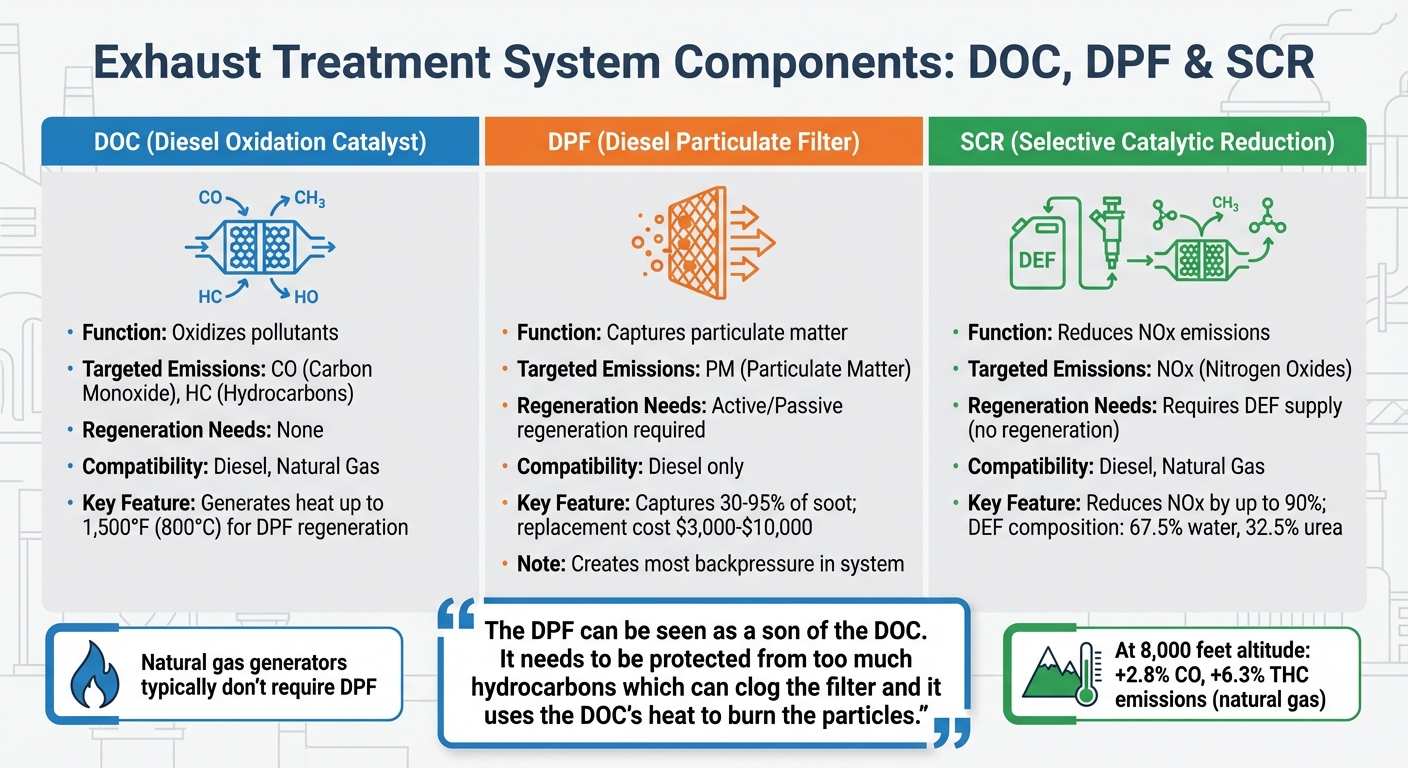
Exhaust Treatment System Components Comparison: DOC, DPF, and SCR
Function, Targeted Emissions, and Compatibility
Each component in an exhaust treatment system plays a specific role, and understanding these roles is crucial for selecting the right setup. The DOC (Diesel Oxidation Catalyst) focuses on gaseous pollutants like carbon monoxide (CO) and hydrocarbons (HC), using chemical oxidation to neutralize them. The DPF (Diesel Particulate Filter) is designed to trap soot and other particulate matter (PM). On the other hand, the SCR (Selective Catalytic Reduction) system injects DEF (Diesel Exhaust Fluid) to convert nitrogen oxides (NOx) into nitrogen and water vapor.
Diesel generators typically integrate all three components to meet stringent EPA Tier 4 standards. In contrast, natural gas generators usually don’t require a DPF. For these units, the DOC and SCR systems manage emissions like CO, THC (total hydrocarbons), and NOx. This is especially critical at high altitudes, where emissions can spike. For instance, a 1 MW natural gas generator operating at 8,000 feet produces 2.8% more CO and 6.3% more THC than it does at sea level.
| Component | Function | Targeted Emissions | Regeneration Needs | Compatibility |
|---|---|---|---|---|
| DOC | Oxidizes pollutants | CO, HC | None | Diesel, Natural Gas |
| DPF | Captures particulate matter | PM | Active/Passive | Diesel |
| SCR | Reduces NOx emissions | NOx | Needs DEF supply | Diesel, Natural Gas |
The DPF requires periodic regeneration to burn off accumulated soot, while the SCR relies on a steady DEF supply but doesn’t need regeneration. Keep in mind that DPFs create the most backpressure in an exhaust system. Before installation, ensure your generator can handle this added load to avoid potential engine damage.
"The DPF can be seen as a son of the DOC. It needs to be protected from too much hydrocarbons which can clog the filter and it uses the DOC's heat to burn the particles." - Wolf Oil Technical Expertise
For natural gas applications with extremely low NOx requirements, SCR systems are highly effective. A great example is the Birchmount Energy Centre, where Safety Power installed a compact vertical SCR system on a 3 MW natural gas generator. This setup achieved less than 5 PPM of NOx output, showcasing the system's capability for large-scale power generation.
sbb-itb-501186b
Regulations and Compliance Standards
EPA Emission Standards for Generators
The Environmental Protection Agency (EPA) oversees power generators through regulations under NSPS (New Source Performance Standards) and NESHAP (National Emission Standards for Hazardous Air Pollutants). These rules vary depending on whether the generator runs on compression ignition (diesel) or spark ignition (natural gas or propane). This distinction plays a key role in determining the exhaust treatment systems required.
For stationary engines, specific EPA guidelines apply. Diesel generators must comply with Stationary Compression Ignition Internal Combustion Engines (NSPS), while natural gas and propane units fall under Stationary Spark Ignition Internal Combustion Engines (NSPS). Additionally, all stationary engines must adhere to RICE NESHAP standards, which address emissions from reciprocating internal combustion engines.
Portable or mobile generators are subject to the EPA's Tier standards, with Tier 4 being the most stringent. Tier 4 compliance often requires advanced exhaust treatment systems. For example, generator sets over 560 kW must meet emission caps of 1.07 g/kW-hr for nitrogen oxides (NOx) and 0.05 g/kW-hr for particulate matter (PM). Smaller units, ranging between 130 kW and 560 kW, face tighter limits of 0.80 g/kW-hr for NOx and 0.04 g/kW-hr for PM. These limits dictate the type of exhaust treatment systems needed, such as DOC (Diesel Oxidation Catalyst), DPF (Diesel Particulate Filter), SCR (Selective Catalytic Reduction), or a combination of these technologies.
The EPA also enforces Not-To-Exceed (NTE) standards, which ensure that generators meet emission limits under various conditions, including different altitudes and temperatures. When testing for compliance, operators must account for ambient conditions up to 5,500 feet to meet the required NTE multipliers.
While federal standards provide a baseline, local regulations can impose stricter emission limits, making it essential to check both federal and local requirements.
Meeting Local and Industry-Specific Requirements
In addition to federal standards, local jurisdictions often have their own rules that operators must follow. Before installing a generator, it’s crucial to consult the local air quality district to understand specific emission limits and requirements.
Different industries also face varying compliance challenges. For instance, natural gas turbines used for power generation typically range from 300 to 20,000 horsepower, while microturbines used for backup power in oil and gas operations are generally under 300 horsepower. Each application may trigger different regulatory thresholds, so understanding the specific requirements for your industry is vital.
To comply with federal regulations, all stationary engines must have a permanent Emission Control Information label. Engines that are exempt from nonroad certifications must clearly indicate they are for stationary use only. Missing or incorrect labeling can lead to federal penalties. Additionally, operators are required to submit compliance reports, such as semiannual compliance summaries or annual fuel usage reports for engines running on landfill or digester gas. Failing to submit these reports is considered a violation.
| Maximum Engine Power | PM Cap (g/kW-hr) | NOx Cap (g/kW-hr) |
|---|---|---|
| 56 to less than 130 kW | 0.04 | 0.80 |
| 130 to 560 kW | 0.04 | 0.80 |
| Greater than 560 kW (Generator Sets) | 0.05 | 1.07 |
Manufacturers can also participate in the EPA's Averaging, Banking, and Trading (ABT) program, which allows the exchange of emission credits. This means some engine families can exceed standard limits if offset by cleaner engines, as long as they remain below the Family Emission Limit (FEL) caps. However, tampering with engines or using defeat devices is strictly prohibited for all models, including older Tier 1, 2, or 3 engines, throughout their operational life.
Maintenance and Regeneration of Exhaust Treatment Systems
Routine Maintenance for DOC and DPF Systems
Keeping DOC (Diesel Oxidation Catalyst) and DPF (Diesel Particulate Filter) systems in top shape requires consistent maintenance. Start by using Ultra-Low Sulfur Diesel (ULSD) fuel and API CJ-4/CK-4 low-ash engine oils to minimize ash buildup in the DPF. These choices help reduce the maintenance burden and extend the system's life.
When it comes to cleaning the DPF, avoid using an air hose to blow it out. Instead, rely on professional ash removal methods like baking, which should be done every 1,000 to 3,000 hours of operation.
Regularly inspect key components such as mounting straps, U-clamps, joints, and exhaust pipe insulation for damage or leaks. For SCR (Selective Catalytic Reduction) systems, only use high-quality Diesel Exhaust Fluid (DEF). Never pour diesel fuel into the DEF tank - doing so can lead to sensor and catalyst damage that may cost over $10,000 to repair.
Another important tip: Avoid prolonged low-load operation, which can lead to wet stacking. Perform load banking periodically to maintain high engine temperatures. Additionally, recalibrate NOx and PM sensors regularly to ensure accuracy. At every service interval or annually, inspect the fuel injector (doser), and clean the nozzle and pipe as needed.
Following these steps ensures your system is ready for effective regeneration when needed.
Regeneration Processes for DPF Systems
Alongside regular maintenance, proper regeneration is essential to keep the DPF functioning effectively. Passive regeneration happens naturally during high-load operations when exhaust temperatures exceed 1,000°F. This process occurs unnoticed by the operator.
When soot levels reach 45% capacity, active regeneration kicks in. This process involves injecting extra fuel to raise exhaust temperatures to between 1,100°F and 1,500°F. While active regeneration temporarily increases fuel consumption, it’s a necessary step to maintain system performance.
In situations where automatic regeneration isn’t possible - such as during extended idling or low-speed operation - a parked (stationary) regeneration is required. Before starting this manual process, make sure the generator is in a safe, well-ventilated area, as exhaust temperatures during regeneration can reach between 932°F and 1,112°F. The engine coolant temperature must be at least 149°F, and the machine should be running at low idle. This process typically takes 20 minutes to an hour to complete.
Ignoring regeneration requests isn’t an option. Failure to regenerate can lead to engine de-rating, fuel contamination, and even damage to the turbocharger or engine. On the flip side, unnecessary forced regenerations are wasteful. A study on a common engine model revealed that 1,114 unnecessary regenerations led to over 1,671 hours of avoidable downtime and fuel costs ranging from $3,954.70 to $5,932.05.
Conclusion
Key Takeaways
Exhaust treatment systems play a dual role: they help protect the environment while ensuring power generators operate efficiently. Technologies like DOC (Diesel Oxidation Catalyst), DPF (Diesel Particulate Filter), and SCR (Selective Catalytic Reduction) work together to significantly reduce harmful pollutants, including NOx, CO, particulate matter, and unburnt hydrocarbons. These systems ensure compliance with EPA standards and local air-quality regulations.
Choosing the right system depends heavily on the generator's application. For instance, emergency-rated generators, which are limited to 100 hours per year for non-emergency use, typically require simpler exhaust systems. In contrast, non-emergency generators demand advanced solutions to meet Tier 4 standards.
"CHP packages typically achieve total system efficiencies of 70 to 80 percent, resulting in lower fuel consumption and reduced emissions compared with conventional separate generation of heat and power."
- Richard A. Crump, Global Marketing Manager, Gas Power Generation, Caterpillar
Regular maintenance is key to keeping these systems running smoothly. Using ULSD (Ultra-Low Sulfur Diesel), monitoring regeneration cycles, and following manufacturer-recommended schedules can help avoid costly breakdowns and service interruptions. Proactive maintenance not only prevents failures but also enhances system performance over time.
Another way to improve efficiency is through Combined Heat and Power (CHP) integration. By capturing waste heat, CHP systems can boost efficiency to an impressive 70–80%. When paired with renewable fuels like biogas or landfill gas, this approach not only offsets emission control costs but also supports long-term sustainability goals.
FAQs
What are the key components of an exhaust treatment system for power generators?
An exhaust treatment system in power generators is designed to handle emissions effectively, ensuring both performance and compliance with environmental regulations. Here are the primary components and their roles:
- Exhaust pipe: Channels exhaust gases safely away from the generator.
- Muffler (or silencer): Dampens the noise produced by exhaust gases, making operation quieter.
- Catalytic converter: Helps reduce pollutants by transforming harmful emissions into less harmful substances.
- Tailpipe: Discharges the treated gases into the atmosphere.
- Exhaust gas recirculation (EGR) system: Minimizes nitrogen oxide emissions by redirecting some exhaust gas back into the engine.
Together, these components ensure the generator runs efficiently while adhering to emission standards. Each part contributes to managing emissions and maintaining the balance between performance and environmental responsibility.
What is a Selective Catalytic Reduction (SCR) system, and how does it reduce NOx emissions?
A Selective Catalytic Reduction (SCR) system is a cutting-edge technology designed to cut down nitrogen oxides (NOx) in exhaust gases. The process involves injecting Diesel Exhaust Fluid (DEF), a solution of aqueous urea, into the hot exhaust stream. When exposed to heat, the DEF breaks down into ammonia, which then interacts with NOx on a specially designed catalyst.
This reaction converts NOx into harmless nitrogen (N₂) and water (H₂O), with only a small amount of carbon dioxide (CO₂) produced as a byproduct. SCR systems are incredibly effective, capable of reducing NOx emissions by as much as 90%, making them essential for meeting stringent modern emission regulations in power generation systems.
Why is it important to maintain Diesel Particulate Filters (DPFs) in power generators regularly?
Proper upkeep of Diesel Particulate Filters (DPFs) is crucial to avoid the accumulation of soot and ash. If left unchecked, this buildup can increase back-pressure, compromise system efficiency, and prevent the filter from regenerating as it should. Over time, neglecting maintenance may lead to damage not just to the DPF itself but also to critical components like the variable geometry turbocharger (VGT) or even the engine.
Taking care of the DPF helps your generator stay emissions-compliant, run efficiently, and steer clear of expensive repairs. Regular cleaning and inspections play a vital role in extending the filter's lifespan and ensuring your power generation equipment operates dependably.