

How to Evaluate SMRs for Your Project
Small Modular Reactors (SMRs) are compact nuclear reactors designed to generate up to 300 MW(e) per unit. They stand out for their factory-built modular design, reduced construction timelines, and ability to provide reliable, carbon-free power. These reactors are especially suited for industries needing constant energy, like data centers and chemical plants, and can scale incrementally to meet growing demands.
Key Takeaways:
- Output & Efficiency: SMRs range from 20 MWe to 300 MWe, with capacity factors exceeding 90%. Some models can operate for decades without refueling.
- Safety: Advanced passive safety systems eliminate the need for active intervention during emergencies.
- Cost & Deployment: Initial costs are high for first projects, but serial production can lower costs significantly. Construction times range from 3–5 years.
- Regulatory Pathways: U.S. NRC offers licensing options like 10 CFR Part 50 and Part 52, with design certification taking 3–5 years.
- Challenges: High costs for early projects, limited HALEU fuel supply, and workforce shortages.
When selecting an SMR, consider your project’s energy demand, location, and operational needs. Assess vendors based on capacity, readiness, and regulatory progress. Early planning and realistic cost modeling are critical for success.
SMRs for Replacing Coal: Opportunities and Challenges for Small Modular Reactors
sbb-itb-501186b
Technical Specifications of SMRs
For procurement professionals evaluating Small Modular Reactors (SMRs), understanding their technical details is vital to align the system's capabilities with project requirements.
Modular Design and Factory Assembly
SMRs are predominantly factory-built, with 70%–95% of their components manufactured off-site in controlled environments. These modules are then transported to the site via rail, truck, or barge. This shift to a product-focused approach helps curb the historical cost overruns often associated with nuclear construction.
"The real breakthrough in Small Modular Reactors (SMRs) isn't just the physics - it is the supply chain. By moving nuclear construction from a 'project' mindset to a 'product' mindset, we finally address the historical cost overruns of the nuclear industry." - Atul Singla, Founder, Epcland
Many SMRs incorporate an integral design, where steam generators, pumps, and pressurizers are housed directly within the Reactor Pressure Vessel (RPV). This eliminates the need for large primary coolant pipes, reducing the risk of large-break loss-of-coolant accidents. Advanced designs also cut down the number of valves, pumps, and pipes by over 60% compared to traditional reactors. As a result, construction times are significantly reduced to 3–5 years, compared to the 8–12 years typically required for conventional nuclear plants. This streamlined process enhances both construction efficiency and operational performance.
Power Output and Efficiency
SMRs generally produce between 20 MWe and 300 MWe per unit, which is about one-third of the output of traditional reactors exceeding 1,000 MWe. For instance, a single 300 MWe SMR unit can supply power to 150,000–300,000 homes. Smaller designs, like Last Energy's PWR-20 at 20 MWe, are capable of powering approximately 20,000 homes.
A standout feature of SMRs is their operational flexibility. Nuclear power boasts an average capacity factor of 92%, nearly double the 55% seen with natural gas. Many SMR models offer load-following capabilities, meaning they can adjust their power output to match electricity demand or complement renewable energy sources. Additionally, SMRs require less frequent refueling - typically every 3 to 7 years, compared to the 1–2 years for conventional reactors. Some designs can even operate for up to 30 years without the need for refueling.
For industrial uses, high-temperature SMRs can achieve outlet temperatures of up to 950°C. This makes them viable for applications like hydrogen production, desalination, and chemical processing. A notable example is China's HTR-PM plant in Shidaowan, which began operations in December 2023. It features two 250 MWt high-temperature gas-cooled reactors that power a single 210 MWe turbine using TRISO fuel pebbles to achieve these high temperatures. These performance metrics are complemented by the advanced safety measures inherent in SMR designs.
Safety Features and Passive Systems
SMRs are equipped with passive safety systems that rely on gravity, natural convection, and conduction to manage decay heat indefinitely, without requiring operator intervention, external power, or active pumps. This "walk-away safe" capability ensures that the reactor can safely self-cool during emergencies without human action.
In January 2023, NuScale's 77 MWe VOYGR SMR design became the first to receive U.S. NRC certification. This design incorporates an integral pressurized water reactor (PWR) with no external pumps, relying on natural circulation for cooling. The reactor is submerged in a 2.8-million-gallon pool, providing passive cooling for extended periods. Compared to traditional Generation II reactors, which typically have around 20 safety-related systems (mostly active), NuScale's design uses only 8 safety-related systems, most of which are passive.
Another example is GE-Hitachi's BWRX-300 design, which eliminates large-break loss-of-coolant accidents by avoiding large pipes below the core elevation. It uses just 8 isolation valves, compared to the 300+ found in conventional boiling water reactors. SMRs also have smaller radioactive inventories - about 5% of a 1,000 MWe reactor - and are often built below grade for added protection against sabotage, aircraft impacts, and natural disasters. These enhanced safety features have led many SMR developers to propose reduced emergency planning zones, often limited to the site boundary (approximately 1,000 feet), compared to the standard 10-mile radius for traditional reactors.
Regulatory and Licensing Requirements
Understanding and navigating regulatory requirements is a crucial step in evaluating Small Modular Reactor (SMR) projects. In the U.S., the Nuclear Regulatory Commission (NRC) oversees all licensing activities. Getting a clear picture of the process early on can help save time and lower financial risks.
NRC Licensing Process
The NRC provides several pathways for licensing SMRs, each with its own set of benefits and challenges.
Under 10 CFR Part 50, developers first secure a Construction Permit based on a preliminary design. Once construction is nearly complete, they apply for an Operating License. While this approach allows flexibility to modify designs during construction, it carries the risk of the operating license being denied after significant investments have already been made.
The more streamlined option is the 10 CFR Part 52 pathway, which combines construction and operation approvals into a single step, issuing a Combined Operating License (COL) before construction begins. This method requires a finalized design upfront, but it minimizes financial risks by addressing safety and operational issues before construction starts. For COL applications, the NRC uses ITAAC (Inspections, Tests, Analyses, and Acceptance Criteria) to confirm the plant's readiness for operation before fuel is loaded.
NuScale set a milestone in January 2023 when its 50-MW SMR design became the first to receive NRC certification, completing the process in just 41 months - the fastest review in NRC history. Later, in May 2025, the NRC approved NuScale's uprated 77-MWe module in only 22 months, finishing two months ahead of schedule. This achievement highlighted the NRC's growing efficiency.
"SMRs are no longer an abstract concept. They are real and they are ready for deployment thanks to the hard work of NuScale, the university community, our national labs, industry partners, and the NRC." - Dr. Kathryn Huff, Assistant Secretary for Nuclear Energy
Here’s a quick breakdown of the key licensing pathways:
| Licensing Pathway | Regulation | Key Characteristics |
|---|---|---|
| Two-Step Process | 10 CFR Part 50 | Separate Construction Permit and Operating License; allows design changes during construction |
| Combined License (COL) | 10 CFR Part 52 | Single license for construction and operation; requires a finalized design upfront |
| Advanced Reactor Pathway | 10 CFR Part 53 | Under development; uses a risk-informed, technology-inclusive framework for advanced designs |
To speed up approvals, developers should engage with the NRC early. Using tools like Letters of Intent and Regulatory Engagement Plans can help identify potential issues before formal submissions. Submitting Topical Reports on key technical challenges can also secure pre-approval for specific design elements, reducing the risk of rejection. Additionally, referencing existing Design Certifications (DC), which are valid for 40 years, can avoid redundant reviews and shorten timelines.
Once licensing is secured, developers must also address environmental and safety evaluations to proceed with deployment.
Environmental and Safety Compliance
Every SMR application undergoes rigorous environmental and safety reviews. Developers must submit a Safety Analysis Report outlining design criteria and accident scenarios, along with an Environmental Report detailing the facility's potential impacts. The NRC then issues a Final Environmental Impact Statement after public and agency reviews.
Procurement specialists should note the value of Early Site Permits (ESP) and independent evaluations by the Advisory Committee on Reactor Safeguards (ACRS). ESPs allow developers to resolve site safety and environmental concerns before selecting a reactor design. These permits are valid for 10 to 20 years and can be renewed, providing flexibility for long-term planning. Meanwhile, the ACRS conducts independent safety evaluations for each application, offering an additional layer of oversight beyond the NRC staff reviews. Public participation is integral, with mandatory hearings for permits and licenses and outreach meetings near proposed sites.
A recent example of progress in this area occurred in June 2024, when the NRC issued a construction permit to TerraPower for the Kemmerer Power Station Unit 1 in Wyoming. This marked the first commercial non-light water reactor construction approval in the U.S. in decades. Milestones like this highlight the evolving regulatory landscape that developers and procurement professionals must navigate.
Economic Viability and Deployment Challenges
Capital and Operating Costs
When evaluating the economic feasibility of Small Modular Reactors (SMRs), procurement specialists need to dive into the numbers. The overnight capital costs - essentially the cost to build a plant if it could be constructed instantly - range from $3,985/kW for molten salt designs to $4,844/kW for light-water SMRs. For comparison, traditional large reactors sit at a much higher $7,030/kW, making SMRs appear more cost-effective on a per-kilowatt basis.
However, the reality of First-of-a-Kind (FOAK) projects can be far different. These initial builds often see costs balloon to two or three times the original estimates due to design adjustments, new regulatory hurdles, and supply chain challenges. A prime example is the NuScale-UAMPS project in Idaho, where cost projections skyrocketed from $5.3 billion to $9.3 billion before the project was ultimately canceled in November 2023. This led to levelized costs of energy (LCOE) exceeding $100/MWh for early projects, with some estimates climbing as high as $141–$221/MWh.
The financial outlook improves significantly with serial production. Costs are expected to drop by 25–40% by the time a manufacturer reaches the fifth unit, as efficiencies in production and learning curves take effect. For instance, bottom-up cost models suggest that Nth-of-a-Kind (NOAK) SMRs could achieve LCOE between $50–$70/MWh, with molten salt designs possibly settling around $80.6/MWh. Factory assembly plays a big role here, improving labor efficiency and making project timelines more predictable, which in turn lowers financing costs.
Federal incentives also play a crucial role in improving the economics of SMRs. The Inflation Reduction Act offers production tax credits of $25/MWh or investment tax credits of 30% for eligible projects. Additionally, the U.S. Department of Energy (DOE) Loan Guarantee Program provides critical financial support. For example, Ontario Power Generation’s GE-Hitachi BWRX-300 project received CAD $970 million in federal financing toward its CAD $5 billion total cost. Similarly, TerraPower’s Natrium project in Wyoming secured a $2 billion DOE grant.
Key cost drivers include navigating the Nuclear Regulatory Commission (NRC) design certification process, which alone costs $300–$500 million and takes 3–5 years. Supply chain constraints, particularly for High-Assay Low-Enriched Uranium (HALEU) fuel and heavy forgings, add further uncertainty. At present, Russia dominates HALEU production, but the U.S. DOE is investing $700 million to accelerate domestic production through Centrus Energy. These economic and logistical hurdles are critical factors in determining deployment timelines and operational readiness.
Deployment Timelines and Readiness
Beyond costs, deployment timelines and resource availability play a pivotal role in the feasibility of SMR projects. The development cycle for an SMR typically spans 8–15 years from initial planning to commercial operation. While construction for light-water SMRs averages 4.5 years (plus or minus 0.8 years), this is still a significant commitment, even though it’s much faster than the 10+ years required for conventional large reactors.
Regulatory processes are often the biggest source of delays. For instance, Ontario Power Generation’s Darlington project, which began construction in 2024, aims for commercial operation by 2029 - a five-year timeline from groundbreaking to completion.
Early planning must account for the availability of critical components. Over 30 SMR designs depend on HALEU fuel, but domestic production capacity remains limited. Heavy forgings face similar bottlenecks due to a small number of global suppliers. Workforce shortages compound the issue, with the U.S. nuclear industry needing over 8,000 new workers annually through 2030 to meet demand.
Vendor readiness also varies widely. NuScale’s VOYGR design is already NRC certified as of early 2026. GE Hitachi’s BWRX-300 is under construction permit review, with a target completion date of December 2026 at Clinch River. X-energy’s Xe-100 gas-cooled design entered the NRC construction permit review process in May 2025, with an 18-month review period. Meanwhile, Westinghouse aims to secure design certification for its AP300 by 2027. Each developer’s regulatory progress directly impacts deployment timelines.
For projects that integrate SMRs with industrial facilities, the risk of delays becomes even more critical. Any setbacks in SMR deployment can ripple through the primary facility’s operations. A good example is Dow Chemical’s plan to install four X-energy Xe-100 reactors at its Seadrift, Texas petrochemical complex. This 320 MW project is expected to cut emissions by 440,000 tons of CO₂ annually. However, delays in reactor construction would directly affect the facility’s decarbonization efforts and operational planning.
Pros and Cons of SMRs
| Advantages | Disadvantages |
|---|---|
| Modular construction: Factory-built components enhance quality and reduce on-site labor demands. | FOAK cost premium: Initial projects are significantly more expensive. |
| Scalable deployment: Capacity can be added incrementally rather than requiring massive upfront investment. | Diseconomies of scale: Smaller reactors often have higher costs per unit of output compared to larger reactors. |
| Passive safety systems: Features like gravity-driven cooling eliminate the need for complex pumps and external power sources. | Waste generation: SMRs may produce 2–30 times more spent fuel per unit of energy compared to traditional reactors. |
| Flexible siting: Smaller footprints allow deployment at industrial sites, retired coal plants, or remote locations. | Supply chain gaps: Limited availability of key components like HALEU fuel and heavy forgings. |
| High capacity factor: Nuclear power operates at an average capacity factor of 92%, far exceeding natural gas (55%), solar (27%), and wind (37%). | Regulatory uncertainty: Licensing processes are lengthy and unpredictable. |
| Land efficiency: Requires significantly less land than solar or wind for equivalent energy output. | Workforce shortage: The industry faces a major skills gap, needing thousands of new workers annually. |
| 24/7 baseload power: Provides reliable energy for industrial processes and data centers. | Long development cycles: Projects take 8–15 years from planning to operation. |
The business case for SMRs strengthens when companies commit to fleets rather than single-unit projects. For example, Microsoft’s 2024 agreement with Constellation Energy to restart Three Mile Island Unit 1 reportedly priced power at over $100/MWh, showing that corporations are willing to pay a premium for reliable, clean energy. In 2024 alone, major tech firms announced plans to procure over 2 GW of nuclear energy to power data centers. This growing demand could help drive down costs through economies of scale.
Procurement specialists should base financial models on realistic timelines and FOAK cost premiums, rather than overly optimistic projections from vendors. Including provisions for price escalation and milestone payments in power purchase agreements can help align vendor incentives with actual project performance. Additionally, jurisdictions like Canada and the UK may offer shorter licensing timelines compared to the U.S., thanks to regulatory frameworks tailored to support SMR development.
Matching SMRs to Your Project
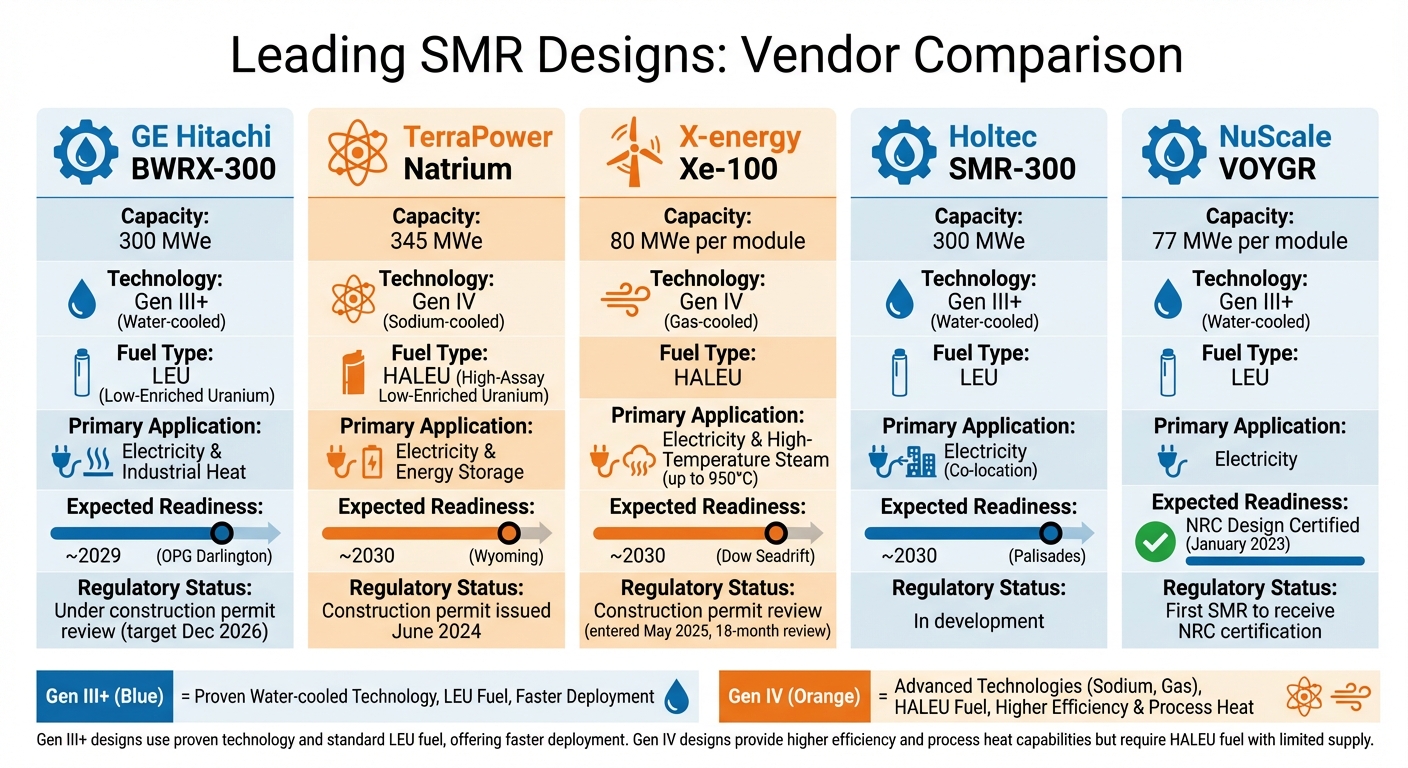
SMR Vendor Comparison: Capacity, Technology, and Deployment Timeline
This section focuses on aligning Small Modular Reactors (SMRs) with the specific demands of your project, building on the earlier discussion of their technical and economic aspects.
Identifying Project Requirements
The first step is ensuring your project's power needs align with the capacity of an SMR. Facilities with smaller energy demands (under 50 MW) might find SMRs too large and costly, while higher energy requirements can be met by combining multiple modules. This modularity allows for gradual scaling as demand increases.
Beyond capacity, consider your operational needs. SMRs are built for continuous operation, with capacity factors often exceeding 90%. This makes them perfect for industries like data centers, steel mills, or chemical plants that can’t afford downtime. However, if your energy use fluctuates or you’re looking to supplement renewable energy sources, the constant output of an SMR might not be the best fit.
Thermal energy needs add another layer of consideration. Projects requiring process heat above 500°C - like hydrogen production or cement manufacturing - will need advanced designs such as X-energy's Xe-100 or TerraPower's Natrium reactors. Standard light-water SMRs can't meet these high-temperature demands. For instance, Dow Chemical plans to use Xe-100 reactors at its Seadrift, Texas site to replace natural gas with nuclear-generated steam.
Location is another key factor. SMRs are compact and can be installed in areas with limited space or water resources. They’re also ideal for repurposing sites like retired coal plants, which often have existing grid connections and cooling systems, helping reduce costs and deployment time.
Lastly, fuel supply is critical. While conventional light-water SMRs use Low-Enriched Uranium (LEU), over 30 advanced designs require High-Assay Low-Enriched Uranium (HALEU). This reliance on HALEU introduces supply chain risks that could impact your project timeline. Balancing these factors ensures your project aligns with the right SMR technology.
Sourcing Supporting Equipment
Once you’ve defined your project’s needs, the next step is acquiring the necessary electrical infrastructure. Equipment like nuclear-grade transformers, switchgear, and power distribution systems must meet strict safety and reliability standards. Platforms such as Electrical Trader can simplify procurement by offering both new and used components, including transformers and breakers.
Don’t forget auxiliary systems. Backup generators, uninterruptible power supplies (UPS), and emergency shutdown equipment are crucial for maintaining safety and reliability during commissioning and operation.
Vendor and Technology Comparison
After clarifying your technical and operational needs, compare SMR vendors to find the best match. Evaluate them based on capacity, regulatory readiness, and fuel requirements. Below is a summary of leading SMR designs:
| Vendor & Model | Capacity (MWe) | Technology Type | Primary Application | Expected Readiness |
|---|---|---|---|---|
| GE Hitachi BWRX-300 | 300 MW | Gen III+ (Water-cooled) | Electricity & Industrial Heat | ~2029 (OPG Darlington) |
| TerraPower Natrium | 345 MW | Gen IV (Sodium-cooled) | Electricity & Energy Storage | ~2030 (Wyoming) |
| X-energy Xe-100 | 80 MW | Gen IV (Gas-cooled) | Electricity & High-Temperature Steam | ~2030 (Dow Seadrift) |
| Holtec SMR-300 | 300 MW | Gen III+ (Water-cooled) | Electricity (Co-location) | ~2030 (Palisades) |
| NuScale VOYGR | 77 MW (per module) | Gen III+ (Water-cooled) | Electricity | NRC Design Approved |
Generation III+ designs, like the BWRX-300 and NuScale VOYGR, use proven water-cooled technology and LEU fuel, making them closer to deployment. On the other hand, advanced Generation IV models, such as the Xe-100 and Natrium, offer higher efficiency and process heat capabilities but face regulatory hurdles and depend on HALEU.
Regulatory status is a major factor. NuScale's VOYGR has received NRC certification, while GE Hitachi's BWRX-300 is still navigating the review process, aiming for commercial operation by 2029. If your timeline is tight, choosing a vendor with advanced regulatory approval can save time.
Operational models differ, too. Some providers, like Last Energy, offer turnkey solutions with long-term operations and maintenance support, while others leave staffing and oversight to the customer. Be sure to understand the service model before signing contracts.
"$900 million is better than nothing, but the investment required to deploy even just one SMR unit is more than that."
– Jacopo Buongiorno, Professor of Nuclear Science and Engineering, MIT
To finalize your choice, consider using a weighted criteria matrix to rank vendors based on factors like cost, schedule, safety, and fuel availability. For projects involving co-location with industrial facilities, joint agreements or anchor tenancy arrangements can help manage risks and ensure alignment.
Conclusion
Selecting the right Small Modular Reactor (SMR) for your project means balancing technical, regulatory, and economic considerations with your facility's specific needs. Whether your project demands the proven reliability of Generation III+ reactors or the advanced features of Generation IV models, your choice should align with operational goals and project requirements.
Regulatory and economic factors are just as critical as technical compatibility. For instance, navigating the Nuclear Regulatory Commission (NRC) design certification process can take 3–5 years and cost between $300–$500 million. Partnering with a vendor that already holds advanced licensing approvals can help minimize delays and reduce risks. Additionally, economic feasibility improves as early first-of-a-kind (FOAK) projects transition into standardized production.
Don’t overlook the importance of electrical infrastructure. From nuclear-grade transformers to backup systems, these components must be fully integrated to ensure smooth SMR operation. Platforms like Electrical Trader can help source compliant and reliable electrical systems for your project.
Once infrastructure needs are addressed, comparing SMR vendors becomes the next priority. Using a weighted criteria approach - evaluating factors like capacity, fuel type, regulatory readiness, and operational support - can help ensure the selected reactor meets your goals for decarbonization, energy security, and dependable power generation.
With the global SMR market expected to reach $300 billion by 2040, early adopters who carefully assess these factors can position themselves to take advantage of this growing opportunity.
FAQs
How many SMR modules would my facility need?
The number of SMR modules you'll need hinges on your facility's power requirements and the capacity of each module, which can go up to 300 MW per unit. For instance, if your facility requires 600 MW, you might need two modules. A demand of 900 MW could call for three. To figure out the right number of modules for your project, consider factors like your total power demand, future scalability, and any site-specific constraints.
Which licensing path (Part 50 vs. Part 52) fits my timeline best?
The right licensing choice hinges on how quickly your project needs approval and the specific regulations it must meet. Part 50 takes a more traditional approach, involving a detailed review process that can span several years. On the other hand, Part 52 combines construction and operating licenses into a single process, which can shorten the overall timeline. If you're working with a tight schedule, Part 52 might be the better route, but success depends on meticulous early planning and proactive collaboration with the NRC to simplify pre-application steps.
Will my SMR design need HALEU fuel, and can I secure it?
The design of your SMR could depend on HALEU fuel, which is currently being developed through domestic initiatives in the U.S. The Department of Energy is actively distributing HALEU to various SMR developers, increasing the likelihood that obtaining this fuel will become achievable soon. As these programs advance, access to HALEU is expected to become more reliable.