

Data Center UPS Systems and Compliance Standards
Data centers can't afford downtime. Every minute of downtime costs businesses $5,600 on average, potentially leading to losses of hundreds of thousands of dollars during an outage. This is why Uninterruptible Power Supply (UPS) systems are essential - they provide temporary power during outages and protect sensitive equipment from voltage issues.
Key takeaways from the article:
-
UPS Systems: Two main types are used in data centers:
- Online Double-Conversion: Offers continuous power protection with zero transfer time but comes at a higher cost.
- Line-Interactive: More affordable with moderate protection, suitable for less demanding setups.
-
Compliance Standards:
- UL 1778: Ensures safety and performance.
- NEC/NFPA Codes: Guides UPS integration into emergency power systems.
- Uptime Institute Tiers: Defines redundancy and availability requirements.
- Efficiency and Cost: Modern UPS systems can achieve efficiencies over 96%, reducing energy costs. ENERGY STAR-certified models save 30%-55% more energy.
Choosing the right UPS depends on your facility's uptime needs, compliance requirements, and budget. Online systems are ideal for critical environments, while line-interactive systems work well for smaller operations.
03. Keeping the Lights On: Exploring UPS Design Choices for Data Centers
sbb-itb-501186b
UPS Systems and Regulatory Compliance
Data center UPS systems must align with strict safety, installation, and reliability standards. At the forefront is the UL 1778 standard, which evaluates UPS systems for electrical, thermal, and mechanical safety. This standard ensures protection against overvoltage, short circuits, and surges. It also mandates the use of fire-resistant materials, effective cooling systems, and proper battery safety measures. For instance, replacement batteries must match the manufacturer's catalog number and voltage rating to maintain the system’s original safety certification. This standard forms the foundation for additional national and performance-specific regulations.
The National Electrical Code (NEC) provides essential guidelines for integrating UPS systems into facility infrastructure. Article 645 addresses information technology systems, while Articles 700, 701, and 708 focus on emergency, standby, and critical operations power requirements. Complementing these guidelines are NFPA 110 and NFPA 111, which set performance benchmarks for emergency power systems, including acceptable transfer times and fuel supply durations. For facilities in high seismic risk areas, Level 1 systems must sustain 96 hours of operation without refueling.
"A UPS cannot be the sole source of emergency power in mission critical facilities. It can be part of the emergency/critical power system. For long duration backup power fuel fired generators should be used." - Murali Vakacharla, PE, Senior Engineer, WSP
The Uptime Institute Tier standards define redundancy requirements based on availability targets. For example:
- Tier I facilities offer 99.671% availability with basic infrastructure.
- Tier II facilities include N+1 redundancy, raising availability to 99.741%.
- Tier III systems ensure concurrent maintainability, achieving 99.982% availability by allowing components to be serviced without downtime.
- Tier IV systems deliver 99.995% availability with fault-tolerant 2N+1 configurations capable of withstanding unplanned outages.
These tier requirements heavily influence UPS topology choices. Higher-tier facilities often require systems with zero transfer time and advanced power isolation to meet stringent performance demands.
Battery maintenance is another critical area of compliance. Poor battery upkeep accounts for 25% of dropped loads in data centers. Additionally, the choice of transfer switches significantly impacts performance. Automatic Transfer Switches typically operate within 50 to 200 milliseconds, while Static Transfer Switches provide near-instantaneous switching in under 4 milliseconds. These operational factors are key when selecting UPS systems, particularly for Online Double-Conversion and Line-Interactive models, as they directly affect system reliability and performance.
1. Online Double-Conversion UPS
Compliance with UL 1778
Online double-conversion UPS systems adhere to the strict safety standards of UL 1778, covering electrical, thermal, and mechanical aspects. These systems continuously convert AC power to DC and back to AC, offering built-in protection against overvoltage, short circuits, and power surges. Effective cooling and ventilation mechanisms ensure proper thermal regulation, while reinforced enclosures meet mechanical safety requirements.
"Online double conversion UPS technology represents the pinnacle of power protection systems, continuously converting incoming AC power to DC and then back to clean, regulated AC output." - Legrand
UL 1778 certification also aligns with NEC standards for IT, emergency, and critical power systems, specifically Sections 645.11, 700.12(E), and 708.20(G). For businesses operating internationally, choosing systems with dual certifications - UL 1778 for North America and IEC 62040-1 for global compliance - simplifies equipment distribution and maintenance. These certifications are essential for meeting the rigorous requirements of NEC and NFPA emergency power regulations.
Alignment with NEC/NFPA Standards
In addition to UL compliance, online double-conversion UPS systems meet NEC and NFPA emergency power standards. With zero transfer time, these systems align with NFPA 110 and NFPA 111, which govern emergency power setups, typically involving generators. The UPS effectively bridges the power gap until backup systems are fully operational. For instance, the Legrand Keor FLEX offers scalable power ranging from 100 kW to 1.2 MW, achieving 98.4% efficiency. Its bidirectional rectifier technology allows parallel connections for up to 4.8 MW, meeting NEC redundancy requirements while supporting concurrent maintenance.
Uptime Institute Tier Requirements
Online double-conversion UPS systems are ideal for facilities aiming to meet Uptime Institute Tier standards. For Tier III setups, hot-swappable modular designs - like the Legrand Keor Mod, which provides 25 kW to 250 kW in 25 kW increments while using only 2 rack units per module - enable maintenance without interrupting power supply. In Tier IV configurations, continuous inverter operation ensures complete isolation from utility disturbances, a critical feature for fault-tolerant systems.
"On-line systems offer the greatest degree of compliance with tier requirements for power protection, because the load is supplied with processed power at all times." - Alan Luscombe, Director, KOHLER Uninterruptible Power Ltd.
Efficiency and Suitability
Modern online double-conversion UPS systems boast efficiency ratings above 96%. For example, the Legrand Trimod HE achieves 96% efficiency while delivering power ranging from 10 kW to 80 kW through self-configuring redundant modules. These systems maintain precise output voltage regulation within ±1% and frequency stability within ±0.1%, making them suitable for sensitive IT equipment. They also support up to 3:1 crest factors, accommodating the non-linear loads of virtualized servers. When selecting a UPS, both kVA and kW ratings must be considered, as IT loads often operate with a power factor between 0.6 and 0.8. Additionally, factors like ambient temperature and altitude can impact UPS performance, requiring larger systems to ensure reliability under varying conditions.
2. Line-Interactive UPS
Line-interactive UPS systems provide a more affordable option for applications that don't require the continuous power conditioning offered by online double-conversion systems. They strike a balance between cost and functionality, making them a popular choice for less demanding scenarios.
Compliance with UL 1778
These systems adhere to UL 1778 standards, ensuring safeguards against electrical, thermal, and mechanical risks, as well as fire protection. For data centers, UL 1778-certified systems are evaluated to meet the requirements of NFPA 75, ensuring they are appropriate for electronic computer and data-processing environments.
Battery safety is a critical aspect of compliance. Systems must clearly label battery specifications and include replacement instructions to maintain certification.
"It is permissible to replace the batteries of a UPS with specific types of batteries that are identified by the manufacturer of the UPS system on the equipment and within the product instructions as required by UL 1778." - Jeffrey A. Fecteau, Senior Regulatory Engineer, UL Solutions
Alignment with NEC/NFPA Standards
Line-interactive UPS systems are well-suited for network closets and small-to-medium business setups, aligning with NEC Articles 701 (Legally Required Standby) and 702 (Optional Standby). They offer a transfer time of 2–5 ms, which is faster than standby systems (5–10 ms) but slower than online double-conversion systems (0 ms). While this transfer time is sufficient for most business-critical applications, it falls short of meeting the stringent requirements of NEC Article 700 (Emergency Systems) and Article 708 (Critical Operations Power Systems), which are essential for mission-critical data centers.
These systems use an autotransformer to regulate voltage, providing basic power conditioning. However, their reliance on batteries for this function can lead to increased battery wear over time, potentially impacting long-term reliability.
Uptime Institute Tier Requirements
For applications under 5,000 VA, such as network closets, line-interactive UPS systems are a practical choice. However, they may not meet the fault-tolerance standards required by Tier IV facilities, which demand 99.9994% subsystem availability. Their 4–6 ms power break is a limitation for such high-demand environments.
"The true significance of a data centre operations TUI tier rating arises because it depends on all aspects of the site's infrastructure that impact data centre operations, including both subsystems, installed and operational sustainability." - Kenny Green, Technical Services Manager, KOHLER Uninterruptible Power
For Tier I and Tier II facilities, which require availability levels of 99.98333% and 99.98547%, respectively, line-interactive systems can provide adequate protection when appropriately sized and maintained.
Efficiency and Suitability
Line-interactive UPS systems are an efficient choice for environments with stable utility power. They offer moderate operating costs and are cost-effective to deploy, making them particularly appealing for small-to-medium enterprises or as support systems in larger facilities. However, their efficiency doesn't quite match the continuous power conditioning provided by online double-conversion systems. This is largely due to their reliance on battery power for voltage regulation, which can lead to faster battery degradation compared to systems that reserve battery usage for actual power outages.
These systems excel in settings where utility power is generally stable, and voltage fluctuations are the primary concern. When choosing a line-interactive UPS, it's essential to evaluate the sensitivity of connected equipment and ensure the transfer time meets acceptable thresholds.
Pros and Cons
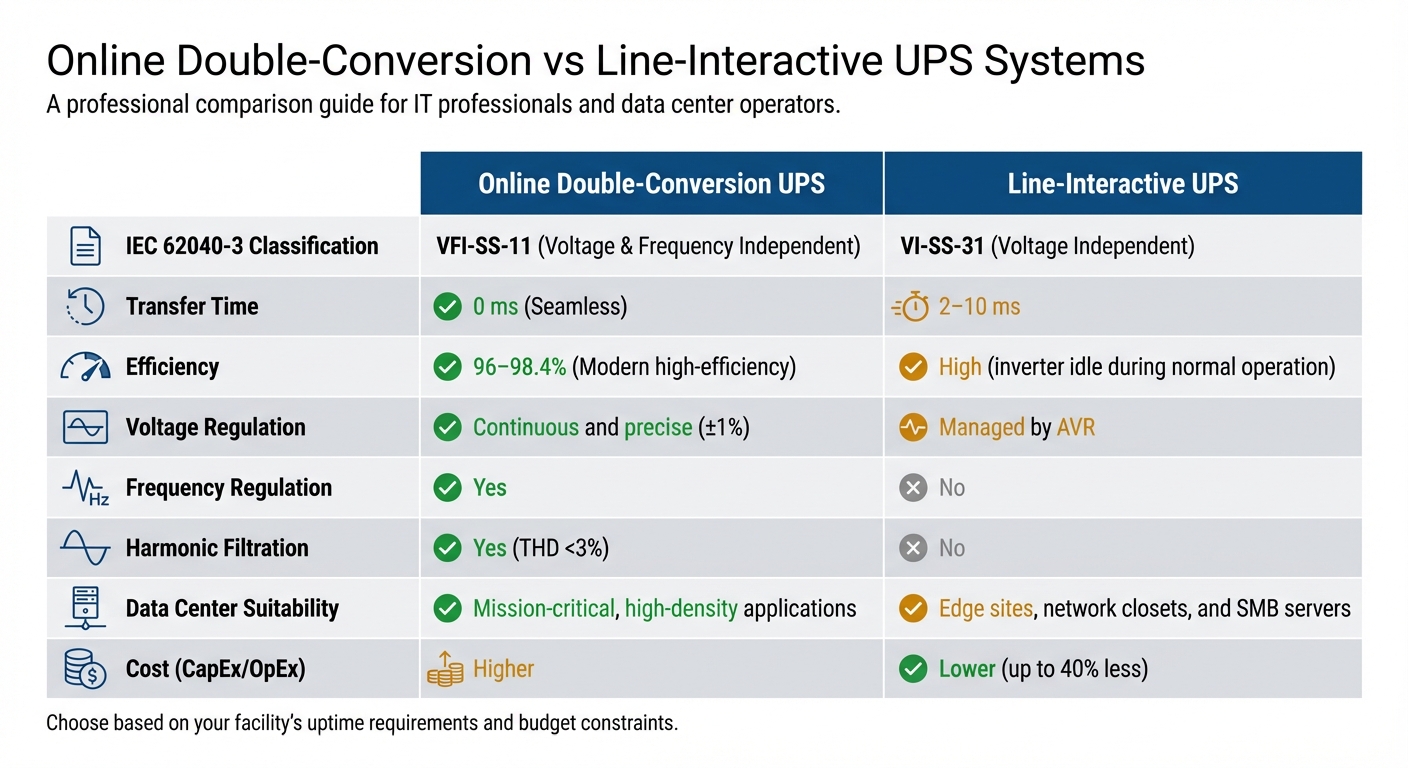
Online Double-Conversion vs Line-Interactive UPS Systems Comparison
This section breaks down the strengths and weaknesses of the two UPS topologies discussed earlier.
Online double-conversion systems are known for their seamless performance, offering zero transfer time and electrical isolation. They provide protection against all nine IEEE-defined power anomalies, including frequency variations and harmonic distortion. Modern versions boast impressive efficiency levels, with some models, like the Legrand Keor FLEX, achieving up to 98.4% efficiency. However, these systems come with higher upfront costs (CapEx) and consume more energy due to continuous power conversion, although advancements have reduced this gap significantly.
On the other hand, line-interactive systems are a more budget-friendly option, costing up to 40% less than online units. They achieve high efficiency by keeping the inverter idle under normal conditions. These systems feature Automatic Voltage Regulation (AVR), which handles voltage fluctuations without tapping into battery power, thereby extending battery life. Nevertheless, reliance on battery-assisted AVR can accelerate battery wear over time. Additionally, their 2–10 millisecond transfer time may cause brief interruptions, potentially rebooting sensitive networking equipment. They also lack protection against frequency variations and harmonic distortion.
"A total cost of ownership (TCO) evaluation of the OpEx for running an UPS over 10 years creates an operational savings of $1.4 million when energy efficiency improves a single percent - from 93% to 94% efficiency." - Harry Handlin, Director of Critical Power Applications, GE
Here’s a quick comparison of these two UPS types:
| Feature | Online Double-Conversion UPS | Line-Interactive UPS |
|---|---|---|
| IEC 62040-3 Classification | VFI-SS-11 (Voltage & Frequency Independent) | VI-SS-31 (Voltage Independent) |
| Transfer Time | 0 ms (Seamless) | 2–10 ms |
| Efficiency | 96–98.4% (Modern high-efficiency) | High (inverter idle during normal operation) |
| Voltage Regulation | Continuous and precise (±1%) | Managed by AVR |
| Frequency Regulation | Yes | No |
| Harmonic Filtration | Yes (THD <3%) | No |
| Data Center Suitability | Mission-critical, high-density applications | Suitable for edge sites, network closets, and SMB servers |
| Cost (CapEx/OpEx) | Higher | Lower (up to 40% less) |
For environments where uptime and power quality are critical, online double-conversion systems are the go-to choice despite their higher costs. In contrast, line-interactive systems are ideal for scenarios where cost savings and efficiency are priorities, offering a favorable total cost of ownership over a 10-year period. These distinctions make it clear that each UPS type serves unique operational requirements, ensuring compliance and performance based on specific data center needs.
Conclusion
Choosing the right UPS for your facility depends on its criticality and compliance requirements. For environments where even a millisecond of downtime is unacceptable - like data centers, financial institutions, and healthcare facilities - online double-conversion systems are the go-to solution. These systems are designed to meet high-availability standards, reliably supporting N+1 or 2N redundancy.
"If you can't afford even one millisecond of downtime, an online UPS may be right for you." – Robert Faulkner, VP of Engineering and Operations at Enconnex
Line-interactive systems, on the other hand, are well-suited for medium-density deployments, such as branch offices, where cost-efficiency and moderate power conditioning are sufficient. These systems address five of the nine most common power problems, making them a practical choice for less critical applications .
Online systems also stand out due to their VFI classification under IEC 62040-3. They protect against a broader range of power issues, including frequency variations and harmonic distortion, which line-interactive systems cannot fully handle. This makes them indispensable for operations requiring seamless power delivery and strict compliance.
Ultimately, your decision should weigh uptime demands against budget and compliance needs. Reviewing your UPS performance data and certifications can help ensure compatibility with your facility's requirements. Look for systems that provide a pure sine wave output for sensitive IT equipment, and evaluate vendor efficiency curves to understand real-world performance under load . For smaller facilities or non-critical operations, line-interactive systems offer a balance of protection and energy efficiency. However, for core data centers and high-density environments, the zero-transfer-time performance of online double-conversion systems is unmatched.
For facilities seeking to align compliance standards with budget considerations, Electrical Trader (https://electricaltrader.com) offers a range of new and used UPS systems that meet these rigorous demands, ensuring reliable power quality for your operations.
FAQs
Do I need an online or line-interactive UPS for my tier level?
The type of UPS system you choose hinges on your data center's tier classification and how reliable your power supply needs to be. Tier III and IV data centers typically go for online UPS systems. These systems are designed to ensure maximum uptime and fault tolerance, often set up in redundant configurations like N+1 or 2(N+1). On the other hand, line-interactive UPS systems are a more budget-friendly option, better suited for smaller setups with less stringent power reliability requirements. However, they don't offer the redundancy essential for higher-tier operations.
Which codes and standards apply to my UPS installation?
The main codes and standards to follow for UPS installations include NFPA 70 (National Electrical Code) 2023, which outlines electrical safety requirements, IEC 62040-1:2008, focusing on safety and backfeed protection, and UL standards like UL 1778 and UL 62368-1 for ensuring product compliance. Adhering to these standards is crucial to maintain both safety and compliance in your installation.
How do I size a UPS (kW vs kVA) for my IT load?
To determine the right size for a UPS, it's important to grasp the distinction between kW (real power) and kVA (apparent power). Most equipment operates with a power factor (PF) below 1, often falling in the range of 0.8 to 0.9. To calculate the required kVA, divide your total kW by the power factor. Select a UPS with a kVA rating higher than this value to accommodate potential future needs and ensure it can handle your equipment's power requirements.