

New vs Used Circuit Breakers: Reliability Comparison
When deciding between new, used, or reconditioned circuit breakers, the choice comes down to reliability, cost, and safety. Here’s the bottom line:
- New circuit breakers are the safest and most reliable option. They come with warranties (5–25 years), meet modern safety codes (like NEC standards), and have a lifespan of 20–40 years. However, they cost more upfront, ranging from $25–$500 depending on type and capacity.
- Used circuit breakers are the cheapest option (50–80% less than new) but come with no warranties, unknown operating history, and higher failure risks. They often violate safety codes and may void insurance coverage.
- Reconditioned circuit breakers strike a balance. They cost 30–60% of new breakers, are inspected and tested by certified technicians, and often include a short warranty (6 months to 2 years). While not as reliable as new breakers, they are a better choice than used ones, especially for older systems.
Quick Comparison
| Factor | New Breakers | Used Breakers | Reconditioned Breakers |
|---|---|---|---|
| Safety | High | Low | Moderate |
| Warranty | 5–25 years | None | 6 months–2 years |
| Compliance | Meets all codes | May violate codes | Meets codes if certified |
| Cost | $25–$500+ | 50–80% less than new | 30–60% less than new |
| Failure Risk | Very low | High | Moderate |
| Lifespan | 20–40 years | Uncertain | Shorter than new |
If safety and long-term reliability are priorities, new breakers are worth the investment. For budget-conscious projects, reconditioned breakers from certified suppliers are a better alternative to used ones. Avoid used breakers unless they are for non-critical applications, and always verify compliance with safety codes.
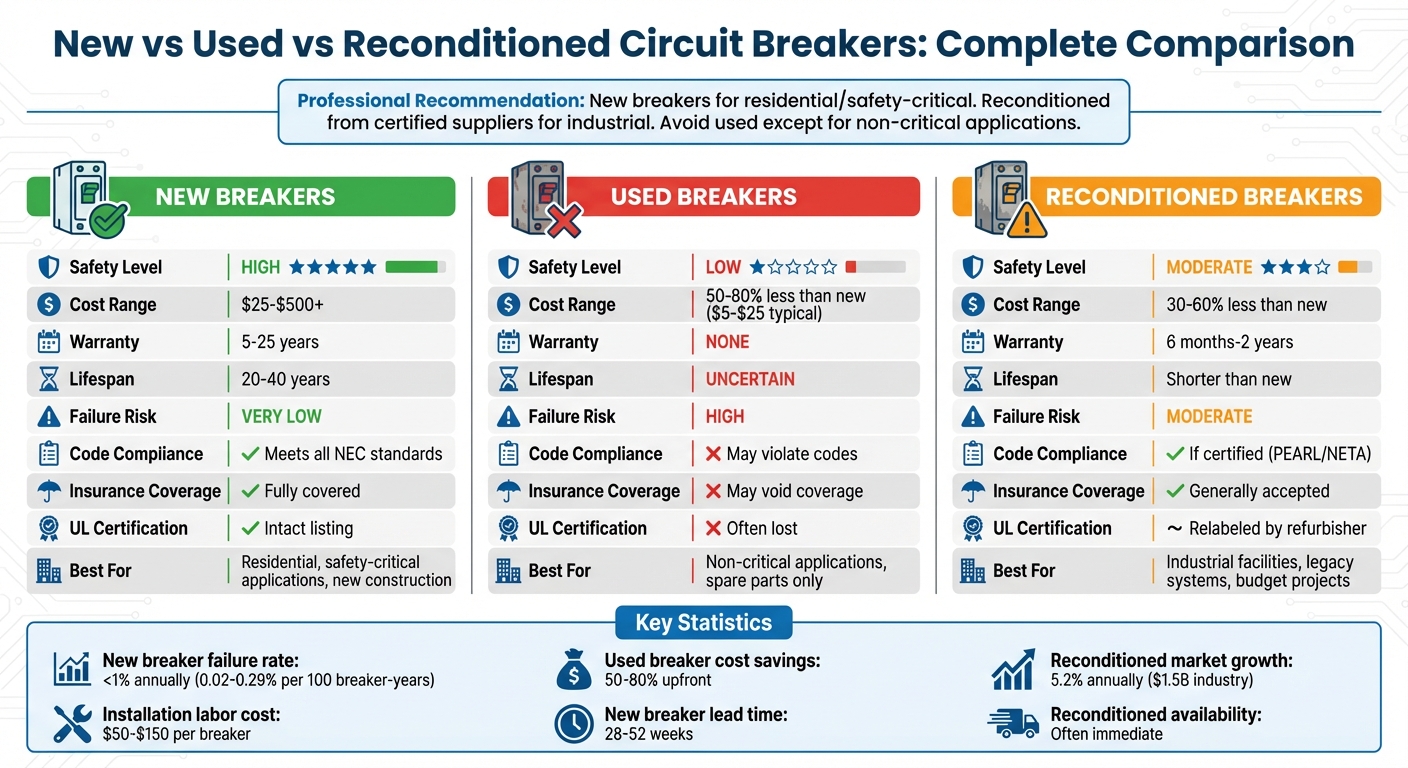
New vs Used vs Reconditioned Circuit Breakers Comparison Chart
New Circuit Breakers: Performance and Reliability
Factory Testing and Manufacturing Standards
Every new circuit breaker goes through detailed factory testing to ensure it meets performance expectations. These tests evaluate key factors like trip curves, response times, and continuity to confirm the breaker functions as intended. A major benchmark for quality is the UL 489 certification. This certification applies to molded-case circuit breakers rated for up to 1,000 volts AC and 1,500 volts DC, with current ratings reaching as high as 6,000 amperes. The UL listing mark guarantees the device has been tested for fire safety, electrical shock, and mechanical hazards, fulfilling the National Electrical Code (NEC) Article 110.3(B) requirement that equipment must be both "listed" and "identified". These stringent standards ensure that new breakers deliver consistent and dependable performance, further supported by robust warranty options.
Warranty Coverage and Service Life
New circuit breakers come with manufacturer warranties ranging from 5 to 25 years, depending on the type. Single-pole breakers typically have warranties of 5 to 10 years, while high-amperage units are often covered for 15 to 25 years. These warranties protect against manufacturing defects, offering peace of mind. Beyond the warranty, new breakers boast an expected service life of 20 to 40 years. This longevity ensures that you’re working with fresh, reliable components and a predictable operational lifespan. Together, the warranty and extended service life highlight the reliability of these devices, which are designed to meet modern safety standards.
Current Code Compliance and Updated Technology
Modern circuit breakers comply with the latest NEC standards and often include features that older models lack. For example, many newer breakers come equipped with AFCI (Arc Fault Circuit Interrupter) and GFCI (Ground Fault Circuit Interrupter) protection, which are now mandatory in residential applications. Additionally, the industry has moved away from pneumatic mechanisms in favor of spring-operated designs. These newer mechanisms support higher voltage ratings - up to 800 kV - and are more dependable. Thanks to these updates, failure rates have dropped significantly over the past 30 years, with engineering advancements ensuring greater safety and reliability. These improvements not only meet today’s codes but also deliver better performance compared to older technologies.
Used Circuit Breakers: Challenges and Concerns
Unknown Operating History and Wear
One of the biggest issues with used circuit breakers is the lack of verifiable operating history. Details like cycle counts, load conditions, and internal wear from corrosion, water damage, or arcing remain unknown. Gabriel Arce, Consulting & Modernization Offer Manager at Schneider Electric, sums it up perfectly:
"Since the equipment is not coming directly from a manufacturer, its traceability is lost, and you don't really know where the parts or the breaker have been".
This uncertainty can compromise the trip mechanism, leading to delayed responses or outright failure during electrical faults. While new breakers are designed to last 20 to 40 years with reliable performance, used breakers lack this assurance. Research shows that failure rates increase significantly when equipment exceeds its intended lifespan. This creates a ripple effect, impacting warranties and certifications, as discussed next.
No Warranty or Certification
Unlike new circuit breakers, which come with manufacturer-backed warranties (ranging from 5 to 25 years) and intact UL listings, used breakers are typically sold "as-is." Once removed from service, they often lose their certification. According to the 2020 National Electrical Code, reconditioned equipment must have its original listing mark removed, and NEC Article 110.3(B) requires that all equipment be both "listed" and "identified".
This lack of certification introduces serious safety and compliance risks. Installing non-compliant breakers could lead to code violations, voided insurance coverage, or denied claims in the event of an electrical fire. Without warranties or certifications, the decision to save money by purchasing used breakers becomes even more complicated when weighed against safety concerns.
Cost Savings vs. Failure Risk
Used circuit breakers are undeniably cheaper, often costing 50% to 80% less than new ones. For instance, a new single-pole breaker priced at $25–$50 might be available for $10–$25 when purchased used. Similarly, high-voltage industrial breakers can sell for 30% to 60% of their new price.
But these upfront savings come with significant risks. As JRL Electric Supply Inc. warns:
"A used/reconditioned circuit breaker may look perfect on the outside but be damaged on the inside".
If a used breaker fails to prevent wiring from overheating, the consequences can be severe - ranging from electrical fires and electrocution to equipment damage and denied insurance claims. What might seem like a cost-effective choice initially can quickly backfire when hidden risks and safety concerns come into play. For this reason, professional electricians strongly advise against using used circuit breakers in residential installations.
| Factor | New Circuit Breakers | Used Circuit Breakers |
|---|---|---|
| Safety Level | Maximum protection guaranteed | Unknown reliability, potential failure risk |
| Code Compliance | Meets all current NEC standards | May violate local electrical codes |
| Warranty | Full manufacturer warranty (5–25 years) | Typically no warranty protection |
| Insurance | Fully covered by insurance | May void insurance claims |
Reconditioned Circuit Breakers: Middle-Ground Option
Professional Reconditioning Process
Reconditioned circuit breakers provide a balanced choice between the affordability of used units and the dependability of new ones. According to the IEEE, reconditioning involves restoring power switchgear to working condition using OEM parts and adhering to specific guidelines. Unlike used breakers, which are sold "as-is", reconditioned units go through a meticulous overhaul process. This includes replacing worn components and conducting fault simulation tests to ensure proper performance.
The process begins with a thorough inspection of both the exterior and interior components to identify damage, wear, or signs of tampering. Technicians then disassemble the breaker, clean it to remove contaminants, and replace key parts like contacts, springs, and trip units with new or OEM-approved replacements. Once reassembled and lubricated, the breaker is labeled with the reconditioner's name and date, and a detailed test report is issued.
When done correctly, a reconditioned breaker can perform as reliably as a new one of the same model. This intensive process ensures a high level of reliability, making reconditioned breakers a strong contender for those seeking quality and cost-effectiveness.
Warranty Options and Pricing
Reconditioned breakers often come with warranties ranging from 6 months to 1 year, with some suppliers extending coverage up to 2 years. These warranties, issued by the reconditioning company rather than the original manufacturer, reflect the refurbisher's confidence in the unit's mechanical integrity.
In terms of cost, reconditioned breakers are priced at 50% to 70% of the cost of new units when factory-refurbished and accompanied by a warranty. This represents a substantial savings compared to new breakers, while offering significantly more reliability than used units, which typically cost only 20% to 40% of new but lack any warranty coverage. Another major advantage is availability - while new breakers often have lead times of 28 to 52 weeks, reconditioned units can frequently be shipped immediately. These factors make reconditioned breakers a practical and economical choice for many buyers.
Supplier Verification and Test Documentation
The dependability of a reconditioned breaker hinges on the quality of the reconditioning process. To ensure this, it's crucial to confirm that the supplier is affiliated with organizations like PEARL (Professional Electrical Apparatus Reconditioning League) or NETA (InterNational Electrical Testing Association). These groups establish ANSI-approved standards for reconditioning and certify technicians.
Buyers should request a comprehensive test report that includes primary and secondary injection tests, insulation and contact resistance measurements, and trip calibration results. Primary injection testing is especially critical as it replicates real fault conditions, offering a more robust assessment than simple continuity tests. Additionally, the breaker should feature a label with the refurbisher's name and reconditioning date, as required by the National Electrical Code (NEC) for traceability. It's also worth noting that the 2020 NEC mandates the removal of the original UL listing mark from reconditioned equipment, as the certification applies only to the factory-new condition.
Reliability and Safety Comparison
Failure Rates by Breaker Type
New circuit breakers are known for their dependability, with major failure rates staying well below 1% annually. For instance, vacuum circuit breakers (VCBs) boast a failure rate as low as 0.02% per 100 breaker-years, while generator circuit breakers (GCBs) come in at 0.08% per 100 breaker-years. On average, high-voltage circuit breakers worldwide have a failure rate of about 0.29% per 100 breaker-years.
On the other hand, used breakers show a much higher likelihood of failure. Without a clear operating history or recorded cycle counts, their reliability is hard to predict and significantly lower than that of new units. Equipment that has been in service for 35–40 years or more tends to experience "extremely high" failure rates compared to newer systems. This trend highlights the growing reliability gap as equipment ages.
Reconditioned breakers provide an alternative, occupying a middle ground between new and used options. Certified firms using OEM parts and adhering to ANSI/IEEE standards can restore these breakers to a "like-new" condition. However, reconditioning has its limits, as it cannot fully reverse the effects of frame aging. As industry expert Dick Bopp explains:
"A properly specified new breaker is superior to either a reconditioned or unreconditioned used breaker".
The reliability data underscores the importance of choosing warranty-backed, code-compliant equipment, as discussed earlier. These differences in failure rates also tie directly into safety and compliance considerations.
Safety Risks and Code Compliance
New circuit breakers offer the highest level of safety, ensuring accurate trip curves and consistent performance. They meet all National Electrical Code (NEC) standards and retain their UL listings, providing peace of mind for both homeowners and professionals.
In contrast, used breakers often fail to meet these standards. NEC Article 110.3(B) requires electrical equipment to be both "listed" and "identified", but used breakers frequently lose their listing, increasing the risk of fire hazards. Connecticut Electric cautions:
"used or refurbished circuit breakers offer no guarantee that they will function safely and effectively... they may be damaged on the inside due to corrosion and water".
Insurance and Liability Factors
The reliability of circuit breakers directly impacts financial risk over time. Installing used or non-compliant breakers can lead to serious consequences, including voided property insurance coverage. Insurance companies may also deny claims related to electrical fires if the equipment does not comply with local codes. VIOX Electric warns:
"installing used circuit breakers may violate local electrical codes and void your home insurance coverage".
Reconditioned breakers, when certified and tested to industry standards, are generally acceptable to insurers. However, the strongest liability protection comes with new breakers, which often include manufacturer warranties ranging from 5 to 25 years. These warranties not only cover replacement costs but also provide legal protection in case of system failures or safety incidents.
sbb-itb-501186b
Total Cost of Ownership Analysis
Initial Purchase and Installation Costs
The price of new circuit breakers varies depending on the type and capacity. Single-pole units (15–20A) typically range between $25 and $50, while double-pole units (30–50A) cost $50 to $100. High-amp breakers (60–200A) are priced at $100 to $300, and specialty GFCI units can cost anywhere from $150 to $500. If you're looking for savings, used breakers are available for $5 to $25, offering a 50%–80% discount compared to new units. Reconditioned breakers fall in between, costing 30%–60% of the price of new ones. For installation, labor costs typically range from $50 to $150 per breaker.
However, the true cost isn't just about the upfront expense. As VIOX Electric points out:
"The potential costs of used breaker failure far exceed the initial savings, making new breakers the economically smart choice".
Hidden Costs of Breaker Failure
Choosing a breaker based solely on price can lead to significant hidden costs. A failed breaker often means emergency replacement, which comes with premium labor rates. For industrial facilities, the stakes are even higher - system downtime can result in thousands of dollars per hour in lost production. Additionally, using non-compliant used breakers can lead to fines for violating NEC standards, not to mention the expense of reinstallation to correct the issue.
Insurance is another area of concern. If inspectors discover used or non-listed breakers, insurance carriers may deny claims for fire damage, leaving you to cover the costs. For systems older than 30 years, the situation worsens. Schneider Electric warns that sourcing spare parts for aging breakers can cost 7 to 8 times the original price, making maintenance a costly endeavor.
Long-Term Value Assessment
When you factor in long-term reliability and performance, the total cost of ownership becomes a critical consideration. New breakers, backed by warranties ranging from 5 to 25 years, ensure predictable performance for 20–40 years, effectively eliminating replacement costs during that time. Reconditioned breakers, while tested and verified, typically offer only a one-year warranty and cannot fully counteract the effects of age. Used breakers, on the other hand, come with no warranty and an uncertain lifespan.
Take this example: A $300 new high-amp breaker with a 25-year warranty costs just $12 per year over its lifespan. Compare that to a $60 used breaker that fails after three years. The emergency replacement, downtime, and potential insurance complications quickly erase any initial savings. This highlights the reliability gap - while new breakers may cost more upfront, their long-term value makes them the better choice for critical applications.
How to Choose the Right Circuit Breaker
Safety-Critical Applications
When it comes to residential installations or new construction projects, using new circuit breakers is non-negotiable. This ensures compliance with safety standards and local codes while also protecting insurance coverage. While new breakers may come with a higher upfront cost, they offer a full service life - typically 20 to 40 years - making them a sound long-term investment. In safety-critical scenarios, the focus should always be on avoiding the potentially severe consequences of failure rather than cost-cutting. For less critical applications, factors like supplier reliability and overall cost can also influence the decision.
Supplier Verification and Inspection
For projects where safety isn't the primary concern, reconditioned circuit breakers can be a practical choice - but only if sourced from verified suppliers. Look for suppliers accredited by PEARL or NETA and always request certified test reports. These should confirm that the breaker has undergone primary injection testing and has been relabeled in compliance with NEC standards. As Dick Bopp puts it:
"You are not taking a risk to save a few bucks by reconditioning a breaker - provided you find the right firm to do the job".
Balancing Cost and Reliability
Choosing the right breaker often comes down to balancing cost with reliability. New breakers are the go-to option when code compliance, insurance coverage, and maximum reliability are essential. On the other hand, reconditioned breakers can be a smart choice for industrial facilities that rely on older equipment - like legacy Westinghouse or ITE models - where new replacements are no longer available. They also help bridge the gap when facing long lead times of 28 to 52 weeks for new industrial-grade units.
For non-critical applications, used "as-is" breakers can serve a purpose, such as providing spare parts for field service companies or being used in training scenarios. Reconditioned units are generally more cost-effective, priced at 30% to 60% of new breakers, and typically come with a one-year warranty. In contrast, new breakers often include warranties ranging from 5 to 25 years.
Platforms like Electrical Trader make it easier to compare both new and reconditioned options, offering specifications and pricing from verified suppliers. No matter which option you choose, ensure the breaker is UL-classified and approved for your panel brand to maintain system integrity.
Conclusion
This article explored the reliability, safety, and long-term costs of new, used, and reconditioned circuit breakers, highlighting how the right choice depends on balancing safety, budget, and specific application needs.
New circuit breakers provide the highest reliability, thanks to rigorous factory testing, adherence to modern codes, and insurance backing. These features make them ideal for residential settings and safety-critical systems. While they come with higher costs and longer lead times, their 20–40-year lifespan and dependable performance justify the investment for many buyers.
Reconditioned breakers strike a middle ground, offering savings of 30–60% compared to new units while meeting factory standards - if refurbished by certified suppliers. However, the 2020 National Electrical Code restricts their use in new installations for molded-case breakers, narrowing their application to larger low-voltage power breakers.
Used "as-is" breakers, priced at just 20–40% of new units, are readily available but lack warranties and often violate local codes. Their use is generally limited to emergencies or sourcing spare parts .
The second-hand market for circuit breakers has grown into a $1.5 billion industry, expanding at an annual rate of 5.2%. This growth reflects ongoing supply chain challenges and a push toward more sustainable practices. For those navigating their options, platforms like Electrical Trader can help buyers compare products from verified suppliers, ensuring UL classification and proper documentation. With this information, you can confidently choose the breaker that best meets your safety and budgetary needs.
FAQs
How can I tell if a breaker will fit my panel?
To ensure a breaker fits your panel, start by checking the brand and model compatibility. Breakers are typically designed to work with panels of the same brand, and using mismatched breakers can lead to problems like loose fittings or even safety risks.
Pay attention to key specifications such as frame size and voltage rating. If you're unsure, it's a good idea to consult the panel’s manufacturer or reach out to a licensed electrician. This step is crucial for ensuring both a proper fit and a safe installation.
What test report should I request for a reconditioned breaker?
When requesting information about a reconditioned breaker, ask for a detailed test report that covers results from both the 'as received' testing (the condition of the breaker before any work was done) and the final testing (after reconditioning). This report should also include a list of any parts that were replaced during the process. Having this information ensures the breaker has undergone thorough testing and meets safety and reliability standards.
Will a used breaker fail a home inspection or void insurance?
A previously used breaker doesn’t necessarily mean a failed home inspection or canceled insurance, but its condition and adherence to safety standards are crucial. Insurance companies often evaluate the age and reliability of breakers, as older or damaged ones can present hazards. While a used breaker in solid working order might clear inspection, swapping out outdated or potentially unreliable units for new, code-compliant ones is generally the safest choice to sidestep potential problems.
Related Blog Posts
- New vs Used Electrical Components: Which to Buy?
- Top 7 Benefits of Buying Used Electrical Equipment
- New vs Used Transformers: Supply Chain Insights
- Fuse or Circuit Breaker: Best Use Cases