CAES vs Battery Storage: Key Differences
Compressed Air Energy Storage (CAES) and Battery Energy Storage Systems (BESS) serve distinct roles in energy storage. CAES is ideal for long-duration energy storage (LDES), offering 6+ hours of discharge, while BESS excels in short-duration tasks like frequency regulation, lasting up to 4 hours. Here's what you need to know:
- Cost: Batteries cost $125–$304 per kWh, scaling linearly with capacity. CAES costs $1,000–$2,000 per kW but is more cost-effective for durations over 8 hours due to its decoupled scaling of power and energy.
- Efficiency: Batteries are more efficient (85–95%) compared to CAES (40–70%). Advanced CAES systems improve efficiency by reusing heat.
- Lifespan: CAES systems last 30–40 years, outpacing batteries, which degrade over 10–20 years.
- Applications: Batteries respond instantly (<1 second) for grid balancing, while CAES is better for extended energy delivery and black start capabilities.
- Environmental Impact: Batteries rely on rare materials and face disposal challenges. CAES avoids these issues, using recyclable components and achieving zero emissions with advanced setups.
Quick Comparison
| Feature | CAES | Battery Storage (BESS) |
|---|---|---|
| Cost | $293/kWh (8+ hours) | $125–$304/kWh (short tasks) |
| Efficiency | 40–70% | 85–95% |
| Lifespan | 30–40 years | 10–20 years |
| Response Time | Minutes | <1 second |
| Discharge Duration | 6+ hours | 1–8 hours |
| Materials | Recyclable, no rare minerals | Rare minerals, disposal risks |
Both technologies address different energy needs. Batteries are ideal for quick, precise energy delivery, while CAES is better for large-scale, long-term storage.
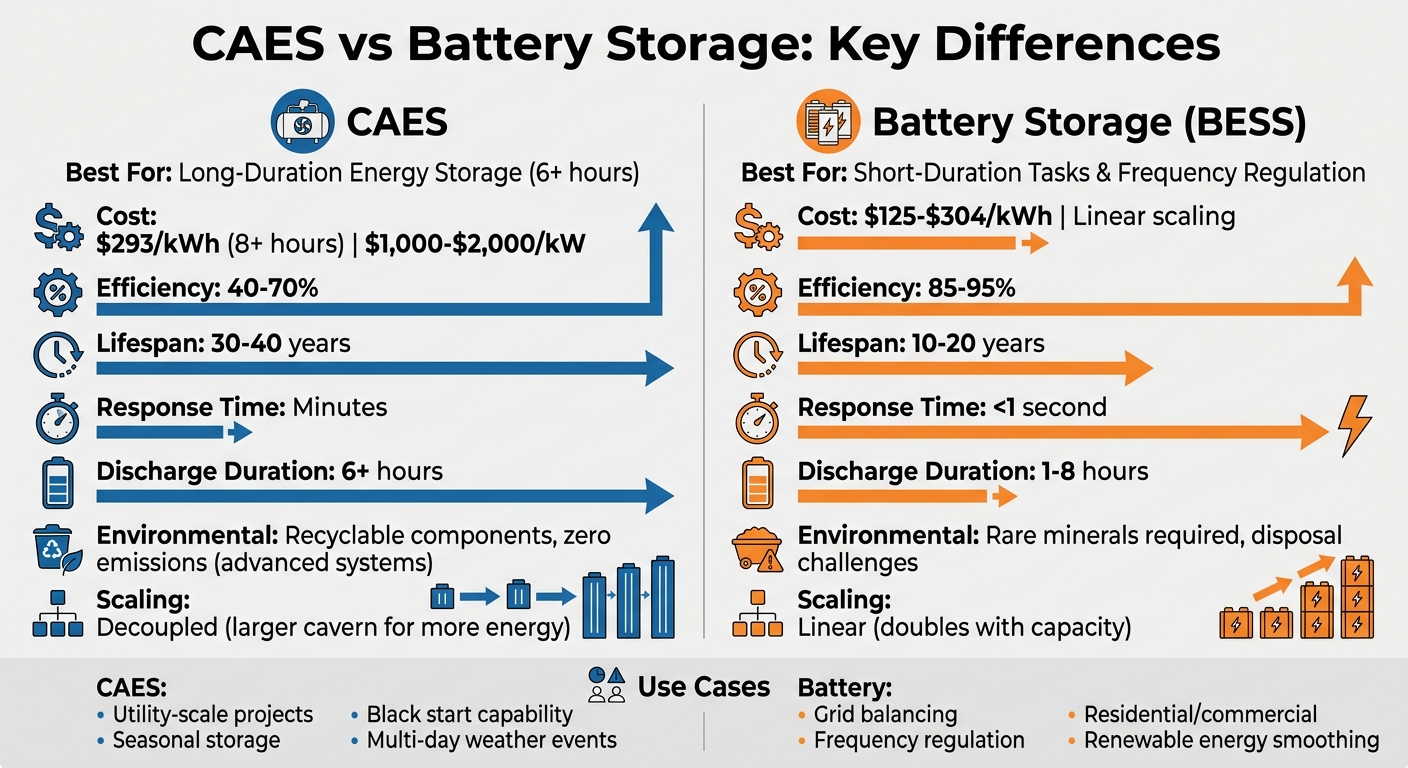
CAES vs Battery Storage Systems Comparison Chart
Cost Comparison
Initial Investment and Scaling Costs
Utility-scale battery storage systems come with a total cost of about $125 per kWh as of late 2025. This breaks down into $75 per kWh for core equipment and an additional $50 per kWh for installation. On the other hand, CAES (Compressed Air Energy Storage) systems have power capacity costs that range from $1,000 to $2,000 per kW.
Battery costs increase proportionally with capacity, meaning they scale in a linear fashion. CAES, however, separates power and energy costs. To increase energy capacity, CAES systems simply require a larger storage cavern rather than additional equipment. This makes CAES particularly cost-effective for longer discharge durations. For instance, with discharge durations exceeding eight hours, CAES averages $293 per kWh, compared to $304 per kWh for 4-hour lithium-ion systems.
Recent contracts in places like Saudi Arabia and Italy have confirmed battery system costs of around $120–$125 per kWh.
These upfront cost differences are just the starting point. The real contrasts emerge when examining lifecycle costs.
Lifecycle Costs
When you look beyond the initial investment, the long-term economics of these technologies become even more distinct. Lifespan and operational expenses significantly influence their overall value.
Battery systems generally last 10 to 20 years, after which they require either cell replacement or augmentation. In contrast, CAES systems can operate for 30 to 40 years, with some estimates extending up to 100 years. This is because compressed air, unlike battery cells, doesn’t degrade over time.
Operational costs also differ. Batteries typically incur annual costs of about 2% to 2.5% of their initial capital expenditure. However, lithium-ion batteries experience a yearly capacity fade of around 2%, leaving them with roughly 65% of their initial energy capacity after 20 years. CAES systems, while requiring more mechanical maintenance for components like compressors and turbines, benefit from the ability to refurbish parts instead of replacing them entirely. For longer durations (over 8 hours), liquid air CAES systems, such as those developed by Highview Power, report levelized energy costs between $140 and $200 per MWh.
Cost Comparison Table
| Cost Metric | Battery Storage (BESS) | Compressed Air (CAES) |
|---|---|---|
| Initial Investment | $125–$304/kWh | $293/kWh (8-hour duration) |
| Power Capacity | $50–$100/kW | $1,000–$2,000/kW |
| Scaling Approach | Linear (doubles with capacity) | Decoupled (larger cavern only) |
| Operational Lifespan | 10–20 years | 30–100 years |
| Annual O&M Costs | 2–2.5% of capex | Lower long-term |
| Capacity Degradation | ~2% annually | Minimal/negligible |
sbb-itb-501186b
Efficiency and Performance
Round-Trip Efficiency
Battery storage systems consistently outperform CAES when it comes to round-trip efficiency. Lithium-ion batteries boast an efficiency range of 85% to 95%, meaning the majority of the stored energy is recoverable when needed. On the other hand, traditional diabatic CAES systems lag significantly, with efficiencies between 40% and 55%.
The reason for this disparity lies in the energy losses during air compression. As air is compressed, it heats up, and much of this energy escapes as waste heat. Conventional CAES plants release this heat into the atmosphere, later relying on burning natural gas to reheat the air during expansion. However, advanced adiabatic CAES systems address this issue by capturing and reusing the heat, improving efficiency to a range of 55% to 70%. A notable example is the Huai'an adiabatic CAES plant in China, which became operational in May 2026. This facility achieves an impressive 71% efficiency with its two 300 MW units and a total storage capacity of 2.4 GWh.
"One may see claims of a round-trip efficiency of 70% or more for some highly optimised and proprietary air storage systems. Care must be taken when comparing such systems and making sure they are presented on a like for like basis."
– Craig Branch, Advisor, Innovation & Technology, io consulting
While efficiency is a key metric, it’s also important to consider how quickly and reliably these systems respond to operational demands.
Response Times and Reliability
Lithium-ion batteries shine in terms of response time, acting almost instantaneously - typically in under one second. This makes them ideal for real-time applications like grid balancing and frequency regulation. In contrast, CAES systems require 5 to 12 minutes to start from cold, as their compressors and turbines need time to reach full operating speed. However, when operated as a hot spinning reserve, CAES plants can ramp up to full capacity in just seconds.
When it comes to longevity, CAES systems have an edge. They can operate for 30 to 40 years with minimal degradation since compressed air storage doesn’t experience the chemical wear and tear that batteries do. Additionally, CAES plants provide black start capability, which enhances grid resilience by enabling power restoration during outages.
These factors highlight the varying strengths of each technology, which are further summarized in the table below.
Performance Comparison Table
| Technology Variant | Efficiency | Response Time | Discharge Duration |
|---|---|---|---|
| Lithium-ion Battery | 85–95% | <1 second | Minutes to 8 hours |
| Huntorf (Diabatic CAES) | 42% | Minutes | 2–4 hours |
| McIntosh (Diabatic CAES) | 54% | Minutes | 26 hours |
| Huai'an (Adiabatic CAES) | 71% | Minutes | 4 hours |
| Hubei Yingchang (CAES) | 64–70% | Minutes | 5 hours |
| Storelectric (A-CAES Pilot) | 70–80% (Target) | Minutes | 8–20 hours |
Storage Duration and Applications
Storage Duration
The main difference between CAES (Compressed Air Energy Storage) and battery storage lies in how long they can discharge energy. CAES systems are designed for extended periods of operation, often lasting days or even weeks, thanks to their use of large geological caverns. A great example is the McIntosh plant in Alabama, which can run at its full 110 MW capacity for 25 hours straight.
On the other hand, lithium-ion batteries are typically optimized for shorter durations, usually between 1 and 4 hours, with an upper limit of around 8 hours due to economic constraints. Unlike CAES systems, which can scale power and energy independently through separate equipment and cavern adjustments, extending the storage duration of batteries requires adding more cells. This approach increases costs proportionally.
An interesting development in the storage space is Form Energy's iron-air battery project for Georgia Power, set to go live in mid-2026. This system will deliver 15 MW of power with a capacity of 1,500 MWh, offering an impressive 100 hours of storage.
These differences in how long energy can be stored make each technology better suited for specific applications.
Best Use Cases
Lithium-ion batteries shine in situations that demand quick responses. Their ability to react in less than a second makes them perfect for tasks like frequency regulation, handling sudden demand surges, and balancing real-time supply and demand on the grid. Their compact, modular design also makes them a popular choice for residential and small commercial setups where space is tight.
CAES, on the other hand, is better suited for scenarios that require energy delivery over extended periods. For instance, utilities are increasingly seeking long-duration energy storage (8+ hours) to handle multi-day weather events when renewable energy sources like wind and solar may underperform.
"LDES allows you to store energy when costs are low and sell it when costs are high. It also reduces the need for grid expansion"
– Megan Reusser, Technology Manager at Burns & McDonnell
CAES also plays a crucial role in grid resilience by offering black start capabilities, which help restart the power grid after a total blackout.
Real-World Examples
Real-world projects highlight how CAES and battery storage meet different energy needs.
In China, the Hubei Yingchang Project showcases CAES on a utility scale. Operational since 2025, it delivers 300 MW of power with a 1,500 MWh capacity, allowing for 5 hours of discharge. The project repurposes abandoned salt mines and achieves a round-trip efficiency of 64% to 70%.
In California, Hydrostor's Willow Rock Energy Storage Center represents another milestone for CAES. This 500 MW Advanced-CAES project, set to launch in 2029, stores compressed air 2,000 feet underground using a hydrostatic design. It targets a 12-hour discharge duration and avoids natural gas combustion, with a projected levelized cost of $0.08 to $0.10 per kWh.
The McIntosh plant in Alabama, operational since 1991, remains a testament to CAES reliability. It takes about 40 hours to fully compress air into its salt caverns, which then provides 25 hours of full-capacity power.
Pros and Cons
Main Advantages and Disadvantages
Compressed Air Energy Storage (CAES) systems have a lifespan of 30–40 years, significantly outlasting lithium-ion batteries, which typically last 8–15 years. Unlike batteries, CAES systems avoid the use of rare earth minerals, relying instead on widely available materials like steel and concrete. Plus, compressed air - the storage medium - is both abundant and does not degrade over time.
However, batteries shine in areas where CAES falls short. They can respond to energy demands within milliseconds and feature a modular design. CAES, on the other hand, requires mechanical startup and is tied to fixed site requirements. When it comes to round-trip efficiency, batteries also outperform CAES by a wide margin.
Maintenance needs further emphasize these differences. CAES systems rely on mechanical parts, such as compressors and turbines, which can be refurbished and recycled. In contrast, batteries degrade chemically over time, leading to hazardous waste that is both costly and challenging to manage. These distinct strengths and weaknesses shape how each technology is used in grid management.
Environmental Impact
Environmental factors add another layer of distinction between the two systems. CAES components are largely recyclable and do not involve hazardous materials or the extraction of rare minerals. Advanced adiabatic CAES systems even achieve zero emissions by capturing and storing the heat generated during compression.
"Disposal of burnt-out lithium-ion batteries has proven to be extremely costly for the battery manufacturing companies and hazardous for the environment in general." – Princy A. J, Research Dive
In contrast, battery production comes with significant environmental costs due to mining and manufacturing processes. Disposal at the end of a battery's life is another major challenge, creating risks for both manufacturers and the environment.
Pros and Cons Table
| Feature | CAES | Battery Storage |
|---|---|---|
| Lifetime | 30–40 years | 8–15 years |
| Main Advantages | Long lifespan; avoids rare materials; scalable for long-duration storage | Fast response (milliseconds); high efficiency (85–95%); modular design |
| Main Disadvantages | Requires specific geological formations; lower efficiency (45–70%); high upfront costs | Limited lifespan; resource scarcity; hazardous disposal |
| Emissions | Zero emissions (with advanced adiabatic systems) | Zero during operation; high embodied energy in manufacturing |
| Recyclability | Highly recyclable (mechanical components) | Disposal challenges due to hazardous materials |
These differences highlight why CAES and battery storage are deployed in different ways to meet the needs of grid operations.
Scalability and Site Requirements
Power Ratings and Infrastructure Needs
CAES systems rely heavily on specific geological formations like salt caverns or depleted gas fields, alongside specialized infrastructure such as compressors, turbines, and thermal energy storage units. These requirements limit their deployment to utility-scale sites, typically ranging between 50 and 500 MW.
In comparison, battery storage systems come with far fewer site restrictions. Thanks to their modular design, they can be installed in diverse locations, from homes and businesses to large industrial settings. Expanding battery capacity is straightforward - adding more battery racks and power conversion units can scale systems from as little as 1 kW to over 100 MW.
Take the Huntorf plant in Germany as an example. Operating since 1978, it delivers 290 MW using two salt caverns, showcasing the specific geological and scale requirements of CAES. On the other hand, modular battery systems like the Moss Landing facility in California, which hit 500 MW by early 2025, highlight how quickly and flexibly battery storage can scale. These differences in site and scalability underscore the contrasting approaches to grid integration between the two technologies.
Grid Integration and Black Start Capability
Grid integration further sets these technologies apart. CAES systems offer black start capability, meaning they can restart the grid during a major outage without relying on external power. For instance, the McIntosh plant in Alabama, operational since 1991, can initiate emergency starts in just nine minutes, providing 110 MW of power for up to 25 hours.
"The unit performs emergency starts in nine minutes and the plant runs all year round. It provides peaking power when needed and otherwise helps control the grid in fall and spring or provides backup power based on market conditions." – Morgan Hendry, President of SSS Clutch
Meanwhile, batteries excel at real-time grid support, responding to fluctuations in milliseconds. This makes them well-suited for frequency regulation and smoothing out renewable energy variability. However, their role in black start scenarios is limited and depends on specific system configurations. In essence, CAES shines in long-duration grid stabilization and emergency recovery, while batteries are tailored for fast-response tasks like balancing and integrating renewable energy.
How Compressed Air Batteries are FINALLY Here
Conclusion
Choosing between CAES and battery storage depends on the specific needs of the application. Batteries excel in short-duration tasks like frequency regulation, smoothing daily solar output, or managing residential energy use. With an efficiency of 85–95% and response times measured in fractions of a second, they are ideal for quick, reliable energy delivery. Their modular design and lack of geological constraints make them easy to deploy almost anywhere.
On the other hand, CAES is better suited for long-duration energy storage, especially for applications exceeding 6–8 hours. These systems boast lifespans of 30–40 years, far outlasting the 8–15 years typical of batteries. CAES is often used in utility-scale projects requiring massive energy capacities, seasonal storage, or black start capabilities to restore power after outages.
Cost considerations also play a key role. While batteries cost approximately $400–$800 per kWh for short discharges, CAES becomes more economical for durations over 6–8 hours, with costs around $1,000–$1,500 per kW and levelized costs of $21–$54 per MWh. This makes CAES a cost-effective choice for extended storage needs.
Another key difference lies in site requirements. CAES relies on specific underground geological formations, which can limit where these systems can be built. Without suitable geology, above-ground storage vessels are an option, but they can significantly increase costs. Batteries, in contrast, offer a flexible, plug-and-play solution that can scale from small residential systems to large 500-MW facilities.
Hybrid systems are also gaining traction, combining the rapid response of batteries with CAES's ability to handle long-duration storage. In the end, the decision between CAES and battery storage hinges on balancing the need for fast energy delivery against the benefits of long-term, cost-efficient, high-capacity storage.
FAQs
When is CAES cheaper than batteries?
Compressed Air Energy Storage (CAES) stands out as a more economical option when it comes to long-duration storage - anything over 8 hours. Its costs remain steady over time, making it a reliable choice for large-scale applications like stabilizing power grids and integrating renewable energy sources.
On the other hand, batteries are typically more affordable for shorter durations (under 4 to 6 hours). This is largely due to their lower upfront costs and higher efficiency, making them a better fit for short-term energy storage needs. CAES, however, shines when extended energy storage is the goal.
Why is CAES less efficient than batteries?
Compressed Air Energy Storage (CAES) systems tend to fall short compared to batteries when it comes to efficiency. The main issue lies in the energy losses that occur during the compression and expansion of air, along with the challenges of managing heat and other thermodynamic factors.
Batteries, particularly lithium-ion systems, operate differently. They store energy chemically, which eliminates the inefficiencies tied to air compression and expansion. As a result, lithium-ion batteries often achieve round-trip efficiencies of over 85-90%, making them a more effective choice for energy storage in most scenarios.
What site geology does CAES need?
Compressed Air Energy Storage (CAES) systems rely on specific geological features to function properly. These include underground caverns or porous rock formations that can securely hold compressed air under high pressure. The formations need to be strong enough to handle the pressure without compromising safety or efficiency.