Biofuel Integration in Industrial Generators
Biofuels are reshaping industrial power generation. Here’s what you need to know:
- Types of Biofuels: Biodiesel (FAME), Renewable Diesel (HVO), and Biogas/Biomethane are the main options. Each offers reduced emissions compared to diesel, with HVO and B100 biodiesel cutting carbon output by up to 85–90%.
- Challenges: Switching to biofuels requires addressing fuel compatibility, storage stability, and cold-weather performance. For example, FAME biodiesel can gel in low temperatures and degrade faster during storage.
- Solutions: Use materials like FKM or PTFE for seals, install fuel heaters, and follow strict maintenance schedules. Renewable Diesel (HVO) is a "drop-in" option needing minimal engine modifications but may require lubricity additives.
- Compliance and Storage: Biofuels must meet ASTM or EN standards. Proper storage practices, like using stabilizers and water separators, are critical to avoid microbial growth and fuel breakdown.
- Procurement Tips: Start with lower blends (e.g., B5 or B20) for testing. Ensure generators are certified for the intended blend, and confirm warranties cover biofuel use.
Key takeaway: Biofuels can significantly cut emissions, but proper planning and maintenance are essential for smooth integration.
Fuel Compatibility and Engine Performance
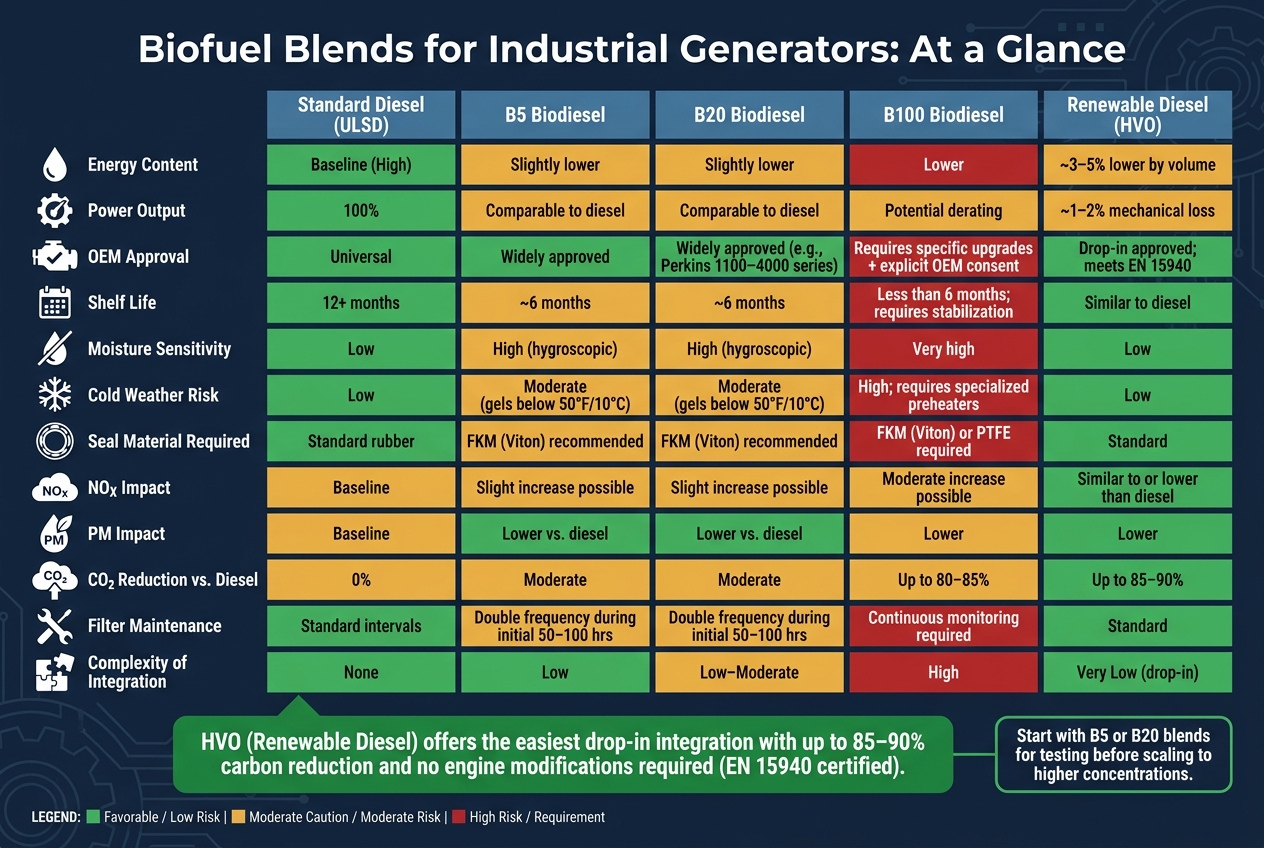
Biofuel Blends for Industrial Generators: Performance, Storage & Emissions Compared
Common Fuel Compatibility Problems
Engines react differently to biofuels due to their unique chemical properties. Take FAME-based biodiesel, for instance - it contains 10–12% oxygen, which can make it prone to oxidative instability. Over time, this leads to carbon deposits forming on injectors.
Another issue with FAME is its tendency to dissolve old fuel deposits. This can clog filters, especially during the first 50–100 hours of use. On top of that, FAME doesn’t mix well with natural rubber, causing seals and gaskets to degrade, which may result in leaks. Cold climates pose yet another challenge: FAME can begin to gel at temperatures between 23°F and 50°F, making it problematic for operations in northern regions.
HVO (renewable diesel) sidesteps many of FAME’s issues but presents a different challenge: low lubricity. Since HVO is highly refined, it lacks the natural lubricity of conventional diesel, which can lead to faster wear in fuel injection systems unless additives are used.
Let’s look at some practical solutions to tackle these compatibility challenges.
How to Improve Fuel Compatibility
To address FAME-related issues, replace natural rubber components like hoses, seals, and gaskets with materials such as FKM (Viton) or PTFE, especially for blends higher than B5. In cold weather, installing fuel heaters becomes essential when temperatures drop below 50°F. During the first 100 hours of operation with higher FAME blends, double your fuel filter replacement schedule. Afterward, keep an eye on fuel pressure drops and periodically test injectors for carbon buildup.
For HVO, ensure the fuel complies with EN 15940 standards, which guarantees lubricity additives are already included. In May 2026, FG Wilson Engineering (Dublin) Ltd partnered with Tria Energy to test HVO under both standby and prime power conditions. The trials showed that EN 15940-certified HVO required no modifications to engines or fuel systems.
"Our customers depend on reliability above all else. These trials prove that HVO can meet that standard without compromise, while helping operators make immediate, measurable reductions to their carbon footprint." - Darren O'Connor, Managing Director, FG Wilson Engineering (Dublin) Ltd
If your generator’s Engine Control Module (ECM) allows it, reprogramming injection timing can help stabilize combustion and reduce stress on injectors when using higher biofuel blends. These adjustments not only enhance performance but also extend the engine’s lifespan, ensuring biofuels integrate smoothly into industrial generators.
Fuel Blend Comparison: Diesel, B5, B20, and B100
Here’s a breakdown of how different fuel blends perform in terms of energy content, power output, and compatibility with industrial generators:
| Fuel Type | Energy Content (Vol.) | Power Output | OEM Approval Status |
|---|---|---|---|
| Diesel (ULSD) | Baseline (High) | 100% | Universal |
| B5 | Slightly lower | Comparable to diesel | Widely approved |
| B20 | Slightly lower | Comparable to diesel | Widely approved (e.g., Perkins 1100–4000 series) |
| B100 | Lower | Potential derating | Requires specific upgrades and explicit OEM consent |
| HVO (EN 15940) | ~3–5% lower by volume | ~1–2% mechanical loss | Drop-in approved; meets EN 15940 |
Nicholas Hawes, a CPE Technical Specialist at Cummins Inc., highlighted that while HVO causes a modest 1–2% power drop due to its lower energy content by volume, this is manageable for most standby applications. However, if your generator’s mechanical output is already close to its electrical rating, you’ll need to account for this slight reduction before making the switch.
"Due to the lower energy by volume with HVO fuel, a mechanical power loss of 1–2% was observed during engineering testing." - Nicholas Hawes, CPE Technical Specialist, Cummins Inc.
sbb-itb-501186b
Fuel Storage and Maintenance Challenges
Biofuel Storage Risks and Degradation
Storing fuel properly is a must, especially for standby generators where fuel might sit unused for long periods.
Biodiesel, in particular, poses unique challenges compared to traditional diesel. It breaks down faster due to factors like oxidative instability, its tendency to absorb moisture, and its susceptibility to gelling in colder temperatures. For instance, biodiesel's oxidative instability limits its storage life to around six months unless stabilizers are used, while petroleum diesel can last over a year. The moisture biodiesel absorbs makes things worse by increasing the likelihood of microbial growth and tank corrosion:
"Biodiesel is hygroscopic, meaning it attracts and absorbs moisture, which can promote microbial growth and lead to fuel system corrosion." - Jubaili Bros
Cold weather adds another layer of complexity. When temperatures drop below 50°F (10°C), biodiesel can gel, clogging fuel lines and jeopardizing reliable startup. To avoid these problems, adopting specific storage practices is essential.
Best Practices for Storing Biofuels
Before switching to biodiesel blends, it’s crucial to clean your fuel tank thoroughly. Years of diesel use can leave behind sludge and deposits that might clog filters during the first 50–100 hours of biodiesel operation.
Here are some targeted measures to tackle common biodiesel storage issues:
- Install water separators and fuel polishing systems to continuously manage moisture levels.
- Use fuel stabilizers if you plan to store biodiesel for more than six months.
- In colder climates, opt for winterized blends or install fuel heaters to prevent gelling.
- Conduct regular oil analyses to check for fuel dilution, viscosity changes, or rising acid levels.
- Schedule injector tests to detect early signs of carbon buildup.
Additionally, always source biodiesel that complies with ASTM D6751 (in the U.S.) or EN 14214 standards. Subpar fuel quality is a frequent cause of warranty disputes for engines certified for B20 blends.
Storage and Maintenance Requirements by Fuel Type
The table below highlights how storage and maintenance needs differ across fuel types:
| Factor | Standard Diesel | B5–B20 Blends | B100 |
|---|---|---|---|
| Shelf Life | 12+ months | ~6 months | Less than 6 months; requires stabilization |
| Moisture Sensitivity | Low | High (hygroscopic) | Very high |
| Cold Weather Risk | Low | Moderate (gels below 50°F/10°C) | High; requires specialized preheaters |
| Filter Maintenance | Standard intervals | Double frequency during initial hours | Very high; demands continuous monitoring |
| Seal Material | Standard rubber | FKM (Viton) recommended | FKM (Viton) or PTFE required |
| Solvent Effect on Tank | Minimal | High; tank cleaning necessary before transition | Very high |
This comparison underscores the need for proactive maintenance and careful planning when working with biodiesel, especially higher blends like B100. Each fuel type demands specific strategies to maintain its integrity and ensure reliable performance.
Emissions, Compliance, and Microgrid Integration
Emissions Rules and Regulatory Compliance
The EPA's Non-Road Diesel Rule serves as the primary federal guideline for industrial generator emissions. It classifies engines into Tiers 1 through 4 based on their horsepower and production year, with Tier 4 Final being the strictest standard. For generator sets exceeding 560 kW, Tier 4 Final limits particulate matter (PM) emissions to 0.05 g/kW-hr and nitrogen oxides (NOx) to 1.07 g/kW-hr. The classification of generators - whether for prime power (continuous use) or standby (emergency use) - is key in determining which standards apply. For instance, prime power units must meet Tier 4 Final requirements, while standby units operating fewer than 100 hours annually often adhere to Tier 2 or Tier 3 standards. Engines rated at or above 37 kW are considered to have a useful life of either 8,000 hours or 10 years, whichever comes first.
State regulations can be even more stringent than federal rules. States like California (CARB), Texas (TCEQ), and New York (NYSDEC) enforce tougher standards, especially in areas with high pollution levels. For example, Massachusetts mandates that non-road diesel equipment over 50 HP must use Ultra-Low Sulfur Diesel (ULSD) with sulfur content capped at 15 ppm. If your operations span multiple states, you're responsible for staying on top of each jurisdiction's regulations.
Here’s a detail that often catches operators off guard: the EPA and CARB differentiate between dual-fuel systems (which alternate between fuels) and bi-fuel systems (which burn two fuels simultaneously). The certification process for these systems varies under Tier 4 Final and CARB rules, directly impacting incentives and permits. Before purchasing, confirm that your generator is factory-certified for all intended fuel types - not just the primary one.
For older Tier 1 or Tier 2 units, retrofitting with technologies like Selective Catalytic Reduction (SCR) or Diesel Particulate Filters (DPF) can help meet modern air quality standards without requiring a full replacement. Keep permits, fuel reports, and maintenance records well-organized and readily available - inspections can occur without much notice. These compliance measures are key for incorporating biofuel systems into advanced power setups.
Connecting Biofuel Generators to Microgrids
Meeting emissions standards is just one part of the equation; integrating biofuel generators into microgrids adds another layer of complexity. Successfully linking a biofuel generator to a microgrid - whether alongside solar panels, wind turbines, or battery storage - requires precise, real-time coordination. Maintaining stable voltage and frequency is especially critical during transitions between grid-connected and island mode.
Specialized controllers from manufacturers like ComAp and Deep Sea Electronics are designed to handle these challenges. These devices manage tasks such as fuel switching, load sharing, and communication with renewable energy sources in real time. This functionality is crucial for responding to sudden changes in demand or grid outages.
When done correctly, the benefits are substantial. For example, operating a dual-fuel generator on natural gas - similar in operation to biogas - can cut NOx emissions by 20–40% compared to running on pure diesel. This reduction can help facilities in non-attainment zones meet environmental goals while maintaining reliability.
Emissions Profiles by Fuel Type
The table below highlights the emissions impacts and regulatory considerations for various fuel types, reinforcing the compliance and integration strategies discussed earlier.
| Fuel Type | NOx Impact | PM Impact | CO Impact | Regulatory Notes |
|---|---|---|---|---|
| Standard Diesel | Baseline | Baseline | Baseline | Must comply with applicable EPA Tier standards |
| B5–B20 Blends | Slight increase possible | Lower vs. diesel | Lower vs. diesel | Generally compatible with Tier 4 engines; OEM approval required |
| B100 | Moderate increase possible | Lower | Lower | May need engine recertification; verify with CARB and state permits |
| Renewable Diesel (HVO) | Similar to or lower than diesel | Lower | Lower | Drop-in compatible; favorable under CARB's Low Carbon Fuel Standard |
| Biogas (Dual-Fuel) | 20–40% reduction vs. diesel | Lower | Varies | Requires different EPA/CARB certification; check dual-fuel vs. bi-fuel status |
Procurement and Retrofit Strategies
Tackling technical and operational challenges requires careful planning in both procurement and retrofitting.
How to Phase In Biofuel Use
Introducing biofuels into your operations should be a step-by-step process. Start with lower blends like B5 or B20. This approach allows your team to identify and address any compatibility issues before committing to a full-scale transition.
Begin with a pilot test, using one or two generators to monitor performance. Pay close attention to factors like fuel filter condition, oil quality, and injector performance. During the initial 50–100 hours of operation with a new blend, stick to the enhanced filter maintenance schedule outlined earlier. Once the system stabilizes, you can return to regular maintenance intervals and evaluate whether a higher blend is feasible based on consistent performance.
Standardizing a single biofuel blend across all units can simplify storage and maintenance processes. It's also critical to confirm that your fleet's OEM certifications align with the chosen blend.
After validating performance through this phased approach, shift your focus to procuring biofuel-compatible generators equipped with the necessary features to support biofuel integration.
What to Look for When Buying Biofuel Generators
When shopping for biofuel-compatible generators, prioritize these key features:
- Engine Certification: Verify that the OEM certifies the generator for your intended biofuel blend. For instance, Perkins' 1100, 2200, 2500, and 4000 series engines are often certified for use with up to B20.
- Fuel Injection Technology: Opt for generators with common-rail electronic fuel injection and a programmable ECM. This ensures precise injection timing, which is crucial for maintaining stable combustion as the energy density of biofuel blends varies.
- Material Compatibility and Cold-Climate Features: Look for components like seals, gaskets, and hoses made from durable materials such as FKM or PTFE. Additionally, ensure the unit comes with water separators, fuel polishing systems, and integrated preheaters for operation in colder climates.
- Warranty Terms: Confirm in writing that the OEM warranty explicitly covers the intended biofuel blend. Some manufacturers exclude coverage for issues like microbial contamination or off-spec fuel quality, so clarity on this point is essential.
For a selection of new and used power generation equipment that meets these criteria, Electrical Trader (https://electricaltrader.com) provides a range of options.
Retrofit vs. New Equipment: A Side-by-Side Comparison
Once you’ve gathered performance data and outlined procurement needs, the next step is deciding between retrofitting existing generators or purchasing new biofuel-ready models. Here’s how the two options stack up:
| Factor | Retrofitting Existing Units | Purchasing New Biofuel-Ready Units |
|---|---|---|
| Upfront Cost | Lower; focuses on upgrading specific components | Higher; involves complete equipment replacement |
| Implementation Time | Longer; requires downtime for tasks like seal replacement, ECM reprogramming, and tank cleaning | Quicker if site infrastructure already supports biofuels |
| Flexibility | Limited by the age and design of the existing equipment | Greater flexibility with modern fuel injection and ECM systems |
| Warranty | Modifications may void the original warranty | Comes with a full factory warranty for the specified biofuel blend (e.g., B20) |
| Components Needed | Includes items like FKM/PTFE seals, water separators, and possibly fuel heaters | Pre-equipped with compatible materials and advanced filtration systems |
Your choice will depend on factors like your budget, how much downtime your operations can tolerate, and your long-term performance goals. Retrofitting can be a budget-friendly option when only minor adjustments are required. However, investing in new biofuel-ready generators offers modern technology, better performance, and comprehensive warranty coverage, aligning directly with the risk reduction strategies discussed throughout this guide.
Operating Biofuel Generators: Best Practices and Risk Reduction
Standard Procedures for Biofuel Generator Operation
Running biofuel generators efficiently starts with following strict operational guidelines. First and foremost, the fuel must comply with ASTM D6751 standards, which regulate viscosity, water content, and oxidative stability. Using subpar fuel can lead to warranty issues and unexpected downtime. Before the initial fill, clean the fuel tank thoroughly. Biodiesel’s solvent properties can loosen old deposits, which might end up clogging filters or damaging injectors. During the first 50–100 hours of operation, replace filters more frequently to catch any dislodged debris.
Temperature is another critical factor. Biodiesel tends to gel when temperatures drop below 50°F (10°C). To keep fuel flowing smoothly, especially in colder regions like the northern U.S. during winter, install fuel heaters and add cold-flow additives to the mix. These steps not only ensure smooth operation but also set the stage for effective operator training and performance checks.
Operator Training and Performance Verification
Operators need to be well-prepared to handle the unique challenges of biofuel generators. Training should focus on biodiesel's solvent action during the initial operating period, teaching operators how to monitor pressure drops across filters and spot anomalies that require immediate attention.
Verification is equally important. Two key checks include periodic oil sampling and injector pop-testing. Oil analysis helps identify shifts in viscosity or rising acid numbers, which could indicate unburned biodiesel diluting the crankcase oil. Similarly, pop-testing injectors can catch carbon buildup caused by biodiesel degradation. Both of these tests are essential for identifying potential issues early, before they escalate into costly failures.
Service logs and fuel purchase records are also crucial. Many manufacturers won't cover failures stemming from poor fuel quality or microbial contamination, so detailed documentation is a must.
Common Operational Risks and How to Prevent Them
In addition to standard procedures and training, it’s vital to address common operational risks. Here’s a quick guide to some of the most frequent issues and how to prevent them:
| Operational Risk | Primary Cause | Preventive Measure |
|---|---|---|
| Filter Clogging | Dislodged tank deposits | Clean tanks before switching to biodiesel; change filters more often during the first 50–100 hours. |
| Microbial Growth | Biodiesel absorbing moisture | Use water separators, fuel polishing systems, and conduct regular microbial testing. |
| Fuel Gelling | High cloud and pour points in cold weather | Install fuel heaters for temperatures below 50°F (10°C) and use cold-flow additives. |
| Fuel Degradation | Low oxidative stability | Turn over fuel within six months and use stabilizers to extend its shelf life. |
| System Corrosion | Moisture and acidic byproducts | Use FKM or PTFE seals and regularly drain tanks to keep them dry. |
| Lube Oil Dilution | Unburned fuel entering the crankcase | Perform regular oil analysis to monitor viscosity and acid levels. |
Microbial growth deserves special attention. Biodiesel’s tendency to absorb moisture can lead to water accumulation in fuel tanks over time, creating a breeding ground for bacteria and fungi. This is especially concerning for standby generators that sit idle for long periods. Installing fuel polishing systems and water separators can help manage this issue effectively.
Conclusion: Key Takeaways for Biofuel Integration
Switching to biofuels for industrial generators is entirely possible with the right preparation and attention to detail. Here’s what you need to know for a smooth transition:
Start by confirming your engine’s certification, material compatibility, and any required infrastructure updates. For example, modern engines like the Perkins 1100, 2200, and 4000 series can handle up to B20 biodiesel with ease. However, using B100 often requires additional manufacturer approval and upgrades, such as FKM seals and preheaters.
Fuel quality is another critical factor. It must meet ASTM D6751 standards to avoid warranty issues and reduce wear and tear. Poor-quality fuel can lead to expensive long-term problems. On the bright side, biodiesel can reduce CO2 emissions by as much as 80% compared to traditional diesel.
"Biodiesel offers a path to lower emissions and enhanced sustainability, but it must be implemented with care." - Jubaili Bros
Maintenance routines will need adjustments to account for biodiesel’s properties. Since biodiesel is hygroscopic (it absorbs moisture) and has a shorter storage life, you’ll need to use stabilizers, water separators, and conduct regular oil analysis. Ideally, biodiesel should be used within six months unless treated with stabilizers.
Detailed documentation is essential to protect your investment. Keeping records of fuel quality and maintenance practices helps ensure compliance with OEM warranties. This includes maintaining thorough fuel purchase records and service logs, which are often key to successful warranty claims. For more on equipment selection, check out Electrical Trader for certified power generation solutions.
FAQs
Which biofuel is the safest “drop-in” choice for my generator?
HVO, or Hydrotreated Vegetable Oil, is considered the safest “drop-in” biofuel for generators. It serves as a direct substitute for fossil diesel, requiring no changes to the engine or fuel system. HVO complies with established quality standards like EN 15940, guaranteeing dependable performance and seamless compatibility.
What should I change first to prevent biofuel storage problems?
Proper storage and handling are critical to avoiding biofuel-related issues. Start by thoroughly cleaning fuel tanks before transitioning to biofuels. This helps remove residues that could interfere with the new fuel. Use water separators to manage moisture, a common problem with biofuels, and consider installing fuel polishing systems if you're planning for long-term storage.
During the initial phase, keep a close eye on filters and replace them more often to prevent microbial buildup. These steps - cleaning tanks and ensuring effective filtration - lay the groundwork for a smooth switch to biofuels.
Will using biodiesel or HVO affect my generator’s emissions compliance?
Using biodiesel or HVO (Hydrotreated Vegetable Oil) can help meet emissions standards. HVO delivers performance comparable to traditional diesel without requiring any engine modifications, all while cutting down on exhaust emissions. Similarly, biodiesel generates fewer harmful pollutants than petroleum diesel. Both fuels present practical alternatives for reducing overall environmental impact.