




APC vs. Eaton: Power Backup Reliability Compared
In industrial settings, reliable power backup systems are essential to avoid costly downtime. APC and Eaton are two leading brands in this space, each offering distinct strengths:
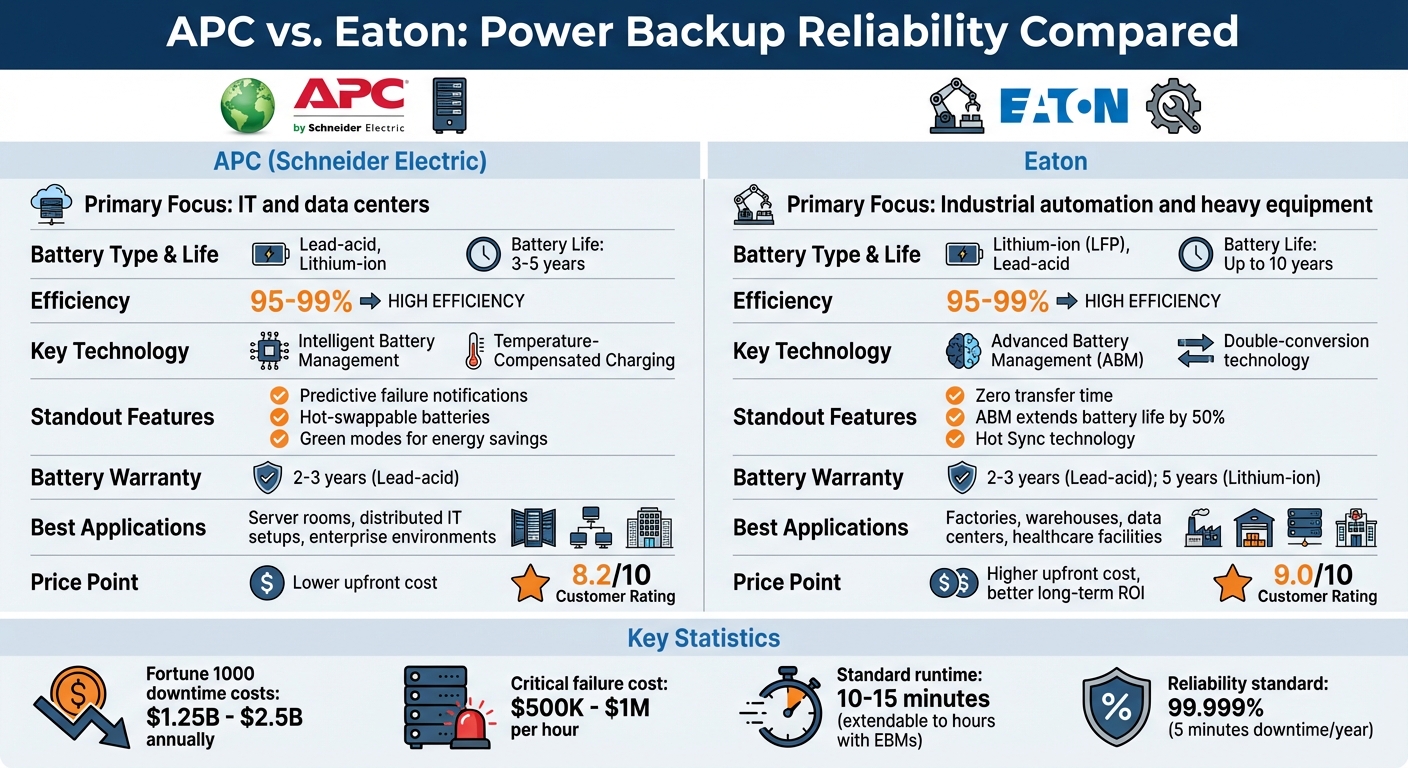
- APC specializes in IT-focused UPS solutions, with features like predictive maintenance, temperature-compensated charging, and hot-swappable batteries. These are ideal for server rooms, data centers, and distributed IT setups.
- Eaton focuses on industrial-grade systems, offering advanced double-conversion technology, lithium-ion batteries with extended lifespan, and zero transfer time during power disruptions. These are better suited for factories, warehouses, and heavy industrial applications.
Key Differences:
- Battery Life: Eaton's lithium-ion batteries last up to 10 years, while APC's lead-acid batteries typically last 3-5 years.
- Technology: Eaton's Advanced Battery Management (ABM) extends battery life by up to 50%, while APC uses intelligent battery management for proactive maintenance.
- Applications: APC is better for IT environments; Eaton excels in industrial and high-load scenarios.
Quick Comparison:
| Feature | APC | Eaton |
|---|---|---|
| Primary Focus | IT and data centers | Industrial automation |
| Battery Type | Lead-acid, Lithium-ion | Lithium-ion (LFP), Lead-acid |
| Battery Life | 3–5 years | Up to 10 years |
| Efficiency | 95–99% | 95–99% |
| Key Strength | Predictive maintenance | Zero transfer time, ABM |
| Best Fit | IT setups, server rooms | Factories, heavy equipment |
Choosing between APC and Eaton depends on your specific needs. For IT environments, APC offers reliable and cost-effective solutions. For industrial settings, Eaton provides advanced durability and performance.
APC vs Eaton UPS Systems: Industrial Power Backup Comparison
Replacing UPS from Eaton 1500 to APC Smart UPS

APC Power Backup Reliability for Industrial Use
APC, established in 1981 and now part of Schneider Electric, has built a reputation for its Smart‑UPS product line, which is specifically designed to minimize costly downtime in tough industrial settings.
APC Reliability Features
APC's reliability in industrial environments comes from a range of advanced features. These include intelligent battery management with precision charging algorithms, self-tests to catch early signs of battery failure, and temperature-compensated charging to avoid overheating. The Automatic Voltage Regulation (AVR) feature ensures voltage stability without draining the battery, while predictive failure notifications enable maintenance teams to address problems before they escalate.
Many APC models are equipped with hot-swappable, user-replaceable batteries, which help reduce downtime during maintenance. Some also feature "green modes" that bypass unused components during stable power conditions, cutting energy use. Remote monitoring capabilities allow users to stay on top of power usage, system health, and performance data from anywhere. Together, these features are tailored to meet the demands of industrial environments.
That said, field reports note some limitations. Smaller APC units may struggle with generator synchronization, and their aggressive charging profiles could lead to battery overheating under heavy loads. These factors highlight the importance of real-world performance, which is discussed further below.
APC Performance in Industrial Settings
APC batteries generally last between 3 to 5 years, with replacements recommended every 3 to 4 years to ensure consistent performance. For optimal reliability, it's advised to size UPS systems with an output watt capacity 20% to 25% higher than the total connected load. This accounts for power factors and helps prevent overloads.
Performance in continuous operation has been mixed. While some APC systems have run flawlessly for over five years, others have faced issues like deep discharges that make restarting difficult.
Dave Thomas from hardwarexpress stresses the importance of regular maintenance: "Timely replacement of APC UPS batteries is crucial for maintaining the efficiency and effectiveness of the UPS system. Aging batteries can lead to decreased runtime, reduced capacity, and ultimately, a higher risk of power failure".
For manufacturing processes requiring three-phase power protection, APC provides industrial-grade solutions designed to support mission-critical systems where downtime is not an option.
Eaton Power Backup Reliability for Industrial Use
Eaton has built a strong reputation for providing industrial-grade power protection systems. Their solutions, featuring double-conversion technology and lithium-ion batteries, are designed to handle high inrush currents, manage voltage inconsistencies, and endure extended power outages.
Eaton Reliability Features
Eaton's industrial UPS systems utilize Voltage- and Frequency-Independent (VFI) double-conversion technology. This process transforms incoming AC power into DC and then back into clean AC power, effectively shielding sensitive equipment from issues like harmonic distortion, frequency shifts, and electrical surges - common challenges in industrial environments. One standout feature is the zero transfer time to battery power, which prevents disruptions in industrial controllers. This is a key advantage over line-interactive systems, which typically experience a 2–4 millisecond delay.
Eaton's Advanced Battery Management (ABM) employs a three-stage charging process, extending battery life by up to 50%. Their lithium-ion batteries, built on lithium phosphate chemistry, offer a lifespan of up to 10 years - far exceeding traditional lead-acid batteries. Additionally, these batteries eliminate oxygen production during thermal events, reducing the risk of ignition.
The system's hot-swappable modules allow technicians to replace components without interrupting operations, cutting maintenance downtime by up to an hour. Eaton also includes a battery-independent restart feature, which automatically restores UPS functionality and connected equipment after a complete battery discharge once utility power is restored. With high power factor ratings of 0.9, Eaton systems can deliver up to 1,000 additional watts on a 10,000 VA system compared to units with a 0.8 power factor - all without increasing circuit demands.
These features ensure Eaton systems perform reliably in even the most challenging industrial environments.
Eaton Performance in Industrial Settings
Eaton's advanced features translate into dependable performance in real-world applications. For instance, an Eaton 9390 80kVA UPS operated continuously for 15 years before requiring repairs, even under deferred maintenance conditions.
In June 2017, Zenium Data Centers implemented Eaton Power Xpert 9395P UPS systems and Power Xpert FMX medium-voltage switchgear at their 46,300-square-foot facility in Slough, England. The project, led by Principal Engineer Mike Venables, incorporated prefabricated, containerized power distribution units to save floor space and meet tight timelines. The result was an N+N fully concurrent maintainable electrical distribution system, which reduced cable heat emissions by 33% and contributed to ultra-low Power Usage Effectiveness (PUE).
"Eaton not only provided proven technology with market-leading electrical efficiency and reliability, but also served as a major project collaborator that listened to our challenges and proactively responded with solutions catered to our needs", said Mike Venables, Principal Engineer, Zenium.
Eaton's online UPS systems maintain output voltage within a tight 2–3% range of nominal voltage, a significant improvement over the 10–15% variation typical of line-interactive systems. While standard internal batteries provide 10 to 15 minutes of runtime during outages, Eaton's Extended Battery Modules (EBMs) can extend this to several hours. For specialized needs, Eaton offers models like the 9155 Marine and 9PHD Marine, designed for extreme temperatures and marine applications, ensuring consistent performance in unique industrial settings.
This performance data highlights Eaton's ability to deliver reliable and efficient power solutions tailored to industrial demands.
Reliability Comparison: APC vs. Eaton
Both APC and Eaton deliver flagship UPS models with efficiency ratings ranging from 95% to 99%. APC leans on predictive notifications to identify potential faults early and replace components proactively. Eaton, on the other hand, decentralizes control with its Hot Sync technology, which eliminates single points of failure during UPS paralleling. These strategies lead to distinct reliability outcomes depending on the application.
APC enhances battery life through controlled charging protocols. Meanwhile, Eaton's Advanced Battery Management (ABM) uses a three-stage charging process that can extend battery service life by up to 50%. Eaton also provides a 5-year warranty for lithium-ion UPS models like the 5P and 9PX, in contrast to the standard 2–3 years typically offered for lead-acid models by both brands.
The cost of unplanned downtime is staggering. For Fortune 1000 companies, downtime costs can range from $1.25 billion to $2.5 billion annually. Critical application failures alone can average between $500,000 and $1 million per hour. To mitigate these risks, APC incorporates automatic self-testing, while Eaton employs proactive performance monitoring to ensure operational reliability.
Here’s a breakdown of their key reliability features:
| Reliability Feature | APC (Schneider Electric) | Eaton |
|---|---|---|
| Primary Strength | Proven reliability in IT and high-availability infrastructure | Scalable modularity and industrial automation performance |
| Battery Management | Intelligent Battery Management with temperature-compensated charging | ABM (Advanced Battery Management) technology |
| Failure Prevention | Predictive failure notifications for proactive replacement | Proactive performance monitoring and remote diagnostics |
| Redundancy Technology | Hot-swap batteries and SmartSlot management cards | Hot Sync technology for paralleling without a single point of failure |
| Efficiency | 95–99% efficiency ratings | 95–99% efficiency ratings |
| Battery Warranty | Typically 2–3 years (Lead-acid) | 2–3 years (Lead-acid); 5 years (Lithium-ion) |
| Best Fit | Enterprise IT, server rooms, and distributed offices | Data centers, industrial facilities, and healthcare |
Eaton’s modular design and Hot Sync technology are ideal for handling variable industrial loads and data centers. On the other hand, APC’s predictive maintenance and advanced monitoring shine in enterprise IT and high-availability setups.
Performance Comparison: Uptime, Efficiency, and Runtime
Uptime and Efficiency Data
APC and Eaton both deliver efficiency levels ranging from 95% to 99% in their high-end models. Eaton’s 9SX series, for example, achieves up to 95% efficiency even in online double-conversion mode, which helps cut down on energy and cooling costs in industrial settings. Meanwhile, APC implements "Green Modes" to reduce power consumption during stable operating conditions.
Eaton’s online double-conversion technology stands out by offering zero transfer time, meaning there’s no delay during power switching. This continuous inverter operation also shields equipment from utility power fluctuations. Additionally, Eaton systems maintain voltage regulation within 2–3% of nominal voltage, while line-interactive systems typically vary by 10–15%. For environments with varying power demands, Eaton’s modular design allows power modules to scale according to actual usage, optimizing energy consumption.
"Energy Saver System (ESS) [is] innovative technology from Eaton that enables select UPS models to operate at 99 percent efficiency without compromising reliability." - Eaton
With uptime and efficiency covered, let’s look at how runtime adjusts under different loads.
Runtime Under Different Loads
Most standard UPS batteries provide a runtime of 10–15 minutes. For instance, under a 300W load, Eaton’s 9E (1000VA) offers 16 minutes of runtime, while the Eaton 9SX (1000VA) extends this to 25 minutes. The 9SX also supports a higher load - 900 watts compared to the 9E’s 800 watts - thanks to its improved power factor.
Both APC and Eaton cater to extended runtime needs with external battery options. APC’s "Scalable Runtime" system allows for plug-and-play external battery packs, while Eaton offers Extended Battery Modules (EBMs) designed for industrial use. Additionally, both brands feature hot-swappable batteries, enabling maintenance without interrupting critical operations.
sbb-itb-501186b
Battery Technology and Maintenance Comparison
APC and Eaton both offer Valve-Regulated Lead-Acid (VRLA) and Lithium-ion battery technologies, but their approaches to battery management differ. VRLA batteries generally last between three to five years, though this can be shortened in settings with frequent voltage fluctuations or high temperatures. Eaton tackles these challenges with Advanced Battery Management (ABM) technology, which employs a three-stage charging process to extend battery life and provide early warnings of potential failures. APC, on the other hand, uses Temperature-Compensated Battery Charging, which adjusts the charge voltage based on real-time battery temperature.
"Although a lead-acid (VRLA) UPS battery is typically rated for a three- to five-year lifespan, frequent transfers to battery and high ambient temperatures can reduce expected battery life." - Eaton
These charging strategies highlight the brands' commitment to improving battery performance and reliability in demanding environments.
When it comes to lithium-ion batteries, both companies offer advancements that include longer lifespans, faster recharge times, and more compact designs compared to VRLA batteries. Eaton stands out by using lithium phosphate (LFP) chemistry, which minimizes the risk of ignition by preventing oxygen generation during thermal incidents. Over a UPS's lifecycle, lithium-ion batteries also help lower operating costs compared to VRLA options.
Both brands prioritize proactive maintenance, featuring predictive notifications or early warning systems to detect potential issues before they escalate.
| Feature | APC Battery Technology | Eaton Battery Technology |
|---|---|---|
| Battery Type | VRLA & Lithium-ion | VRLA & Lithium-ion |
| Life Extension Tech | Temperature-Compensated Charging | ABM (Advanced Battery Management) |
| Maintenance Design | Hot-Swappable | Hot-Swappable |
| Monitoring | Predictive Failure Notifications | Early Failure Detection |
| Runtime Expansion | Plug-and-Play External Batteries | Extended Battery Modules (EBMs) |
| Lithium Chemistry | Not specified | Lithium Phosphate (LFP) |
Industrial Applications and Case Studies
Here’s a closer look at how these systems deliver dependable performance in real-world industrial settings.
APC Industrial Applications
APC systems shine in environments where consistent performance and broad compatibility are essential. Take the Smart-UPS line, for example. Since its launch in 1990, it has set the standard for network power protection in industrial settings. These systems are a common sight in warehouses and manufacturing facilities, where ease of use and reliable performance are top priorities.
For distributed retail branches and smaller manufacturing operations, APC’s extensive product availability is a game-changer. This wide availability helps reduce downtime across multiple locations. Plus, with PowerChute software, industrial facilities can monitor power health across various sites from a single, centralized dashboard.
While APC emphasizes compatibility and straightforward replacements, Eaton focuses on offering solutions tailored to more demanding industrial conditions.
Eaton Industrial Applications
Eaton’s power backup systems are built for tough industrial and commercial environments, designed to handle voltage fluctuations and provide strong power conditioning. These systems support a wide range of industries, including agriculture, mining, construction, forestry, and oil and gas.
"If your environment runs servers, storage appliances, or anything sensitive to voltage fluctuations, Eaton generally provides better electrical performance and efficiency." – Ryan, DC Supplies
One standout feature is Eaton’s DIN rail industrial UPS systems, which are compact and ideal for factory floors, warehouses, and edge computing setups. These units offer localized protection for critical networking and control equipment while conserving space. The double-conversion online topology is particularly effective for safeguarding sensitive electronics like PLC power supplies and ice cube relays.
Eaton’s reliability is backed by real-world examples. In one case, a Southeast U.S. data center experienced a major failure with an Eaton 9390 80kVA UPS after 15 years of operation without maintenance. The failure disrupted global operations, highlighting the importance of regular service even for dependable systems. Eaton’s acquisition of Tripp Lite for $1.65 billion in March 2021 further bolstered its capabilities in edge computing and single-phase UPS solutions for industrial use.
Advantages and Drawbacks: APC vs. Eaton
When comparing APC and Eaton, their distinct approaches to battery management and maintenance highlight unique strengths and weaknesses. APC stands out for its energy-efficient systems, easy deployment, and scalable, redundant designs with hot-swappable configurations. However, users often note that its remote monitoring capabilities leave room for improvement. On the other hand, Eaton shines with its advanced PredictPulse monitoring, robust overload capacity, and ability to handle high inrush currents without disrupting operations. That said, Eaton units tend to have a larger physical footprint, and their advanced features might pose challenges for smaller-scale setups.
| Feature | APC (Schneider Electric) | Eaton |
|---|---|---|
| Primary Strengths | Energy efficiency, ease of deployment, lower upfront cost | Advanced monitoring, high inrush load handling, virtual environment integration |
| Build Quality | Scalable and redundant modular designs | Innovative touchscreens and robust management cards |
| Environmental Durability | Micro Data Center enclosures for edge/facility use | DIN rail options for factories |
| Load Handling | Redundant configurations for high availability | Industrial-strength overload capacity for motors and heavy inductive loads |
| Weaknesses | Remote management and monitoring require improvement | Larger physical footprint and higher heat dissipation |
Price points further distinguish the two brands. APC systems are generally more affordable upfront, making them a go-to for businesses prioritizing initial cost savings. Eaton, however, justifies its higher price tag - around $300,000 for large 750-block units compared to more approachable 12kW models - by delivering long-term operational efficiency. Customer reviews reflect this balance, rating Eaton UPS at 9.0/10, while the APC Smart-UPS VT scores 8.2/10.
Choosing Between APC and Eaton for Industrial Use
Start by identifying your facility's load requirements. For sensitive electronics like PLCs, a double-conversion online UPS is essential. This type ensures zero transfer time and shields equipment from utility power fluctuations. Once you know the total wattage, pick a UPS with a VA rating that's about 1.2 times higher than the load. This extra capacity is crucial for handling high inrush currents, especially for equipment like motors, variable-speed drives, or medical imaging systems during startup. Beyond load, consider factors like the environment and maintenance needs, which can significantly impact performance.
For physical environments, the choice depends on the setting. Eaton's DIN rail industrial UPS is ideal for factory floors and warehouses, while APC's Micro Data Center works well for edge deployments or remote industrial sites. If your facility deals with frequent voltage fluctuations or poor power quality, prioritize an online topology system. This prevents constant battery cycling, which can otherwise shorten the battery's lifespan.
Battery type plays a big role in long-term costs and maintenance. Lithium-ion batteries last much longer - 10+ years compared to 3-5 years for VRLA - and take up less space. Eaton’s Advanced Battery Management (ABM) can extend battery life by up to 50%. If your facility operates in high-temperature conditions, look for features like temperature-compensated charging or consider upgrading to lithium-ion batteries to reduce maintenance needs.
For facilities with generators, Eaton systems tend to synchronize more effectively with natural gas or diesel generators compared to some APC models. If compliance is a concern - like TAA compliance for government use or UL-certified hospital-grade systems for healthcare - Eaton offers specific product lines to meet these requirements. Additionally, for decentralized sites, remote monitoring is invaluable. Network management cards enable you to monitor UPS status and environmental factors like temperature and humidity through SNMP or a web interface.
Finally, think about your budget beyond just the upfront cost. While APC systems often come with a premium price tag, Eaton’s focus on energy efficiency and fewer battery replacements can result in a better total cost of ownership over time. A typical UPS provides 10 to 15 minutes of runtime at full load, but this can be extended to several hours with External Battery Modules (EBMs). To minimize downtime during maintenance, look for systems with bypass switches or hot-swappable modules, ensuring critical industrial loads remain operational.
Conclusion
Both APC and Eaton deliver dependable industrial power backup solutions, but their strengths cater to different priorities. Eaton shines with features like PredictPulse and the Energy Saver System (ESS), which can achieve up to 99% efficiency without compromising protection. However, this advanced technology comes with a higher upfront cost. For example, mid-range 12kW units are priced between $50,000 and $70,000, while larger 750-block systems can cost around $300,000.
On the other hand, APC, a Schneider Electric brand, offers a more budget-friendly entry point and faster deployment. Its systems are praised for their stability, durability, and user-friendly maintenance, thanks to features like hot-swappable batteries. That said, some older or entry-level models may lack the advanced remote management capabilities found in Eaton's higher-end offerings.
The right choice ultimately depends on your operational needs. If your facility prioritizes cutting-edge technology and seamless integration - especially in virtualized environments - Eaton's ABM battery technology and superior system integration make it a compelling option. For those focused on cost efficiency and proven reliability, APC provides excellent value. Both brands uphold a 99.999% reliability standard, limiting downtime to just over five minutes annually. Aligning their strengths with your specific requirements ensures the reliability your mission-critical operations demand.
FAQs
How do APC and Eaton power backup systems compare in terms of reliability and performance?
When it comes to power backup systems, both APC and Eaton are popular and dependable names. However, they serve slightly different purposes, depending on what you need.
Eaton systems are often the go-to for industrial settings and data centers. Why? They offer features like scalability, redundancy, and advanced battery management. These capabilities make them a solid pick for large-scale operations or critical environments where power reliability is non-negotiable.
APC, on the other hand, shines in office spaces and small business setups. Their systems are built with simplicity in mind, focusing on ease of deployment and low-maintenance operation. This makes them perfect for straightforward setups that don’t require the heavy-duty capabilities Eaton provides.
So, how do you choose? If you’re managing a high-stakes operation with complex power needs, Eaton is likely the better fit. For smaller, more manageable setups, APC offers a dependable and practical solution.
Which brand provides better battery life for industrial power backup systems?
Eaton stands out for its industrial UPS systems that boast extended battery life. Their advanced battery management technology works to maximize lifespan by carefully managing elements such as ambient temperature, charge cycles, and upkeep. This focus on durability and efficiency makes Eaton a trusted option for industries needing dependable power backup solutions.
How reliable are APC and Eaton UPS systems for industrial use, and how do they handle maintenance?
APC and Eaton UPS systems are built to provide dependable power backup in industrial environments. A central element of their approach is preventive maintenance, which helps avoid unexpected equipment failures and minimizes downtime.
Eaton takes things up a notch with its advanced battery management solutions, like ABM technology, designed to extend battery life and boost reliability. They also stress the importance of regularly inspecting critical components, including batteries and capacitors. APC, on the other hand, focuses on routine maintenance and offers recommendations for service plans tailored to meet the specific demands of industrial operations. Their maintenance priorities include key components like batteries, fans, and capacitors.
By implementing proactive measures - such as scheduled testing and servicing - both APC and Eaton work to ensure their systems deliver uninterrupted performance, even in the most challenging industrial settings.