

Ultimate Guide to Remote Generator Monitoring
Remote generator monitoring lets you track your generator's performance and status from anywhere using devices like smartphones or computers. This system ensures your generator is always ready, sending real-time alerts about issues like low fuel or overheating and enabling remote control for actions like starting or stopping the generator. Here's what you need to know:
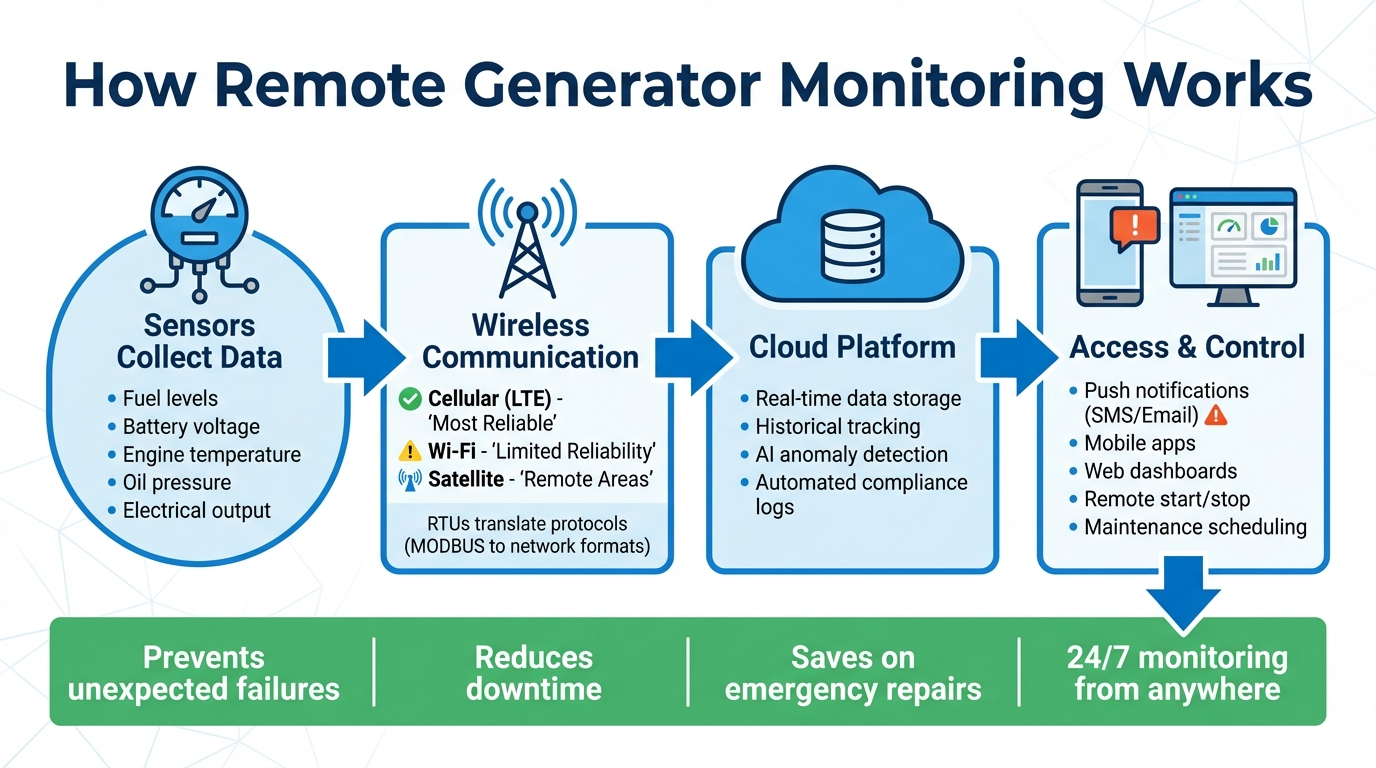
- How It Works: Sensors collect data (fuel levels, battery voltage, etc.), transmit it wirelessly (Wi-Fi, cellular, satellite), and store it in the cloud. Alerts and insights are delivered via apps or dashboards.
- Key Features: Real-time updates, remote diagnostics, maintenance scheduling, and compatibility with most generator models.
- Communication Methods: Cellular is the most reliable, with satellite as an option for remote areas. Wi-Fi is less dependable during outages.
- Benefits: Prevents unexpected failures, reduces downtime, and saves money on emergency repairs by enabling proactive maintenance.
How Remote Generator Monitoring Systems Work: Components and Data Flow
Key Components of Remote Generator Monitoring Systems
Core Hardware: Sensors and Controllers
At the heart of remote generator monitoring systems are sensors and controllers, which work together to gather and relay critical data. Sensors perform specific tasks like measuring fuel levels, monitoring battery voltage, and tracking engine temperature. For example, fuel level sensors use floats, ultrasonic waves, or pressure to determine tank levels, while battery voltage sensors ensure the starting battery stays charged. Other sensors, such as oil pressure monitors, verify proper lubrication, and current transformers (CT clamps) measure electrical output by clamping around power lines.
Remote Terminal Units (RTUs) or gateways act as intermediaries, collecting data from these sensors and the generator’s built-in controller. They translate protocols like MODBUS into network-friendly formats. Modern generators often use digital RS‑485 protocols, offering detailed insights with thousands of data points. In contrast, older models typically rely on simpler mechanisms, such as contact closures, which trigger basic alarms like "Minor Fault" or "Critical Fault."
Field testing has shown that modern RTUs are highly effective at interpreting generator data accurately. Many systems also include a backup battery to keep monitoring active even if the generator itself fails. To avoid errors in readings, fuel sensors should be calibrated to match the specific size and shape of your tank.
Once sensors capture the necessary data, reliable communication methods ensure this information reaches your monitoring tools.
Communication Methods: Wi‑Fi, Cellular, and Satellite
The way monitoring data is transmitted from the generator to your device is a critical aspect of the system. Wi‑Fi is a common choice for residential setups due to its simplicity, but it has limitations. Power or internet outages can disrupt its reliability. As CRN Wireless highlights:
Wired Internet and WiFi are not good communication technologies for RGM, for the many reasons covered in this white paper.
For most applications, LTE cellular connectivity is the most dependable option. It operates independently of local networks and remains functional during grid failures. South Shore Generator emphasizes:
LTE cellular communication is the best option for RGM communication at any locations which have reliable LTE cellular coverage.
However, with older 2G and 3G networks being phased out, upgrades to newer hardware may be necessary within the next one to five years. When cellular coverage isn’t available, satellite connectivity steps in, offering global reach. While it’s more expensive and requires a clear view of the sky, it ensures uninterrupted monitoring in remote areas. Advanced systems also store data locally during connection outages and upload it once the connection is restored.
After data is transmitted, user interfaces transform it into meaningful, actionable insights.
User Interfaces: Dashboards and Mobile Apps
Modern user interfaces are designed to make complex data easy to understand and act upon. Dashboards and mobile apps provide real-time visibility into critical metrics like fuel levels, battery voltage, oil pressure, and engine temperature. These tools also allow remote control features, such as starting or stopping the generator and scheduling maintenance exercises.
For businesses managing multiple generators across different locations, cloud-based platforms offer centralized control, making it easier to oversee an entire fleet. Mobile apps deliver instant push notifications for urgent issues, ensuring prompt responses, while web dashboards provide in-depth reporting and allow users to download historical data. Customizable notifications keep the right people informed without overwhelming them with unnecessary alerts.
Benefits of Remote Generator Monitoring
Real-Time Status Updates and Alerts
Remote generator monitoring ensures you're never caught off guard by silent failures. By keeping tabs on critical parameters like battery voltage, fuel levels, engine temperature, and oil pressure, the system sends alerts via SMS or email whenever something goes wrong. This allows technicians to often diagnose and fix minor issues remotely, keeping your generator ready when you need it most. As Power Telematics puts it:
Generator owners expect their generators to work EVERY TIME. If a generator shuts down, the only way customers are going to know... is when there's a power outage and they're left in the dark.
Catching problems early not only prevents unexpected outages but also avoids costly emergency service calls, which can be double the price of regular maintenance. These real-time updates make proactive care much easier.
Preventive Maintenance and Reduced Downtime
With remote monitoring, maintenance becomes proactive instead of reactive. The system tracks actual run-time hours and alerts you when it's time for scheduled upkeep, ensuring small problems don’t snowball into expensive repairs. It also monitors fuel, oil, and coolant levels, quickly identifying leaks or efficiency drops. Valley Power Systems describes it best:
It's like having your own personal technician looking over your generator 24/7!
Battery voltage monitoring is particularly crucial since a low charge is one of the most common reasons generators fail to start. By addressing potential issues before they escalate, operators can keep downtime to a minimum and ensure smooth, uninterrupted performance.
Improved Operational Efficiency and Cost Savings
Remote monitoring isn’t just about convenience - it’s a smart way to save money. By enabling remote diagnostics like engine and switch tests, technicians can cut down on travel time and vehicle costs. Real-time fuel management helps you plan refueling more effectively, avoiding expensive last-minute orders. Automated compliance documentation also reduces administrative burdens and ensures you stay up to code, avoiding fines.
Beyond these practical benefits, advanced systems are now using artificial intelligence to detect performance anomalies before they cause disruptions. This combination of early alerts and data-driven maintenance not only keeps your generator running efficiently but also extends its lifespan, helping you make smarter decisions about repairs and replacements. The result? Lower costs and better operational efficiency.
How to Set Up Remote Generator Monitoring
Assessing Your Generator's Compatibility
Start by checking whether your generator already has built-in monitoring capabilities or if it needs additional equipment. Look at the control panel for an RS‑485 port or support for MODBUS - this digital protocol transmits detailed data and is widely used in remote monitoring setups.
Andrew Erickson from DPS Telecom explains:
MODBUS is a common link between devices and allows for easy integration into your overall remote monitoring set-up.
If your generator doesn't support digital protocols, it might use simpler systems like contact closures, which provide basic alarms (e.g., minor, major, or critical). Next, assess your connectivity options. Test your Wi‑Fi signal strength, check for reliable LTE cellular coverage, or consider satellite communication if the generator is in a remote area. Curtis Power Solutions emphasizes:
A remote generator monitoring system cannot function for long-distance monitoring without internet connection. It does require the internet whether it is for data transmission or to access data remotely.
Finally, decide whether to use brand-specific accessories (like Generac Mobile Link) or a universal monitoring system that works across different generator brands. Once compatibility is confirmed, you can move on to installing the necessary sensors and modules.
Installing Sensors and Communication Modules
Once you've verified compatibility, install the sensors and communication hardware. Typically, these devices are mounted externally near the generator's engine or control panel for accurate data collection. Installation involves connecting the sensors to the generator's terminal blocks or internal connectors using the appropriate wiring or harnesses.
Power Telematics offers this insight:
The monitor is installed on the generator using its custom wire harness.
For cellular systems, insert a SIM card, or connect the Wi‑Fi device to a router within range. After setting up the hardware, calibrate the fuel sensors to your tank's size and shape to ensure accurate fuel level readings. Use magnetic mounts for antennas to improve signal strength, and perform a functional test by manually starting and stopping the generator. This ensures the monitoring system captures real-time data. For electrical connections, it's best to hire a qualified technician.
Configuring User Interfaces and Alerts
With the hardware in place, the next step is setting up the monitoring interface to provide meaningful alerts. Configure the system to ignore routine self-tests (usually the first 15 minutes of operation) and to trigger alerts only for prolonged activity, such as running over 20 minutes. Advanced remote terminal units (RTUs) can filter out unnecessary alarms, helping you focus on critical issues.
Set custom thresholds for analog sensors, such as "Low Fuel at 25%". Always include an alert for generator start-up - this can serve as an early warning of a commercial power outage. To protect the system, implement user-level security with defined profiles and permissions to prevent unauthorized changes. Also, make sure alerts are sent to multiple team members to avoid missing critical notifications.
Lastly, select an interface that offers visual tools like charts or graphs for tracking trends such as fuel usage or battery voltage. These visualizations make it easier to spot potential issues before they become major problems. Properly configured, your monitoring system will provide reliable and actionable alerts.
sbb-itb-501186b
Top Features to Look for in Remote Monitoring Systems
Fuel Level and Battery Status Monitoring
Keeping an eye on fuel levels is crucial to avoid unexpected outages. Modern remote monitoring systems provide real-time fuel tracking and send alerts when levels drop below 25%. This ensures you have enough time to refuel before it becomes a problem.
Equally important is monitoring the battery voltage. Battery failure is a common reason generators fail to start. Valley Power Systems highlights this with a practical example:
Imagine being on vacation across the country and receiving an alert on your smartphone that your generator's battery voltage is extremely low. You can send a technician to repair or replace the battery right away.
In addition to fuel and battery monitoring, these systems should track oil and coolant levels. This helps detect leaks or potential overheating issues before they escalate into costly shutdowns. Together, these features create a solid foundation for better maintenance planning.
Run Time Tracking and Maintenance Scheduling
Tracking run hours and load percentages can save you from expensive emergency repairs. Remote monitoring systems enable maintenance based on actual usage, ensuring compliance with standards like NFPA 110. FM Generator sums it up well:
Remote monitoring is a low-cost service that can save thousands in downtime and emergency repairs.
Advanced systems also let you remotely start or stop the generator and perform transfer switch tests, eliminating the need for on-site staff during routine checks. Combined with real-time alerts, these tools make it easier to integrate your generator into larger power management systems.
Integration with Electrical Trader's Power Equipment
Beyond basic monitoring, integrating with platforms like Electrical Trader can streamline your power management setup. Look for universal, OEM-agnostic systems that work with any generator brand or model. This flexibility is valuable if you’re managing multiple units or planning to expand, as it allows you to retrofit existing generators without relying on proprietary devices.
Electrical Trader offers a wide selection of power generation tools, including emergency standby diesel generators and related components. Their centralized marketplace simplifies procurement and ensures compatibility across your infrastructure.
For the best experience, choose systems with cloud-based dashboards and mobile apps that provide 24/7 visibility across all your sites. Features like visual charts and graphs for tracking fuel consumption, battery voltage, and engine temperature make it easier to spot trends and address potential issues. Most providers offer these services with a one-time installation fee and affordable subscription plans for ongoing software access and data transmission. This level of integration gives you centralized control over your entire power system, ensuring reliability and efficiency.
Generator Remote Monitoring and Control with GenStar
Conclusion
Remote generator monitoring transforms backup power management from a reactive scramble into a proactive strategy. By keeping tabs on fuel levels, battery voltage, and engine temperature 24/7, potential issues can be spotted and resolved before they escalate into full-blown failures during critical outages. As GenServe aptly puts it:
Remote generator monitoring stands as a powerful tool that empowers end-users to proactively manage their generators, ensuring reliability, compliance, and peace of mind.
– GenServe
The technical perks of remote monitoring translate directly into financial advantages. With systems priced between $300 and over $5,000, businesses can avoid costly downtime and steep emergency service fees. Remote diagnostics also cut down on unnecessary site visits, while automated compliance reporting simplifies meeting standards like NFPA 110, EPA, and Joint Commission requirements.
Selecting the right equipment is just as important. Look for OEM-agnostic systems that can retrofit existing generators and manage mixed fleets through a single dashboard. Platforms like Electrical Trader's marketplace make it easier to find tools and components tailored to your needs, including emergency standby diesel generators and compatible monitoring solutions.
Lastly, consider your connectivity options - Wi‑Fi, cellular, or satellite - to ensure seamless centralized control, instant alerts, and reliable performance. This proactive approach guarantees your backup power will be ready when you need it most.
FAQs
What are the main advantages of using remote generator monitoring systems?
Remote generator monitoring systems give you real-time access and control over your equipment. With these systems, you can track performance, start or stop generators from a distance, and get instant alerts if something goes wrong. They also support predictive maintenance, allowing you to spot potential issues early - helping to avoid costly repairs and prolong the life of your generator.
By reducing unexpected breakdowns and boosting reliability, remote monitoring safeguards your equipment and ensures power is available when it’s needed most. This can be crucial in emergencies, providing peace of mind and potentially saving lives. Plus, these systems make operations more efficient by cutting down on the need for frequent on-site inspections, saving both time and resources.
How can I check if my generator supports remote monitoring?
To figure out if your generator can support remote monitoring, start by reviewing the manufacturer’s documentation or checking their website for connectivity details. Look for options like Wi-Fi, cellular, or Ethernet compatibility. Also, see if they offer any monitoring accessories, such as sensor kits or communication modules. These typically connect to the generator’s control board to relay data.
You’ll also need to confirm that the generator’s communication ports and voltage ratings align with the requirements of your chosen monitoring device. While some monitors are designed to work universally, they might still require specific wiring or configuration. Don’t forget to check if the generator’s firmware is current and works with the monitoring platform.
For those based in the U.S., Electrical Trader provides a range of remote-monitoring kits and can assist in finding the right match for your generator. By verifying these key details - compatibility, communication ports, and firmware - you’ll be able to determine if your generator is ready for remote monitoring.
What are the best communication methods for monitoring generators remotely in different environments?
Remote generator monitoring can be achieved through various communication methods, each tailored to specific needs and environments. Cellular networks (3G, 4G, or 5G LTE) are a popular choice for commercial and utility sites because they offer broad coverage, dependable performance, and straightforward setup. Whether you're in an urban hub, a suburban neighborhood, or even a remote area with carrier service, cellular networks are a practical solution.
For residential or small-business generators, Wi-Fi is a great fit if there's a strong local network available. It delivers fast data speeds and keeps ongoing costs low. On the other hand, satellite connections are the go-to option for remote or isolated locations like construction sites or offshore platforms. While they ensure reliable coverage, they do come with higher costs for equipment and subscriptions.
In industrial or data-center settings, Ethernet or fiber-optic connections shine with their high reliability and low latency, though they may require some additional installation efforts. For environments with metal structures or harsh conditions, low-power radio technologies like LoRa are a smart choice. These systems can send data over several miles to a local gateway, which then relays the information via cellular or satellite.
When deciding on the best method, focus on three main factors: signal availability, data needs (such as basic alerts versus detailed logs), and your budget for both initial setup and ongoing service. To enhance reliability, many operators use a dual-connection approach - pairing a primary option like cellular or wired with a backup like satellite or radio. This ensures that critical alerts are always delivered, no matter the circumstances.