ISO 50001 Energy Management Software: Top 5 Tools
ISO 50001 helps organizations cut energy costs and improve efficiency using a structured framework. The right software simplifies compliance and improves energy performance by automating processes, centralizing data, and enabling real-time monitoring. Here's a quick look at five tools designed to support ISO 50001:
- Enersee: AI-driven platform with real-time monitoring, anomaly detection, and automated PDCA workflows.
- ioTORQ EMIS: Modular system that centralizes data and supports customizable workflows.
- EnergyCAP: Focuses on utility cost management and financial tracking, integrating with accounting systems.
- Enerit ISO 50001 Software: Workflow-oriented tool for energy planning, action tracking, and audit management.
- GridPoint: IoT-based platform offering equipment-level insights and energy optimization.
Each tool caters to specific needs, such as AI automation, financial tracking, or equipment-level data. Choosing the right software can reduce audit prep time and boost energy savings significantly.
ISO 50001 Energy Management Software Comparison: Top 5 Tools Features and Capabilities
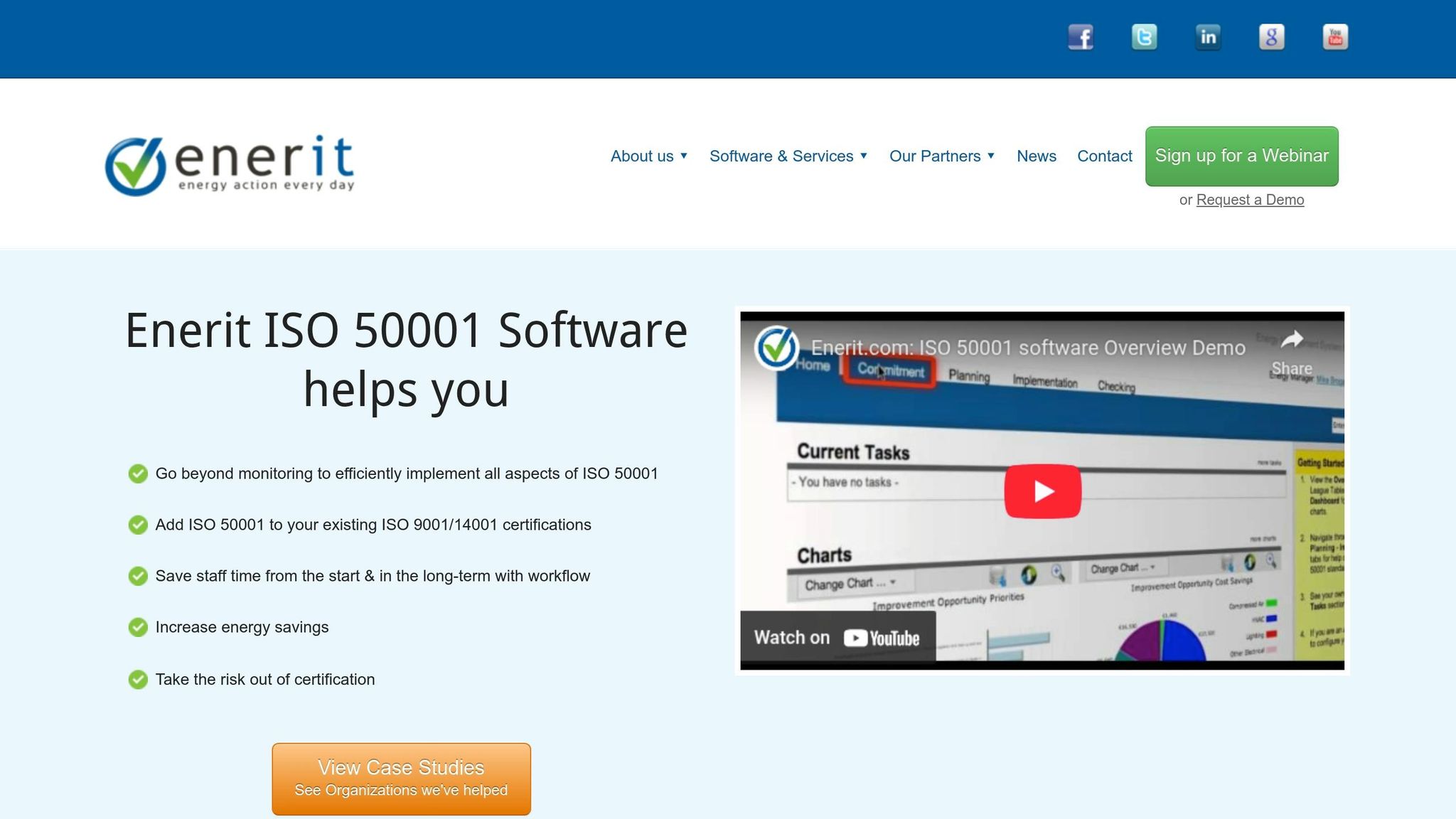
Enerit.com: ISO 50001 software Overview Demo
sbb-itb-501186b
Quick Comparison
| Feature | Enersee | ioTORQ EMIS | EnergyCAP | Enerit ISO 50001 Software | GridPoint |
|---|---|---|---|---|---|
| Focus | AI, PDCA, anomaly alerts | Data centralization | Financial tracking | Workflow and audits | IoT, equipment insights |
| Baseline Type | Dynamic/contextual | Configurable | Utility-based | Energy reviews | Equipment-level |
| EnPI Tracking | Automated/AI | Supported | Supported | Integrated charts | IoT-based |
| Reporting | M&V, benchmarking | ISO 50001 aligned | Cost-focused | Management reviews | Real-time equipment data |
| Anomaly Detection | AI-driven alerts | Threshold-based | Limited | Manual setup | Equipment health |
These tools simplify ISO 50001 compliance, making energy management more efficient and measurable.
1. Enersee
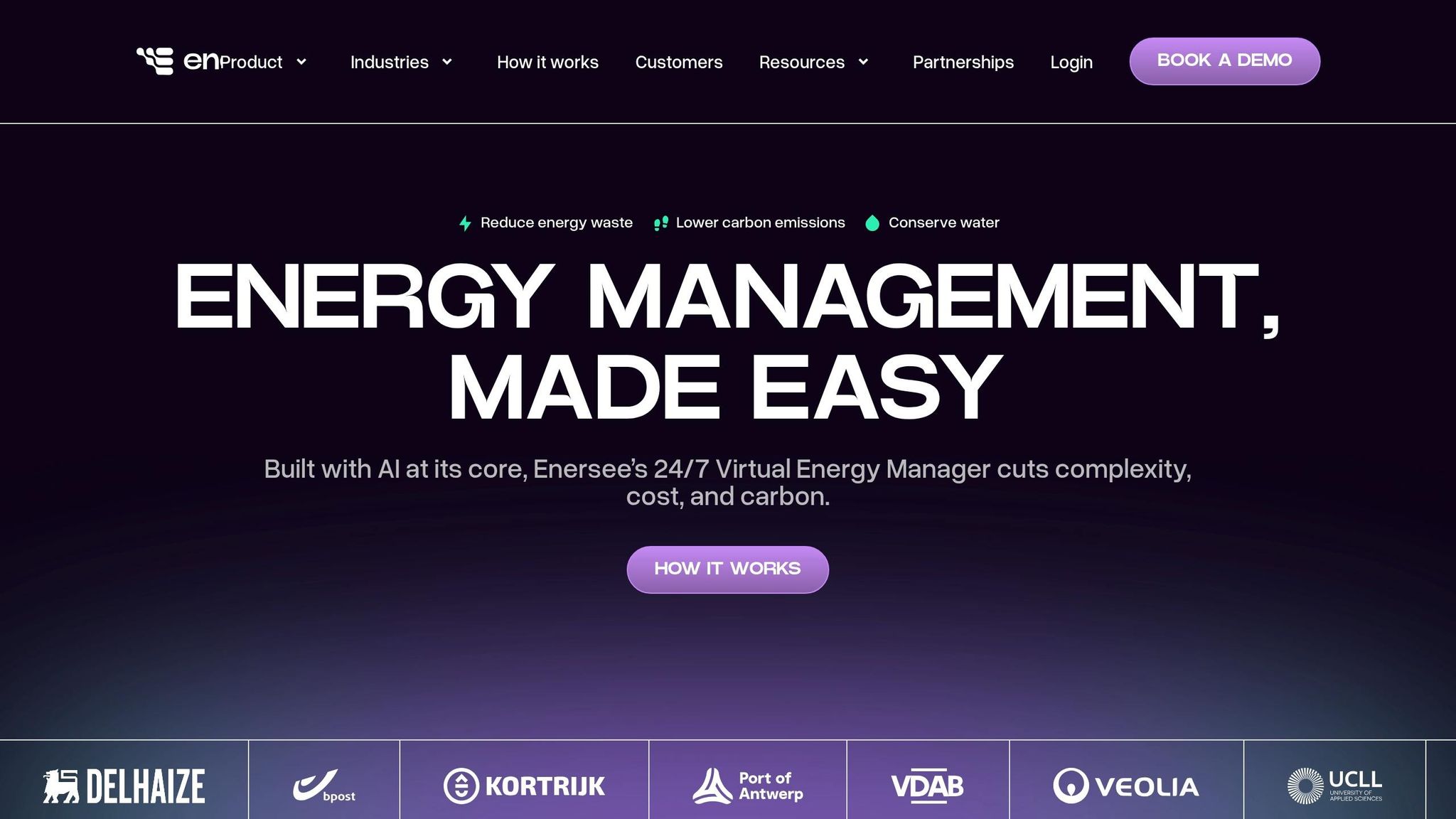
Enersee acts as a "24/7 Virtual Energy Manager" tailored specifically for ISO 50001 compliance. Instead of being just another monitoring tool, it combines monitoring, project tracking, and strategic planning into a seamless workflow that directly aligns with the standard's framework. This transforms energy management from a periodic task into an ongoing daily practice, which is crucial for maintaining continuous control during surveillance audits. Let’s dive into how Enersee supports the ISO 50001 PDCA cycle.
PDCA Cycle Support
Enersee is built around the Plan-Do-Check-Act (PDCA) cycle, which lies at the heart of ISO 50001.
- Plan: Enersee automates the creation of energy baselines, tracks Energy Performance Indicators (EnPIs), and identifies Significant Energy Uses (SEUs) through dynamic models - eliminating the need for static spreadsheets.
- Do: It introduces continuous monitoring, supported by AI-powered anomaly detection, to ensure energy performance stays on track.
- Check: The platform’s built-in Measurement and Verification (M&V) tools validate energy-saving projects, comparing actual results to expected outcomes.
- Act: By analyzing recurring patterns and benchmarking performance across portfolios, Enersee helps refine energy strategies over time.
With these features, Enersee ensures that organizations can seamlessly implement the PDCA cycle while maintaining robust data integration for real-time insights.
Data Integration Capabilities
Enersee eliminates the hassle of manual monthly reporting by offering real-time telemetry every 15 minutes, delivering live performance updates across entire portfolios. It combines raw energy consumption data with contextual factors like weather conditions and building metadata to create dynamic, accurate models. By centralizing data that might otherwise be scattered across multiple systems, Enersee ensures consistent records for baselines, EnPIs, and SEUs. This approach provides audit-ready documentation at all times, avoiding the last-minute rush to prepare for certification deadlines.
Anomaly Detection Features
Traditional fixed-threshold alarms can often lead to false positives, but Enersee takes a smarter approach. Using AI, it models the specific behavior of each building and flags deviations in context. This means it can quickly pinpoint issues like unexpected energy use during off-hours, allowing small teams to focus on critical control points without being overwhelmed by manual monitoring.
A great example of this in action is VDAB, a public employment agency in Flanders, Belgium. In 2025, they deployed Enersee across 140 sites, covering about 4,305,560 square feet (400,000 m²). The results? A 53% reduction in primary energy consumption, 30% more energy savings than initially expected, and an impressive 162% ROI in the same year. These AI-driven insights integrate directly into ISO 50001 workflows, ensuring meticulous audit preparedness.
ISO 50001-Specific Workflows
Enersee automates essential ISO 50001 processes, enabling continuous energy management. Its dynamic baselines, enriched with contextual variables, modernize the way baselines are calculated. The platform also uses its M&V capabilities to validate energy-saving projects with measurable data, addressing a common audit issue: unverified savings claims.
This automation significantly reduces the time spent on audit preparation. Where organizations might previously have spent over 40 hours preparing, Enersee cuts this down to less than five. By streamlining these workflows, Enersee ensures that teams can focus on achieving real energy improvements rather than getting bogged down in manual processes.
2. ioTORQ EMIS
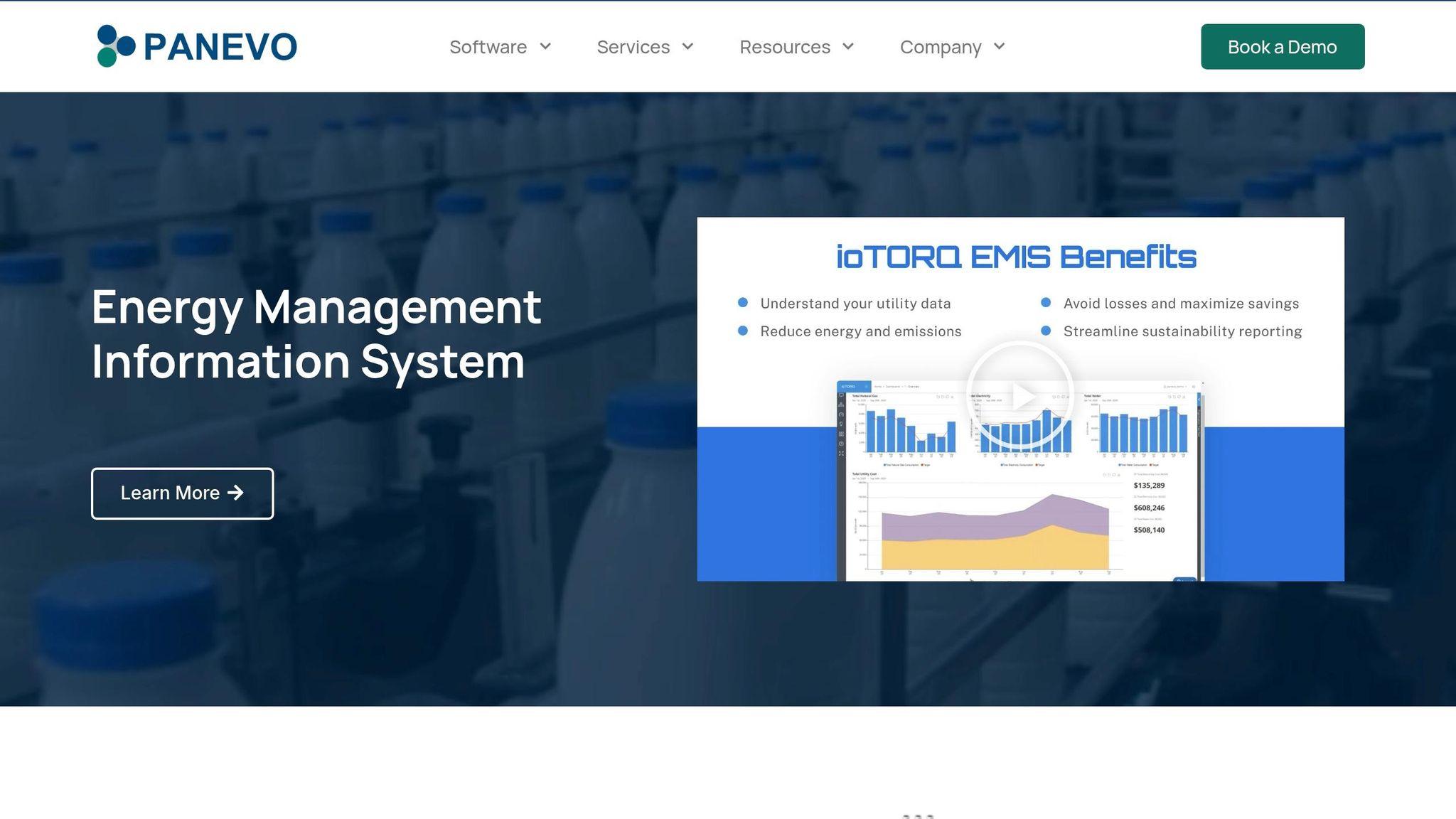
ioTORQ EMIS is a modular platform built on Microsoft Azure, designed to align with ISO 50001 standards while accommodating the unique needs of different organizations. Its flexibility allows businesses to customize internal processes, making it a practical choice for teams seeking tailored solutions. The platform offers tools to support every phase of the ISO 50001 PDCA cycle, alongside features like data integration, anomaly detection, and workflow customization.
PDCA Cycle Support
ioTORQ EMIS is designed to guide organizations through the entire Plan-Do-Check-Act (PDCA) cycle. In the Plan phase, its modeling tool uses multivariate regression to create precise baselines and targets. During the Do phase, real-time alerts ensure energy performance stays on track with established goals. The Check phase focuses on validating project results against initial expectations, while the Act phase includes project management tools to support ongoing improvements. Companies can configure workflows to match their energy management maturity and specific needs.
Data Integration Capabilities
The platform excels at consolidating data from multiple sources, including FTP(s), HTTP(s), process historians, IIoT devices, and third-party websites. Its Utility Bill Management module simplifies corporate reporting and benchmarking by automating data aggregation. A schematic builder enhances usability, allowing users to map meter data onto system models for real-time performance visualization. With SOCII Type 1 and Type 2 certifications, ioTORQ EMIS also ensures high-level data security.
Anomaly Detection Features
Leveraging its integrated data capabilities, ioTORQ EMIS uses machine learning to detect anomalies and optimize asset performance in real time. Automated alerts notify users of deviations from targets or potential data errors, enabling quick responses without the need for constant manual monitoring.
ISO 50001-Specific Workflows
The platform simplifies EnPI (Energy Performance Indicator) tracking by allowing users to define KPIs and set intelligent targets across various levels - assets, departments, and facilities. It also supports auditable carbon reporting in line with international standards and provides customizable dashboards for better sustainability insights. While integrating the platform into existing operations can pose challenges, dedicated customer support is available to assist with any issues.
3. EnergyCAP
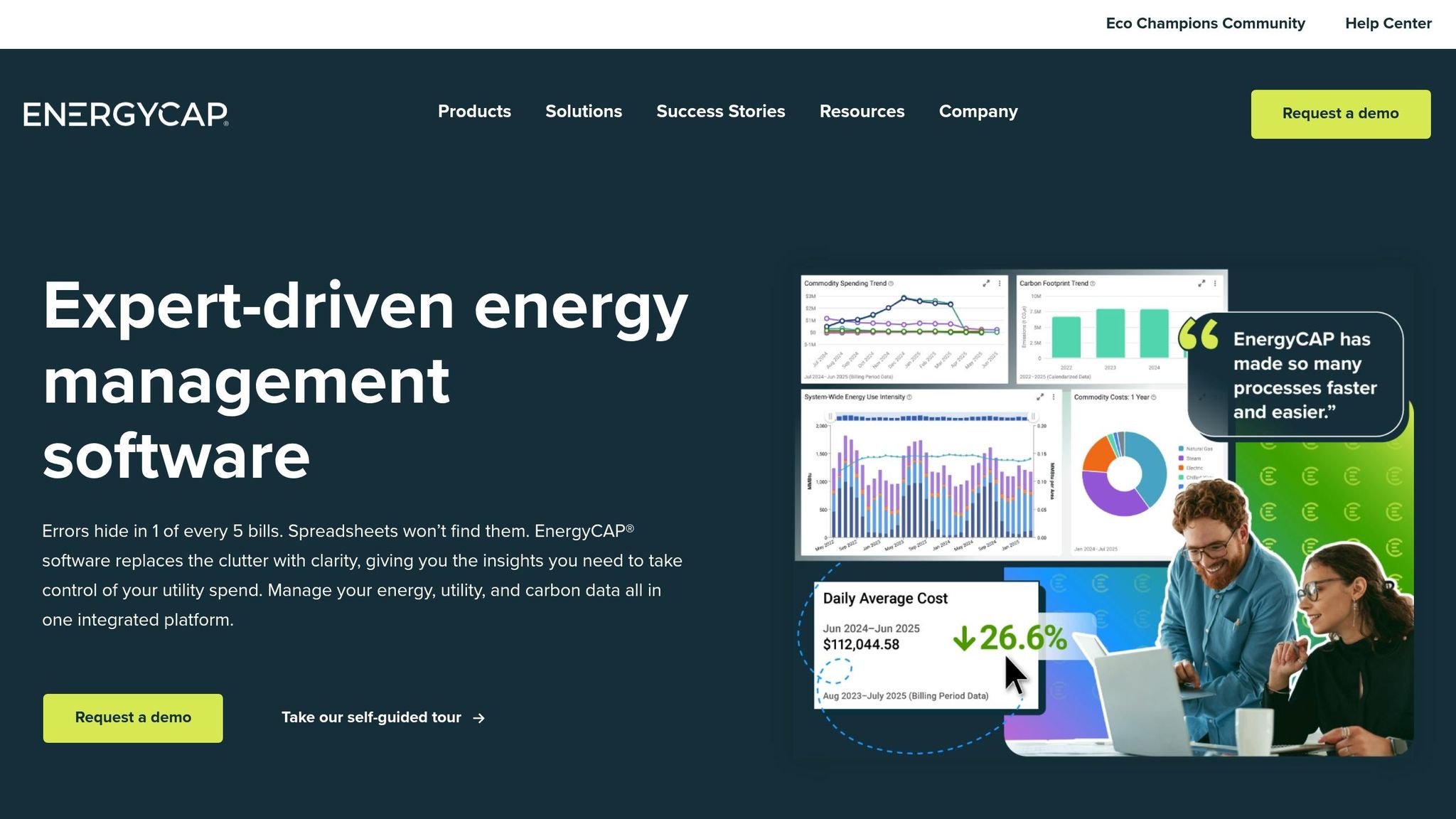
EnergyCAP stands out among ISO 50001-compliant tools by focusing on both energy efficiency and cost management. This platform adopts a financial-first approach, making it especially useful for organizations that aim to link utility expenses with ISO 50001 compliance. EnergyCAP consolidates utility bills, smart meter interval data, rate schedules, and emissions data into one centralized system, eliminating the need for manual recordkeeping. Impressively, over half of EnergyCAP’s customers reduce their annual utility costs by at least 10%. Additionally, the platform manages over $100 billion in utility bill value annually for more than 26,000 users.
PDCA Cycle Support
EnergyCAP aligns closely with the ISO 50001 framework by supporting every phase of the Plan-Do-Check-Act (PDCA) cycle. In the Plan phase, it facilitates benchmarking and baseline establishment. During the Do phase, the platform tracks Energy Conservation Measure (ECM) implementation. The Check phase leverages Measurement and Verification (M&V) tools that adhere to IPMVP standards, alongside real-time interval data monitoring. Finally, in the Act phase, automated reporting and customizable dashboards provide actionable insights for management reviews and strategic decisions. By integrating seamlessly with energy data, EnergyCAP simplifies energy cost management across the PDCA cycle.
Data Integration Capabilities
EnergyCAP excels in automating data workflows, saving time and reducing errors. Its Bill CAPture Services automatically import utility data from various formats, saving organizations an average of 350 employee hours annually. The platform also integrates with Accounts Payable (AP) and General Ledger (GL) systems, bridging energy and financial workflows. Additionally, it synchronizes with ENERGY STAR Portfolio Manager to help organizations meet local and state requirements. EnergyCAP users identify and resolve over 1 million billing errors annually and flag 375,000 unusual bills related to usage, costs, or demand. These proactive measures help customers save approximately 5% on utility bills each month by catching issues early through automated validation.
ISO 50001-Specific Workflows
EnergyCAP provides tools for creating energy baselines normalized for factors like weather, floor area, and production data, ensuring accurate performance tracking from a financial perspective. Its M&V features allow organizations to define baselines, establish reporting periods, and measure savings from ECMs. Beyond its utility bill management and cost tracking capabilities, EnergyCAP offers comprehensive documentation tools that simplify the ISO 50001 certification process, making compliance more manageable.
4. Enerit ISO 50001 Software
Enerit provides a workflow-driven solution designed to help organizations meet ISO 50001 compliance requirements. It manages key aspects like significant energy uses, action reports, and the entire energy planning process seamlessly. In March 2018, Germany's Federal Office for Economic Affairs and Export Control (BAFA) officially recognized Enerit as qualified Energy Management System software. The software is available in two versions: Enerit Systematic Energy Manager, which complements existing ISO 9001 or ISO 14001 systems, and Enerit ISO 50001 Manager Pro, a standalone platform offering additional features like document control and audit management.
PDCA Cycle Support
Enerit aligns its functionality with the PDCA (Plan-Do-Check-Act) cycle, a cornerstone of ISO 50001.
- Plan Phase: The software includes tools like Sankey diagrams to conduct energy reviews, establish baselines, and set Energy Performance Indicators (EnPIs).
- Do Phase: It automates task assignments, complete with deadlines and email reminders, ensuring smooth execution of energy-saving actions.
- Check Phase: Enerit generates management reports, EnPI charts, and dashboard analytics. For users of the Manager Pro version, audit management modules are also included.
- Act Phase: The software helps schedule management reviews and track corrective actions, ensuring continuous improvement.
Data Integration Capabilities
Enerit connects with existing energy monitoring systems, automatically calculating EnPIs and populating management reports. This integration allows organizations to leverage their current systems while adding the necessary workflow and documentation layers for ISO 50001 compliance. For companies already using ISO 9001 or ISO 14001, the Systematic Energy Manager version minimizes administrative overlap, making compliance more efficient.
ISO 50001-Specific Workflows
Enerit takes it a step further by offering workflows tailored specifically for ISO 50001. These workflows help organizations identify and prioritize energy improvement opportunities, simplifying the process of building business cases for energy management projects. The software also includes tools for capturing energy baselines and EnPIs, allowing users to visualize energy usage patterns effectively.
"pulls all aspects of the standard into ONE manageable package and greatly simplifies the process" - Paul Farrell, Energy Lead at a global pharmaceutical company
The Manager Pro version expands on these features with additional workflows for audit management, tracking non-conformances, and documenting legal requirements.
5. GridPoint

GridPoint blends hardware, IoT integration, and analytics to deliver real-time energy management at the equipment level. With its platform, customers have saved over $1.5 billion in energy costs, cut down more than 10.6 billion kWh of energy usage, and avoided over 18.5 billion lbs of CO₂ emissions. While GridPoint shines in operational control, organizations aiming for ISO 50001 certification will need additional systems to handle formal PDCA documentation and provide audit-ready evidence.
Data Integration Capabilities
GridPoint's strength lies in its ability to integrate and analyze data deeply. It collects energy data from both within the facility and the utility grid, combining facility performance metrics with demand response signals. The platform supports main load metering for entire sites and submetering for specific equipment like HVAC systems, refrigeration units, and lighting. This detailed data capture helps organizations pinpoint Significant Energy Uses (SEUs), a critical aspect of ISO 50001 compliance. Additionally, its API integrations allow seamless sharing of data with third-party management tools, creating a unified dashboard that consolidates equipment details, historical trends, and overall building performance.
Anomaly Detection Features
GridPoint uses automated systems to identify inefficiencies in equipment. For instance, its HVAC health monitoring can spot minor issues early, prioritizing alerts through real-time diagnostics. A notable success story is a New Jersey Auto Mall, which saved over $1.7 million annually by leveraging GridPoint's optimization tools. The platform also employs advanced control algorithms to manage peak energy demand and automate asset scheduling, ensuring continuous operational improvements. These features tie directly into the PDCA cycle, ensuring ongoing efficiency.
PDCA Cycle Support
GridPoint actively supports the Plan-Do-Check-Act (PDCA) cycle by utilizing its operational data. During the Plan phase, granular data highlights inefficiencies. The Do phase is driven by automated controls and optimization algorithms. Real-time diagnostics and submetering are essential for the Check phase, while automated anomaly detection and equipment optimization recommendations guide the Act phase.
Feature Comparison Table
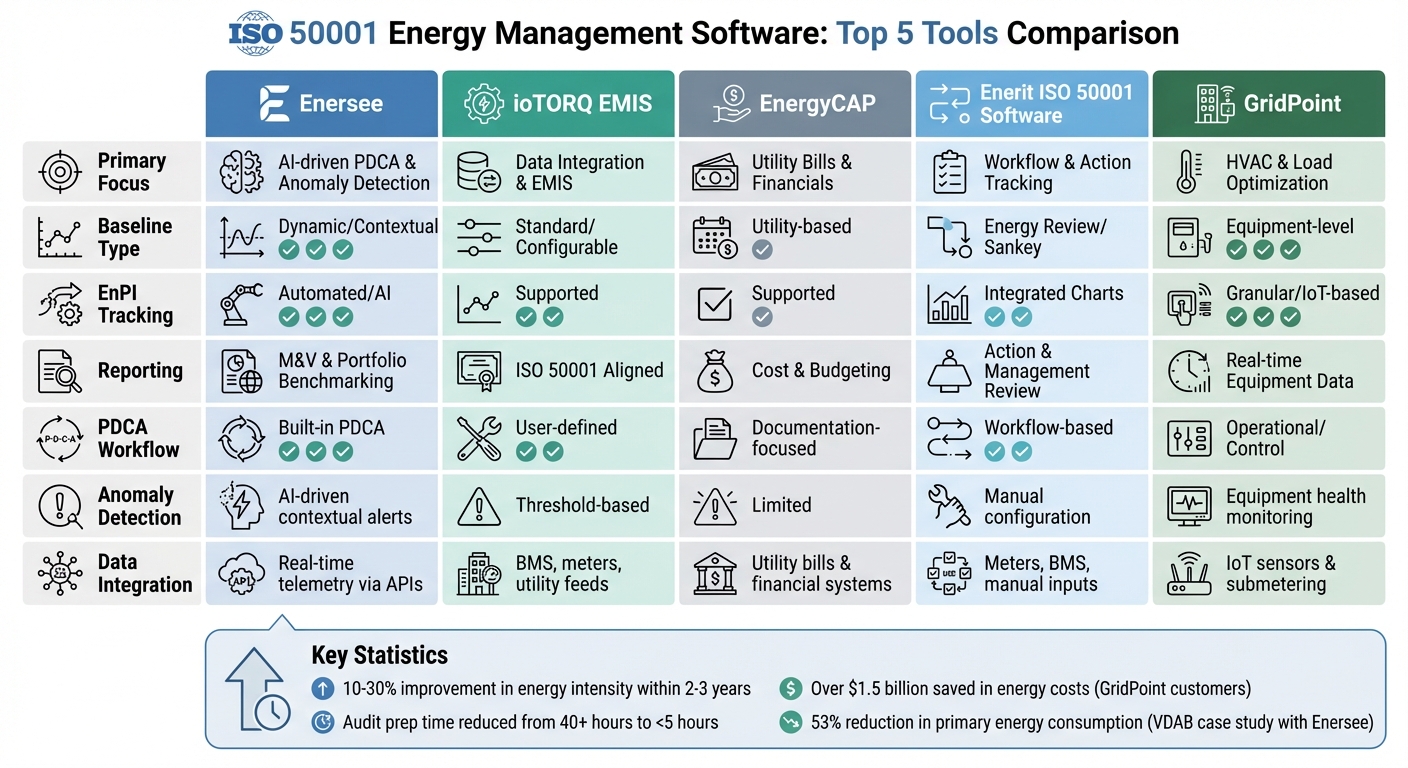
Selecting the right energy management software depends on your priorities - whether it's automating workflows, tracking financials, or enabling real-time monitoring. Each tool specializes in different areas, so understanding how they stack up against key ISO 50001 features can make your decision easier. Here's a quick-reference table summarizing the main capabilities of Enersee, ioTORQ EMIS, EnergyCAP, Enerit ISO 50001 Software, and GridPoint.
| Feature | Enersee | ioTORQ EMIS | EnergyCAP | Enerit ISO 50001 Software | GridPoint |
|---|---|---|---|---|---|
| Primary Focus | AI-driven PDCA & Anomaly Detection | Data Integration & EMIS | Utility Bills & Financials | Workflow & Action Tracking | HVAC & Load Optimization |
| Baseline Type | Dynamic/Contextual | Standard/Configurable | Utility-based | Energy Review/Sankey | Equipment-level |
| EnPI Tracking | Automated/AI | Supported | Supported | Integrated Charts | Granular/IoT-based |
| Reporting | M&V & Portfolio Benchmarking | ISO 50001 Aligned | Cost & Budgeting | Action & Management Review | Real-time Equipment Data |
| PDCA Workflow | Built-in PDCA | User-defined | Documentation-focused | Workflow-based | Operational/Control |
| Anomaly Detection | AI-driven contextual alerts | Threshold-based | Limited | Manual configuration | Equipment health monitoring |
| Data Integration | Real-time telemetry via APIs | BMS, meters, utility feeds | Utility bills & financial systems | Meters, BMS, manual inputs | IoT sensors & submetering |
Enersee stands out with its AI-powered PDCA automation and anomaly detection, while EnergyCAP focuses on utility and financial tracking. Enerit simplifies action management with workflow tools, GridPoint delivers granular equipment-level insights, and ioTORQ EMIS excels in centralizing diverse data for custom workflows.
When choosing a platform, think about how well it supports the full PDCA cycle versus just specific functions like monitoring or reporting. Tools that detect contextual deviations - such as those influenced by weather or production schedules - can help avoid unnecessary alerts, reducing false positives. Additionally, consider whether the software includes built-in Measurement and Verification (M&V) capabilities. These are crucial for validating energy-saving projects and meeting ISO 50001 audit requirements.
Conclusion
Implementing ISO 50001 doesn’t have to mean endless spreadsheets or scrambling for audits. With the right software, compliance becomes an opportunity to gain a strategic edge. Many organizations report a 10–30% improvement in energy intensity within just 2–3 years of adopting ISO 50001. These results highlight why choosing the right tool is essential for a smooth and effective integration.
Each software option offers distinct advantages: Enersee stands out with its AI-powered anomaly detection and automated PDCA cycles, ioTORQ EMIS provides modular flexibility for diverse data needs, EnergyCAP focuses on utility bill management and financial clarity, Enerit covers workflows comprehensively, and GridPoint delivers detailed equipment-level insights using IoT hardware. Together, these platforms help organizations move beyond basic compliance to achieve continuous improvement.
The potential benefits are substantial. Industrial facilities with advanced ISO 50001 systems can save over $2 million annually in energy costs. Digital tools also drastically cut audit preparation time - from over 40 hours to less than 5 hours - allowing teams to dedicate their efforts to real energy improvements rather than administrative tasks.
When selecting software, prioritize platforms that support the full PDCA cycle instead of just offering data visualization. Built-in Measurement and Verification (M&V) capabilities are crucial, as they provide auditor-approved data for assessments. Additionally, seamless integration with existing meters, Building Management Systems, and utility providers reduces the risk of manual data entry errors.
By embracing digital tools, companies can shift their focus from mere compliance to achieving sustained energy performance.
"It pulls all aspects of the standard into ONE manageable package and greatly simplifies the process." - Paul Farrell, Energy Lead at a global pharmaceutical company
Whether your focus is AI automation, workflow management, or equipment-level insights, the right software transforms ISO 50001 from a burdensome task into a driver of ongoing efficiency and improvement.
FAQs
Which ISO 50001 tool fits my organization best?
The right ISO 50001 energy management software depends on what you're looking for. If simplifying compliance is your priority, Baseline 50001 might be your best bet. For a more all-encompassing toolset, including features like audit management, check out Enerit ISO 50001 Manager Pro.
Looking for automation? AI-powered EnMS software can streamline your energy management processes. If measurable energy performance is a key focus, Oxmaint is designed with that in mind. Lastly, ISO Align offers seamless integration of ISO 14001 and ISO 50001 standards for those managing multiple frameworks.
Your choice should align with your specific needs, whether that's ease of use, automation, or integration capabilities.
What data sources should the software integrate with?
The software needs to connect seamlessly with essential data sources, including meters, building systems, utility inputs, and energy performance indicators (EnPIs). Additionally, it should handle both historical energy data and real-time energy monitoring. This combination is crucial for efficient energy management and staying on track with ISO 50001 compliance.
Do I need built-in M&V for ISO 50001 audits?
Built-in Measurement & Verification (M&V) isn't a requirement for ISO 50001 audits. However, having solid M&V processes in place can make a big difference. They help prove energy performance improvements and make compliance easier to demonstrate. Plus, they provide measurable results that can streamline the audit process.