


How to Choose Between Online and In-Person Compliance Training
Choosing between online and in-person compliance training depends on your goals, team needs, and budget. Here's a quick breakdown to help you decide:
- Online Training: Flexible, cost-effective, and ideal for remote teams or self-paced learning. Great for theoretical topics and certification tracking.
- In-Person Training: Hands-on, interactive, and better for complex or practical skills. Suited for team-building and immediate feedback.
Key Considerations:
- Training Goals: Define whether the focus is certifications, skills, or legal compliance.
- Team Needs: Assess size, roles, and location. Remote teams may benefit from online options, while on-site teams might prefer in-person formats.
- Costs: Online training often saves money, with lower recurring costs compared to in-person sessions.
- Scheduling: Online training offers 24/7 access, while in-person requires fixed schedules.
- Retention: Online tools like microlearning and gamification improve retention, but in-person training excels in engagement and hands-on learning.
- Documentation: Online platforms simplify tracking and compliance audits, while manual records are common in in-person formats.
Quick Tip: A hybrid approach - combining online modules for theory and in-person sessions for practical skills - can balance flexibility and effectiveness.
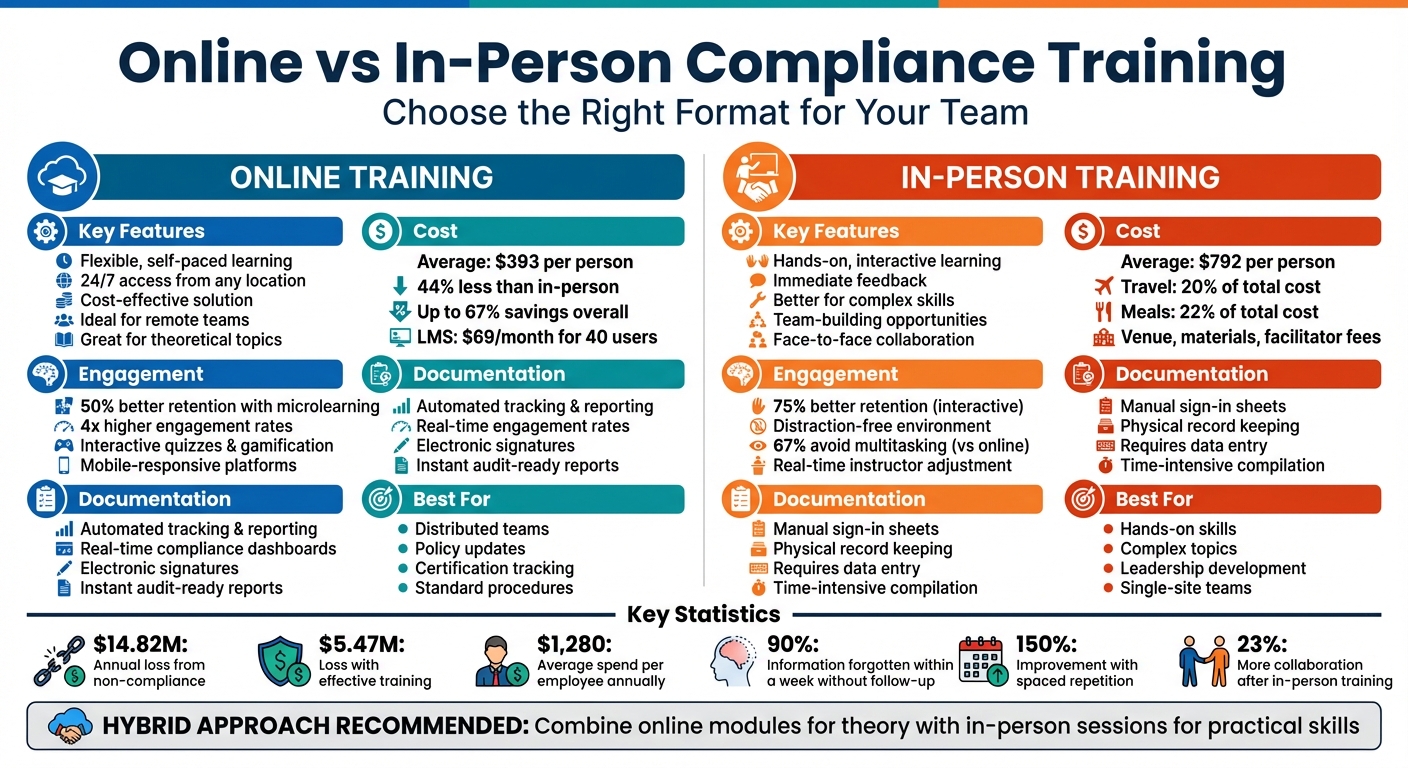
Online vs In-Person Compliance Training Comparison Guide
Online vs In Person Training Which Wins?
sbb-itb-501186b
Identify Your Compliance Training Goals
Picking the right training format starts with knowing exactly what you want to achieve. Is your focus on meeting regulations, earning certifications, or filling skill gaps? Defining these goals upfront ensures your efforts are targeted and effective.
Set Clear Training Objectives
Start by asking yourself: Is the goal certification, skill development, or regulatory compliance? For example, in the electrical field, compliance with OSHA standards is non-negotiable. Certifications like OSHA 10 or 30-hour cards are often required to show that your team is prepared to identify and mitigate workplace hazards.
Before enrolling in any program, confirm whether online OSHA certifications meet the requirements of unions, job sites, or state regulations. Some certifications might mandate in-person training sessions. Skipping proper compliance training can be costly - companies that fail to invest in this area lose an average of $14.82 million annually due to non-compliance, compared to $5.47 million for those that prioritize effective training.
By clearly defining your objectives, you’ll have a better roadmap for assessing your team’s needs.
Review Your Workforce Needs
Your team’s size, roles, and locations are critical factors in choosing the right training approach. Conducting a Training Needs Assessment at the organizational, occupational, and individual levels can help you identify specific gaps.
For instance, if your electricians are spread across various job sites, online training offers the flexibility to fit different schedules. This is especially helpful for professionals who rely on platforms like Electrical Trader (https://electricaltrader.com), as they frequently work in multiple locations and need adaptable learning options. On the other hand, if your team operates from a single site and requires hands-on learning - like detailed walkthroughs of procedures - in-person training might be the better choice.
Leverage tools like mock audits, anonymous feedback, and data-driven reviews to pinpoint areas for improvement. Interestingly, only 10% of employees feel that compliance training has made a meaningful impact on their job, and fewer than 23% rate their training as "excellent". This highlights the need to tailor your training to the real-world responsibilities and challenges your team encounters.
Once you’ve identified your objectives and workforce needs, the next step is ensuring your training aligns with the relevant regulations.
Know the Regulations That Apply
Understanding the regulations that govern your industry is essential for crafting effective training programs. For electrical work, OSHA standards outlined in 29 CFR 1910 and 29 CFR 1926 are key.
"Compliance training must address each role's legal and operational responsibilities." - D2L
Training should address the specific risks tied to each role. For example, finance teams managing purchase cards might need Anti-Money Laundering (AML) training, while electricians working in the field could require Bloodborne Pathogens certification if there’s a risk of exposure to infectious materials.
Many certifications need regular updates. For instance, HIPAA and Information Security Awareness often require annual renewal, while some states mandate OSHA 10/30 cards be renewed every five years. Using a Learning Management System (LMS) to send reminders 30 days before certifications expire can help you maintain compliance without any hiccups.
Compare Costs and Budget Requirements
Once you've outlined your training objectives, it's time to tackle the financial side of things. Evaluating costs allows you to make informed decisions without compromising on quality. When comparing online and in-person training, it’s important to consider both the obvious expenses and the hidden ones.
Cost Breakdown by Format
In-person training comes with a variety of expenses: venue rental, facilitator fees, travel, catering, and printed materials. A 2019 study revealed that in-person training costs about $792 per participant, with travel and meals accounting for 20% and 22% of the total costs, respectively.
On the other hand, online training involves costs like LMS (Learning Management System) subscriptions, content creation tools, and ongoing technical support. For example, TalentLMS charges $69 per month for up to 40 users, while iSpring Learn costs between $2.29 and $3.14 per active user each month.
"eLearning courses, while often costing more to design and develop, don't cost as much in the presentation phase. In contrast, offline courses tend to cost less to develop, but more to present." - eLearning Industry
Virtual training proves to be a more budget-friendly option in many cases. A study comparing the two formats found that virtual training costs averaged $393 per person - 44% less than in-person sessions. Additionally, research shows that eLearning can save organizations up to 67% on training costs.
Calculate Total Training Costs
To get a full picture of your training expenses, add up both direct costs (such as instructor fees, venue rental, materials, and travel) and indirect costs (like employee wages during training, administrative time, and IT support).
For example, you can estimate employee downtime costs by multiplying their hourly rate by the training duration, then adding 10–20% for managerial oversight. On average, organizations spend $1,280 per employee annually on workplace learning.
For online training, divide your development costs by the expected number of participants to calculate the per-person expense. For instance, if you spend $10,000 creating a course that will be used by 500 employees, the development cost per person is $20. In contrast, in-person training incurs recurring facilitator fees each time the session is conducted.
Tips for Training on a Budget
- Start with pre-built content: For standardized topics like HIPAA, GDPR, or OSHA compliance, many LMS platforms offer pre-existing libraries that are far more affordable than custom development. TalentLMS, for example, has a "Forever-Free" plan for up to 5 users, which works well for small teams.
- Blend online and in-person training: Use online modules for theoretical knowledge and save in-person sessions for hands-on skills that require physical practice. This approach is especially useful for industries like electrical work, where technicians often train during downtime instead of traveling to dedicated sessions.
- Choose an LMS with automation features: Look for platforms that handle certification tracking and reminders automatically. Some systems even allow internal subject matter experts to create courses using AI-powered tools, cutting down on the need for external instructional designers. For specialized training, consider hiring consultants strategically - rates often start at $100 per hour.
These strategies can help you optimize your training budget, ensuring both efficiency and compliance, while paving the way for effective scheduling.
Review Flexibility and Scheduling Needs
Integrating training into your team’s daily routine is essential for meeting compliance requirements without disrupting operations. The training format you select plays a big role in how smoothly this integration happens.
Match Training to Employee Schedules
Online training offers employees the flexibility to tackle learning at their own pace. With asynchronous delivery, scheduling conflicts become a thing of the past, as each employee can complete modules whenever it works best for them.
On the other hand, in-person training requires everyone to attend at the same time, which can be tricky for teams working around the clock or spread across multiple locations. Microlearning - short, focused lessons - provides another option, allowing employees to squeeze in training during short breaks or downtime.
This flexibility helps keep workflows running with minimal interruptions.
Maintain Workflow During Training
A key factor in compliance training is ensuring that it doesn’t disrupt operations. Online training shines here, as it allows employees to complete courses from their workstations, keeping productivity intact. The Health & Safety Institute (HSI) emphasizes this by noting that moving temporary worker safety training online lets companies "sit each temp employee down at a computer so they can train and you can walk away without any worry about training activity being recorded, scheduling, or lost productivity".
With 24/7 access, online training fits seamlessly into shift-based environments. Embedding training into platforms like Microsoft Teams or Slack keeps learning integrated into the workday. Automated reminders can also help by prompting employees to complete refresher courses as certifications approach expiration, avoiding last-minute scheduling hurdles.
In contrast, in-person training often means pulling employees away from their duties for extended periods. This can be disruptive, especially for businesses that rely on continuous workflows.
Scheduling Comparison: Online vs. In-Person
Here’s a quick look at how the two formats compare when it comes to scheduling:
| Feature | Online Training | In-Person Training |
|---|---|---|
| Flexibility | High – available 24/7 from any location | Low – requires attendance at specific times/places |
| Scheduling Ease | Easy – self-paced learning | Difficult – involves coordinating instructors and staff |
| Employee Access | Broad – accessible via mobile devices or work apps | Limited – physical presence often required |
| Workflow Impact | Minimal – can be done in short increments | Significant – requires time away from regular tasks |
For frontline workers, such as electricians or technicians who don’t have consistent desk access, mobile-responsive platforms with offline capabilities are a game-changer. These tools ensure training continues even without a stable internet connection, making compliance easier to manage for those in the field.
Recognizing these challenges, Electrical Trader supports electrical professionals by providing practical insights and solutions that help them balance operational needs with essential training.
Measure Training Effectiveness and Retention
Effective training isn't just about delivering information - it's about ensuring employees retain that knowledge over time. Choosing the right training format plays a big role in helping employees remember critical compliance details.
Engagement Tools and Methods
In-person training creates a distraction-free environment, helping employees stay focused. Unlike virtual settings, where multitasking is common - 67% of employees admit to checking emails or browsing during online sessions - in-person sessions keep attention on the material. Facilitators can also use body language and eye contact to gauge participants' understanding and adjust their approach in real time.
Online training combats distraction by using interactive tools like quizzes, branching scenarios, and gamification elements such as progress bars, badges, and leaderboards. Microlearning, where lessons are broken into 5–10 minute chunks, prevents cognitive overload and keeps learners engaged. Mobile-first platforms make it even easier, allowing employees to complete training during downtime, fitting learning into their busy schedules.
For a middle ground, virtual instructor-led training (VILT) combines the flexibility of online learning with the interactivity of in-person sessions. Features like breakout rooms, live Q&A, and direct facilitator interaction replicate many benefits of face-to-face training.
Knowledge Retention by Format
The way training is delivered affects how much employees remember. Interactive environments help learners retain up to 75% more information compared to passive formats like pre-recorded videos. Whether it's online or in person, the key is keeping learners actively engaged.
Mobile microlearning takes this a step further, boosting retention by 50% and increasing engagement rates fourfold. These bite-sized lessons make it easier for employees to absorb information and apply it immediately.
In-person training is especially effective for hands-on learning. Using physical tools or equipment alongside group problem-solving exercises helps employees internalize material more deeply. However, without consistent follow-up, learners can forget up to 90% of new information within a week. To counteract this, online spaced repetition - using automated reminders and follow-up modules - can improve long-term recall by as much as 150%.
This combination of engagement and reinforcement creates a strong foundation for effective learning and collaboration.
Immediate Feedback and Group Learning
One of the standout benefits of in-person training is the ability to provide immediate feedback. Instructors can quickly address confusion or disengagement, ensuring complex compliance topics are understood.
"The human element matters - especially in complex topics... where immediate clarification can prevent misunderstanding and accelerate learning." – Data Society
Face-to-face training also encourages collaboration. Spontaneous discussions, group exercises, and problem-solving activities lead to "aha" moments that stick with employees well beyond the session. Building relationships during training has lasting benefits too - employees who connect with colleagues during training are 23% more likely to collaborate effectively later.
Online training, on the other hand, often relies on asynchronous communication like message boards or email, which can delay feedback. However, well-designed VILT sessions that include live chat, polling, and real-time Q&A can help close this gap.
These feedback and collaboration opportunities not only improve learning outcomes but also make it easier to track progress during compliance checks. For electrical professionals juggling fieldwork and compliance, Electrical Trader offers practical tips to seamlessly integrate these strategies.
Track Documentation and Certifications
Keeping accurate training records isn’t just a good practice - it’s essential for ensuring your team is prepared for certifications and audits. Proper documentation not only supports legal requirements but also demonstrates the effectiveness of your training strategy. The format you choose for record-keeping can make all the difference when it’s time to prove compliance.
Record and Monitor Training Progress
Online training platforms have made tracking employee progress much simpler. These systems automatically log training completion, offering features like real-time dashboards that show who’s compliant and flagging certificates nearing expiration.
"Online training offers trackability, enabling organizations to measure engagement levels and assess employees' comprehension of the learning content." – Kelsey Botne, Director of Learning, eduMe
In contrast, in-person training relies on physical sign-in sheets and manual data entry, which can be cumbersome - especially for teams spread across multiple locations. A hybrid approach can bridge this gap. For example, you could combine in-person sessions with quick online microlearning modules to create a digital record while still benefiting from face-to-face interaction.
Once you’ve established a reliable digital record-keeping system, you’ll be better prepared to meet the demands of audits and compliance checks.
Prepare for Audits and Compliance Checks
Audits require more than just attendance logs; they demand proof that employees understood the material. Online platforms simplify this process by generating detailed reports on completion rates, assessment scores, and even electronic signatures - all ready for review at a moment’s notice.
"Check if there are any legal or industry requirements for training completion records or records of assessment passing. Consider whether this will be easier and more scalable to be managed in-person or online." – eduMe
In-person training, on the other hand, involves manually compiling records, which increases the risk of missing key documentation. If your industry requires certifications with fixed expiration dates - common in fields like electrical work, healthcare, and manufacturing - online systems can automatically track and renew credentials. This eliminates the need for manual reminders and scheduling of refresher sessions.
For professionals in industries like electrical work, where fieldwork adds to the complexity of compliance, platforms like Electrical Trader provide tools and resources to streamline documentation, no matter the training format.
Conclusion
Aligning your training format with both operational goals and compliance requirements is all about finding the right fit. Deciding between online and in-person training depends on your specific needs. For teams spread across different locations or for straightforward topics like standard operating procedures or policy updates, online training provides the flexibility and cost efficiency that make sense. On the other hand, when it comes to hands-on skills, leadership development, or complex subjects requiring immediate feedback, in-person sessions offer the kind of engagement and practice that digital platforms can’t fully replicate.
"We don't believe it's an either/or. With there being benefits to both in-person and online training, it's important to leverage the strengths of both approaches to achieve exceptional results." – Kelsey Botne, Director of Learning, eduMe
Budget considerations also play a big role. Between June 2019 and August 2020, research revealed that virtual training led to 12–14% higher skill proficiency rates while saving around $399 per clinician. This blend of cost savings and measurable results highlights the importance of choosing the right format for your training needs.
A hybrid approach often works best: use online modules for preboarding and refresher training, while reserving in-person sessions for high-stakes activities and team-building exercises. This method not only stretches your training budget but also caters to the varied learning preferences of your workforce.
For electrical professionals dealing with complex compliance requirements, tailored solutions can make a real difference. Platforms like Electrical Trader provide tools and resources to simplify documentation and ensure audit readiness, no matter which training format you choose.
FAQs
When is in-person compliance training legally required?
In some cases, in-person compliance training is legally required, particularly when state regulations specify face-to-face sessions. Certain states insist on training through state-approved providers or in an interactive in-person format, even though online training might be acceptable in other regions. It’s crucial to review your state’s specific compliance rules to ensure all legal obligations are met.
How do I calculate the true cost of online vs. in-person training?
To understand the true cost of training, you need to account for both direct expenses and indirect costs.
Direct expenses include things like platform fees, content creation, and the time instructors spend teaching. On the other hand, indirect costs cover factors such as employee time spent on training, potential impacts on productivity, and ongoing maintenance.
For instance, creating in-house training materials can require a significant number of hours, which quickly adds to the overall cost. By adding up all these factors, you’ll get a much clearer picture of the total investment required - whether you’re considering online or in-person training options.
What’s the best way to track certificates and audit records?
The best way to manage certificates and audit records is by leveraging compliance management software. These tools bring everything together in one place - training requirements, automated reminders, and audit-ready documentation. With features like real-time tracking, automated renewal notifications, and comprehensive record-keeping, they cut down on manual work and help avoid errors. This ensures certifications remain current and compliance workflows run smoothly.