




Top 5 Latin American Transformer Manufacturers
Latin America's transformer market is booming, driven by the rise of renewable energy, industrial expansion, and grid modernization. In 2025, the market hit $4.79 billion, with projections to grow to $5.71 billion by 2030. Key players like WEG S.A., Prolec GE, Hitachi Energy, Siemens Energy, and Schneider Electric lead the region, offering specialized solutions for utilities, industrial facilities, and renewable energy projects. Here's a quick look at what sets them apart:
- WEG S.A.: Expanding production by 50% by 2026 with facilities in Brazil, Mexico, and Colombia, focusing on renewable energy and transmission projects.
- Prolec GE: Known for its Monterrey and Canoas plants, offering transformers up to 1,200 MVA and expanding North American capacity.
- Hitachi Energy: Investing $200M to double Brazilian production by 2028, with advanced digital and eco-friendly transformer solutions.
- Siemens Energy: Focused on grid modernization and sustainability, with major projects in Brazil and digital innovations like Sensformer®.
- Schneider Electric: Specializing in digital-ready transformers and renewable energy systems, leveraging its EcoStruxure platform.
These companies are shaping the future of energy distribution in Latin America through advanced technologies, regional investments, and tailored products. Whether you're sourcing for utilities, industrial needs, or renewable energy, these manufacturers are well-equipped to meet evolving demands.
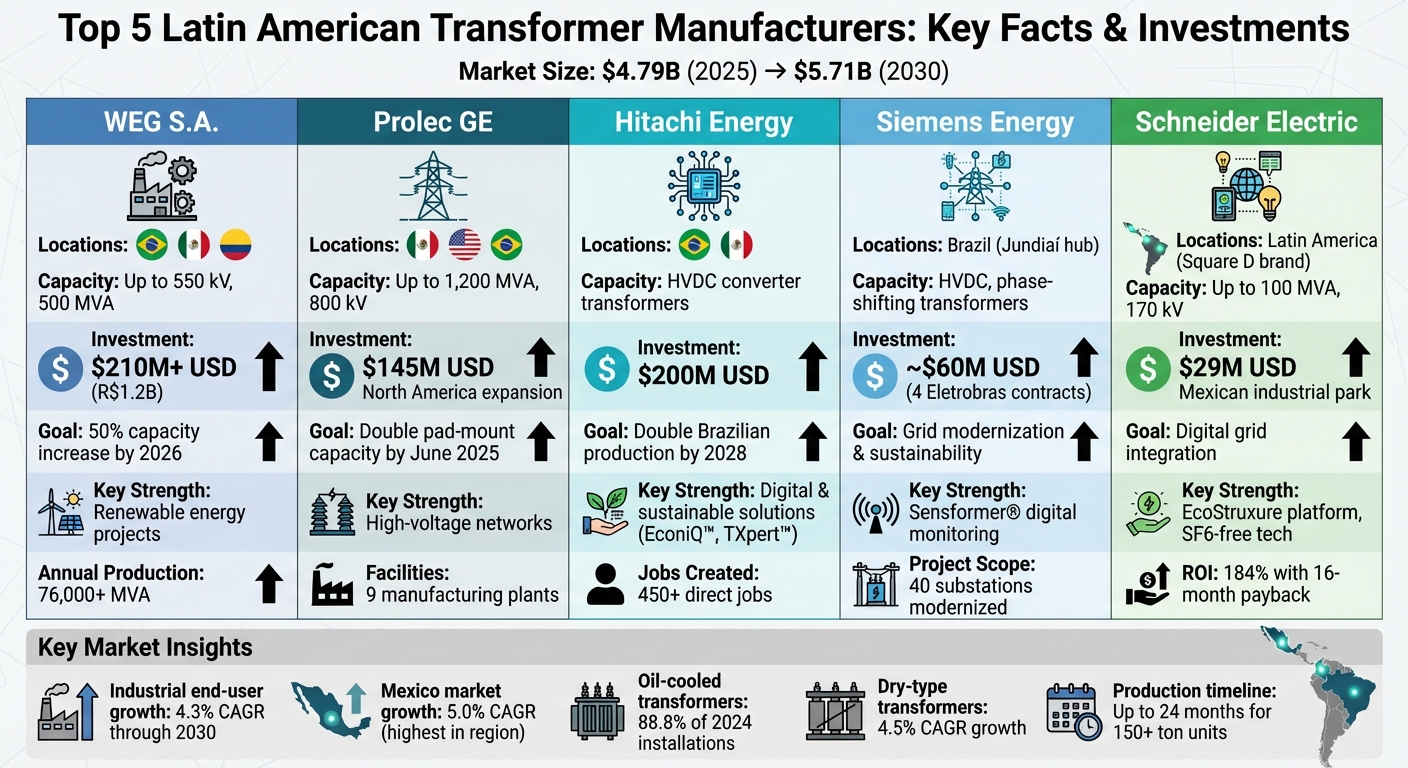
Top 5 Latin American Transformer Manufacturers Comparison 2025
1. WEG S.A.
WEG operates a vast network of transformer facilities across Brazil, Mexico, and Colombia, catering to a wide range of energy needs. In Brazil, the Betim and Itajubá plants focus on producing large-scale power transformers and measurement units. Mexico’s Huehuetoca plant handles transformers for 138 kV to 230 kV applications, while the recently established Atotonilco de Tula facility serves North American transmission markets with products up to 550 kV. Meanwhile, the Rionegro plant in Colombia specializes in transformers up to 60 MVA, targeting the oil industry and regional infrastructure projects. This extensive footprint allows WEG to offer a diverse range of products tailored to different regional requirements.
The company’s product lineup meets a variety of transformer needs across Latin America. Its distribution transformers include pad-mounted units (45 kVA to 10 MVA), pole-mounted units (45 kVA to 500 kVA), and secondary substations up to 46 kV. On the power transformer side, WEG manufactures products ranging from 10 MVA substation units to large oil-type transformers with capacities up to 500 MVA and 550 kV. Mexican facilities, in particular, produce station-type, generator step-up (GSU), and auto-transformers with capacities up to 400 MVA and 500 kV.
WEG has strengthened its market position by contributing to major renewable energy projects. Highlights include a 161 MWp photovoltaic plant in northeastern Brazil, a solar project in Colombia, compact SKID substations for CEMIG in Minas Gerais, and a substation modernization project in Colombia that benefits over 25,000 users. These initiatives reflect WEG’s ability to deliver integrated electrical solutions that align with the region’s growing focus on renewable energy.
To meet rising demand, WEG is implementing a R$1.2 billion expansion plan (2023–2026) to increase its Latin American production capacity by 50%. The investment breakdown includes R$765 million for Mexico, R$283 million for Brazil, and R$190 million for Colombia. The Atotonilco de Tula plant, spanning 33,000 m², will focus on North American transmission markets, while the 23,000 m² Rionegro facility will serve as an export hub for countries like Chile, Bolivia, Peru, Ecuador, and Central America. These strategic moves aim to position WEG as a key player in addressing the region’s growing energy needs.
"We are intensifying our investments to keep up with the significant increase in demand for Transmission and Distribution solutions. With the energy transition and growth in electrification, there is a growing need for transformers and digital products that optimize electrical grids."
- Carlos Diether Prinz, Managing Director of T&D at WEG
With net revenue projected at R$38 billion in 2024 and an annual production capacity exceeding 76,000 MVA, WEG is well-prepared to capitalize on Brazil's upcoming transmission auctions and the region’s expanding renewable energy sector. By 2026, the Betim plant is expected to reach 75,000 m², and the Itajubá facility will double its capacity through automation and robotics.
2. Prolec GE
Prolec GE runs nine manufacturing facilities across Mexico, the United States, and Brazil, making it a key transformer supplier for the Americas. Its operations in Latin America are anchored in two major hubs: Monterrey, Mexico, and Canoas, Brazil. The Monterrey plant concentrates on producing distribution transformers, supporting grid resiliency and electrification efforts in North America. Meanwhile, the Canoas facility, covering 271,648 square feet, focuses on large-scale power transformers and shunt reactors with capacities up to 1,000 MVA and 800 kV, serving high-voltage networks throughout South America. This operational diversity supports a wide product range tailored to meet the region's high-voltage needs.
Prolec GE's product lineup includes a variety of energy solutions. Its power transformers range from 5 to 1,200 MVA with voltages up to 800 kV, while distribution transformers cover 5 to 15,000 kVA in pole-type, pad-mounted, and network designs. The company also produces renewable energy transformers (500 to 5,000 kVA) for solar and wind projects, shunt reactors up to 120 MVAr, and voltage regulators ranging from 38 to 833 kVA. With its products installed in over 35 countries, Prolec GE serves utilities, industrial clients, and renewable energy developers across the region.
To expand its capabilities, Prolec GE announced an $85 million investment in December 2023 to double its single-phase pad-mount transformer capacity in Monterrey. The new facility, located less than a mile from its current plant, aims to address increasing demand for grid equipment and is expected to be operational by June 2025. This project is part of a larger $145 million investment plan for North American customers. Earlier in April 2023, the Canoas facility completed a 29,600-square-foot expansion of its tank shop, bringing transformer tank production in-house to enhance quality control and reduce lead times.
"We are thrilled to be investing additional time and money to increase our manufacturing capacity in support of North America's electrification goals... Prolec GE is proud to provide the critical equipment needed to improve grid resiliency, efficiency, and reliability." - Ricardo Suarez, CEO, Prolec GE
Prolec GE also prioritizes research and development through its Prolec Labs division, which focuses on advanced insulating materials, dielectric innovations, and smart grid integration. In August 2025, the company hosted its first "Prolec Day" technical seminar in Canoas, bringing together over 50 industry experts to highlight synchronized manufacturing systems and discuss advancements in transformer testing and insulating oil treatment. Additionally, the company employs the Total Productivity System (TPS) across its Latin American facilities to promote continuous improvement and operational excellence.
3. Hitachi Energy Latin America
Hitachi Energy has established significant operations in Latin America, with major facilities in Brazil - specifically in Guarulhos, Blumenau, and a cutting-edge 500,000-square-foot plant in Pindamonhangaba - and in Reynosa, Mexico. In 2024, the company announced a substantial investment of $200 million to double its transformer production capacity by 2028. Construction at the Pindamonhangaba site kicked off in August 2025, aiming to create 450 direct jobs by mid-2028.
These facilities support an expanding range of transformer solutions. Hitachi Energy’s portfolio includes power transformers, distribution transformers (both liquid-filled and dry-type), traction transformers, shunt reactors, autotransformers, and HVDC converter transformers. The company has also developed cutting-edge products like EconiQ™ sustainable transformers, which use biodegradable natural esters, TXpert™ digitally enabled transformers, offering real-time monitoring and predictive maintenance, and TXpand™ rupture-resistant transformers. These solutions are tailored to meet the needs of utilities, renewable energy projects, data centers, transportation networks, and heavy industries across the region.
This focus on innovation has had a profound impact in the region. Hitachi Energy’s technology has been instrumental in key projects like Brazil’s Rio Madeira HVDC link - spanning 1,475 miles with a 7,100 MW capacity - and the modernization of the Garabi HVDC system, which supports 2,200 MW of cross-border energy exchange. In Chile, the company delivered the nation’s first 500 kV digital substations, bolstering grid reliability. In September 2024, El Salvador’s utility, DELSUR, adopted EconiQ™ transformers and TXpert™ monitoring systems for its Ateos and Lourdes substations, earning accolades for advancing sustainability.
"The new unit was designed to meet the most demanding energy sector requirements, both in Brazil and in international markets. With automated processes and global quality standards, we reinforce our ability to offer robust, efficient, and sustainable solutions to our customers." - Alexandre Malveiro, Hub Manager for Latin America of the Transformer Business Unit, Hitachi Energy
In addition to its work in Brazil, Hitachi Energy is expanding in Mexico with a $70 million factory in Reynosa dedicated to producing single-phase pad-mounted transformers for the North American market. In March 2025, the company announced an additional $250 million global investment to scale up production of critical components, positioning South America as a key strategic hub. All new facilities are integrated within the company’s TrafoStar™ technology platform.
4. Siemens Energy Latin America
Siemens Energy is playing a key role in Latin America's push for grid modernization. One of its major hubs is a manufacturing facility in Jundiaí, Brazil, where the company produces high-voltage equipment and transformers. This facility also manages logistics for delivering equipment to substations located as far as 1,550 miles away.
The company's offerings include Large and Medium Power Transformers for both transmission and distribution purposes. Additionally, they provide distribution units such as Carepole, Geafol, and LIDT, alongside specialized products like HVDC converters, phase-shifting transformers, and traction transformers. Siemens Energy is also prioritizing sustainability by incorporating 100% recycled copper and biodegradable ester insulation fluids into its products.
In October 2025, Siemens Energy completed a massive retrofit project for AXIA Energia (formerly Eletrobras Chesf), modernizing 40 substations across northeastern Brazil. This project involved replacing over 900 circuit breakers and disconnectors while using line bypass techniques to maintain uninterrupted power flow. Impressively, this work was carried out on infrastructure that had been in service for over three decades.
"The daily commitment of the AXIA Energia and Siemens Energy teams to keep a project of this magnitude on schedule has turned the goal of replacing more than a thousand pieces of equipment by 2025 a reality." - Charlles de Souza Marinho, Project Coordinator, AXIA Energia
In December 2025, Siemens Energy secured four contracts with Eletrobras valued at around $60 million. These contracts aim to renew transmission assets across Brazil. Key components of the project include installing online gas monitoring systems for transformer stations in the Madeira River area and adding fixed series capacitor banks to the Imperatriz line in Maranhão to enhance transmission capacity. Notably, the Grajaú substation in Rio de Janeiro, which supplies nearly 40% of the city's electricity, is also part of this initiative. Furthermore, Siemens Energy has introduced Sensformer® Advanced technology, enabling real-time health monitoring and digital twin simulations to extend transformer lifecycles [27,31].
"Brazil's transmission system is reliable but aging. With climate change and extreme weather events becoming more frequent, updates are needed to ensure continued performance and grid stability." - André Clark, Vice President, Siemens Energy Latin America
Through its modernization efforts and commitment to sustainability, Siemens Energy is shaping the future of Latin America's evolving transformer market.
sbb-itb-501186b
5. Schneider Electric Latin America

Schneider Electric has established itself as a leader in Latin America's distribution and industrial transformer markets. Operating primarily under its Square D brand, the company focuses on medium-voltage (MV) transformers, distribution transformers, and equipment tailored for renewable energy systems and smart grid integration.
One standout feature of Schneider Electric's strategy is its commitment to digital-ready transformers. These advanced units come equipped with integrated digital sensors, aligning perfectly with the region's push toward digital grid modernization. Through its EcoStruxure Grid platform, Schneider offers real-time network and asset management capabilities, supporting utility grid digitalization programs. This innovation has earned Schneider the #1 spot from ABI Research for its leadership in grid digitalization software. By pairing cutting-edge digital tools with a diverse product portfolio, Schneider sets itself apart in the market.
The company’s product lineup caters to various needs, including:
- Minera SGrid: Handles up to 1,000 kVA at 36 kV.
- Minera PV: Supports solar systems with capacities up to 4 MVA.
- Vegeta: An eco-friendly solution with capacities up to 100 MVA at 170 kV.
- Minera Ex: Designed for explosive atmospheres.
- Minera R: Addresses high harmonic levels, with capacities up to 80 MVA.
This carefully tailored range strengthens Schneider's position in renewable energy and smart grid projects.
In March 2024, Schneider Electric invested $29 million to upgrade power systems at a Mexican industrial park. This initiative aimed to tackle voltage fluctuations affecting production, a move that aligns with the growing trend of near-shoring - where manufacturers relocate closer to North American markets. The investment has also triggered additional infrastructure upgrades across Latin America. Notably, industrial end-users in the region's transformer market are expected to grow at a 4.3% compound annual growth rate (CAGR) through 2030.
Schneider is also driving grid decarbonization with SF6-free medium voltage technologies. In collaboration with Enel, the company is modernizing aging electrical networks by using digital planning and operational tools. These upgrades not only enhance renewable energy integration but also improve grid resilience. According to Schneider, their digitalization and smart grid solutions can deliver an impressive 184% return on investment for utility operations, with a payback period of just 16 months.
Comparison Table
Here’s a clear breakdown of the key operational details for major transformer manufacturers in Latin America:
| Manufacturer | Manufacturing Locations | Transformer Types | Target Industries | Major Regional Investments |
|---|---|---|---|---|
| WEG S.A. | Minas Gerais and Rio Grande do Sul (Brazil); Atotonilco de Tula (Mexico); Rionegro (Colombia) | Power transformers (up to 550 kV), distribution transformers, instrument transformers | Utilities, oil & gas, renewables, transmission | $210+ million USD (R$1.2 billion) to boost capacity by 50% across Brazil, Mexico, and Colombia by December 2026 |
| Prolec GE | Multiple facilities across Mexico | Generation, transmission, and distribution transformers; high and low voltage components | Utilities, industrial, renewables | - |
| Hitachi Energy Latin America | Reynosa (Mexico); Guarulhos and Pindamonhangaba (Brazil, opening 2028) | Power transformers, distribution transformers, HVDC systems | Data centers, AI infrastructure, renewables, utilities | Over $200 million USD to double Brazilian production capacity by 2028, creating 600+ jobs |
| Siemens Energy Latin America | Regional facilities across Latin America | Power transformers, distribution transformers | Utilities, industrial, infrastructure | - |
This table highlights the strategic differences shaping the transformer market in Latin America. For example, WEG S.A. stands out with its aggressive expansion plans, aiming for a 50% capacity increase by the end of 2026. Its integrated operations, like radiator and boiler manufacturing, further strengthen its position as a key exporter. Meanwhile, Hitachi Energy has set its sights on 2028 to double its production in Brazil, signaling a longer-term growth strategy. These distinctions reflect the competitive and evolving nature of the region's transformer industry.
Conclusion
The five manufacturers highlighted - WEG S.A., Prolec GE, Hitachi Energy, Siemens Energy, and Schneider Electric - are playing a critical role in transforming Latin America's energy infrastructure. With the region’s transformer market expected to grow from $4.79 billion in 2025 to $5.71 billion by 2030, and Mexico leading with a 5.0% CAGR, these companies are well-positioned to meet evolving demands with their specialized expertise and strategic investments.
Choosing the right manufacturer depends on specific project requirements like power rating, cooling technology, and installation conditions. For high-voltage transmission projects exceeding 100 MVA, Hitachi Energy, Siemens Energy, and Prolec GE stand out with advanced impulse testing capabilities. Industrial buyers focusing on near-shoring initiatives should look to WEG and Schneider Electric, known for their K-factor-rated transformers designed for handling precision loads. For indoor environments - such as hospitals, metros, or high-rises - where fire safety is critical, dry-type transformers from Siemens Energy or WEG are ideal.
Large transformers weighing over 150 tons can take up to 24 months to produce and require specialized transportation. Oil-cooled transformers, favored for their superior heat management in tropical climates, are expected to account for 88.8% of installations in 2024. Meanwhile, dry-type transformers are gaining traction, with a 4.5% CAGR, especially for safety-critical applications.
Digital advancements are also reshaping the market. Features like IEC 61850 automation and fiber-optic sensing enhance predictive maintenance and grid resilience. Solutions such as Hitachi Energy's TXpert, Siemens Energy's Sensformer, and WEG's WConnect are at the forefront, offering improved operational efficiency and cost-effectiveness. For those sourcing transformers, platforms like Electrical Trader provide a wide range of options, including three-phase transformers and substation units.
When selecting a manufacturer, ensure they hold ISO 9001, ISO 14001, and ISO 45001 certifications and comply with standards like IEC 60076 and IEEE C57.12.00. Consider local factors such as currency fluctuations in Brazil and Argentina, and prioritize manufacturers with strong regional production capabilities and in-house impulse testing to minimize delays. These considerations are vital for ensuring successful project outcomes and maintaining the region’s competitive edge in the transformer market.
FAQs
What is driving the growth of the transformer market in Latin America?
The transformer market in Latin America is steadily growing, fueled by several important trends. Governments across the region are actively pushing for grid modernization and offering green financing programs, which are prompting the replacement of outdated equipment with more energy-efficient transformers. On top of that, the rise of nearshoring in manufacturing and the steady increase in urban populations are driving up energy demand in multiple industries.
Countries like Brazil, Chile, and Peru are expanding their renewable energy projects, creating a need for medium- and high-capacity transformers to support new power transmission systems. Meanwhile, the increasing presence of data centers and the rapid adoption of AI technologies are boosting demand for advanced transformers equipped with high-performance cooling systems and real-time monitoring features. These combined factors are shaping a dynamic and evolving market for transformers across the region.
How are companies like WEG S.A. and Hitachi Energy supporting the growing demand for renewable energy in Latin America?
WEG S.A. is ramping up its transformer production to back renewable energy projects across Latin America. In December 2023, the company revealed plans to invest $240 million over the next three years. This funding will go toward building new factories in Brazil, Mexico, and Colombia, boosting the region's production capacity by about 50%. The initiative is geared toward meeting the growing demand from transmission projects and renewable energy sources like wind and solar. Among recent milestones, WEG delivered large transformers for wind and solar energy projects in Chile.
Hitachi Energy is also stepping up to address the region’s renewable energy needs with major investments and advanced solutions. The company announced a $200 million plan to establish a new transformer plant in São Paulo and expand its current operations, aiming to double Brazil’s production capacity by 2028. Hitachi Energy’s offerings, including offshore wind transformers and the TXpert™ digital platform, are designed to modernize power grids and integrate renewable energy sources while adhering to international sustainability benchmarks. These initiatives are part of broader efforts to support Latin America’s energy transition and reduce carbon emissions.
What new technologies are Latin American transformer manufacturers using to improve efficiency and reliability?
Latin American transformer manufacturers are stepping up their game by incorporating advanced technologies aimed at boosting efficiency and ensuring long-term reliability. A great example of this is the integration of real-time sensors and remote-monitoring software into their transformers. These tools allow utilities to fine-tune load management and catch potential problems early, preventing costly issues down the line. Meanwhile, there’s a growing trend toward eco-friendly designs - think bio-based insulating fluids and self-cooling systems - perfectly suited for renewable energy projects.
On the production side, manufacturers are upgrading their facilities with automated processes and precision testing to align with international quality standards. What’s more, they’re offering customizable features, such as advanced cooling systems, so customers can get solutions tailored to their unique requirements. Platforms like Electrical Trader are making it easier than ever for U.S. buyers to access these cutting-edge transformer technologies from Latin America.